Wednesday, January 25, 2023

"Assassins" on Target

When a production of Assassins hits its target, it sometimes kills the applause. How do you clap when you're cringing?

In the 1990 musical by book writer John Weidman and composer-lyricist Stephen Sondheim, the characters are drawn from history, all the misfits who've aimed guns at U.S.Presidents from John Wilkes Booth to John Hinckley. Their delusions make us laugh, but their earnest self-justifications can make us profoundly uncomfortable.

After a pause to show that the assassins' methods and views are not necessarily those of the audience, we cheered this past weekend at the Jennie Anderson Theatre in Marietta GA to tell the actors and musicians how we appreciated the expressive pitch-perfect voices, flawless performance of music that demanded precision, and commitment to playing characters who could easily have been presented as caricatures.

L-R: Byck, Guiteau, Fromme, Zangara, Booth, Oswald, Czolgosz, Moore, Hinckley

The cast made strong impressions:

  • Michael Joshua Williams in a grimy Santa suit as unemployed tire salesman Samuel Byck in tears because he can't tell from the media what is true anymore;
  • Lukas Chaviano as Charles Guiteau, with a warm smile and tireless optimism right up to the moment he faces the noose -- and then summons the will to accept that, too;
  • Cameron Scofield as hippie Lynette "Squeaky" Fromme and Jessica Miesel as scatterbrained suburban housewife Sarah Jane Moore, abandoned by everyone else, bonding with each other over Charles Manson;
  • Chase Sumner as college dropout John Hinckley, Jr., taunted by Fromme for never having a girl friend and joining her in a soft-rock duet addressed to their idols (Jodie Foster and Manson);
  • Claudio Pestana as immigrant ditch-digger Giuseppi Zangara who "never had no chance" and doesn't care about his target "so long as it's king";
  • Marcus Hopkins-Turner as factory worker Leon Czolgosz, dignified, lonely, brooding on the injustice of his position;
  • Jordan Patrick as hapless Lee Harvey Oswald, with his soft admission, "yes," all he wants is for someone to care about him (even if it's hatred they feel); and
  • Craig Smith as John Wilkes Booth, lamenting in the score's most beautiful musical passage "the country is not what it was / when there's blood in the clover" a few measures before he sings the score's ugliest lyric.

As quasi-emcees, Ithica Tell gave her rich low voice to the "Proprietor" in the opening song, and cheerful "Balladeer" Skyler Brown looked genuinely stricken when his optimistic paean to the American Dream is overwhelmed by "Another National Anthem" for "the ones who can't get in to the ballpark."

This was a "concert version" that didn't have, and didn't need, a set. Director Clifton Guterman made a striking and meaningful backdrop from a vast American flag on which images of the assassins' targets were projected. Under the flag, the orchestra sat in full view upstage of most of the action. Around a central platform just large enough to bear 11 actors, a semicircle of chairs gave the assassins a place to watch each others' scenes. In a nice touch, director Clifton Guterman suited each chair to the character and their time: an ornate white rattan chair for Booth, a 70s easy chair from the Hinckley family basement, and even an airplane seat for Byck, who planned to hijack a jet to drop on Richard Nixon's White House.

The effect of the assassins rising from their chairs to join Oswald on that platform was creepy enough to make me catch my breath, and yet it felt like what the whole show was heading to: the misfits who couldn't connect to anyone in their lives connect to each other through Oswald's assassination of Kennedy. Booth calls it "the real conspiracy."

The orchestra, conducted by Holt McCarley, sounded bigger than they were and better than I've heard outside of New York. As Sondheim often interweaves different musics for different characters to tell their stories (e.g., a Sousa march for American tourists plays parallel to a tarantella for the Italian assassin Zangara), it was fun to watch McCarley corral all the moving pieces through tempo changes to reach climactic points together -- gunshots, an electrocution, a hanging. Being able to see the orchestra was a plus.

Because this production didn't include supporting actors, assassins variously doubled as a soldier, a reporter, and bystanders. Without an actress to play Emma Goldman, this production cut the scene at a train station where Czolgosz offers to carry luggage for the socialist orator. Perceiving how the man is lonely and ashamed of his scars from his work in a furnace, she touches his face and tells him that his scars make him beautiful. It's the only tender moment in the script, and I missed it.

The cast shortage did give the actors the opportunity to play sympathetic characters for a song late in the show, "Something Just Broke." Sondheim interweaves stories from everyday Americans across the decades who recall where they were when they learned "the President's been shot." They didn't have to like the President to agree that "Something just spoke, / something I wish I hadn't heard."

The line acquired new resonance with the January 6 insurrection. I wish it hadn't.

Earlier Posts about Assassins

[See my Sondheim page for curated links to my articles about the composer, his craft, his colleagues, and his shows. I wrote about Joe Mantello's production of Assassins in 2004 with Neil Patrick Harris as both "Balladeer" and "Oswald." After seeing several productions around Atlanta, I wrote in 2012 how low budgets and even vocal weakness don't diminish the show's emotional impact. See Sondheim Mini-Festival in Atlanta.]

Tuesday, January 10, 2023

Books 14 and 15 in the Cork O'Connor Series: Deep "Canyon"

←← | ||

For books 14 and 15 of the series featuring detective Cork O'Connor, author William Kent Krueger dreamed up two of his most memorable openings. These two books also give us two halves of one arc in a crisis for the hero Cork, whose loved ones observe to each other that he has lost something essential. The friends and family who support him through his trouble grow both in number and in depth.

Windigo Island
Readers of the series know from Ojibwe tradition that the cannibal spirit called a "windigo" will call the name of its next victim in the wind, and that the only way to defeat a windigo is to become one.

This novel opens with Native boys in their early teens who canoe to Windigo Island for a daring stunt. As a long-time middle school teacher, I can attest to Krueger's accuracy and sympathy depicting this age: we're fully on the boys' side when the weather turns suddenly and the wind calls out one name. Then they see the creature.

Chapter two involves the detective and his grown daughter Jenny in the search for two missing Native girls in their teens. As the trail leads quickly into the business of child trafficking led by a brute named Windigo, Cork's anger grows until, some chapters later, he is becoming what he opposes. Cork gave up firearms earlier in the series, but here he aims a gun at a man's old dog. A new character, Daniel English, tells Jenny, "Something [in Cork] died there." It's a relief that Krueger shifts away from Cork to tell the story through Jenny's perceptions.

Krueger alludes many times to a tribal adage, that two wolves battle inside all of us, Love and Fear: the one we feed will win. In Windigo Island, there's a lot to fear -- powerful men with guns, flame, explosions -- but the fear of disappointing a loved one is strongest.

Manitou Canyon
Krueger frontloads this story with foreboding. A band of Natives, including a woman, a tall man, and a teenaged boy with a rifle encamp above a secluded lake. The boy learns that the name of his target is Cork O'Connor. He sights the shoreline, and the woman behind him whispers "Bang."

In the pages that follow, Krueger sets Cork on a hunt for a millionaire engineer, once Cork's friend in childhood, missing from a fishing trip on that same lake.

Visions, important to the Ojibwe traditions of Cork's family, deepen the dread. Cork's memories of failures and fatalities in Novembers of other years make this November "cruelest" month. His loved ones sense that he has changed. His son Stephen comes home early from a vision quest because he has such a strong sense of danger enveloping his father. And a new character, Leah, still angry after five decades that the Ojibwe healer Henry Meloux rejected her, now comes to him for help, terrified from her waking dream: hundreds of fish with human faces, gasping, drowning. 

Stephen and Cork come to recognitions about their roles in life as healer and guardian, respectively.

While this novel goes to dark places, there are buds of hope along the way that open as in time-lapse photography to make this novel a bouquet of reconciliation and gratitude. How many detective novels have ever left me feeling that way? I can't think of one.

[See my responses to other Krueger books]

←← | || Use the arrows to follow the entire series in sequence.

Friday, January 06, 2023

Tom Wayman Works: Poems 1973-1993

In "What Good Poems are For," a man in his 50s reads one of Tom Wayman's works to strangers in a bar because the poem was about work he did, what he knew about, / written by somebody like himself ("What Good Poems are For," Did I Miss Anything? Selected Poems 1973-1993). The poem could've been any number of Wayman's works that come at industry from different angles.

In "The Factory Hour" (68), the poet depicts the work day as a voyage on the blue tide of the early morning sun. The workers share experiences of car pools, the grey plastic lunch bucket and safety boots. Walking in through the asphalt yard / we enter the hull of the vessel for a voyage marked by the sounds of machines, the drone of the PA system, and short breaks. We're immersed in the sounds and feeling of the journey.

One of the co-workers named by the PA gets his own poem on the next page of Wayman's collection, a paean to the experience of the iron itself, dormant for eons before it's pulled into the light and transformed miraculously to bolts with purpose ("Neil Watt's Poem" 70). Playful in its personification and language (the iron proclaims We are ore), the poem conveys awe, admiration, and pride. In another poem, one worker's steady beat draws all the men into a joyful jam/dance. The foreman goes away shaking his head ("Industrial Music" 100).

The foreman is a bad guy, or at least incompetent, in many of Wayman's poems. The foreman harangues his workers to go faster, but when they team up to finish ahead of schedule -- showing how superfluous he is -- he obstructs them ("Asphalt Hours, Asphalt Air" 155). The foreman at the sugar silo who's supposed to monitor safety from uptop is MIA while men deep in the silo risk their lives ("One Lump or Two" 201). When Wayman, just hired, asks to be trained for his dangerous new job, the foreman says only, "Nothing to worry about... Can you start tomorrow?" ("Wayman in the Workforce: Actively Seeking Employment" 66). The foreman in "Factory Time" is so polite on Friday afternoon, long cheques dripping out of his hands (102).

Why should the foreman earn more than the ones who exhaust their bodies all day? "Socialism" in Canada wasn't such a dirty word in the 1970s the way it has been in the US, but Wayman still doesn't hammer us with Marx. Some of these poems did wear me down, ones that seem like documentaries, in which Wayman gives distinctive voices to many men and women on the workforce. I prefer the playfulness in "Paper, Scissors, Stone" (192), which makes a children's game of figuring the worth of work:

An executive's salary for working with paper
beats the wage in a metal shop operating shears
which beats what a gardener earns arranging stone.

But the pay for a surgeon's use of scissors
is larger than that of a heavy equipment driver removing stone
which in turn beats a secretary's cheque for handling paper.

Wayman figures everyone should be paid the same for their time. Sixteen years earlier, figuring how hourly expenses squeeze hourly wages every hour of the day, Wayman gives us this delightful vision of harmony and justice:

...every bright season, chemical workers
in the factory of the leaf
effortlessly, without wages, and with everything they want
change sunshine and water into a living thing
("It is Seven O'clock" 41).

So Wayman's poems give us trees and sunshine, too, with friendship, love, and whimsy.

He has a dialogue with his poor tired body: "You go to work if you're so keen," / it says. "Me, I'm going back to sleep." ("Routines" 72). He empathizes with "The Feet," so important during the day, but made to lie down naked / in a part of the bed no one visits... with nothing to do, crossed like a blind horse putting his head over the neck of another blind horse (145).

He plays with personification: Some unfamiliar people who call to him from a bar say they're his needs, including talkative Friendship, a guy with hard hat and hammer named Shelter, and the unnamed woman who smiles every time he looks her way. Wayman asks, Shouldn't there be someone here named, uh, New Stereo? ("Meeting Needs" 178). Things get uncomfortable when he asks about "the Major," as in, Major Social Change. His "Kitchen Poem" is both a cooking lesson and an allegory for global inequities (106). [This inspired my poem On Track.]

Wayman comes up to the edge of scorn when he's dealing with consumer culture, but he doesn't forget the humanity of the misguided. Each object in a suburban home "whispers" its four numbers all day long -- purchase date, price, savings, and present worth -- until the woman of the house goes berserk ("Saturday Afternoon in Suburban Richmond" 109). After he tells us that a particular family's TV is like a grandmother, he carries that idea through the day so vividly that it's not a screen I picture in the corner of the family room, but a little old lady talking to herself ("Grandmother" 114). The chatter of radios and the whining of tourists intrude on the reverence of trees gathered at a mountain like worshipers at a cathedral ("The Banffiad: The Silence That is Like a Song" 49).

The title poem of the collection, "Have I Missed Anything?" is Wayman's greatest hit. He gives a special page to it on his website. It was a meme before there were memes, circulated by FAX, posted to professors' office doors, passed around teachers' lounges, often attributed to "Anonymous." It's all the snarky things that come to a teacher's mind when a student returning from absence asks that question.

My gateway to Wayman was "What Good Poems Are For" (1986) from Christian Wiman's anthology Home. Wayman imagines that a poem is like a potted plant on a sunlit windowsill in a lake by a cabin, a decoration you might not notice -- but you'd notice its absence. As I've been writing poems all year, I can identify with Wayman's experience:

Only those who work on the plant
know how slowly it grows
and changes, almost dies from its own causes
or neglect, or how other plants
can be started from this one...
(131).

Catching up with 30 more years of Wayman's work, I have work to do.

Thursday, January 05, 2023

The Bike in the Piazza: Venice

←← | ||

Scott Smoot on a bike in Venice, virtually

Since November 8, I've biked 130 miles on trails around Atlanta. On the map of my virtual tour of the world, that distance takes me from Milano to 38 miles west of Venice. With inclement biking weather, I've completed the remaining 38 miles swimming at the West Cobb County Aquatic Center. Let's pretend that I swam the canals.

In the photo, I'm in St. Mark's Square, known to locals as Piazza San Marco. Glass barriers have kept out most of the flood waters. At the far end of the square stands the basilica of San Marco, the white building topped by crosses and cupolas.

When Mom and Dad took me along for a visit to Italy in January 1991, demonstrators protested in the piazza. Bombing had just begun in the first Gulf War. Something else that had just begun was CNN, which we could view each night in our hotel.

My strongest emotional connection to this place, however, is music for worship in the basilica composed in 1610 by Claudio Monteverdi, a local musician. Because choirs of singers and instruments at San Marco faced each other in balconies across the nave, Monteverdi often wrote antiphonal pieces for one side to echo the other.

I was still new to the Episcopal Church when a wonderful 2-LP recording of his Vespro della Beata Vergine (Vespers of the Blessed Virgin) came out around 1984. Director Andrew Parrott restored the chanting of the worship service with Monteverdi's music. The Episcopal liturgy helped me to appreciate this Catholic liturgy. I played the album during Saturday afternoons, which I had made my Sabbath (Sundays I was always busy with choir and preparations for class Monday).

Something else I love about the Vespers is Monteverdi's eclectic mix of styles. Plainchant calls us to worship; then comes a grand brass fanfare (from THE first opera, his Orfeo) with chorus singing homophonically -- a first, when composers thought in terms of counterpoint, not chords. Some of it is dance music; "Surge Amica" from the Song of Solomon is a love song by soloist with lute. The mix of styles appealed to me, much the same way that Leonard Bernstein's Mass (11/2013) had done. I emulated both when I studied composition with Dr. James Sclater (11/2015) beginning in 1987.

My title for this blogpost alludes to a wonderful musical by Adam Guettel which I write about in A Little "Light" Music (01/2008).

←← | || Use the arrows to follow the entire bike tour from the start.

Sasha Sagan on the Richness of Ritual

"I was taught to be skeptical, not cynical," Sasha Sagan told an interviewer on NPR this past week. 

She comes from parents famous for their writing and video presentations of a secular, scientific, and humane world view. Her mother Ann Druyan produced Cosmos, the documentary series that made the late Carl Sagan's voice and image familiar nationwide. Sasha Sagan's book For Small Creatures Such as We was the subject of the interview. In her book, she offers the insight that rituals enrich our lives, whether or not we believe in God. 

 Here are a few notes I made after I heard the interview:

  • "Every ritual is a portal to another way of being." I can see that, as I experience both the scripted rituals of the Prayer Book and the habitual rituals involved in dog care, friendship, and daily routines -- actions that bond me to another, re-center my thinking, or prepare me to make an effort.
  • Knowing that the universe is so huge and we are of so little matter to it makes us more significant, more of a miracle just by our chance existence.
  • Her mother's favorite toast at Thanksgiving is, "You don't need to know whom to thank for you to feel thankful."
  • Her interviewer mentioned how seeing the moon is a "special event" for her little daughter; Sasha jumped on that as a perfect example of an attitude that she would cultivate.
  • Mathematicians have proven that we all breathe in atoms that were breathed out by everyone who ever lived. Simply deep breathing, then, becomes a ritual of connection to all those in history whom we honor, and to all whom we have loved and see no longer.
  • The kinds of rituals she has in mind needn't be contrived or solemn. During the early days of COVID, she (or the interviewer?) made a ritual of wiping little hands with the "potion" that sanitized her fingers that had shared the playground with runny-nosed friends. A family she knows will howl at the moon before bedtime. A cab driver eavesdropping on a young couple anxious about their future, told them to lighten up and just sing their ABCs, which they've done every week ever since.

Ritual, I know, can be a control valve that lessens anxiety, a reminder of past joys, a re-adjustment of perspective. My faith is sustained by ritual. Part of that faith is the assurance that God's spirit is working in each of us, whether we know it or not, and the urge to pray or praise is the work of the Spirit in us.

Thursday, December 29, 2022

"Empire of Light" Blesses the New Year

My friend Suzanne and I went to Empire of Light on the recommendation of NPR and the reputation of writer/director Sam Mendes. Very glad we did. Also very surprised that a poem by Philip Larkin seems to have had a part in shaping the movie.

Olivia Colman plays Hilary, a white middle-aged middle manager of the Empire Cinema in Margate, England, 1981, who trains Stephen, a new employee played by Micheal Ward. They find common interest in the design of the old theatre and in caring for an injured bird. There are problems: a daily dose of lithium is all that keeps demons of her mental illness at bay, while he feels more vulnerable every week during a surge of racist nationalism in the U.K.

We want these people to make each other happy, and so do their co-workers (except her abusive boss, played by Colin Firth). The projectionist Norman, played by Toby Jones, teaches Stephen how a thin stream of light passing through still pictures at 24 frames per second registers to the human eye as life, and the darkness between frames doesn't show.

So movies are themselves a metaphor for the hope that both of these people need.

A key moment in their relationship occurs at midnight on New Year's Eve. Another key moment is an admission that "last year is dead," conveyed by the "fullgrown thickness" of trees in spring. We hear that message from Hilary's reading aloud of Philip Larkin's poem "The Trees." Larkin's trees are also telling us, "Begin afresh, afresh, afresh."

From a movie that has its share of darkness, it's a sweet message.

Wednesday, December 28, 2022

New Poems at Year's End

For an hour or two every weekday morning, yellow legal pad in my lap, I sit in the poetry workshop I've made in my basement. Since Halloween, I've posted five new poems at First Verse, along with images by my friend Susan Rouse. (One of those is included here.)

Although they're all taken from real-life incidents, I had to flash my poetic license a lot.

Tuesday, December 27, 2022

Like a Sondheim Virgin

I'm no Sondheim virgin. My first experience was the LP of A Little Night Music 50 years ago (thanks to Paul Ford who became Sondheim's go-to pianist ). You might call me a "Sondheimite," but I prefer another term I read recently, "Steveadore."

Still, I do sometimes wonder, if I were to encounter Sondheim's songs for the first time now (as I "discovered" Joni Mitchell some years ago), would their qualities be apparent without my knowing the stories and thematic connections, without the actors who "sell" them? Must you have "been there" to "get" a Sondheim song?

Eleri Ward's album A Perfect Little Death gave me a perfect little opportunity to find out. Ward recorded 13 Sondheim songs in her closet during the COVID lockdown with an acoustic guitar and her laptop. She labels it "indie-folk Sondheim." Hearing just a few seconds of Ward and her guitar, you might mistake her for early Joni Mitchell.

Ward sings the melodies straight. Her accompaniment might be called "stripped down," but what I hear is Ward building up each song the way Sondheim himself did, with a "vamp," a repeated musical pattern. Ward's vamps are just enough to provide a steady beat and an outline of harmony, leaving space for Sondheim's unexpected turns into different keys.

All that said, I'm now going to imagine that I'm hearing these songs for the first time.

First Listens

With the first lines of the first song, I'm disoriented:

And are you beautiful and pale
with yellow hair, like her?
I'd want you beautiful and pale,
the way I've dreamed you were,
Johanna.

The initial word "And" drops us into someone's interior monologue. The woman (or man?) who sings of this Johanna has evidently not seen her recently (if ever), and we haven't a clue who the "her" is that Johanna might be "like," except for the hint that they might be family, expected to resemble each other. The same voice, overdubbed, sings "I feel you, Johanna" and, later, "City on fire." It's all very weird, but intriguing. The voices and images express a strong yearning for both Johanna and "her," a regret for time lost, and resignation to thinking "less and less" of Johanna as "we learn to say 'good-bye.'" Some conflict -- a city on fire? -- is preventing a reunion. You don't have to know the details to know those feelings.

Three songs evoke the domestic life of women (presumably). While these women sing of buttons, bread, the coffee cup, tending the flowers, they all seem to be preoccupied by someone absent. Yet each song has a different character.

  • "Every Day a Little Death" perks along like a children's song, before the lines "I would murder him right there, / but first I die." We get the sense that someone who seems in control is letting her mask slip -- just a little.
  • "Losing My Mind" starts as a cheerful love note about how "I think about you" all day long, addressed to someone who may be away at work. But then he doesn't come home during her "sleepless nights," and, in a recap of earlier stanzas, frustration replaces cheerfulness. She raises her voice. "Does no one know?" she asks. "You said you loved me," she sings, mournfully, "or were you just being kind?" When she sings "Am I losing my mind?" at the end, almost in a whisper, I think she means it.
  • "In Buddy's Eyes" the singer tells us that "life is slow, but it seems exciting 'cause Buddy's there." When she sings of Buddy, her voice warms up: "I'm so lucky, I feel like crying." When she concludes, "the best I ever thought of me / is every minute there to see / in Buddy's eyes," she sounds ecstatic. She has doubts about herself, but she's grateful to the man who doesn't doubt her, climbing to a note high above the range of the rest of the song, but soft, when she sings of his "eyes."

"Pretty Women" is another look at women going about their daily activities, a reverie about how "something in them cheers the air." It's a lovely melody. But something's wrong. I thought Ward was singing in the character of a man, and a line later confirms it: "How [pretty women] make a man sing!" But as the images pile up about women observed from a cool distance -- at their mirrors, in their gardens, silhouetted -- and we hear how women "stay within you, breathing lightly," we get a stalker vibe incongruous with the lovely melody.

Ward's lilting "Ballad of Sweeney Todd" sounds like a Victorian murder ballad. The vocabulary is Dickensian: "He shaved the faces of gentlemen / who never thereafter were heard of again." Rhymes are playful: "Inconspicuous, Sweeney was, / quick and quiet and clean 'e was." Except for the complications of an eerie overdubbed vocal obligato and elaborate middle section about how the title character "heard music that nobody heard," it's a song you might learn around a campfire. I love how Ward's voice dips low to ominous effect for the refrain, "the demon barber of Fleet Street."

Intimacy is worth all the inconveniences of living with someone. That's the message you get from "Being Alive." She sings first how she has to put up with "Someone to hold me too close, someone to know me too well... someone to sit in my chair..." But soon she's singing the same phrases as a prayer: "Somebody hold me too close, Somebody know me too well." She drives the point home with the biggest vocal climax of the album.

The final song "Sunday" is strangely compelling. There's no "you" or "me" in it, only a description of "a perfect park" where people are "strolling through the trees... forever." The park is described in terms of colors and abstract shapes: "blue-purple-yellow-red water" and "the verticals of trees," for two examples. Several overdubbed voices sing harmony, creating a sense that a community is sharing this experience "on an ordinary Sunday." I'm intrigued enough to wish I had someone to connect the dots.

The Sequel
Eleri Ward's second Sondheim album is available for download. Her producer's addition of strings has not diluted the strength of her straightforward vocals. It's called Keep a Tender Distance. Every Steveadore knows that phrase from "Marry Me A Little" cut from Company and later restored. I'm waiting for the CD.

[For a curated list of articles about Sondheim, his work and his colleagues, see My Sondheim Page]

Saturday, December 24, 2022

Christmas Card with Mom


That's Mom with my sister, with me, with her Visiting Angel Laura, and my brother.

With her blood sugar under control, now, she's much cheerier. She's engaged in a conversation, and you can tell she means something when she speaks. Though the words don't make sense, often, they sometimes do. We draw her out on how she wants us to respond, with "How do you feel about that?"

[See my page Dementia Diary for a curated list of blogposts that relate to our 10+ years dealing with the disease.]

Tuesday, December 06, 2022

"God as Trinity: An Approach through Prayer" by Sarah Coakley

The image of the Trinity, from the 15th century, appears with a hymn from the same period in a blog by "A Clerk of Oxford". Here are verses two and three of many more:

2. O three persons in one unity
Being but one god and no mo,
[more]
One in substance, essence and might,
O deus sine termino.

3. O, which hast made both day and night,
Heaven and earth round like an O
By thy wisdom and endless might,
O deus sine termino.

The Clerk notes that 21st century Christians write tortured arguments about the Trinity while their medieval counterparts wrote beautiful and playful hymns. The "O," she writes, is a standard vocalisation in hymns, but also a common expression of "one," and also an image of the earth and heavens "round like an O."

Looking for images of the Trinity, I ran across an article about conflicts over the doctrine at another blog Anxious Bench (06/2016). One group of Baptists accuses other Baptists of making up a new (false) god by pushing the Trinity; their opponents accuse the others of imposing their own views and limits on the Bible.

My assignment this week, however, has been to read an essay by Sarah Coakley printed in the Reading and Reflection Guide, Volume B used by participants in Education for Ministry (pp. 253-264).

Coakley's "approach" to the Trinity "through prayer" comes with assurances that she understands why Christians would dismiss "seemingly alien formulas" of the Council of Chalcedon in the 5th century. The focus of scholarship and devotion on the person of Jesus has been much more appealing to believers in the past 200 years, and the many references to Father, Son, and Holy Spirit in the New Testament are "unsystematic." Even charismatic Christians think of having the Spirit as an expression for having an experience of "God with us." That the Trinity is an obstacle to interfaith dialogues is another point against pushing the doctrine.

Even as Coakley introduces the idea that Christians in silent prayer to God feel they are being prayed in, she first lists caveats. The "phenomenon of prayer is varied" and its descriptions are "inexact," and there's "circularity" in using "certain cherished doctrines" to interpret prayer that has already been influenced by those same doctrines; and other faiths have "contemplative" traditions in which the sense of a Trinity has not arisen.

To all this, Coakley answers that Paul struggled to express his sense of the spirit within that leads us to Christ and God the Father. "No one can say Jesus is Lord except by the Holy Spirit" (1 Cor 12.3). Christ is not just "an external model," she writes, but indwelling: "It is no longer I who live, but Christ who lives in me" (Gal 2.20).

When we experience abandonment by the Spirit, Coakley writes, it's neither the historical Jesus nor the eternal Father who leaves us. The "dark night of the soul" that St. John Chrysostom (ca.400 CE) wrote about is, she says, "the death-throes of the domineering ego" as the Spirit breaks down our the barriers of our individualism. (The analogy comes to mind of the symptoms that resulted from a recent vaccine: I felt the fight between my body's defenses and the force that was teaching my body to resist the virus.)

Coakley up to this point in the essay is taking bits from Paul and presuming to tell us what our experience will be like when we really pray. I'm on the edge of resenting the essay.

Coakley is on more solid ground when she goes back to the councils that established the Trinity, and even further back, to show that the Trinity was something that Christians experienced and were passionate about. The councils were not "periodic bureaucratic reviews of a continuing theoretical problem." She shows first that Christians of the first three centuries prayed longer, and more often, than we think of today; "spiritual life" was not for specialists. Second, she shows how the liturgy of the eucharist embeds the doctrine of Trinity, even in the simple exchange "May the Spirit of the Lord be with you...And with thy Spirit: it is the Spirit in the priest who invokes the presence of Christ, not the priest's incantation.

While Coakley stresses Christian experience of the Trinity through prayer, she tells us that the councils' trinitarian formulas were "primarily" defenses against alternatives that were "misleading."

Regarding other faiths, Coakley admits that the Trinity is a barrier. "Yet," she writes, "the darkness, the sheer defencelessness of wordless prayer usually lead ... to a greater openness to other traditions."

Just at the end of her essay, Coakley raises the tradition of the Spirit as feminine and motherly, who was called "Our Mother" by Julian of Norwich. Gregory of Nyssa saw a balance of masculine and feminine between Son and Spirit.

[Our clergy's sermons on the Trinity have been helpful to me. See Belief in Things Unseen and Episcopal Wisdom on Death, Trinity, and Church Architecture]

Monday, December 05, 2022

The Rector Retires; The Clerk Reflects

The applicant whom the Rector Search Committee rejected became the chief priest of the corner at Church Street and Polk. That was 11 years ago; now Fr. Roger Allen is retiring from St. James Episcopal Church, Marietta, and it's time to reflect.

Origin Story

In 2009, parishioners expressed to a survey their preferences for a priest under 45 years old with children and at least 10 years' experience leading a large congregation. At 57, happily married without children, an ex-lawyer who'd led a small parish only six years, Fr. Roger Allen did not meet specs.

Yet we on the Search Committee heard good things from priests who'd worked with him, and we heard from a gentleman whose parish was destroyed by Katrina a month after Roger's first Sunday there: "Fr. Roger was a tower of strength to us when everything had fallen apart." When Fr. Roger's name was one of three that our committee passed to the Vestry, the Sr. Warden told me that two candidates were perfectly suitable; they elected the one who was extraordinary.

Clerk of the Vestry Looks Back

Soon after Fr. Roger began his tenure at St. James, I became Clerk of the Vestry, so I've not only seen the ups and downs of his service, but I've typed them.

Regarding the business of the church, Fr. Roger exerted control. He consolidated bank accounts and sorted through an array of special funds. He took a hard look at groups and programs that had operated for years without oversight. Some who chafed at his oversight had also criticized the previous rector (unjustly) for not being strong enough: go figure.

Every year, to reach a balanced budget, the Vestry considered cutting programs and personnel. Every year, Fr. Roger maintained that a church cannot thrive if it cuts what's vital to the parish. Have faith, he would say. Every year, parishioners came through with their pledges, expenses were lower than expected, other resources were found, and the budget balanced.

Fr. Roger's choices of personnel made a difference. He gave the parish what it wanted in Associate Rector Fr. Daron Vroon, a young priest with children. (See an appreciation of Fr. Daron.) Peter Waggoner brought children, teens, and college students into the choir program, and established a "St. James School of Music" where musicians could give lessons -- an outreach program that paid dividends to the church in dollars and in participation. Matt Bowers reinvigorated the flagging Youth Ministry; when he moved out of state during COVID, Riley Dugan continued to grow the program. Fr. Roger hired staff from outside of the parish to serve as disinterested professionals: Jenny Mancini, Assistant to Clergy; Charlene Smith, Financial Manager; Amy Goetze, the Director of Communications (someone to manage our web site -- at last!); and Building Superintendent Erik Linso, who saves the church thousands of dollars with DIY proactive repairs.

Fr. Roger's pastoral ministry happened mostly out of my sight, but I got a sense of it early in his tenure. I was still known for chairing the Search Committee when an elderly gentleman accosted me after a service. "Do you know what that rector you got us did last week?" I braced myself. "He stayed all night with me and my wife when she went into the Emergency Room." I know Fr. Roger recently took similar care with a bereaved father. As Clerk taking names of visitors after services, I saw the personal connections Fr. Roger had made to the people who waited in line for a word with him. People routinely clasped both of his hands; they hugged him; they whispered in his ear, and received whispered words back, or a promise, "I'll call you." He has often visited my mother in memory care, but I wouldn't know it if her caregivers hadn't told me.

Until COVID, Fr. Roger saw to it that worship took place at St. James nearly every day. Sundays there were three services for three worship styles (Rite One no music, Rite Two with music, Rite One high church with chanting), plus Evensong spoken, sometimes sung. Weekdays there was morning prayer, and Wednesday evening healing services. Some of my most memorable worship experiences were for feast days I'd never known about in my 30 previous years in the Church. Fr. Daron or Fr. Roger would preach and serve communion for groups of six-to-twelve parishioners on Ascension Day, the Annunciation, and, in the church cemetery, All Soul's Day.

Metrics of all sorts were headed in the right direction, bucking trends in the Diocese, until COVID hit in March 2020, and our church building was practically barricaded by decree of the Bishop. Still, Fr. Roger and his team found ways to do church, adapting to changing protocols. Easter live-streamed from Fr. Daron's living room was memorable -- with mother Julie Vroon keeping her youngest boys respectfully silent, mostly. I stood in for the choir a few times once that was allowed, singing to the camera accompanied by interim organist Paul Kelley. There were eucharists in the parking lot, with priests in masks moving from car to car even in cold wind and rain. No wonder that Fr. Roger, expressing thanks when church at last opened up again, was overcome with emotion and couldn't speak.

COVID was responsible in one way or another for declines in attendance, discontinuation of the small services, and the departure of the choir director. Fr. Roger's appointment of Bryan Black to lead music at St. James may turn out to be one of most enduring and consequential gifts in his legacy. As a baritone in the choir, that's how it feels.

So now Fr. Roger can rest. When Roger introduced me to his wife Elisabeth back during the search process, he said he'd married her because "she's fun!" I'm sure she's thrilled. In the words of that catchy hymn tune (with an even catchier title Ora Labora), a glad sound comes with the setting sun, / "Servants, well done."

Reflections on Sermons
I've reflected on sermons by Fr. Roger through the years. I'd make notes on my bulletin, and write on my blog if my teaching schedule gave me the time. Here are my reflections, most recent listed first:

Fr. Roger Allen

Friday, December 02, 2022

"Thinking Inside the Box" by Adrienne Raphel

When crossword puzzles first became a fad in America in the 1920s, moral panic ensued. Editorialists in England cried that America was "enslaved" to crosswords; but soon, the English were addicted. We learn this from Adrienne Raphel's Thinking Inside the Box: Adventures with Crosswords and the Puzzling People Who can't live without them (p.78).  The book was a gift to me from dear friend Kitty Drew and her late husband Terry Strecker.

Raphel pushes back on those who regard puzzle-solving as a shameful waste of time and effort. She almost convinces.

In favor of crosswords, Raphel offers these facts:

  • People at the tops of their fields regularly work(ed) crosswords: Nabokov, Eliot, Auden, Sondheim, Pelosi, President Clinton, Bret Favre, and Yo-Yo Ma (xiv).
  • A puzzle saved civilization when it was planted in the London Times as bait to draw puzzle-solvers to Bletchley Park, where they broke the Nazis' enigma code (91).
  • Studies show that doing crosswords delays the onset of dementia (ch. 13). (I wish to forget that dementia, when it does hit, hits puzzlers harder.)

Then there's the beneficence of Will Shortz, puzzle editor of the New York Times, "puzzle master" of NPR's Weekend Edition Sunday, and "everyone's uncle":

He carries himself with the formal politeness of a foreign affairs diplomat and the wholesomeness of a Midwestern tennis coach. He has a sheepish grin, boyish cheeks, and a trimmed mustache that defies trendiness; his eyes flicker on each blink between anxious to please and slyly ready to deceive. (65)

Raphel meets with Shortz and his assistants at the puzzle-master's home, a "Juilliard of puzzling" for his interns, where they sift through hundreds of submissions from hopeful puzzle-writers nation-wide. Raphel herself writes a puzzle, giving us insight to the tricks, tools, and demands of the craft. Like most of the others she saw at Shortz's home, hers comes back with the notation TDEME. The letters stand for "Theme Didn't Excite Me Enough" (69), but I notice that the pronunciation of the letters could be "tedium."

Is joy a good enough reason to spend a lot of your life doing crosswords? What makes crosswords enjoyable has changed over the decades. During the Shortz tenure at the Times, the puzzles have tilted away from puzzles that rewarded arcane knowledge towards word-play. Unlike his predecessor Eugene T. Maleska, Shortz allows phrases, brand names (ZZZQUIL was one answer), and pop cultural references. Shortz and his team look for "the kind of pattern that puts an involuntary smile on the editors' faces" (70).

In other chapters, Raphel takes us to a crossword-solving competition, she reviews some faux pas that prompted Shortz and his staff to remove their white-male blinders, and she surveys puzzles in fiction.

Still, what good is a puzzle when you've done it? I've a pile of puzzle books going back 15 years. With my notations beside the hardest-won and cleverest answers -- mostly, HA! and AH-HA! -- the books are trophies, stacked and annually dusted with reverence. But I've never reopened one.

Despite Raphel's book, there's an accusing angel inside me charging that I've wasted time solving puzzles that could have gone into studying great literature or creating literature of my own.

The devil's advocate argues that working a crossword, reading a poem, and writing a poem are equally creative. Sure, someone else shaped the piece, leaving us the clues. Still, our imaginations and memories are also struggling to find the perfect word, the interconnection, the shape, the meaning. Coming to puzzles from the other side, we mirror what their creators do.

When I'm writing a poem, closing in on the draft that I will eventually decide is the final one, I feel like I'm uncovering something that I should have seen all along. Like the solution to a crossword, the right words were there -- somewhere in the back of my mind -- the whole time. So, whether I'm creating something myself or re-creating what someone else composed, the sensation is the same.

There's a quasi-religious side to crosswords, too:

  • Stephen Sondheim, famous composer-lyricist and the man whose British-styled "cryptic crosswords" introduced the genre to American audiences*, said that's the thing about crosswords: you know there IS a solution.  Sondheim never believed in the Creator of the universe; but he liked believing in the creator of any puzzle.   
  • Shortz wrote in his introduction to Cartoon Puzzles: "I haven't just solved something, I've discovered something that's pretty. And I don't know how the people who put this together did it." His sense of awe and gratitude is where religion begins.

So, to pass the time with a puzzle is not a waste of time. Neither is reading about it in Raphel's playful book.

*Cryptic clues are two-in-one: first, there's the answer, and then a play on words that gives the answer in another way. "Successor to The Sound of Music" gives you HEIR (a successor) which has the "sound" of music, i.e., air. "Entertain and wind again" gives you REGALE, which consists of the word "gale," i.e., a strong wind, and "re-" again.

I've crossed crosswords and theology before:

  • Theology of Crossword Puzzles: A Shortz Sermon is an acrostic on the name of NPR's "puzzle master" for which each line relates a truth about crosswords to a spiritual principle (03/2010)
  • Cartoon Puzzles: The Real Intelligent Design (01/2007) relates puzzles to humor and awe
  • My poem "Cliff Hanger" was inspired by Raphel's simile for diagramless crosswords: solvers had to figure out where the black squares were, as well as the correct answers, relying on the letters provided like climbers clutching grips to scale a rock wall (105). Across the top of every draft of that poem, I wrote GOD-CLIFF-CROSSWORDS-POETRY

Saturday, November 26, 2022

Say "Murder" and Smile: Group Photos in Glass Onion, Last of Sheila & Rising Tide


Murder disrupts a reunion of sixty-somethings who've retreated to the same beach house since they were teens.

That's the premise of The Rising Tide (Minotaur, 2022) by Ann Cleeves. The author sets up the situation from different points of view, involving us with tensions among friends that will lead to the crime. Cleeves kept me turning pages and guessing wrong through to the end. Her detective Vera Stanhope is a charismatic character, the rare detective who seems to enjoy what she's doing. As often happens in novels by Cleeves, our sympathies are engaged even more in the detective's seconds. Junior officers Holly Clarke and Joe Ashworth bring this novel to an especially strong conclusion.

But it was page 129, when Vera shows Holly and Joe a photo from the 1970s, before I was moved to write in the margin I'm enjoying this! Not that I liked the preceding pages less, but that the photo snapped layers of time into focus at a glance, ramping up the energy of the story. 

Because a similar photo is important to the recent film The Glass Onion, I will veer away from Vera to consider the group photo as a trope of crime fiction.

Group Photos in Rising Tide and Glass Onion
Looking at the photo in Rising Tide, Joe recognizes the "short, skinny one" who became both a TV celebrity and a murder victim, observing, "He'd have been bullied at our school, looking like that," and guessing that two dour young men staring at the camera would've been "the ones doing the bullying." When the detectives identify a stylish young woman as the one who would later drown in the eponymous high tide at the group's first reunion, Vera speaks directly to the photo, "Eh lass, let's find out why you died."

In Glass Onion, a group of characters now prominent in their fields appear in a photograph taken at a club "The Glass Onion" when they were geeky thirty-somethings. When we see that photo, the friends smiling with their arms around each other, we're already aware of the reasons all of them have to resent "Miles Bron," the man smiling at center. His hand is on the shoulder of the one person who isn't mugging for the camera -- the one he will betray, abetted by the others.

In both Tide and Onion, there's a shiver of irony as we compare the best friends forever of the past with the resentful rivals of the present. In Onion, there's also humor, as the characters' public personae are undercut by this photo of their nerdy and goofy young selves.

Sondheim and the Trope of the Group Photo

A group photo figures prominently in The Last of Sheila (1973), a film that must have inspired Onion's writer/director Rian Johnson. I deduce this because Stephen Sondheim, who co-wrote Sheila with actor Anthony Perkins, is one of two dedicatees of the film.

[In Onion, Sondheim makes a cameo appearance with Angela Lansbury (star of both Murder, She Wrote on TV and Sondheim's Sweeney Todd on Broadway). Onion is dedicated to both Sondheim and Lansbury, "who taught us so much."]

Another clue is that Onion tracks Sheila pretty closely during the set-up. In the first several minutes of both films (after a prologue in Sheila), we see each character receive their invitation to join a millionaire-host.  Characters in both films gather on a yacht in the vicinity of Greece. The host in each movie introduces a mystery-themed party game before the stories diverge.

In Sheila, the host poses his guests on the dock for a photo. He's fussy about who stands where. In the background is the yacht named for his late wife Sheila, killed by a careening car as she fled a party where these same people were guests. As secrets are revealed and recriminations begin, the carefree poses of the photo become ironic.

Sondheim and Perkins also use the photo to tease. The host tacks it beside the score card for his game, remarking that the solution to the mystery is in plain sight. In Onion, we hear the same words spoken where that group photo is displayed.

Any Other Examples?
I haven't thought of any more examples from movies or books, but I myself used the group photo for effect in a murder mystery.

My 8th grade students created the story of Under the Surface through improvised encounters between characters. Like Onion and Rising Tide, the premise is a reunion. The characters, in college now, attend a memorial for their friend Lily, who presumably drowned the previous summer, though her body hasn't been found.

We created a group photo for which the actors dressed like kids in summer camp, to have a visual aid for exposition. The audience was close enough to the stage to see the photo while college-aged characters reminisced about summer gatherings going back to middle school days.

Group photo in Under the Surface six years before enmity and murder break up the group. This was the cast for a revival of the play produced when the ones who wrote it were high school seniors.
 

The photo also gave us an eerie and effective tableau for the end. The penultimate scene of the play climaxed in a suicide-murder: the criminal, cornered by his accuser, has doused the cabin with gasoline. He lights a match. "Fire!" a boy screamed off-stage as, simultaneously, the lights blacked out. Running in from behind the audience, the boy drew attention away from the stage where the actors quickly exited.

Lights came up as he hit the stage screaming, "It's the bonfire!" The characters chatted as they entered for the group photo, and, knowing how it will all end, we hear the stirrings of personal resentments "under the surface." They smiled and froze: slow fade.

Irony, pathos, and some classic misdirection: they made a great conclusion.

The group photo is not a murder-mystery cliché -- yet. I recommend the technique.

More Connections
  • At least two bits of dialogue in The Glass Onion come from Sondheim's songs for Merrily We Roll Along - "Now You Know" and "Our Time." The show relates, being about the dissolution of old friendships.
  • My blogpost Sondheim's Murder Mysteries tells more about Sheila and traces numerous connections between Sondheim and Knives Out, the previous film in the Onion domain.
  • See a curated list of links to my reflections on other novels by Ann Cleeves.

Saturday, November 19, 2022

The Vision of the Detective's Boy in "Tamarack County"

←← | ||

Stephen, a teenaged boy of the Ojibwe tribe, follows an elder's direction to sit all day in a meadow by a lake:
Mosquitoes and blackflies plagued him, and the sun was hot, and he grew thirsty, but still he sat. A wind came up, and the grass bent. The wind died, and the grass grew still. A couple of turkey vultures circled on the thermals above him, spiraling upward until they were like small ashes against that great hearth in which the sun burned.
There's a lot going on in Stephen's life, as we know because his father is detective Cork O'Connor, and this is Tamarack County, 13th book in the series by William Kent Krueger. Stephen is deeply involved with his girlfriend Marlee whose family has been targeted by a stalker who killed her dog; his dad is looking for a missing woman, wife of a retired judge; and the two cases may be related to a prisoner's wrongful conviction brought to light by another prisoner who happens to be Marlee's uncle. Add to all this that Stephen's sister Annie, a nun-in-training, has come home from college angry, depressed, and determined to leave the Church. Stephen is conflicted about something he learns when Annie's college friend Skye appears at the family home in Minnesota.

Stephen may be the most compelling of all Krueger's continuing characters, if only because we've watched him grow from a needy little boy to a courageous young man, through family love and conflict, physical danger, and loss. This memory of the day in the meadow, coming in the middle of this exciting book, seems to be an important step in his growth. Krueger, whose descriptions of nature often bend into poetry, continues:

Because he didn't know the reason he was there, had no purpose that he could understand, his mind was filled with a flood of debris -- pieces of thoughts, drifting images, half-formed questions.

Near the end of the day, his eyelids grew heavy and his mind grew quiet and he saw something he had not seen before. He saw that he was no longer sitting in the place he'd sat that morning. He hadn't moved, yet nothing around him was the same. He realized it had been that way all day. In every moment, everything had abandoned what it had been in the moment before and had become something new. He was looking at a different meadow, a different lake, a different sky. These things were very familiar to him, and yet they were not. He was keenly aware of each scent as if he'd never smelled it before, each new sound, new breath or wind, new ripple in this new universe. (128-9)

By coincidence, the morning after I read that page, I came across this passage from a collection of essays called Living in the World as if It were Home (1999) by Canadian poet Tim Lilburn:

Look at a meadow long enough and your bearings vanish. The world seen deeply eludes all names; it is not like anything; it is not the sign of something else. It is itself. It is a towering strangeness.

That's Stephen's experience, right there!

The excerpt appears among poems and prose in the anthology Home (2021), edited by Christian Wiman. The context is Lilburn's critique of "some contemplative writers" whose vision of nature "travels into the world only far enough to grasp the presence it anticipates." Quick to draw conclusions and connections to their own worldviews, they miss the world.

Lilburn and Krueger might be writing directly to me. Whatever else happens in Tamarack County, I'm already taking away something to keep in my heart. I recommend the novel and the anthology by Wiman. I may have to look into the works of Lilburn, too.

Addendum: I finished the book yesterday. The story builds to an action-packed hunt and a cathartic confrontation that draws together strong emotions, a moral dilemma, and a (temporary) resolution of spiritual conflicts in the story. Cork's circle of loved ones seems to be growing wider. Today I bought the next three novels in the series.

[See my responses to other Krueger books]

←← | || Use the arrows to follow the entire series in sequence.

Wednesday, November 16, 2022

"Agatha Christie: An Elusive Woman" by Lucy Worsley

In Agatha Christie: An Elusive Woman, author Lucy Worsley wraps the story of the writer's life around a fair appraisal of her work.

The novelist, born Agatha Miller, wrote because she had to. Writing was a compulsion. Having seen the "chaos" of ideas in Christie's notebooks, Worsley was touched to see the old lady working on a plot right up to the end of her life. Also, Christie had to write because she needed the money. She had a privileged childhood on the kind of estate where she set so many of her novels, until her father's mismanagement plunged the family into a precarious existence, moving around Europe to elude creditors. Even as a world-famous novelist, Agatha signed some disadvantageous contracts before she found a publisher she could trust, she spent too much on properties, and she was burdened by debt and unpaid taxes in the UK and US.

Groomed to be a proper lady and a wife, she didn't identify with the "modern" working woman that she expemplified. At the start of the Great War, she married Archie Christie, an incompetent pilot but "a hottie" according to Worsley. During his absence, young Mrs. Christie volunteered at the army hospital where she saw horrific injuries and learned a lot of useful facts about poisons. After the war, her writing career took off.

So her disappearance in December 1926 was an international sensation. She left her little daughter Rosalind with a nanny, drove all night, ran her car off the road, and vanished. When she turned up weeks later, she had been living at a resort under an assumed name. She claimed to have no memory of who she was and how she got there.

Whole decades fly by in single chapters elsewhere in the book, but Worsley gives this incident five chapters. She recounts modern examples of "dissociative fugue" to establish that an amnesiac response to unbearable stress is real. Christie had just experienced the death of her mother and had discovered Archie's affair with Nancy Neele, an acquaintance of hers.

"The great injustice of Agatha Christie's life" wasn't the infidelity, Worsley writes. "It was the fact that she was shamed for her illness in the nation's newspapers in such a public way that people ever since have suspected her of duplicity and lies" (136). Her biographers, "notably her male biographers," have accepted the conclusions of police and newsmen of the time that it was a publicity stunt or a scheme to frame her unfaithful husband for murder. Worsley does undercut her advocacy for her subject when she notes that Agatha's alias "Teresa Neele" combines the surname of Archie's mistress with an anagram for "teaser" -- coincidence, or a clue that the puzzle-writer couldn't resist planting?

Max Mallowan, a little archaeologist ten years her junior, became the abiding love of her life. Traveling with him to digs in the Middle East opened up new settings for Agatha's stories, and she wrote much of her best work in the first ten years of her marriage, before the second World War.

Worsley appreciates Christie's work without fawning. She admits that she herself first encountered Agatha Christie through "cosy, cleaned-up versions of her stories on television." The TV series transposed all her stories to the years between the wars, making her work seem to be nostalgic.

But the original novels were a product of a twentieth century that had broken with the past. Christie herself lived a 'modern' life; she went surfing in Hawaii; she loved fast cars; she was intrigued by the new science of psychology. And when her books were published, they were thrillingly, scintillatingly 'modern' too (xvi).

The plotting can be "algebraic," Worsley admits, and certain "Christie tricks" repeat in her novels. A man and woman who despise each other turn out to have been lovers; an important clue is hidden in plain sight; description of a character's appearance is misleading. Christie pioneered the sub-genre of serial murders with The ABC Murders, in which authorities come to perceive a pattern in seemingly random killings -- overlooking a different connection. The plots have overshadowed "the dialogue, the characters and the humour of her best books" (217).

Christie experimented in some other books. She enjoyed writing Gothic romances as "Mary Westmacott." As Freud's theories entered the culture, Christie introduced "psychological deductions" to crime-solving (212). With Five Little Pigs, she gave her detective Poirot a "cold case" from a decade before, enriching the story with layers of memory [see my blogpost Worst Title for Best Book (03/2017)]. A story of murder in the time of the Pharaohs was less successful. Considering the long runs of Christie's numerous stage plays, Worsley is indignant that a survey of British drama mentions Agatha Christie only as she was parodied by Tom Stoppard.

Worsley dings Christie for blatant anti-Semitism and for the way her disapproval of modern trends and lax youth marred her later books. The zeitgeist after the second war was what one historian called a "paranoid watchfulness," evinced in Christie's fiction: "Fifteen years ago," Miss Marple says, "one knew who everybody was" (281). Christie's personal age by then was weighing on her, maybe more than her family knew. She has been posthumously diagnosed with Alzheimer's, as researchers find a marked decline in her vocabulary over the last decade of her career, along with such mistakes as assigning the same name to four different minor characters in one novel (330-334). As the quality of Christie's work declined, her defensiveness ramped up. Worsley calls Christie's six-page rant to her editor "a stinker."

Early in the book, we read that Christie's "writing binges" were "powerfully felt times for her, times during which she'd feel close to God" (74). Late in the book, her bereaved husband thinks that "her inner spirit lived in near sympathy with Christ" (345). In between, there's hardly a word about faith. Worsley does paraphrase a portion of Christie's autobiography about an influential teacher who taught that "the essence of Christianity was the defeat of despair" (130). But that's a bland takeaway from Christie's passionate words about a believer's relationship to Christ, quoted in my article What Mr. Suchet Saw: Christ in Agatha Christie (10/2014).

The biography helps a reader to appreciate Dame Agatha's works in context and shares a quality with its subject's best writing: I couldn't put it down.

Sunday, November 13, 2022

Lay Delegate Reflects on the 116th Council of the Episcopal Diocese of Atlanta

Delegate Scott Smoot with verger Jessica Kirchner, participant in Scott's EfM class


The Episcopal Diocese of Atlanta's 116th council took place in the main gym of Holy Innocents Episcopal School, established in 1959 by the Episcopal church of the same name. Scott's mother taught there from the early 1970s to the early 2000s. Here's a photo of the same location, then and now.

At a presentation by The Office of Congregational Vitality (vitality@episcopal.org), Scott joined Sue and Sharon, co-mentors of the morning EfM group at St. James. The presenters advertised services offered to congregations regarding stewardship, leadership, and congregational discernment.

There we participated in an exercise based on the late John Westerhoff's list of Anglican characteristics. Stations were set up along the walls of the room for the "temperaments" centered on aesthetics, nature, history, moderation, intuition, comfort with ambiguity, open-mindedness, catholicity, and politics (but not "partisanship" -- one participant told us that a round-table discussion of the Scripture "Behold, I am doing a new thing" earlier in the day had turned ugly when partisanship got involved). The other stations identified Anglican "spiritualities" described as mystical, pastoral, sacramental, communial, and liturgical.

We were asked to stand by one of these that excited us personally and to share our experiences with anyone else who joined us at that station.

When we were asked to identify one of these that's strong at our church and one that's pretty weak, we began to understand how this might be a useful tool for congregations in setting goals.

One of the resources available from the Center is "MapDash," which analyzes data from the church's surrounding neighborhood for the purpose of discerning needs and resources.

The Bishop's sermon drew on a poem about the "minutes" of our lives, and a bit of Isaiah. Before the prophet talks about "a new thing," there's a passage of remembrance of God's great deeds. Then Isaiah tells us to forget about all that -- Bishop Wright called that a "what the--?" move. The Bishop guessed that some of us might be anxious wondering what "new thing" we might have to do and reminded us that it's God who's doing something.

The music was provided by a "flaming Baptist" who led a gospel choir of diverse make-up, young and old, black, white, Hispanic, lay and ordained. The keyboardist accompanied some spoken word parts of the service when we're accustomed to silence. For example, the Psalm was spoken -- alternating high voices and low voices -- with accompaniment. All joined in singing a swinging refrain after every few verses. The Bishop called this an experiment that might inspire us to try something new and appropriate in our parishes.

Saturday

Worship on Saturday was led by youth from the Diocese. The speaker was one of the seniors from my church, St. James, Marietta. Evie Hague spoke of mustard seeds and the mustard plant she grew in Miss Nancy's Sunday school cloass. She told us that the noun "faith" is more properly thought of as a verb, e.g. I faith Jesus. "The grammar may be painful," she said, "but the theology is true."

We used our handy electronic clickers to vote for a few resolutions. Yes, the Council's handling of COVID was retroactively ratified and proactively authorized in the case of another emergency. Yes, parishes are strongly encouraged to make new buildings carbon-neutral according to Leadership in Energy and Environmental Design (LEED) standards and to make plantings environmentally-friendly. Yes, the Diocese will continue to bless same sex marriages even if, hypothetically, these would not be recognized by the state. Deacons can sit on the Standing Committee (that sounds like a joke), and they'll be paid something -- that's new -- but only the minimum needed for them to qualify for benefits, so as not to burden the needy churches they serve.

When business was done and we were ready to bolt, Bishop Diana Akiyama of the Diocese of West Oregon won from us several minutes of rapt attention as she reflected on what she had seen and heard at our council.

She spoke of our "elasticity," seeing evidence of deep listening, respect, prayer, and vibrant ministries. Our other characteristic is "curiosity," for she had wandered around the room during debate, and witnessed leaning in, the "caution and courage" that are needed to be curious. She did wonder if our energy put into legislation might be a way to avoid "heavier" work.

Of the youth presentation, she said that youth ministry is just a "discretionary" item of the budget in many dioceses; obviously not so in Atlanta, and concentrating on raising youth in the faith is imperative.

A traditionalist in Episcopal music, she said that her first thought yesterday when she saw a drum set on the dais was "Shit." But she learned from the worship service. She had heard us sing thanks before we got to controversy, and saw that gratitude "creates a space where you can deal with things that hurt."

These bishops are high-powered people who earn the respect we give them. I also was very impressed by some clergy who came to the mic a lot -- "frequent fliers," Bishop Wright called them -- Father Ben Day was one; State Representative and Priest Kim Jackson was another. Canon George Maxwell and Dean Sam Candler, both of the Cathedral, spoke eloquently, wisely, and graciously to controversial questions.

[Of related interest: See a curated list of my blogposts about the faith and institution of the Episcopal Church at my page Those Crazy Episcopalians]

Saturday, November 05, 2022

Buon Appetito from Milano

←← | ||

Scott Smoot at the Duomo in Milan, Italy, virtually

 I saw something at a restaurant in Milan that changed my life: fathers waiting tables alongside their grown sons.

That's why I'm revisiting Milan for my world tour of places I've lived or loved. Since October 7, I've biked 537 miles on trails around Atlanta, the equivalent distance to Milan from my last stop in Paris. In the photo, I'm at the Duomo, the only site I recall from touring Milan with Mom and Dad in January 1991: Rome, Venice, and Florence were more memorable. But seeing those fathers and sons gave me second thoughts about a secret ambition.

I'd learned in France a decade before that dining can be so much more than a meal. [See My Spiritual Encounter with French Asparagus (09/2018)]. I thought I might learn to make something besides hamburgers and microwaved enchiladas if I got part-time work in a fine restaurant. But I hesitated a long time.

I explained why to 8th graders in my American History course. When Americans bucked the traditional class system, they took on the pressure of earning their own status.  In Italy, where class is inherited, the son of a waiter can be proud to serve tables the rest of his life. In America, guys in their teens and twenties can be respectable servers and line cooks, but any thirty-something in an apron has failed to "make something" of himself, unless he owns the business. That was my father's perception, and I imbibed it. I confessed to my students that I'd be embarrassed if they or their parents saw me working weekends at a restaurant.

The kids urged me to go for my dream, so I did. For more than two years, I worked weekends and summers at Jackson MS's fashionable BRAVO restaurant. I prepared salads and sandwiches and I plated desserts, supervised by employees younger than me, some half my age. I was proud to earn a place on the hot line after a few months of training.

Dad was down with that. Milano, as he called it, was where he developed an appreciation for fine food, expensive wine, and grappa. He was mentored in that by Alfredo Berato, a Milanese entrepreneur who formed a cross-Atlantic partnership with him. After Dad befriended Alfredo, he said buon appetito as a blessing to every meal.

One result of my side gig at BRAVO was the extra income I saved to pay off my house in Mississippi so I could move back to my family in Atlanta.

Another result was a series of inter-connected stories that I wrote to earn my Master's in Professional Writing. Twenty years before the popular series The Bear, my stories focused on different employees of a single restaurant, their artistry, personal drama, and the intensity of their work. With that degree, I earned enough to -- well, "make something of myself."

And since I learned how to prepare food like a professional, I haven't microwaved any more frozen enchiladas.

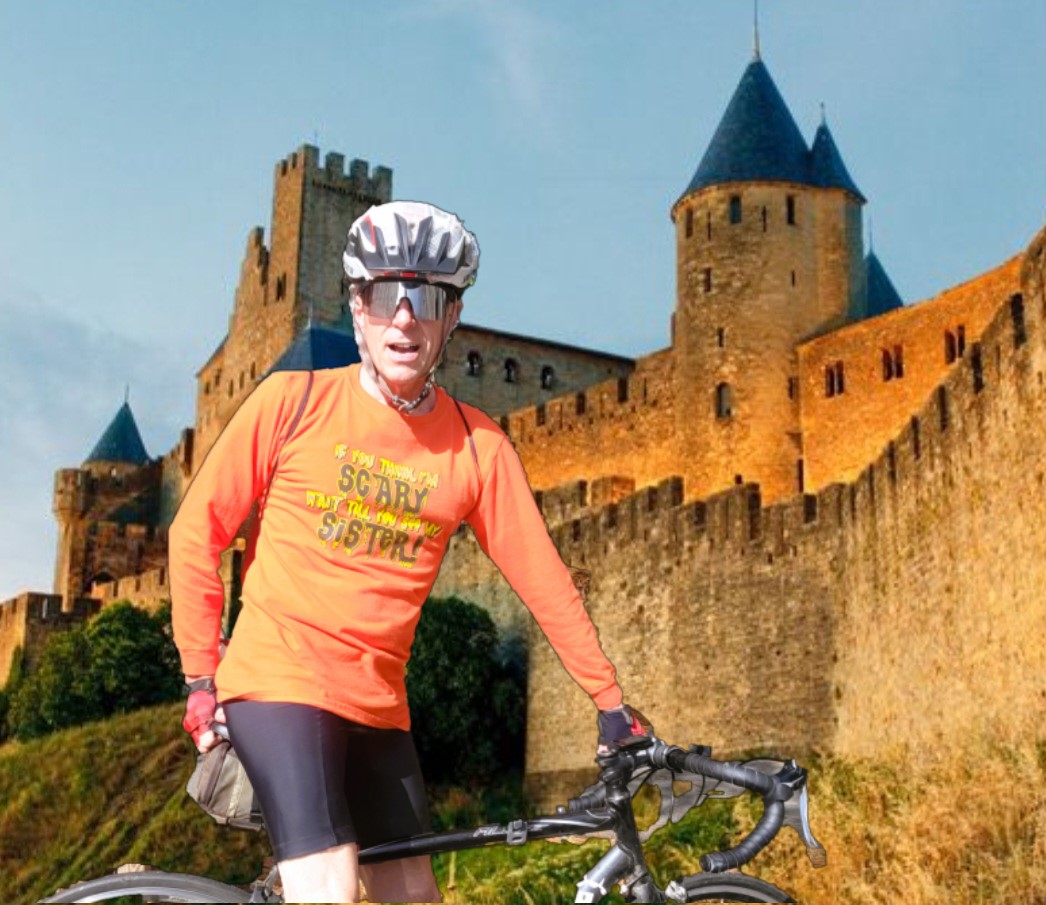
PS - On Halloween, I stopped about 370 miles south of Paris at Montpellier, France to see the eponymous castle -- a stop on the town's ghost tour, naturellement.

←← | || Use the arrows to follow the entire bike tour from the start.