Showing posts with label Religion. Show all posts

Wednesday, April 06, 2022

Episcopalians and Race: One Slice of a Complex Story

By coincidence, the scripture assigned to Episcopalians for April 3 was also the text for a sermon I'd just read by Duncan Gray. An Episcopal priest in Mississippi in 1954, Gray was responding to the Supreme Court's then-recent decision in Brown v. Board of Education. I was following up on information new to me about my church's historical stances on racial equality in Stephanie Speller's book The Church Cracked Open when I ran across Gray's sermon.

I encountered Duncan Gray often when I lived in Jackson, MS. I walked my dogs past his house and sometimes parked in front of it to attend my church two doors down. Bishop Gray officiated when I was received into the Episcopal Church around 1985. I retain the sensation of his hands pressing on my head.

[PHOTO: James Meredith in 1962 and Bishop Gray as I remember him years later.]

I also knew Duncan Gray from hearing that he accompanied young James Meredith in 1962 when the younger man defied a racial ban to enroll at Ole Miss that year. During the 1980s, I also sang at St. Andrews Cathedral in downtown Jackson for midday concerts that Gray had instituted to bring mixed-race audiences together The church offered free admission and free sack lunches to make the concerts feasible for workers on their lunch break and for homeless people.

Gray came to mind because I've been reading The Church Cracked Open by Stephanie Spellers, the Presiding Bishop's Canon for Evangelism, Reconciliation, and Creation. For her, this time of COVID, Black Lives Matter, and dwindling membership is a time of vulnerability and crisis for the church, a "crack" that may lead to new growth in new directions.

One of her messages is that the Episcopal Church has long been complicit in enslavement and colonization of peoples outside of its white Anglo-Saxon base. The University of the South, Sewanee, whose extension program Education for Ministry (EfM) assigned her book, was itself established by Bishops who not only wanted slavery to continue, but who wanted research to support their belief that all non-white peoples of the world were inferior to, and should be subordinated to, whites (Spellers 82). As the 20th century heated up, she writes, the Episcopal Church maintained silence, and did worse: black clergy were not seated at conferences, and black congregations were ruled by white vestrymen from other parishes.

My experience in Mississippi in the 1980s gave me the opposite impression. All (ALL) the people I knew in my Episcopal Church had flocked there to get away from other churches where segregation was enforced. My friends Joe and Linda were literally kicked out, pushed and dragged out, of their church because they re-enrolled their children in the newly-integrated public school system. They showed me a newspaper they'd saved from the mid-1960s in which people I knew had paid for a full-page ad listing their names in favor of an end to racial segregation.

Gray's sermon takes off from I Corinthians 14.1-19. (Read the sermon.) Gray doesn't get to race until several pages in, when he says matter-of-factly that the Supreme Court decision was the right one. But he leads up to that by observing that Paul downplays speaking in tongues. It may be a gift, but it's not intelligible, not helpful, not persuasive to observers. From this, Gray derives the principle that what the church says should be relevant to the society. Too often, he says, our religion is self-centered.

Gray's sermon could be chapter in Spellers' book. She decries self-centrism -- concern with individual self, preoccupation with the preservation of the institution itself. That this idea is still so relevant is sad; that the Episcopal Church has not been quite so blasé about injustice as the recent book suggests is reassuring.

Wednesday, March 02, 2022

The "Secret" of Ash Wednesday

Fr. Daron Vroon, associate rector of St. James Episcopal Church, Marietta, highlighted the familiar reading for Ash Wednesday in an unfamiliar and wonderful way.

When Jesus tells his disciples in Mt. 6.1-6,16-21 not to show off their piety in public, he promises "the Father who sees in secret will reward you." Fr. Daron was struck by the "intimacy" of the image, as "secret" has to do first with being set apart, before we add the connotations of concealment.

While we usually read this passage through the lens of morality and reward, when we read it with the lens of love, the reward is not something after you die, but the immediate continuing relationship of the believer and God. Daron suggested that it's like the delight of a husband and wife in each other during a quiet moment; to broadcast such a moment to the world would be to cheapen it and destroy it.

Wednesday, February 16, 2022

Sheepish Confession

The priest who contributed meditations to this month's issue of Forward Day by Day responds to John 10.10-11, "I came that they may have life, and have it abundantly. I am the Good Shepherd...." She confesses that she knows no sheep and has always accepted what she'd heard, that they are stupid animals. But, no:
Sheep have strong opinions, complex emotional lives, astonishingly good memories, and the ability to run at speeds of more than twenty miles per hour!

That changes the Good Shepherd metaphor:

[Jesus] is not describing us as helpless or expecting us to follow him without question. Instead, he is promising to lay down his life for us exactly as we are: by turns headstrong, doubtful, fearful, and joyful, sometimes eager to follow and sometimes reluctant.

She concludes that "if we can find it within ourselves to follow him, he will lead us into abundant life."

In this context, the word "abundant" suddenly revealed its DNA to me. The prefix a- means no and bund is related to our English boundary, itself related to a binding as, being bound in chains. I've always pictured "abundance" as a pile of stuff, but it really suggests freedom, fearless exploration, going "out of bounds" in a good way.

I'm glad that I checked into Sheep 101 info, a web site run by Susan Schoenian of the University of Maryland for the benefit of 4H and other youth programs. She includes great examples of smart sheep. My favorite one is the flock that figured out that they could roll across the cow-catcher bridge on their backs to reach the neighbors' garden.

But how did sheep get their undeserved reputation? That comes from their being followers, Shoenian says. But when there's a predator, safety for the individual lies in being close as possible to your neighbors. Smart ewe: Who knew?

Thursday, February 03, 2022

"For These Eyes of Mine Have Seen Thy Salvation"

Yesterday evening, I joined my friend Susan for one of those church Feast Days that fall on weekdays. The Feast of the Presentation falls 40 days after Christmas. We were delighted to see around ten other people -- a crowd, for something like this.

The service celebrates the story in Luke, chapter 2, of what happens when Mary and Joseph present the baby Jesus at the temple. The main characters are the holy family, of course, but all the lines go to an old man named Simeon, and an old woman named Anna. He has come to the temple every day for years, having been told that he'd not die before seeing the Messiah. She has lived in the temple fasting and praying for years. Each one recognizes the baby, and Simeon gets to sing a song we call the "Nunc Dimittis" that I've performed with choirs at every evensong for 40 years:

Lord, you now have set your servant free to go in peace as you have promised. For these eyes of mine have seen your salvation which you have prepared for all the world to see: a light to enlighten the Gentiles, and to be the glory of your people Israel.

20 years ago, I set those words to music for choir and organ that I'm still very proud of. Composers I love have set these words to music that can bring tears to my eyes, but they invariably set the long sentences as long lines, and I, for one, gasp in the middle of the phrases.

So I imagined the old man out of breath after rushing up to the family: Lo-ord (breath) you now (breath) have set your servant (breath) free (breath) to go in peace (breath) as you have promised. The accompaniment plays with the first notes of his melody, slowly at first, building to rapid arpeggios, a glittery vision of world-wide salvation.

Fr. Roger Allen delivered a very simple sermon that captured my imagination. "What if Simeon had taken the day off? What if Anna had been looking at something else?" That got a laugh. But then he asked us what we're looking for, and will we miss it? I've not stopped thinking about that in the 24 hours since.

Saturday, January 08, 2022

"Art + Faith" : Joy and Discovery in Making Church

"Well, duh."

That was my first reaction to artist Mako Fujimura's book Art + Faith: A Theology of Making (Yale University Press, 2021). I've always experienced my faith through the arts. (see how)

My second reaction is, Fujimura's idea to integrate art-making with "doing church" might bring new seekers and new commitment to an Episcopal parish.

His idea might also alienate parishioners who've told me they're just not creative. Fear not! Here's what I know from teaching middle school:

  • The difference between an artist and anyone else is not talent or creativity, but only the curiosity to see what emerges if they keep working on a project.
  • That's why making art is a way to discover something.
  • That's why making art is also (1) as hard for a pro as for a novice and (2) a joy.

Let's see what Fujimura has in mind, and then look at possible applications to St. James of Marietta GA.

[PHOTO: Quilt makers at St. James Church honored our change-ringers. Each color represents a different bell in St. James's tower; the sequence never repeats during this set of changes.]

Practicing Resurrection

Fujimura wants Church to appeal to his friends who, when asked their religion, check "none." These "Nones" find spirituality in art, not in church. At the same time, Fujimura doesn't want to alienate Christian friends who are suspicious of unbridled self-expression.

So Fujimura does not limit his idea of "art" to what's in galleries and concert venues. For him, the salient characteristic of art is that something be made, not for utility -- not just for utility -- but for love (18). He finds numerous examples of "making" in our tradition. In Scripture:

  • God creates for love
  • Adam names the creatures
  • craftsmen make the Ark of the Covenant, their names recorded in Exodus for posterity, their work described with loving detail
  • the woman at the last supper anoints the living Jesus for burial
  • Jesus favors storytelling and metaphor to express his vision
  • Poetry fills the Bible in psalms, prophecy, and Paul's letters
  • Apostles are works of art in their transformation, Fujimura says
Our liturgy, its words and music, is art. I would add that the Eucharist, originally a pot luck "love feast," has become today a kind of musical drama that we all participate in. [See my short essay Liturgy as Theatre (03/2013)].

Fujimura also finds the Christian world view reflected by secular works of art. Seeing a movie or novel, he would have us ask, where is God in the world of this work? Sin? Judgement? Redemption?

Fujimura reframes "making art" as "practicing resurrection" (147). By "resurrection," he doesn't mean "resuscitation" but the "new creation" we read about in apocalyptic scripture. He explains that the word translated "new" isn't neo but kainos -- metamorphosis, like caterpillar to butterfly. He likens this to the Japanese art called kintsugi, "new newness," exemplified by a broken tea cup that's not just repaired but reimagined as an amalgamation of fragments with gold (ch. 4). Jesus says the kingdom of God will be as different from the life we know as the full-grown plant is different from the seed.

Fujimura finds that "practicing resurrection" appeals both to his evangelical friends and the Nones.

Art + Faith in an Episcopal Church

I know from parish surveys that music and the church's elegant liturgy are high on the list of what draws worshipers to the Episcopal church in general, and to St. James in particular. Can we build on this baseline of appreciation for arts? Might we draw a larger, more committed congregation through an emphasis on what we make?

Sadly, COVID-19 has given us a real-life experiment with what happens when there's no "making" in the church. While we've passively received prayers and sermons, whether online or sitting in pews six feet apart, attendance has fallen. That's not a knock on the preaching of our clergy, but a demonstration of what Fujimura believes:

[U]nless we are making something, we cannot know the depths of God's being....God cannot be known by sitting in a classroom, or even in a church taking in information about God. I am not against these pragmatic activities, but God moves in our hearts to be experienced and then makes us all artists of the kingdom. (7)

He imagines art not just for display or presentation to an audience, but about spiritual formation for the creators themselves. He writes that faith is like an omelette: you can read the recipe, but to get it, you have to make it (61).

Prior to the pandemic, a lot of us were indeed making things at St. James, Marietta. Every week, not just on Sundays, we would sing hymns and anthems, ring bells (hand- and tower-), sew quilts and knit blankets for the needy, guide children through imaginative responses to Bible stories, and set the chancel with linens and silver, candles and flowers, vessels of bread and wine for eucharist. Our church also practiced outreach through hospitality, offering Sunday breakfast and Wednesday supper, providing food and entertainment through the program we call Reach Out Mental Health, and hosting homeless families.

Two of my favorite pieces of art in our church were made by church members. One is a quilt that hangs in our stairwell that represents two communities of art-makers in our parish, the sewing group and the North American Guild of Change Ringers (NAGCR). Squares of different colors alternate in patterns that correspond to our different tower bells ringing changes, never repeating a pattern to the end of the series. (See photo above)

Another is a processional cross created for use during the penitential season of Lent by Bill, a woodworker in our parish. Elegant and polished, it's beautiful, but the wood at the center of the cross has a crack in it. Bill's choice to use that flawed piece at the heart of the cross suggests the suffering at the heart of the season.

How else could parishioners be involved in "making?" Do we envision art classes and rehearsals, concerts and displays -- at what cost of money and time? Would clergy have to vet every piece of work to be certain it aligns with our tradition? What if the work of amateurs isn't so good? Will parishioners be asked to sit through awkward performances during services or evenings? Will artists be offended if we don't hang their work in our halls?

If the Rector appointed me Director of Arts, I'm not sure that I'd do anything more than draw attention to the quilt and cross, the making we already do, and then proclaim: "Let us intentionally make 'making something' a part of whatever we do -- whether we are engaged in worship, study, socializing, or reaching out to the community."

It wouldn't have to be any scarier than when a fellow teacher challenged me to plan a collaborative "active experience" for our seventh graders at the end of every unit after the chapter test. She knew what Fujimura knows: once they'd learned the facts, our activities would help them to relate their knowledge to their lives.

We already do this kind of artistic thinking in educational activities at our church. Our director of children's education plans collaborative creative experiences with her Bible story curriculum, varying the activities to suit children of different ages.

Adults in EfM (Education for Ministry) practice "theological reflection," a process that might as well be called "thinking like poets" as they explore an event or text with imaginative empathy, memory, Scriptural analogies, and metaphors. Often, they draw all the threads of their discussion together into a "collect," a concise form of prayer that comes close to being poetry. [See Where Prayer Meets Poetry (05/2020)]

Even making a list is creative. I asked my adult EfM class, "What ministry do you imagine for yourself? How could the church be of service to YOU in this?" As they answered, they grew more animated:

  • to provide a type of caregiver support group – “caregiver” broadly defined (illness, parenting, eldercare) -- that takes “me” out of the equation, helping the caregiver to REALLY see the person they’re caring for. Church? Bible study can help, but a group with activities that everyone does together is also important. (Art, music, poetry, conversation…)
  • to create a program that might be called "The Inspired Retired" for retirees to find new ways to become engaged with (1) their own ordinary routines and (2) others
  • to fulfill the 12th step, i.e., to work with others struggling with substance abuse.
  • to make a deliberate effort to engage with people as equals -- especially strangers we encounter, in public, even at the drive-through -– a ministry one conversation at a time. Church could be a place that welcomes people in this way.
  • to pay attention to students who need advising to get through myriad hoops and obstacles during this particularly difficult time.

"Making something" might be sharing participants' insights on video, or using software or art materials to create an image for what they've learned. The subject matter may not be Scripture, but about the church community, about traditions with food and decorations, about life experiences. For example,

  • The most intense half hour I shared at a weekend retreat with EfM mentors was when we were given 30 minutes with old magazines to find images that represent elements of our spiritual lives, to cut and paste them into a circle (making a mandala).
  • When I sent adults of in my EfM class to roam the church campus with their phones to bring back images that "spoke" to them strongly of our faith, they returned exhilarated and eager to share. (My images were the ones in this article of the quilt and the cross.)

No activity has to be shared beyond the small group, but, posted on the church's social media, such "makings" would show online scrollers that we are a church where people learn, search, wonder, think, connect "church" to their own lives, the larger community, and to popular culture.

Bottom Line from Self-Appointed Director of Arts

Art takes work more than talent; it's more a joy than a grind; it's a process of discovery that goes beyond the delivery of a message; it doesn't have to be about religion to be religious.

Fujimura writes what our experience at church bears out, that thinking like a "maker" is a way to "the deepest level of knowing" (Fujimura 72), an intensifier of our response Scripture and liturgy. In an interview, Fujimura says,

The arts are a cup that will carry the water of life to the thirsty. It’s not the water itself; it’s the vessel. What we are doing in the church today is we are just picking up water with our bare hands and trying to carry it to the thirsty. We can still do it, but the effect is minimized by not fully utilizing what God has given us. (Faithandleadership.com)

Our rector in his Christmas Day sermon this year had a message compatible with Fujimura's. He emphasized that we all should be living out our thanks for the gift of the incarnation. Teaching and debate are not the only ways to do that, he said.

Art is also a builder of community through collaboration, and a value in itself (17-18).

When we re-boot church after the pandemic, what additional "making" could involve parishioners, and how else can we make everyone aware of what we're doing?

Thursday, January 06, 2022

Poets on Prayer: Mary Karr and Christian Wiman

Thirst is the truest knowledge of water.
  - Mary Karr, "Philemon: Notes from the Underground"

Mary Karr writes that in a poem about needing to pray. By serendipity, I opened to that poem on the morning after our EfM (Education for Ministry) class had discussed how spirituality is a thirst for relationship with the transcendent, and prayer is where God meets us in our need. It's doubly serendipitous that the class also discussed a whimsical poem by Christian Wiman that spoke to us about another aspect of prayer.

We had read an essay by Urban T. Holmes from "The Spiritual Person" in Spirituality for Ministry, The Library of Episcopalian Classics (Harrisburg, PA: Morehouse, 2002). We all appreciated Holmes's idea about prayer as a space where "our freedom meets God's vision," though we haven't lost our childhood notions of prayer as a wish list for our Santa in heaven. Holmes rates that kind of "petitionary prayer" at the lower end of a continuum. The upper end of Holmes's continuum is wordless communion with God. As a word guy who savors the lines in our Book of Common Prayer, I'd had trouble imagining that until Holmes likened that sort of prayer to the silence between a loving couple.

I got help with that idea of a wordless prayer when, procrastinating, I re-opened Mary Karr's collection Tropic of Squalor. I'd read all the poems except a few at the end of a series she calls "The Less Holy Bible," so I turned to those. One tells of mailing an ex-lover's belongings. "Leaving the post office," she writes, "I enter / the sidewalk's gauntlet of elbows" and she prays to "Christ, my Lord, my savior, / and my good brother," something like the "Jesus Prayer" that our class had discussed. Her foul mood shifts as she prays for everyone she sees. A toddler with a green apple "can become baby Jesus," and an ugly street incident is redeemed ("Petering: Recuperation from a Sunk Love..." 69-70).

Karr's line about "thirst" caps a poem in which the poet describes a dreary subway car. "And in the evil of my pride," she tells God, "I get / to forget I am You-formed" though she sits "among other similarly shaved animals." When she puts her hands together, she sees her fingers as "unlit tapers" that "burn" for God. She calls this one "Philemon: Notes from the Underground" (71), relating the epistle in which Paul asserts the brotherhood of a Christian slave and his owner Philemon to Dostoevsky's novel about a snob resentful of everyone around him. In this context, the poet's thirst for transcendence is itself an entry into knowledge of God.

After our discussion of prayer in EfM, we subjected a poem by Christian Wiman to a process of "theological reflection," a creative search for ways that our religious traditions relate to life experiences, including literature and movies. I brought Wiman's "I Don't Want to be a Spice Store," which begins with a snarky description of pretentious merchandise in an exclusive store in a town where shops don't open before noon and "even the bookstore is brined in charm." The poet writes that he wants to be open and available all the time (we thought of Buc-ee's and 7-11) and carry just the necessities:

Something to get a fire going
and something to put one out.
A place where things stay frozen
and a place where they are sweet.
I want to hold within myself the possibility
of plugging one’s ears and easing one’s eyes;
superglue for ruptures that are,
one would have thought, irreparable,
a whole bevy of nontoxic solutions
for everyday disasters.
  - Wiman, "I Don't Want to be a Spice Store"
  from Survival is a Style (New York: Farrar, Straus, and Giroux, 2020)
The poem ends with the store empty but "humming" at 4 a.m., door unlocked, waiting patiently. Several of us highlighted different parts of the poem before one man observed that, in this way of looking at a convenience store, Wiman had given us a memorable image for what prayer can be. From the list of necessities, to the intercessions for the mending of others' brokenness, to the patience that waits for God to enter in, it touches on all the points we made during our discussion of the essay.

It's a model of prayer in one other way: It doesn't have to say all that to say all that.

Blogposts of Related Interest
Mary Karr writes that poetry is prayer in an essay that concludes her 2006 collection Sinners Welcome. She collects poems about how her son brought her out of her self, poems about the Incarnation of God that make familiar Bible stories uncomfortably physical, poems that express gratitude, and some that don't. See Discomfort and Joy (06/2020). Her afterword and a 1993 poem "Etchings in a Time of Plague" figure prominently in a piece I wrote about a form of prayer that comes close to being a form of poetry. See Where Prayer Meets Poetry: The Collect (05/2020).

Beyond Belief in My Bright Abyss (08/2013) concerns a book of essays by Christian Wiman, once fundamentalist, then atheist, now a kind of believer again. There's also my review (06/2013) of the poet's collection Every Riven Thing.

Sunday, November 28, 2021

Stewardship Message: "The Creator Doesn't Need Our Money, But..."

Good morning. Besides singing with the choir, I work with EfM, and I’m clerk of the Vestry. That means I take notes while others explore options and make hard decisions. That means I have all the fun with none of the responsibility.

But when I was a voting member of the Vestry, I would wake in the night worried because pledges came in so slowly. We saw needs and we saw opportunities, but without pledges to make the budget, our hands were tied. Worse, we had to contemplate cutting programs and staff. This happened every year that I was on the Vestry, and it has happened every year since. We’ve always made it, but it has always been a close call.

When I became Senior Warden, I read books on stewardship. They offered nothing that I didn’t already see here.

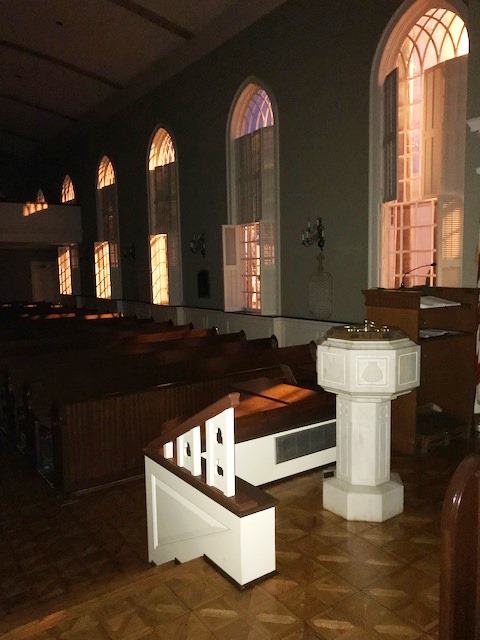
[PHOTO: The view from the lectern at evening. Photo by Susan Rouse, 2018.]

Then, doing research for EfM, I ran across a great stewardship message from the days of Queen Elizabeth (the First). For a pledge drive in 1599, Richard Hooker preached that “the Creator of Heaven and Earth does not need our money. Rather, it is we who need to give it.”

That message resonated with me, because of something a counselor said when I was just out of college and he was helping me to find my way. I was working a minimum wage job, and one hour with him cost as much as rent. But when I told him that I would ask Mom and Dad to foot the bill, he said no. He explained that money does more than pay for a product or service; money is a symbol. It expresses our values. He said that, unless I paid to the limit of my ability, I would not be committed to our work. He cut his fee in half so that what I gave would be mine, and would mean a lot to me.

Likewise at St. James Church. The more I’ve given, the more deeply I’ve felt invested in the ministries of the church, even the ones that don’t involve me.

For the sake of maintaining this campus, our staff, worship, music, education, and our ministry of hospitality;

for the sake of the youth and families, couples and singles, retired people and those beyond our walls that we want to draw in;

for the sake of our own faith and personal connection to the Body of Christ; and

for the sake of our Vestry’s getting a good night's sleep,

Pledge to the limit of your ability, and pledge now.

Friday, October 29, 2021

Liturgy Adapted from Mary Oliver's "Thirst" (mostly)

Every week, our Education for Ministry seminar (EfM) begins class with a worship service. We are encouraged to be creative, so long as our liturgy hits the same marks as ones authorized in our prayer book.

I'd been reading about Mary Oliver's collection Devotions and made the jump to creating a liturgy that would be a sort of collage of pieces from her work. I read her collection Thirst when it was new during the weekend of my first vestry retreat, and blogged about it. That post A Doorway into Thanks is a perrennial hit, read now by thousands.

A Short Worship Service Adapted from Poet Mary Oliver's Thirst (2006)

The ellipsis [...] marks my omissions from Oliver's text; two asterisks ** mark space breaks inserted for the purpose of group reading. Other spaces are Mary Oliver's own.

Opening from "Six Recognitions of the Lord" p. 26
I know a lot of fancy words.
I tear them from my heart and my tongue.
Then I pray.

Confession ibid
Lord God, mercy is in your hands, pour
me a little. And tenderness too. My
need is great. Beauty walks so freely
and with such gentleness. Impatience puts
a halter on my face and I run away over
the green fields wanting your voice, your
tenderness, but having to do with only
the sweet grasses of the fields against
my body. When I first found you I was
filled with light, now the darkness grows
and it is filled with crooked things, bitter
and weak, each one bearing my name.

A Song of Praise from "Messenger" p.1 (adapted for responsive reading - response after each asterisk)
My work is loving the world. Here the sunflowers, there the hummingbird -- equal seekers of sweetness,*
Here the quickening yeast; there the blue plums. Here the clam deep in the speckled mud.

Are my boots old? Is my coat torn? Am I no longer young, and still not half-perfect?*
Let me keep my mind on what matters, which is my work,

which is mostly standing still and learning to be astonished,[...]*
which is gratitude, to be given a mind and a heart and these body-clothes,

a mouth with which to give shouts of joy to the moth and the wren, to the sleepy dug-up clam,*
telling them all, over and over, how it is that we live forever.

Homily "The Summer Day" from The House of Light (1992)
Who made the world?
Who made the swan, and the black bear?
Who made the grasshopper?
This grasshopper, I mean—
the one who has flung herself out of the grass,
the one who is eating sugar out of my hand,
who is moving her jaws back and forth instead of up and down—
who is gazing around with her enormous and complicated eyes.
Now she lifts her pale forearms and thoroughly washes her face.
Now she snaps her wings open, and floats away.**

I don't know exactly what a prayer is.
I do know how to pay attention, how to fall down
into the grass, how to kneel down in the grass,
how to be idle and blessed, how to stroll through the fields,
which is what I have been doing all day.**

Tell me, what else should I have done?
Doesn't everything die at last, and too soon?
Tell me, what is it you plan to do
with your one wild and precious life?

Prayers from "Praying" p. 37
It doesn't have to be
the blue iris, it could be
weeds in a vacant lot, or a few
small stones; just
pay attention, then patch

a few words together and don't try
to make them elaborate, this isn't
a contest but the doorway

into thanks, and a silence in which
another voice may speak.

Silence may follow. Worshipers are encouraged to speak their own petitions.

We sum up all our petitions in the words that our Lord Jesus Christ taught us, saying...
The Lord's Prayer

Collect to be selected from the Episcopal Book of Common Prayer

Closing "Thirst" p. 69
Another morning and I wake with thirst
for the goodness I do not have. I walk
out to the pond and all the way God has
given us such beautiful lessons. Oh Lord,
I was never a quick scholar but sulked
and hunched over my books past the
hour and the bell; grant me, in your
mercy, a little more time. Love for the
earth and love for you are having such a
long conversation in my heart. Who
knows what will finally happen or
where I will be sent, yet already I have
given a great many things away, expect-
ing to be told to pack nothing, except the
prayers whic, with this thirst, I am
slowly learning.

Wednesday, October 27, 2021

Theology for Breakfast: Fr. Adam Trambley in Forward Day by Day

After feeding the dog, birds and squirrels each morning, I sit with my coffee to do morning prayer ("Open my lips, O Lord" --sip--"and my mouth shall proclaim thy praise") and to read the meditation on the day's scripture from the quarterly publication Forward Day by Day. In August 2021, I especially looked forward to the insights of Adam Trambley, a priest in Pennsylvania.

Maybe because this was my first August in 40 years that I had no classes to plan for, I responded to his message that cultivating your inner life is a good and necessary thing but not the only thing. You have to get out of yourself, and our church has to get out of itself, too.

Calm
One message Trambley takes from scripture is calm down. The 5000, having just been fed, clamor for assurance that they'll always have bread (John 6); Trambley says they want a "silver bullet" to make everything fine forever, and that's not what Jesus offers. So calm down, and get on with life in Jesus.

Jesus takes the blind man away from the crowd in Bethsaida to restore his sight, then sends him away from town (Mark 8), because, as Trambley writes, "Our most profound experiences of God can initially feel quite fragile," so we need time alone to "process and appreciate what has happened."

For the Feast of Transfiguration, Trambley tells how disappointed he was to discover on a pilgrimage to Mt. Tabor that a modern church there has set aside three grottoes for Jesus, Moses, and Elijah, just as Jesus forbade the disciples to do. But Trambley relents: how else can we "hold on to encounters with God that transcend what we can process?" (I call this blog my "word sanctuary" as I use it for that purpose.)

When Paul admonishes us to be "careful...how you live...making the most of the time" (Ephesians 5.15-16), Trambley says it's not about being more efficient in tackling our to-do lists:

A wise relationship to time means appreciating every moment and relishing it. Drunkenness and debauchery are shunned because they numb us to the beauty and wonder pregnant in every instant.

When we open our calendars, God would have us grateful instead of stressed.

Have salt in yourselves and be at peace with one another (Mark 9.50) In these words from Jesus, Trambley sees instruction that we are responsible for nurturing our own souls, and we'll be "disappointed if we depend on others to make our lives complete." But when we do find "wholeness in ourselves," then "we can accept and love people for who they are" and be "at peace with one another."

"Silence" was Trambley's last word on this theme. Among myriad instructions for the building of Solomon's temple in 1 Kings 6, Trambley draws our attention to a detail in verse 7, that noisy cutting and hammering of materials for Solomon's temple were to happen off-site to hallow the site of the temple with silence. The reading was assigned for August 27, a day set aside to honor Thomas Gallaudet and Henry Winter Syle, pioneering ministers to the deaf. Trambley challenged us to sit ten minutes in silence, eyes closed. (I tried all week and couldn't do it.)

Fun with Scripture
Then Trambling picks up on some fun things in scripture that I had not noticed or at least had not savored before.
  • Psalm 136 is a litany of thanksgiving that gets weird in the middle where a slew of obscure kings get slain, each killing followed by the refrain "and [God's] mercy endures forever." Trambley takes comfort from the knowledge that "the geopolitical events of ancient Israel were as problematic as our own," and, God's mercy endures forever.
  • Trambley compares Shimei, son of Gura, to a scrappy baseball manager leaving the dugout to scream at the umpire. I'm glad he picked up on this obscure episode in the 2 Samuel 16, where Shimei runs out of his home to curse David and his soldiers. With so much screaming, name-calling, and mockery in our media today, David's response is cool: either he really deserves it and God will let the curses rip, or David will earn credit for his restraint.
  • "Wily" isn't a word we associate with Jesus and St. Paul, but Trambley does. He sees wiliness in the readings that go with Psalm 18.27, With the pure you show yourself pure, but with the crooked you are wily. For example, when Jesus tells the disciples to follow a man with a water jar to the unnamed place where he'll meet them for their Passover seder, "he ensures that his disciples receive the gift of the first eucharist since Judas cannot tell the authorities where to find him until after the meal." Then, Paul tells a centurion to "jettison the ship's lifeboats rather then let sailors sneak away and leave his party to their deaths." Then Solomon uses "a wily trick" to identify the infant's true mother. Trambley asks us to think when we were ever "wily for Jesus."

Prayer Walks
I was so taken by his insights and easy writing style that I bought a book that he co-edited and contributed to. His collaborators take turns drawing lessons for the Episcopal church in this time of declining membership from the building up of the church in Acts 8. So, for example, in Philip's ministry to the city of Samaria, Trambley sees an apostle responsive to the needs he finds. "Loving, thriving churches see themselves as being called to give away their resources to meet the needs of the community," he writes in Acts to Action, compared to dying churches that keep trying to draw support from the community for what they've been doing for decades.

Trambley tells how his spiritual director pushed him to get involved with the city council soon after moving to his new church. Soon, he was offering the church to the council for some community needs, and then there was reciprocation and mutual gratitude.

Trambley also describes taking "prayer walks" sometimes alone, but more often with officials and parishioners. All that's required is

...to take a thirty- to sixty-minute walk in the community or neighborhood and to be in coversation with God about what you see. As you encounter places where things are going well, give thanks. Where you see problems, ask God to intervene. When you find the beginnings of new life, ask God's blessing. The more you walk and pray, the more you will see in the community and what you see will draw you deeper into prayer.
And prayer changes the person who does the praying, especially in growing their awareness.

He seems to be a wise and humble priest working with the Acts 8 Movement to find a way forward for our national church. I'll look for more. See acts8movement.org.

Friday, July 23, 2021

Happy Mary Magdalene Day (one day late)

[Mary Magdalene has things to say to us today even when we realize that we've confused her with other women. PHOTO: Yvonne Elliman as "Mary Magdalene" is anointing Ted Neeley as "Jesus" in the film of Jesus Christ Superstar, something M.M. didn't do in the gospels.]

The Church sets aside July 22 to honor the woman who mistook the risen Jesus for a gardener. It's a heart-stopping moment when he says simply, "Mary," and she recognizes the man she calls "Teacher." All four gospels agree that Mary Magdalene remained with Jesus at the crucifixion when his men shied away. All four gospels agree that she's the first person to proclaim the resurrection, for which she's sometimes called "the first apostle." Besides this, we're told that she's one of the women who supported Jesus and the apostles (Mark 15.40, Luke 8.3). Luke adds the intriguing note that "seven demons had gone out of her," by Jesus, we presume.

Historical Mary Magdalene

Mary Magdalene is not the adultress whom Jesus saved from stoning, Mary of Bethany who sat with Jesus while sister Martha worked in the kitchen, nor the woman who anointed Jesus's feet (unnamed in three gospels, identified in John's gospel as Mary of Bethany). Bart Ehrman, in Peter, Paul, & Mary Magdalene (a title aimed at Boomers) blames a sermon by Pope Gregory in 591 for mashing up different women into a kind of fantasy figure of a promiscuous woman who becomes a repentant servant to men. Ehrman pulls out the Mary Magdalene threads in the gospels and also digs into gnostic literature for numerous passages about her, including a Gospel of Mary.

Ehrman tells us what he infers about the historical woman Mary of Magdala. Historical references supported by archaeological digs suggest that her home town was a cosmopolitan center of leisure activities, like Las Vegas (198). Her "service" to Jesus and the apostles, like that of Joanna listed with her, appears to have been financial support. Whether Mary's wealth came from family, husband, or business, we can only speculate, but Ehrman shows how all three were possible back in the day. (Ehrman, Bart. Peter, Paul, & Mary Magdalene: The Followers of Jesus in History and Legend. New York: Oxford University Press, 2006.)

By the way, Ehrman emphasizes that the "sinful woman" who anoints Jesus in Luke is neither (1) a prostitute, nor (2) Mary Magdalene, who's introduced in the following chapter. "Sinful woman," in this context, Ehrman writes, could be someone who ate some shrimp (189).

Mary Magdalene Superstar

Setting all that aside, the hybrid Mary Magdalene still appeals to our imagination, even for those uncommitted to Christianity. Exhibit A, what comes first to my mind and Ehrman's when we hear her name, is the rock opera Jesus Christ Superstar with lyrics by Tim Rice and music by Andrew Lloyd Webber. Fifty years after I obsessed over that show, I can still quote from memory Rice's lyrics for the character Mary Magdalene:

I don't know how to love him
I don't see why he moves me
He's a man
He's just a man
And I've had so many men before
in very many ways:
He's just one more.
(OMG - what did my parents think as I sang this along with the 8-track tape in our family stereo?) The worldly woman who gives up her independence to serve an idealist, confused but inspired by a love that isn't carnal -- this is great stuff. It occurs to me that it was also in the zeitgeist ca. 1970, when the story was replicated by flower children and, in a bad way, by Patty Hearst.
[See two reflections on Lloyd Webber: The First Things That Come to Mind (02/2013) and a second look occasioned by his memoir Unmasked (06/2018)]

Modern Magdalene in Poetry
Poet Marie Howe explores the hybrid Mary in her collection Magdalene (New York: W.W.Norton & Co., 2017). The book opens with a poem that I heard her read aloud. I'm not alone on the internet in calling this one of my favorite poems of all time. Here's what I blogged about it:
"Magdalene - The Seven Devils" [names] the seven devils that Jesus cast out of Mary Magdalene (Mk 16.9) as if it had happened today:  "The first was that I was very busy."  Other demons include,  "I was worried," and, "envy, disguised as compassion."  But, she goes on tangents and has to start over: "Ok the first was that I was so busy."  The more Howe's Mary Magdalene coiled back, the more tightly wound up in the poem I was, nodding and laughing at feelings I owned. (from Marie Howe: You Must Remember "This" 07/2017)
Its form expresses character and reinforces the content. I'd love to hear the poem recited aloud by a comic, either Tig Notaro's world-weary tone, or Rosie Perez's cheerful Brooklynese, or Dolly Parton's comforting drawl. The poem cries out to be read aloud, no matter who does it.

Other poems in the collection with "Magdalene" in the title seem to form a narrative arc, not necessarily connected to Jesus in Palestine. Magdalene "...on Romance," ": The Addict," "...and the Interior Life," with other poems that lack the Magdalene name, imagine a woman "always sorry / righteous and wrong" ("When I did Wrong" 31), "a door slammer and screamer" ("Magdalene on Romance" 34) addicted to this kind of relationship, who "likes Hell" because

The worst had happened. What else could hurt me then?

I thought it was the worst, thought nothing worse could come.

Then nothing did, and no one.
("Magdalene: The Addict" 36)

From this bottom of the arc, she climbs up in steps that are other poems. Mary Magdalene may not have been the woman nearly stoned, but Howe goes there, anyway. "Magdalene: The Woman Taken in Adultery" imagines the near-death experience; "Next Day" she returns to the scene of the events described in the John 8, "free of the pretense of family now" that her husband and male relations had been ready to kill her -- to see the man who "scribbled in the dust" standing nearby (40).

Perspectives on the rest of the Gospel story follow in the collection: "The Teacher," "The Disciples," "Magdalene on Gethsemane," "Calvary." In "Magdalene Afterwards," the voice that once had seven devils now speaks for many women, with children, without, in heels, in a wheelchair, all "still hungry for I don't know what" "but "sometimes a joy pours through me" (51). Later, in a second poem called "The Teacher," it seems that several teachers are rolled into one who could be the one Magdalene called "Teacher," but her conclusion works regardless:

Can we love without greed? Without wanting to be first?

Everyone wanted to pour his wine, to sit near him at the table.

Me too. Until he was dead.

Then he was with me all the time. (69-70)

Among these "Magdalene" poems are many other poems not directly related. Several concern a fun mother-daughter relationship. The mother suggests, if they're reincarnated, "Next time, you be the mother" (73). "No way Jose" the daughter responds. A slice of life called "Delivery" is a gift -- a man late on a snowy night trudges up flights of stairs past Christmas decorations to deliver packages, and when she asks him about his Jamaican accent, he gives her "a smile so radiant" that she's "a young woman again" remembering "the sweetness of men I've loved" (88).

Next Mary Magdalene Day, let's remember to pour the wine and read Marie Howe's poetry aloud.

[My short essay Out of Ordinary Time (11/2019) includes appreciation for Howe's collection The Kingdom of Ordinary Time]

Wednesday, July 21, 2021

Theology for Breakfast: Kitchen Reverential

My kitchen was my church during COVID; the Feb-Apr '21 issue of Forward Day by Day suggests how a healthy church should be like a kitchen.

Church is like a kitchen, writes Ellis Reyes Montes for a devotion in March. In the kitchen, his family makes meals, decisions, and stories that contain generations of memory. He writes that, in church,

We gather to remember the stories of faith: of Jesus, of the faithful figures in the Bible, of our congregation. We also gather to share communion, a spiritual meal that has been provided to us through tradition, prayer, and blessing. (Forward Day by Day March 7, 2021)

During COVID, the kitchen was where I taught my seventh grade classes and met both my Education for Ministry cohort and church Vestry. On Sundays, when Atlanta's Episcopal churches were closed, the laptop livestreamed services on the kitchen counter while I cleaned house. I paused to respond "Amen" and "also with you." While the priest prepared the bread and wine, I prepared my lunch. Now I still read Forward Day by Day at my kitchen table every morning with coffee, Bible, and prayer book, with Brandy curled up at my feet.

Articles that struck me reading Forward this past spring concerned worship that I can do alone in my kitchen; other articles in the same issue of Forward remind me why collective worship matters. Pieces for February were by Julie Bowers, special ed teacher in Tucson. Montes wrote for March from his experiences as musician, writer, and lifelong Episcopalian in Houston. Fr. Scott Gunn, Executive Director of Forward, wrote pieces for April.

Alone in the Kitchen
"Trust is like a muscle" that can be strengthened with exercise, writes Bowers. Elsewhere she quotes novelist-theologian Frederick Buechner's observation that you shall love the Lord with all your heart eventually becomes "less a command than a promise." I hope so.

Montes, a gardener, sees more than I've seen in Psalm 72.6, "God is like rain." Rain does more good than watering plants, as by "[turning] debris into fertilizer, signaling the seeds to germinate, and encouraging fungi to help with the growing process." Humid air nourishes the plants under the eaves of a roof. "Even when we build barriers," Montes concludes, "God breaks them down and showers us with blessings."

Gunn points out that Satan can't wedge himself between Jesus and God because Jesus had armed himself with Scripture, as I do every day at the kitchen table.

With the Church
Gunn hears people say they don't need "organized religion" because they can "find God in a sunset." Why isn't that good enough? Gunn's first answer is that Jesus and his followers do spend a great deal of time going to the synagogue. Gunn admits that he sometimes doesn't feel like going, but "I never regret going to church." I agree. Just this past weekend, the weather forecast gave me good reason to skip church, but I re-arranged my plans to attend anyway. It did me good, and I did a few other people good by being there. Gunn's bottom line is, "We Christians need each other, and we need to hear the message proclaimed."

Montes admits feeling vulnerable at church, being young, Latino, and gay. But he notes how Jesus doesn't dwell on points of difference when he speaks with the woman at the well -- female, foreigner, adulterer. Church should be like that, Montes writes. With his kitchen analogy, he concludes, "At its core, the house of God is where we strengthen our faith."

About being with others in the kitchen, Frederick Buechner wrote

I sometimes think that all the major dramas of my life have taken place in kitchens, and maybe that's because in kitchens there's always something else to fall back on if the going gets tough, like cooking or eating or doing the dishes. And maybe that's the real drama after all -- just keeping yourself alive day after day and cleaning up afterwards. (Buechner. The Book of Bebb. New York: Atheneum, 1984. P. 363.)
Gunn shares a couple of stories about dramas in church. He regrets a vicious letter he once wrote to a church leader:
I wrote ...thinking I was bearing light, holding up some imagined standard. In fact, I was still in darkness. Thanks be to God that Jesus loves us even when we're jerks. And thanks be to God that the leader to whom I wrote was in the light and ready to share it. (April 13, 2021)
In another church, Gunn became aware after a few months had passed that one of the parishioners had once committed "a fairly horrible crime." Asked about how the church accepted this person, another parishioner echoed Jesus in Luke 5.32, asking Gunn who could need church more than they do?

Bowers remembers a mother whose grown son died of a drug overdose. For the funeral, the mother displayed photos of her son in the narthex of the church where attendees would see them on the way into the service: "sweet, swaddled infant, beaming toddler on daddy's shoulders, joyful sports team member, proud high school graduate" (Feb. 2, 2021). Like photos stuck on the kitchen refrigerator, these memories reminded everyone that her son's story was more than its sad ending.

I'm reminded of funerals that started or ended with gatherings in the kitchen. A funeral for my young student Chris ended in his parents' kitchen with trays of food for guests who celebrated the young man's memory. Then I remember when my cousin had succumbed to AIDS, how we all waited with Aunt Blanche in the kitchen while the cars lined up for the drive to the cemetery. All dressed up in black, coffee and snacks on hand, my cousins, their children, and two grandmothers stood or sat watching The Price is Right. The millionaire grandmother yelled at the screen, "I could get that twenty percent cheaper!" We all laughed; then it was time, and the tears started.

Do kitchens show up in Scripture? Mama's boy Jacob mixes stew in the kitchen while his brother Esau outdoors works up an appetite; a poor widow makes miraculous bread for the prophet Elijah; Martha is in the kitchen complaining while Mary attends to Jesus in the next room; the apostles holed in an upper room broil some fish for the resurrected Jesus. That's not a lot of kitchen in scripture, but the idea of church as a place of nourishment, shared activity, and learning to work through the dramas -- that's something to remember.

[Read more about theologian Frederick Buechner's fantastic, insightful, inspiring, and funny novels about the Reverend Leo Bebb in my blogpost Comedy, Fairy Tale, Tragedy: My Favorite Fiction (01/2010)]

[See my page Theology for Breakfast for several years' reflections on outstanding ideas in Forward Day by Day.]

Monday, June 28, 2021

History Hysteria: Nothing New

Bless Sam Sanders, host of the NPR program It's Been a Minute for bringing on a guest who could give us a long view on the uproar over Critical Race Theory. Sam often gives voice to feelings that many of his listeners share (myself included), and this time it's a sickness in the pit of the stomach as he hears of disruptions to school board meetings, threats to members, and legislators resolving, in effect, to ban the teaching of historical facts that might make students feel bad.

Sam's guest Adam Laats, a professor of educational leadership at New York's Binghamton University, focuses his reasearch on cultural reactions to school reform. He taught history in middle school and high school for ten years.

[Photo: Sam Sanders (left), Adam Laats]

Sam wanted to know, has this happened before? If so, has it ever been this bad? And is it unprecedented that it's erupted so quickly in school districts and state legislatures all across the nation?

Dr. Laats gave examples from 1930s, 50s, and 70s to show that, yes, parents have called for the banning of books for drawing attention to inequities in American history; yes, they've burned books and even bombed school buildings (1974, West Virginia); and, no, there's lots of precedent for national media and Washington politicians whipping up coast-to-coast hysteria over local school affairs. Laats's own article on the current CRT "panic," written with Gillian Frank for Slate, concludes that each of these eruptions has succeeded in the short term by removing the curriculum in question, and in the long-term by discouraging teachers from asking questions that might stir up another hornets' nest.

Adam Laats's own website includes a page called My Two Cents where he curates links to his articles and media appearances. Judging his books by their covers -- risky, I know -- I'd say that Laats is finding ways to bridge gaps between fundamentalists and teachers who encourage critical thinking about science and history.

So my blood pressure is down again. Thanks Dr. Laats and Dr. Sanders.

Of Related Interest
  • To open up critical inquiry for 8th grade history students, I designed a year around four questions derived from the Pledge of Allegiance: How true is it to say that America is, or ever was, one nation? under God? indivisible? with liberty and justice for all? We studied primary sources and reached no simple answers. See details at Teach History with the Pledge of Allegiance (07/2017).
  • "We've been here before" is the somewhat comforting message of Jon Meacham's The Soul of America, a survey of US history composed in 2017 to answer the popular perception that America had never been so divided. See my reflection 07/2018.
  • I've thanked Sam Sanders another time for his friendly inquiry into a fraught subject. See Trans Eye for a Bible Guy

Sunday, June 27, 2021

Episcopal Wisdom on Death, Trinity, and Church Architecture

In the past few weeks, we've had some memorable insights presented during sermons by our two clergymen at St. James Episcopal Church, Marietta.

[Photo: Jesus Asleep in the Boat, painted by Jules Joseph Meynier, 1826-1903]

Father Roger Allen drew our close attention to the theme of death in the readings for today's service. After pointing out myriad ways that our culture both distances us from death and shows morbid fascination with death in entertainments and news media, Fr. Roger drew highlights from the texts.

A reading from the apocryphal book The Wisdom of Solomon tells us "God did not make death, and he does not delight in the death of the living" for "he created all things that they might exist, and the generative forces of the world are wholesome" (Wisdom 1.13-14). The creator made us "in the image of his own eternity" and only those who belong to "the party" of "the devil" experience it (Wisdom 2:23-24).

Bringing out the details of the story of Jesus raising Jairus's daughter (Mark 5, especially v.41-43), Fr. Roger paused to acknowledge the continuing pain of parents in our congregation whose children have died.

He remarked how rare it is now for congregants to walk through the parish cemetery to enter the church, and how that used to be a meaningful arrangement.

He also shared the epitaph of a feisty woman who in 1847 pushed for the founding of the worship center where he went on retreat this past week. Her headstone tells us her name, her dates, and the words, "Demure at last." When we laughed, Fr. Roger told us that it's good for us to laugh at death.

He also pushed us to our own catechism for an answer to the question "Why do Episcopalians pray for the dead?" The elegantly phrased answer is both psychologically sensitive and scripturally sound:

We pray for them, because we still hold them in our love, and because we trust that in God's presence those who have chosen to serve him will grow in his love, until they see him as he is. (Book of Common Prayer 862)
Though I've not read that before, it strikes me as coming close to the essence of what makes the Episcopal Church so appealing to me from all the other approaches to faith that I've encountered.

Remarkably, COVID never came up.

Plus Some Memorable Bits from Sermons in June
Our associate rector Fr. Daron Vroon had a little fun with us on Trinity Sunday by turning upside down the Christians' assumption that the Trinity is something we came to understand only after Pentecost. He gave a quick run-down of numerous places in the Hebrew Scriptures such "the spirit over the waters" in Creation, the burning bush, the human presence who met with Moses in the tabernacle "like a friend." The trinitarian understanding of God was already bubbling up in the Hebrew faith long before Jesus.

Then last week, Fr. Daron looked at the story of the apostles' during a storm at sea waking Jesus up in the hold of the boat. Without seeing the story as "just" metaphor, he helped us to see metaphor in the story. The boat, he said, is a common symbol of salvation (as the sea was a symbol of chaos and death). Then he gestured to the walls of our church: That's why the room where we take in teachings and the sacraments, called "the nave," related to navy, is laid out long and narrow like a ship.

Monday, June 14, 2021

Can't Sleep? Pray This


When I lie awake trying not to think how many hours of sleep I may be missing, I often wish that our Episcopal Book of Common Prayer had a few pages set aside for the hours before sunrise.  Now I've composed such a liturgy for myself.  I hope that the texts are calming in their reassurance and soporific in their familiarity, and I hope that I don't have to try it out anytime soon
.

[Photo: BCP, a copy of this liturgy, and Brandy.]


Prayer During a Restless Night

 “Yours is the day, yours also the night.” Psalm 74.15

or this:  "I commune with my heart in the night; I ponder and search my mind." Psalm 77

or this: “My eyes are open in the night watches, that I may meditate on your promise.” Psalm 119.148


Confession of Sin   Book of Common Prayer p. 79


Most merciful God, We confess that we have sinned against you
In thought, word, and deed,
By what we have done,
And by what we have left undone.
We have not loved you with our whole heart;
We have not loved our neighbors as ourselves.
We are truly sorry and we humbly repent.
For the sake of your Son Jesus Christ,
Have mercy on us and forgive us,
That we may delight in your will,
And walk in your ways,
To the glory of your Name. Amen.

Almighty God have mercy on us, forgive us all our sins through our Lord Jesus Christ, strengthen us in all goodness, and by the power of the Holy Spirit keep us in eternal life. Amen.

Invitatory and Psalter

In returning and rest we shall be saved, in quietness and in confidence shall be our strength. Isaiah 30.15


Psalm 16.7-11


7 I will bless the Lord who gives me counsel;* my heart teaches me, night after night.
8 I have set the Lord always before me;* because he set my right hand I shall not fall.
9 My heart, therefore, is glad, and my spirit rejoices;* my body also shall rest in hope.
10 For you will not abandon me to the grave,* nor let your holy one see the Pit.
11 You will show me that path of life;* in your presence there is fullness and joy, and in your right hand are pleasures for evermore.   

Glory to the Father, and to the Son, and to the Holy Spirit.* As it was in the beginning, is now, and will be forever, amen.

The Lessons.


A reading from 1 Samuel  3.8-10.

 And the Lord called Samuel again the third time.  And he arose and went to Eli, and said, “Here I am, for you called me.”  Then Eli perceived that the Lord was calling the boy.  Therefore Eli said to Samuel, “Go, lie down; and if he calls you, you shall say, ‘Speak, Lord, for thy servant hears.’” So Samuel went and lay down in his place.  And the Lord came and stood forth, calling as at other times, “Samuel! Samuel!” and Samuel said, “Speak, for thy servant hears.”

The word of the Lord. Thanks be to God.


Hymn 24, to be sung or said


The day thou gavest, Lord, is ended, the darkness falls at thy behest;
to thee our morning hymns ascended, thy praise shall sanctify our rest.

We thank thee that thy Church unsleeping while earth rolls onward into light,
through all the world her watch is keeping and rests not now by day or night.

As o’er each continent and island the dawn leads on another day,
the voice of prayer is never silent, nor dies the strain of praise away.

So be it, Lord; thy throne shall never, like earth’s proud empires, pass away;
thy kingdom stands, and grows for ever, till all thy creatures own thy sway. 

 (words: John Ellerton)

A reading from Matthew 6.26-27, 33-34

Look at the birds of the air; they neither sow nor reap nor gather into barns, and yet your heavenly Father feeds them.  Are you not of more value than they?  And which of you by being anxious can add one cubit to your span of life? 

But seek ye first the kingdom and his righteousness, and all these things will be yours as well.  Therefore be not anxious for tomorrow, for tomorrow will be anxious for itself. Let the day’s own trouble be sufficient for that day.

The Apostles’ Creed. Book of Common Prayer, p.96


I believe in God, the Father almighty, creator of heaven and earth.
I believe in Jesus Christ, his only Son, our Lord. He was conceived by the power of the Holy Spirit
and born of the Virgin Mary. He suffered under Pontius Pilate, was crucified, died, and was buried.
He descended to the dead. On the third day he rose again. He ascended into heaven, and is seated at the right hand of the Father. He will come again to judge the living and the dead. I believe in the Holy Spirit,
the holy catholic Church, the communion of saints, the forgiveness of sins, the resurrection of the body,
and the life everlasting.  Amen.

The Prayers. Include one or more of the following prayers.

 from Compline, Book of Common Prayer p. 134.

Keep watch, dear Lord, with those who work, or watch, or weep this night, and give your angels charge over those who sleep.  Tend the sick, Lord Christ; give rest to the weary, bless the dying, soothe the suffering, pity the afflicted, shield the joyous, and all for your love’s sake.  Amen.

For the Aged, Book of Common Prayer p. 830.

Look with mercy, O God our Father, on all whose increasing years bring them weakness, distress, or isolation.  Provide for them homes of dignity and peace; give them understanding helpers, and the willingness to accept help; and, as their strength diminishes, increase their faith and their assurance of your love.  This we ask in the name of Jesus Christ our Lord.  Amen.

For restfulness.

Eternal Father, at sunrise you blessed Jacob who had wrestled through the night:  calm our restless minds when the Enemy turns up old regrets and disappointments, or lures us into dark speculations about our futures, that we may return our minds to you and rest with quiet confidence in your love.  Amen.

Silence my be kept, and free intercessions and thanksgivings may be offered.

The Lord’s Prayer. Book of Common Prayer, p. 97.

General Thanksgiving Book of Common Prayer, p. 836.


Accept, O Lord, our thanks and praise for all that you have done for us. We thank you for the splendor of the whole creation, for the beauty of this world, for the wonder of life, and for the mystery of love. We thank you for the blessing of family and friends, and for the loving care which surrounds us on every side. We thank you for setting us at tasks which demand our best efforts, and for leading us to accomplishments which satisfy and delight us. We thank you also for those disappointments and failures that lead us to acknowledge our dependence on you alone. Above all, we thank you for your Son Jesus Christ, for the truth of his Word and the example of his life; for his steadfast obedience, by which he overcame temptation; for his dying, through which he overcame death; and for his rising to life again, in which we are raised to the life of your kingdom. Grant us the gift of your Spirit, that we may know Christ and make him known; and through him, at all times and in all places, may give thanks to you in all things. Amen.

Antiphon from Compline, Book of Common Prayer p. 134.

Guide us waking, O Lord, and guard us sleeping, that awake we may watch with Christ, and asleep we may rest in peace.

The Song of Simeon.  Book of Common Prayer, p. 93.          

Lord, you now have set your servant free* to go in peace as you have promised;
For these eyes of mine have seen the Savior,* whom you have prepared for all the world to see:
A Light to enlighten the nations,* and the glory of your people Israel.
Glory to the Father, and to the Son, and to the Holy Spirit.* As it was in the beginning, is now, and will be forever. Amen.

Repeat the Antiphon

Guide us waking, O Lord, and guard us sleeping, that awake we may watch with Christ, and asleep we may rest in peace.

Let us bless the Lord.  Thanks be to God.

The almighty and merciful Lord, Father, Son, and Holy Spirit, bless us and keep us. Amen.