Thursday, May 26, 2016

Stephen and Steve: Sondheim Appreciates Reich


Onstage at Lincoln Center for a concert - with - conversation earlier this year, Steve Reich and Stephen Sondheim fairly bubbled with shared enthusiasms and mutual admiration. (watch: Reich and Sondheim: In Conversation and Performance.) One composes music that repeats with only minute changes over long stretches of time, while the other compresses vast stretches of story in song with dramatic music and incisive lyrics. But the connections are clear to longtime fans of Sondheim.

First, as Sondheim himself says during the discussion, "we both are interested in harmony." Both vary the harmony under repeated phrases.  Both men agreed that there's been little harmonic variety in popular songs for the last fifty years or so, which have depended on beat and production values for interest. Sondheim said that rock music did Broadway composers a favor by freeing them from the pressure to write popular songs; he and his colleagues were free to write for the drama.  But both men found interest in the rock group Radiohead.  Reich explained how his latest piece is based on an odd harmonic pivot under the phrase "everything's changed" in a Radiohead song. 

Second, in Sondheim's words, both like "vamps."  In Tin Pan Alley-speak, that's a bit of accompaniment that introduces a song and repeats under the melody:  Think the rolling chords under Sondheim's "Send in the Clowns" or the intro to Kander and Ebb's "New York, New York."  At the end of the Lincoln Center show, we hear a single vamp repeated with little variation during a performance Sondheim's "Someone in a Tree" from the musical Pacific Overtures.  Sondheim adds elements to fill in gaps of the vamp as it repeats, while each singer adds a different perspective on a slice of Japanese history.  The description may sound dry; the song feels joyful.  This, Sondheim tells us, was composed under the influence of his first exposure to Reich's music.

Steve Reich - A Personal Music Journey
When John Simon commented in a review of Sunday in the Park with George that the music -- "if that's what that is" -- was a "superficial" imitation of the "modish minimalism" of Steve Reich, I took it as a challenge:  I'd better get to know the music of Steve Reich.  I started with The Desert Music, Reich's setting of poetry by William Carlos Williams in which block chords sung by voice and brass float in stately succession over waves of pulsing percussion.  Conductor Michael Tilson-Thomas likened it to directing ice bergs.  I was hooked.

I soon added to my collection Reich's exhilarating Tehillim ("Psalms"), Variations for Orchestra, Eight Lines, and Violin Phase.  I branched out to composers who, different as they were, shared with Reich the label "minimalist":  John Adams, Philip Glass, Terry Riley, Michael Nyman.  When Reich in album liner notes mentioned 12th-century composer Perotin and jazz great John Coltrane, he opened up other musical vistas for me.

In those pre-internet days, I sat in the public library to read cover-to-cover a pamphlet Reich published around 1970 to explain that listening to his "process music" was like watching the patterns that shift in sand between our feet as waves recede. Over time, changes accrue to create something quite different from what we saw at the start.  His early music for tape loops, clapping hands, or blocks of wood best fits that description, culminating in the pulsing, shimmering Music for 18 Musicians.

Reich's later music, such as his "counterpoint" series, interweaves ten or so lines pre-recorded by the soloist to make a kind of trampoline from which the live performer can spring into improvisation. Vermont Counterpoint for flute, New York Counterpoint for clarinet, and Electric Counterpoint for guitar, all sharing musical material and structure, each has its own character, thanks to the colors of the instruments.

Still later, Reich used sampling technology to make music from the notes of spoken phrases, adding up to a kind of dramatic collage, as in his marvelous, emotionally touching Different Trains.  Adding video to the mix, with his wife Beryl Korot, he created The Cave, a kind of musical documentary.  They co-wrote Three Tales, a video documentary with live chorus.  This, he said, was as close as he would ever come to writing musical theatre -- although I found a lot of theatrical pleasures in a live performance of Drumming, an austere piece of absolute music (see my appreciation of Drumming in live performance.)

Mutual Appreciation
For a public presentation in 2012,  Sondheim wrote, "Stealing ideas from [Steve] is one of the more satisfying pleasures that I’ve had." He concluded that Reich's music is ...
...a constant delight, by turns dramatic and joyful, its energy infectious, its surprises exhilarating. It is not a coincidence, but astonishing nonetheless, that he comes from a show business family.  Show business may not produce much art but, on occasion, it can produce a first-rate artist, even if indirectly, as this award attests. -  Recorded for the May 16, 2012 award ceremony where STEVE REICH received the Gold Medal for Music. Mr Sondheim was in China.
Reich returned the compliment by contributing to pianist Anthony De Mare's massive project Liaisons, a program of composers' piano pieces inspired by Sondheim's music.  (See my reflection on Liaisons.)  Naturally, Reich chose "Finishing the Hat" from Sunday, with its lyric about the creative process, and Sondheim's accompaniment composed of repetitive small cells of music, Sondheim's version of Reich's music being a good analog to painter George Seurat's pointillism.  First the song, then Reich's response to it, opened the Lincoln Center concert.

For me, the pleasures of the evening were many.  The performers, including singer-actors Alexander Gemignani (whose father is longtime Sondheim conductor Paul Gemignani), Kate Baldwin, and Michael Cerveris sang in character(s), note-perfectly.  The two composers were jovial and eager to tell how they wrote what they wrote.

If there's a negative, here, it's that all their talk is about stuff they did years ago. To quote "Dot" in Sunday, I send out this plea to both Steves: "Give us more to see." 


Saturday, April 30, 2016

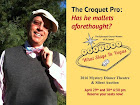
What Slays in Vegas: Mystery Dinner Theatre
by and for Episcopalians

Director/Author’s Note for the Program of What Slays in Vegas
Talk about gambling!  Six years ago, St. James’ Episcopal Church Women bet their biggest fund-raiser on my assurance that amateurs could create a murder – mystery – comedy from foibles in our own church and community.  It worked once, and again two years later.

But every writer fears that the lucky streak will end.  When the actors for tonight’s show met with me in August, we had little to work with, aside from  Suzanne Swann’s notion that the choir might get a gig in Las Vegas.  We had news of spats over sports arenas going up around Atlanta. We had closings of venerable theatres in Marietta.  We had an actress from Brooklyn.

That was enough.    The actors anted up, placing on the table their characters’ backgrounds, hopes, and reactions to anyone who gets in the way.   From those we built a play up to the discovery of the body.  We unanimously elected DeeGee Reisinger “victim” for the third time.  (Congratulations, DeeGee!)   In December, actors fanned out across the campus looking for clues:  during the time of the crime, who saw whom, doing what?  We figured out “whodunit” and finished the script just in time for rehearsals in March.

The ladies of the ECW have indulged our every whim, turning the Parish Hall into a casino, obtaining a sound system, getting us a great technical director in Bill Eubanks.  It’s been my pleasure to work with these characters, and with the actors who created them.  Whatever happens tonight, I know I’ve hit the jackpot.

See my photo collage of the show. 

Promotional Slides for the Show
Synopsis of What Slays in Vegas
It’s casino night at St. Martin’s-by-the-Chicken to fund the choir’s trip to Las Vegas. But an ex-chorister crashes the party to promote sale of the church to build a sports arena. Minutes later, she’s pegged through the heart with a croquet mallet. Who did it? Her resentful boy toy? His jealous ex? The diva? The socialite? The domineering Verger? The scheming former flower child? The Yankee with a sketchy past? When police are detained, it’s up to the Kindergarten teacher, with audience help, to discover whodunit!
  
Is there a conflict between Christian mission and doing comedies based on murder?
Links to more in-depth reflections on the previous two plays:
Church and Theatre: Laughing Matters?
Mystery Dinner Theatre for Episcopalians: Post-Mortem.


Photos by Kevin Triebsch, from top:
Trio sings "Onward Christian Soldiers" in my Las Vegas arrangement, l-r Tonya Grimmke, Mary Nimsgern, Suzanne Swann, and, barely visible, understudy Deb Kemp.

Scott Smoot as "Percival Darcy III" discovering his old 7th grade girl friend.

DeeGee Reisinger as "Gabby Krueger, real estate developer."


Mother and daughter Tonya and Emma Grimmke before the show posed in character as "Addie Haden" the choir-and-kitchen director and "Duh" the teen volunteer.  Decorations provided by the Episcopal Church Women of St. James' Marietta.

Mary Nimsgern as "Marilyn DuVain Gross," enacting a speech from her one-woman musical about Queen Elizabeth I, "Hello Raleigh."

The role of "Serena Nightingale" was created four years ago by Leslie Thompson, and reprised triumphantly on Friday.  Leslie fell ill on Saturday, and theatre student Deb Kemp took on the role with fifty minutes' notice, reading from the script and sight-singing the trio.

Sunday, April 24, 2016

Mahler Wins Teen Night at ASO

Whose idea was it to fill Atlanta's Woodruff Arts Center with teens on a night that featured just one 90-minute long work without words, without pop tunes, without even a slide show?  Genius!

From row "C," close enough to see a violist's socks slide inches below his pants' cuff, I appreciated how Mahler tamed a restless crowd in a bad situation.  Conductor Donald Runnicles waited until the coughing died down to begin Mahler's 9th, so quiet at the start that I had to lean in to hear.   Then from the percussion corner of the orchestra arose an assertive melodic motif, played by a cross between a honky-tonk piano and a zither -- a cimbalon, maybe? -- immediately answered by low strings on the opposite side of the stage.  I might forget the tune among so much of the music that followed, but that wide-spaced dialogue of sounds, though a little different each time, held the first movement together through wide swings of mood.

In the pause before the second movement, we heard the traditional coughing, more than usual.  That begat more coughing, and giggles from the teen gallery down to the stage, where players looked up at the house and smiled and exchanged wise-cracks with the conductor.  Then Mahler threw us dance music, fast and light, interrupted by a rougher dance tune played with percussive force by violists, interrupted again by a ruder, faster dance.  This pile-up was funny and a little delirious.

I should mention that Mahler gave us a spectacle, rows of musicians bowing furiously, furrowing brows in concentration, then sitting still while a single instrument played a melody.

Again, at the end of the second movement, there were coughs; then came a louder, faster, more chaotic third movement, called "sardonic" in the program.  That shut us up:  Not a sound at its end.

The fourth movement seems to end several times, but melody arises yet again, like a sigh, from different areas of the orchestra -- the first cello's melody was especially pleasing -- until we perceive that just about every one of the hundred-plus musicians may get a solo turn. But the audience was patient:  I stayed awake, and didn't need to resort to the cough drops in my pocket.

The very quiet music faded to nothing.  Conductor Donald Runnicles held his hands up in long silence. When he dropped them, the crowd erupted in applause.

The program tells us that Mahler was haunted by death, especially in this ninth.  No argument; but "death" was not what I heard.  Having the symphony wash over us was like watching a movie, though it required more concentration.  I didn't know the story, or the characters, but I felt as though I was going to different places, experiencing extremes of emotion and drama, and, in the end, it was all beautiful.

I'm naturally reminded of another crowd pleaser, Prince.  This week of his unexpected death, many commentators referenced his SuperBowl performance in 2005 for his ability to generate excitement.  Garrison Keillor, in his tribute, told us that the producers called Prince ahead of the game to warn him, "It's raining."  Prince replied, "Can you make it rain harder?"  Yet this guy stayed largely private his whole career, while cultivating a mystique wrapped in androgyny, eroticism, religion, mixed race parentage.

Mahler's fascination with songs of death is his mystique; he knows how to tease the audience, how to build variety and contrast into his vast symphonies; and he doesn't settle for rain - he makes it rain harder.

Saturday, April 23, 2016

Ten Years of this Blog: Progress?

Ten years from the week when I first posted to this blog, what should I conclude from the fact that the concerns I wrote about then are the same as my concerns today?  Aren't we supposed to progress on the road of life?  Maybe that's a bad metaphor.

This blog, at first, was to be a place for spontaneous notes, like a journal.  As soon as Blogger showed me that seekers across the globe at least glanced at my stuff, I put more time into it. But then I felt guilty for the time I spent in this space, remembering that John Updike eschewed journaling because it uses up life material that should go into something productive, i.e., publishable.

Eventually, I realized:  this blog is my garden.  It's a narrow plot, where I return weekly to weed out errors and to tend to subjects of perennial interest to me:  Episcopalianism, Updike, mysteries, and Stephen Sondheim.

While I've tended this garden over ten years, much has changed:  I lost Uncle Jack Maier in 2005; leafing through the hardback collections of my blogposts, I find references to the passing of all the grownups of my youth:  Aunt Harriet, Aunt Blanche, Uncle Jack Smoot, and Dad; only Mom and her cousin Pat remain.  In 2006, my dogs Luis and Bo were vigorous companions, now gone. In 2006, I was riding my bike nearly every day from May to August, averaging 18 m.p.h.;  last summer, I averaged something under 15 m.p.h.   

But I'm in the same house, weighing about the same, looking about the same.  My car still travels the same routes all week, from home to church (choir, worship, meetings) or to school. (Since 2012, I've added Mom's retirement community, but it's on my way to town.) My salary has barely budged since 2006.  Back then, the US was enmeshed in two wars, and I'd never felt politics to be so vicious; now we're still not not enmeshed, and political discourse has reached a new low.  I'm still listening to NPR, enjoying the Atlanta Symphony and occasional plays.

In my teaching, I'd say 90% of my time with students is as fun as ever, interacting  with them over literature (historical texts, then; fiction and poetry now; scripts, always).  There's always that problematic 10%, and I'm just as surprised today as I was the first year I taught when students don't want what I offer.

And on this tenth anniversary of my first blog post, when I sat to write about a wonderful short essay that had just made me laugh and cry, that essay turns out to deal with essentially the same topic as the first one ten years ago, in which I responded to a preacher who boasted that his church was true to God because he treats the Resurrection as a "fact," not a metaphor (link).

The essay that I read this week was by Rabbi Bradley Hirschfield. He tells of a taxi driver, ex-stoner and gung-ho evangelical Christian, who peppers him with questions about Jesus. When the Rabbi explains his belief that Jesus was one of history's greatest human beings and teachers, the cabby asks how the Rabbi can have such respect for Jesus without believing Jesus is God. The Rabbi surprises himself with a neat formulation: "You don't have to be wrong for me to be right."  The cabby swerves off the road in his excitement.  Then he asks what to do about his wife, a non-believer who has stuck with him through years of rehab and turmoil; his pastor has told him to leave her if she won't accept Christ.  The Rabbi essentially repeats his earlier answer: both wife and faith are a blessing; the man should not give up either one.  The story ends in a tearful bear hug.

It's a beautiful story that illustrates a quote from Rumi (via Coleman Barks) used as epigraph for an essay in My Neighbor's Faith: "Out beyond ideas of wrong-doing and right-doing,/ there is a field. / I'll meet you there" (228). (see more about My Neighbor's Faith.)

My earliest essay in this blog looks for that field, too:  Whether Jesus's resurrection is a hard historical fact or something else, it's all in the realm of literature and imagination, now.  What we do with the story, how it colors our responses to our world: these are what matter.

So, am I stuck in a rut on the road to life?  I prefer to think that I'm like my friend Bill L., who has worked the same property for years, building a house and then tending a garden.  Flowers and shrubbery come up, some die, some overcrowd the others, and he re-works that plot.

I'm working this plot of cyber-space, responding to literature, belletristic and otherwise.  I enjoy the writing; I enjoy knowing when others have seen what I do; I enjoy weeding out awkward phrases and mistakes when I catch them in old postings; but I most of all enjoy going back to read things I wrote long ago that strike me as fresh, even now (see personal bests).

So, should I be concerned that I see repetition in my blog over ten years?  Our Episcopal Church itself arranges time in recursive events, readings, and processes.  John Updike returned to his childhood experiences from first story to last poem, always finding life in them.  Stephen Sondheim's collaborators have pushed him in very different directions, but his music for each show builds on a restricted set of motifs.  Layers of memory and intra-volume references are part of what make Wendell Berry's novels wonderful, all concerned with the denizens of one rural Kentucky town.

There's nothing wrong with enjoying perennials.

Source
Bradley Hirschfield, "Finding Faith on the Road: Where Deep Commitment and Genuine Openness Meet."  In  My Neighbor's Faith: Stories of Interreligious Encounter, Growth, and Transformation.  Edited by Jennifer Howe Peace, et.al.   Maryknoll, New York: Orbis Books, 2013. 

Friday, April 08, 2016

My Neighbor's Faith: NPR's Theology?

A rabbi, a preacher, a Hindu, a Muslim, and a feminist respond to a writing prompt.

It's not a joke, but the premise behind My Neighbor's Faith: Stories of Interreligious Encounter, Growth, and Transformation, edited by Jennifer Howe Peace, Or N. Rose, and Gregory Mobley (Maryknoll, NY: Orbis Books, 2012).  The book is part of the curriculum for Education for Ministry (EfM) out of the School of Theology at The University of the South, Sewanee, an Episcopal seminary.  Around fifty short essays tell of faith discovered, challenged, or reinvigorated by encounters between traditions.  

The thing is, I hear stories of such encounters every day on NPR, where voices represent a wide range of religious / political / cultural views, mediated by erudite, respectful, curious correspondents.  I find myself wondering, so long as we have NPR, who needs Church? 
  
NPR's theology
While I settled in to read the book, I was listening to NPR's Morning Edition Sunday.  In just the space of a few minutes, I heard a Republican office-holder in Wisconsin who sees "no good" in the Trump campaign, regardless of Trump's drawing voters to the party, because of the candidate's lack of respect for others.   A gay businessman in North Carolina deplored the state's new "bathroom" law for what it says to any LGBTQ fifteen-year-old, who may even hear parents approve the law; yet the businessman has determined not to follow other businesses out of the state, but to remain a sign of hope for that hypothetical kid. 

During a break in the program, we heard that NPR is sponsored in part by the Gates Foundation, its tagline a precis of this statement from the Gates website:
We seek to unlock the possibility inside every individual.  We see equal value in all lives. And so we are dedicated to improving the quality of life for individuals around the world. From the education of students in Chicago, to the health of a young mother in Nigeria, we are catalysts of human promise everywhere. (www.gatesfoundation.org)
The rest of the day, I heard Gates' values resonating in programs about the arts, politics, stories of individuals with tough problems, Krista Tippett's On Being,  and Back Story's survey of the influence of local political networks on the history of the USA.  As one expects with NPR, within 24 hours, I also heard a Trump supporter, and the sponsor of Georgia's own version of North Carolina's law, who commended his interviewers for always treating him fairly. 

This bedrock assertion of every individual's equal value derives from the same stream of thought as the self-evident truth that all men are created equal, endowed by their Creator with inalienable rights to life, liberty, and "the pursuit of happiness."  As our founding document proclaims that any government that becomes destructive to these ends must be abolished, Gates and NPR work to clear away impediments to good health, education, and fair participation in the community's economy and governance.

Of course, this secular faith in the worth of the individual derives from a thread running through the major religious traditions.  One of the essayists in My Neighbor's Faith cites the Tibetan saying that "everyone was once your mother" and the Jewish story of Adam and Eve as expressions of the same idea that we all are interconnected and worthy of respect (Kamenetz 189-190).  But the idea, self-evident, no longer needs religious scaffolding. 

So, what value does faith add?
The first half of My Neighbor's Faith is about learning to see adherents of other traditions as dignified, respectable, honorable individuals, as NPR does just in the way its hosts ask questions.  The book's second half reaches towards an answer to my question. "What does faith add?"

The closest direct answer comes in an essay by the son of Baptist preacher whose family befriended their neighbor the Rabbi and his family.   Later studying at a secular, lefty college during the secular, lefty late 60s, author S. Mark Heim found "allies" in classmates of any religious tradition: "History was choosing sides," he writes, "and we had chosen the losing one" (193).  His few curricular encounters with religious writers, regardless of tradition, were "precious evidence that intimations of transcendence and the integration of faith and reason were matters worthy to occupy the wise."  Then he writes:

On the great moral challenges of the antiwar and civil rights movements, the churches...seemed like weak and hesitant echoes to the vibrant campus consensus [but] as I struggled to make my own decisions... it was religious convictions that finally counted.... [I observed] a steadied endurance to the engagement of many religious people I knew that contrasted dramatically with antiwar passions that evaporated with a low draft number.

Heim became a student of religious pluralism, and wrote a book that "seems now embarrassingly backwards" because it "treated religions in terms of ideas" (194).  The remainder of his essay tells of a breakthrough experience of moksha or "release" from self.  "But I was not sad to see [the experience] end" and "it was not...a vision with a moral."  He concludes "that behind each tradition in principle there lies something of this same order of otherness and wonder" (196).

The "morals" and the "ideas" of religions are what overlap with NPR and all humane entities; what faith seems to add is power.   It was a staying power that Heim observed.  A Rabbi, co-author with an evangelical Protestant, writes,  "Faith for me is not a confidence that Something Really Nice will happen later, because Someone I can't see is taking care of things.  It is about finding the ability to give love now, in this life," something he and his friend have both found in taking care of severely handicapped daughters (Gottlieb and Leonard 90).

The source of power may be "a generalized sense of a meaningful and life-affirming connection to a transcendent reality" (95), writes Jeffery D. Long, a "born-again Hindu" raised Catholic (98).

The Episcopal Book of Common Prayer would tell us that the faithful are empowered by an actual Spirit bestowed by that Transcendent Reality, not from a mere "sense" of connection. Some of these essays do tell of mysterious or mystical moments when the authors felt or witnessed something outside the physical world.  Besides Heim's moksha, Ruben L. F. Habito writes of a similar breakthrough in "A Christian Confronts a Zen Koan" (165); and Roger Kamenetz, an American Jew, gives us a "shaggy dog story" about his dog Taxi, so taken with the teachings of a visiting guru that he runs away after his new teacher, and, months later, follows him into death -- presumably to be reborn with him to pursue their dharma together (191).

I can see that power -- for good, and for evil -- comes from identity, the feeling that one belongs to a defined community, that one "stands" for the people of that community.  The word doesn't come up much in these essays, though Paul Raushenbush, a Christian preacher, writes of pride in his family's Jewish identity, stronger than doctrine: "To put it bluntly [about afterlife]: if I can't hang with my Jewish cousins up in heaven, then it doesn't sound much like heaven to me" (108).   A Jewish woman who has always seen herself as an outsider in US society is shocked when Black classmates see her as an insider who can "pass" for White anytime, while they "always carry their black identity with them front and center" (Boys 141).    

Narrative gives power to ideas.  While one can haggle with one's conscience over an idea -- "What exactly does justice mean in this instance?" -- it's harder to argue with the vivid parable of the Good Samaritan or the example of Jesus stepping between a woman accused of adultery and the mob intent on stoning her.  In My Neighbor's Faith, an Episcopal priest tells of a Sikh peacemaker motivated by Jesus (Gibbs 180).  A Lakota man finds a way out of hatred of Whites and his substance abuse through the story of Jesus' life, though he refuses to choose the RSV, NRSV, KJV, NIV, CEV, or NKJV, or to accept that "to become a new creation" must mean "to become white" (Twilly 161).  Two essayists give credit for life-changing decisions to Prince Arjuna's story in the Bagavad - Gita, how he hesitates to launch a battle that can have no good outcome (Long 93, Makransky 197).

One essayist sees power in the "discipline" of ritual.  This is a Muslim, familiar with the act of prostration, stunned to see Orthodox Christians bend themselves in the same way (Ziad 117).  He relates the "pain" of bodily discipline to Mary's pain in childbirth, giving us words by Rumi: "The body is like Mary. /  Each of us has a Jesus, but so long as no pain appears, our Jesus is not born."  The author continues, "all ritual is imitation," a way into prayer and unity with God.

Conclusions
Where My Neighbor's Faith might be seen to be blurring boundaries, our clergy may be seen as defining the lines more distinctly.   Fr. Roger Allen and Fr. Daron Vroon have led a series of talks and sermons around such questions as, "Why Christian?  Why Episcopalian?" But I don't see their teachings as rejection of other churches, only as an extension of their ideas expressed often, that there's transformative power in regular prayer and communion, living into our Baptismal covenant, living in community, all beyond the ideas of right beliefs.

During our EfM seminar meetings, we have often heard each other attest to the power of liturgy to comfort or move us, and we've told stories of how memories from these words and rites have motivated us at critical moments in our lives.

Having read most of My Neighbor's Faith, I can stand with that Protestant preacher Bill Leonard, who writes that he and his friend the Rabbi are  "both people of faith, at times coloring outside the canons of our respective Jewish and Christian traditions, but stuck with and in them nonetheless" (89).

That sounds right to me, "stuck" as I am "with and in" the traditions of the Episcopal Church.  When I doubt myself, or my path, when I'm most vulnerable, even the most reasonable voices of NPR vex me with news of strife and intractable problems.  I turn off the radio, and go to my "go to" sources -- the prayer book, the music, the writers, the Bible, the Church itself.

Saturday, March 26, 2016

An Especially Good Friday

Not even sky-high pollen counts could keep this Episcopalian away from Good Friday services.  St. James', Marietta, GA did it right:  nave stripped of candles, vestments, and cushions; silent prayers and somber readings from Isaiah and John; slow procession with a human-sized cross during recitation of the reproaches; chanting of tunes, from ancient tones to the rich spiritual that asks "Were you there?" with the answer implied: "It causes me to tremble."  We left in darkness, our tower bell tolling thirty three times for Jesus.


Yet every Good Friday for me is a return to what I experienced at St. James' in Jackson, Mississippi, in 1982.   [Photo; Good Friday, St. James' Jackson] To borrow an image from an Anglican novel I read at the time, Robertson Davies' The Rebel Angels, the Episcopal church "is not a river to be fished, it's an ocean in which to bathe, and give [ourselves] up to the tides and currents" (Davies 62).

Davies' character was talking about a university education, but I can identify with the idea of full immersion Episcopalianism.  That's what I experienced for the first time that Good Friday.

Since Palm Sunday, I'd been at church nearly every day for a week by the time Good Friday came around. Singing in the choir, I was stunned to silence by our rector Charles Kiblinger's tight-lipped efficiency stripping the altar at the end of the Maundy Thursday service.  For the next day's noon service, two upper-middle-aged tenors McCarrell Ayers and Joe Powell, Sr. took turns singing the words of the Lord in Vittoria's setting of the Reproaches:
I did open the sea before thee: and thou has opened my side with a spear.... I did give thee to drink the water of life from the rock: and thou has given me to drink but gall and vinegar....  I did raise thee on high with great power: and thou has hanged me upon the gibbet of the Cross.
We sang the refrain, "O My people, what have I done unto thee?  Or wherein have I wearied thee? Testify against me," and, in Greek, "have mercy on us." I remember the soloists' distinctive voices to this day, with the emotion of that Renaissance piece.

Joe and his wife Linda invited me after the service to a restaurant at "The Quarter," several cuts above the usual fast food I could afford in those days early in my teaching career.  While we laughed and had serious conversation with our wine, outside were torrential rain, black sky, and thunder that shook the skylight.  I'd taught the Powells' daughter Emily, and I sang with Joe in choir; but my parents were hundreds of miles away, and the Powells took care of me for years.  Joe got me involved in Education for Ministry, a four-year theology extension program of The University of the South; Linda broadened my idea of "religious" literature to include Davies, Updike, and agnostic Iris Murdoch.  Linda covered her refrigerator with cartoons and quips, including one to the effect that true evangelism is to live one's life in such a way that anyone seeing you must believe in miracles.  Linda's own family wrote about her better than I could do in their tribute after her death in 2013:
She will be remembered for her formidable intellect, wit, and devotion. She lived her faith by being part of the daily life of so many people over the course of her 80 years, making each of those lives richer and better. Friends will miss a seat at her table with a full pot of tea, a view of the tranquil setting of her home she tended so lovingly, and her, perched eagerly waiting to listen with care and good counsel. (See more at: http://www.legacy.com/obituaries/clarionledger)
Neither Joe nor Linda, nor the rector, nor anyone else I knew well at St. James' had been "cradle Episcopalians."  This was a peculiarity of the church in Jackson, where Bishop Duncan Grey Sr. had made a stand against racial segregation long before the rest of the state was forced to fall in line.  Joe and Linda, along with my principal Dorothy Kitchings, had lent their names to a public letter against segregation; for their stand, Joe and Linda had literally been kicked down the stairs of their Methodist church. 

The Powells, always challenging but never judgmental, showed me first, and best, that being religious didn't have to do with correct belief.

Now, thirty-four years later, the Episcopal church is for me a presence the way ocean is for a coastal town.  No, I don't go "fishing" for particular doctrines or beliefs.  Rather, the church envelops my life with music grown familiar over decades, stories continued day by day across the years, beliefs enacted in rituals week-by-week, liturgical seasons, fiction and essays growing out of the tradition, and, always present in memory as an ocean's waves are present in sound, the Powells' hospitality.  

Sources
Davies, Robertson.  The Rebel Angels.  New York: Viking Press, 1981.  See my other blogposts about Robertson Davies' works.

St. James' Episcopal Church. Facebook page. 

Saturday, March 19, 2016

Robertson Davies' "What's Bred in the Bone"
Still Works Alchemy

Robertson Davies said that he wrote his novel What's Bred in the Bone to explore questions raised by a true crime, when some Vermeer masterpieces turned out to be the work of a clever faker.

Completing an apprenticeship to a restorer of ancient paintings, Davies' fictional forger Arthur Cornish paints an original triptych in 16th-century manner, marrying all the opposing forces of his life story with his depiction of "The Marriage at Cana." Art experts, stumped by this apparently ancient painting in original style, call its anonymous artist "the Alchemical Master." How close they are to the truth, for Cornish has melded much that was sad and painful into something beautiful, lead into gold.

Davies poses an interesting question through a different art forger. When critics who had loved the forgery turn on him and declare the work worthless, the forger asks, "What delighted you? The magic of a great name? The magic of the past?  Or was it the picture before your eyes?" (353)   Beyond the aesthetic question, there's an interesting religious and psychological angle on the story, that Cornish has drawn on mythologies of the past (alchemy, Christian images) to construct a "personal myth" from the elements of his own life.

Decades after reading the book, I remember the motto inscribed on a banner across the top of this painting: Thou hast saved the good wine for now. Davies himself had his sweetest successes at the end of his career. Looking at retirement, now, I'm clinging to that idea. See also a reflection I wrote on the same theme, You have kept the good wine till now (02/2015).


Thirty years after I first read Cornish's story, the wonder of the novel What's Bred in the Bone still is this imaginary painting, focus of all Robertson Davies' far-flung, even outrageous, plot lines.  Now, as then, I'm fascinated by the way that Davies collected notes about anything that struck his fancy, composing novels in triptychs when the note cards reached a critical mass. As it happens, on this day when I'm thinking how such a confluence of ideas is itself such a great pleasure and uplifter of spirits, I've experienced a confluence of stories through the modern medium of network radio.                           
First, I heard striking stories on the podcast Snap Judgement, episode 706 "Man in the Mirror."  A soprano begins an audio diary at the start of hormone treatments for gender-reassignment, and the voice we first hear singing "Can you hear me?"  deepens through a rough patch of huskiness and voice breaks, until we have a satisfying, lovely duet of the woman's voice and the man's, an octave apart.   

Then, a Brooklyn storyteller sets a different scene:  one "Joe" in his flannel and workboots drinking Bud at 10 a.m., one self-satisfied college-educated storyteller working the bar in her family's establishment, and a hapless Chinese food delivery man who overcharges her; she cringes when "Joe" gets involved, only to hear him speak calmly, slowly, in Chinese.  The story flips her expectations (and ours).  

The program ended with a fiction about a virtual orphan caring for her younger sisters at the time of the London Blitz, the stained glass window placed in their care by the local church, and the apparition of a figure from that window, a guardian Man of Glass. 

The next program brought us actor/sleight-of-hand artist Ricky Jay telling about the subject of his new historical book, Matthias Buchinger: The Greatest German Living.  A little over twenty-four inches tall, born without hands or feet, this late 17th century polymath performed skillful tricks on stage and produced a self portrait comprised of Psalms and the Lord's Prayer in tiny calligraphy, etched backwards for a printing press.  

Both a 16th century dwarf and a picture made from tiny calligraphic lines figure in Davies' story of Francis Cornish.  As a young friend of the small town's mortician, Cornish had sketched the body of a suicide, the town's much-humiliated dwarf.  In a kind of artistic alchemy, he elevates that pathetic man to status of an icon as model for a faux-Renaissance portrait of a court jester.  Cornish also composes a line drawing of the Crucifixion from calligraphic lines from a Gospel passion narrative.

Can I, like Robertson Davies, pull all these strands into a single statement?  Something about the wonder of life might do, or what lies under the surface of our perceptions.  Davies' own idea about alchemy seems to fit all the stories, but, then again, also describes what I believe God to be doing in our world since the earliest days of Scripture.

I'm satisfied, for now, to record the stories for possible use, later. 


Davies, Robertson.  What's Bred in the Bone.  New York:  Elizabeth Sifton Books, Viking, 1985.


Sunday, March 06, 2016

Stefon Harris and Sonic Creed: Jazz Metaphor

From the stage of Atlanta's Spivey Hall last night, Stefon Harris told us "I have to believe in what I'm doing to let it take me away from my wife and son," and that's why he calls his band Sonic Creed.   He'd flown wife and son from Newark for the weekend, to be with Daddy and to celebrate the boy's seventh birthday.  That was by no means the only moment of "awww" in the concert.

Number by number, with a few words between pieces, Harris developed a metaphorical view of what we were seeing. Generous introductions of each musician were part of his message:  Musicians of different generations and backgrounds "problem-solved" every second to redeem "failures" on the fly.  The band included Mike Moreno on guitar, James Francies on piano, Joshua Crumbly on bass, and Jonathan Pinson on drums.

We watched the process of problem-solving as he picked up his mallets at the vibraphone to develop a long improvisation from three notes that we shouted out to him (F, C, Bb).  From those three notes, he launched music pieces in waves, sometimes with a "ha!" or a "huh?!"  Eventually, his band mates got in on the act, and the song morphed into a raucous arrangement of the 1920s standard "Bye Bye Blackbird."

Aside from the beauty of tone that Harris draws from tapping, slamming, and massaging the keys of the vibraphone, Harris's red-topped mallets gave us a way to see how he developed patterns up and down the keyboard.

For an encore, he brought sensitivity and joy to a standard that he says he just learned last year, "I Fall in Love Too Easily," ending on a soft slide of the mallet from one tone to the next, a vibraphone sigh.  Ah!


Tuesday, February 23, 2016

Road Trip to Road Show


Road Show
When the cast recording of Stephen Sondheim and John Weidman's musical Road Show became available, I wrote extensively about its improvement on Bounce, an earlier version of the show that I'd seen in Chicago.  See my reflection here.

Having now seen a production directed by Gary Griffin set in a smokey saloon at Washington / Arlington's Signature Theatre, I can say that the show is a delight from beginning almost to the end.

One pleasure is just what we expect from the Sondheim brand, the polished rhymes, always pointing up something funny, something heartbreaking, something true.  But Sondheim and his collaborators "rhyme" in ways beyond words. At any given moment, a line of dialogue or song resonates with something that we perceive later, and Gary Griffin's staging emphasizes parallels between one decisive moment and another.  There's pleasure simply in perceiving the ingenuity behind the seamless integration of elements.  That was true of Bounce, as well.  

But Road Show gets at the heart, too. The very first song builds to a strong emotional confrontation.  as the ensemble pronounces snide judgement on Addison Mizner's life at the moment of his death: "Waste" of Addison's talent, waste of "the one that [he] loved."  As the Mizner brothers, Josh Lamon (Addison) and Noah Racey (Wilson Mizner), set up the theme of "Brotherly Love" in a charming, believable sung dialogue about a moment when Willy took care of Addie.  Racey made "Wilson" so charming that he seduces us with his personal credo in a song called "The Game," never to settle for what one has but to stake everything on the turn of the next card.  

Much of the joy in this show comes from sharing in Addison's discoveries, first of art, then of love.  These are expressed through music, dialogue, and staging.  The ensemble wordlessly encourages him to envision the kind of wildly eclectic architecture that could encompass a stage full of souvenirs from his failed ventures abroad.  He finds a kindred spirit in young Hollis Bessemer (Matthew Schleigh), and there's joy in the song "You" as admiration and love for each other builds with their business of building mansions for millionaires at Palm Beach.  (Weidman's invention stands out, here, in Addie's exuberantly wacky history behind his eclectic creation, along these lines: "Then the Moors invaded and added a breakfast nook by the pool....")  The song "Best Thing that Ever Happened" is remarkable for many reasons, not least of which is Sondheim's brazen use of just one tone, one rhythmic pattern, and lyrical variations on the title to take the characters through a range of thoughts and feelings.  It builds to a tender moment, very satisfying.  When Hollis joins with Wilson to tempt Addison to give up all they've achieved for an outrageous new venture, "Addison City," we're caught up in the excitement.  

What follows is inevitable, given the true life story of the Mizner brothers, and the pattern set up from the start. It's also a downer.   Sondheim and Weidman couldn't avoid the business fiasco at Boca Raton, but I did feel bafflement at the sudden turn in Addison's relationship with Hollis. I could write an essay to justify it, but nothing about it felt right. 

Road Trip
I'm not big on traveling anymore, but I'm glad I made this exception.  I've been to Washington many times, usually with a busload of middle schoolers, ever since I myself was in 7th grade.  This time, friend Susan and I Ubered past the monuments and toured instead a place that felt like home to us, the NPR national headquarters.  We even exchanged words with critic Bob Mondello about Road Show.  We saw reporter Melissa Block in her office, the "tiny desk" of the eponymous concerts, and the cubicles where reporters prepare those news updates every hour.  

We had a simple lunch at a vast French bistro, empty but for a hundred white-clothed tables, an attentive staff, and us.  We decided it must be a front for the CIA.  At the National Portrait Gallery, we paid homage to old friends whom we know through their words more than through images.

We also ate a lot of fast food.   I was glad to get back to the routine.

[First Photo: Stefan Alexander Kempski (Ensemble), Angela Miller (Ensemble), Noah Racey (Wilson Mizner), Jacob Kidder (Pianist), Bobby Smith (Ensemble), Matthew Schleigh (Ensemble) and Erin Driscoll (Ensemble) in Road Show at Signature Theatre. Photo by Margot Schulman.]

 
[Second Photo: Matthew Schleigh (Hollis Bessemer) and Josh Lamon (Addison Mizner) in ROAD SHOW at Signature Theatre. Photo by Margot Schulman.] 
[Third photo: Yours truly with Henry James, National Portrait Gallery.]

[Fourth photo:  Friend Susan and yours truly in North Carolina, birthplace of Hardee's.]

Wednesday, February 17, 2016

Deep Parody: Coen Brothers' Hail, Caesar

Here's a cheesy metaphor for the wonderful film  Hail Caesar:  It's like lasagna, layer on layer of parodies, personalities, and cultural history, all warmed with faith, hope, and charity melted on top.

Part of the pleasure lies in seeing the layers.  We can imagine Joel and Ethan Coen with buds brainstorming around a table.  So, it's Hollywood, 1951:  What was in the zeitgeist, then?  Gene Kelly musicals, H-Bomb, Esther Williams water ballets, pastel-colored kitchen dramas, Gene Autrey's singing cowboy films, films noir, Red Scare, Biblical epics in Technicolor, actors with fruity accents in highbrow scripts, theologians who were household names, and the H-Bomb.  What if, they must have laughed their heads off, asking,  What if Communists kidnapped the Charlton Heston conservative and brainwashed him?  What if a Priest, a Preacher, an Orthodox Patriarch, and a Rabbi walk into a movie studio?  What if the studio head decides to fill the role of blase blueblood in a highbrow drama with a drawling musical cowboy?  

Holding all these elements together is studio executive "Eddie Mannix," played by Josh Brolin.  He's like the hard-boiled detective with the pure heart.  His unstinting efforts to contain crises bubbling up among the stars of a half-dozen films constitute the action of the movie.  But the story is just one simple choice he has to make, put to him at a lovingly recreated tiki bar by a rep from Lockheed:  Will Mannix take a job that will allow him time to see his wife and children, doing something "serious" for mankind?  "Seriousness" is signified by a photo of an H-Bomb blasting the Bikini Islands to smithereens.  Or will he continue to give heart, soul, and all his days and nights to the frivolous Hollywood film industry, already in decline as TV rises?

For every temptation to join the military-industrial complex,  there's a scene in a confessional booth with an exhausted Priest.  My friend Susan and I have puzzled over the way religious faith and socio-polical idealism emerge as themes in the movie.  The true believers are all comical, and the Biblical epic is ridiculous. Yet Brolin's character takes his faith seriously, the communist stooges make sacrifice for their cause, and we're led to see a speech about "faith" as a sincere moment in the epic (even while we snicker at the "tasteful" presentation of Jesus on the cross).  We don't conclude with some writers that this is some kind of statement about religion, except in the broadest sense of What Really Matters in Life, and that turns out not to be building H-Bombs.


The long-standing rap on the Coens is that they know everything about movies, and nothing about real life.   I feared this movie would leave a sour taste like the last of theirs I saw, another Hollywood parody called Barton Fink.  Instead, Hail, Caesar is relentlessly joyous, exuberant, and sweet.

Sunday, January 10, 2016

Carol's Unpredictable Moments

For all the sumptuous beauty of the settings and costumes of expensive 1951 hotels and bars, my favorite scene in Carol is set among dour suits at a table in a law office.  

Directed by Todd Haynes, based on Patricia Highsmith's novel The Price of Salt, much of the story follows a familiar pattern. 
We've seen Cate Blanchett's "Carol" of the upper-echelon seduce Rooney Mara's young "Therese" from her Bohemian life, and conflict when the husband stumbles on his wife with the younger woman. Once the story gets going, it all seems pretty inevitable.  We guess that some kind of drastic, punishing repercussion will follow the consummation of their relationship.

But as my friend Susan said, "When they sat down with the lawyers to argue over custody of the daughter, I had no idea what was going to happen." The eloquence and simplicity of "Carol's" plea is unexpected and memorable.  "It's going to get ugly," Carol warns, "and we're not ugly people."

I was intrigued by another scene that seemed to serve no purpose in the film. Briefly, we see Therese with pals in a theatre's projection room, all watching Sunset Boulevard.  The scene has no bearing on plot or character development, leaving me to wonder if we're seeing a clue to the director's thinking: does he see his film as analogous to the earlier one?  Is "Carol" a predatory older woman, like "Norma Desmond?"  Commenting on the film, Therese's friend is keeping score of times when the dialogue covers up what the characters really think. Is this a sort of directorial watermark, highlighting for us the Pinter-esque brevity and obliqueness of the dialogue?

A Look Back through
Forward Day by Day May-July 2015

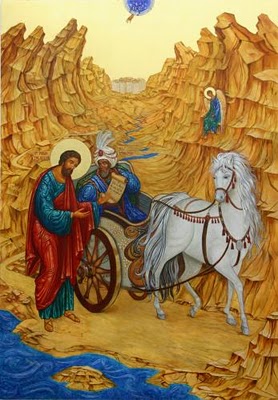
[Picture: Philip and the Ethiopian. see July2]
The periodical pamphlet Forward Day by Day (www.forwardmovement.org) has been a part of my morning routine for decades, more than ever these past few years, giving us a short reflection on Scripture from the daily readings assigned in the Book of Common Prayer. A different author handles each month.  From all the good reminders, a few readings strike me for aptness or unusual insight, and those I'll summarize below.

May 1, 2015, John 14:13 I will do whatever you ask in my name. The commentator for May, Richard H. Schmidt, points out that what's done "in a person's name" is done as that person's agent; so, this isn't a promise that we can use God's name as a magical incantation. Rather, we're promised whatever we ask when doing God's work.  Forget about praying for touchdowns.

May 12, Deut. 8:17 Do not say to yourself, "My power and the might of my own hand have gotten me this wealth."  "The self-made man is a spiritually dangerous myth, as is the myth of the self-made country... We are blessed ... to serve as divine agents of the world" who are called to do three things: give, give, give.

May 13. Luke 12:22ff Can any of you by worrying add a single hour to your span of life? What we worry about is not so important; helping someone else takes our minds off worry; we can trust a God who "has a long history of bringing good out of evil, victory out of defeat...."

May 18-19. Luke 9:62 No one who puts a hand to the plow and looks back is fit for the kingdom of God.  Churches that look backward to see if they have more people, more money, are looking at the wrong things, instead of asking, "How are you expressing your faith in your community?  Are you focused on others or on yourselves?... Do people experience joy when they worship with you?"  In personal life, the author gives me advice I need badly: "It does little good to go back and relive the times we've been attacked."  I like to do that, to imagine telling off so-and-so.  My heart rate goes up, and I get vindictive.  Bad idea!

May 21. Luke 10:29 And who is my neighbor? In the Good Samaritan story, both of the main characters are Jesus.

July 2. Acts 8:27 So he got up and went.  At the urging of an angel, Philip leaves town, evangelizes an Ethiopian eunuch -- high in worldly status, anathema to Jews -- and gets teleported.  The commentator for July, Penny Nash, concludes, "Obedience, it seems, leads to bravery...."  

July 3. Acts 9:5  I am Jesus, whom you are persecuting.  Having built his reputation on opposition to Jesus, Paul falls flat on his face before Him.  Nash writes, "Paul and I have had some serious fights...[but] Paul and I find solidarity in our most humiliating moments."  She writes, "I know what it's like to feel like everything I'd... been righteously indignant and zealous over is ultimately harmful...."  I can second that emotion.

July 10. Acts 10:48. He ordered them to be baptized.  Peter's baptism of gentiles "would have the liturgical wonks, formation directors, the altar guild, and the rector squirming...." Rules, writes Nash, "protect us, make us feel good, and keep our dividing lines nice and tidy."  But Peter "refuses to leave [the crowd] hungry and thirsty and broken.  And thanks be to God for that."

July 13. For Nash, reading Mark's gospel is like listening to seventh graders. "The stories are short on detail, but tall on drama.  Everyone, everywhere, all of the people -- Mark speaks to us with such ardent and terse language.  I can almost hear my students telling me about something amazing that can't wait one more minute."  So we should be telling our good news "to everyone everywhere ... like right now." 

July 20. 1 Samuel 24:13 My hand shall not be against you.  "Saul mistakes David's meekness, his mercy and kindness, for weakness.... A thousand years later, Jesus, understanding the profound and life-changing energy of the meek, proclaims they will inherit the earth."  But "meekness, like grace, is hard to define."  Nash says it's not running up the score, "and it's not sitting in the dirt crying when you've lost by over a hundred points."  It's doing your best and "not slinking off to pack up your entire desk every time someone gives you a bit of constructive criticism."  Good message for me and for my students.

Thursday, December 31, 2015

Luis, Rest in Peace

A year ago, I wrote "Trying to Catch My Old Dog Luis," guessing that the day was coming soon when he would stop being the happy, grateful little dog he's always been since at least 2002, and I would have the vet put him to sleep.   I included many photos from our life together.

More recently, I wrote about the soul or anima of an animal, with descriptions of how desires and pleasures animate my younger dog Mia.   But I was thinking how tired Luis's anima had grown.  (See "Mia's Anima, A Dog's Soul.")


This holiday, even as I write this, Luis has often wandered listlessly, moaning, pausing at the waterdish and not drinking, turning away from food, pausing at the door, but not staying to go out.  Even when I pet him, though he will reach up and lick me once, or lean his face into my palm, he seems distracted and a little anxious -- I suppose because of aches that the pain medicine hasn't helped.
  
It's time.  Here are some recent pictures that show what a happy, contented, affectionate dog he can still be, at moments ever fewer and farther between.

PS - Thank you to friends Susan and Suzanne who went with me to the vet.  They have each cared for Luis over the years.  While we waited, he cycled among the three of us for affection everywhere he turned. 


Wednesday, December 30, 2015

Stoppard's The Hard Problem:
Dramatizing Thought

[Photo: Original production at London's National Theatre, with Damien Molony and Olivi Vinall, from theGuardian.com]

Tom Stoppard early in his career claimed to write plays because they provide a respectable forum to argue with himself.  He argues in his latest script The Hard Problem that both altruism and consciousness itself can be explained by evolutionary biology. Or not.  Though Stoppard argues the heck out of both sides, I'm not sure who wins.

But, reading the script, I noted with pleasure how Stoppard found dramatic situations to fit the thoughts. In drama class, I urge my kids to find ways to do what Stoppard does so well, to make thoughts visible. Like rhyme in essays by Pope and Auden, patterns of images can substitute for developments of substance, and, besides, they are a pleasure in themselves.

For example, there's a visual motif of kneeling in prayer.  We see the protagonist Hilary kneeling at her bed (8).  It's a sign of her belief, her hope, and also her guilt for something revealed shortly after.  The image of kneeling at prayer is repeated (46), then echoed in a scene at a Venice hotel room, where the concluding stage direction reads, "He [Spike, her materialist friend] pauses to listen, kneeling in the light from the minibar" (53). Her final prayer is just "Thank you," spoken aloud, to no one (72).  


The image of mother-and-child works into the fabric of the play's rhetoric and plotline.  Hilary alludes to the bereaved mother who breast-feeds a starving man in The Grapes of Wrath (6), and Hilary's debate partner Spike renames Raphael's Madonna and Child  as "Woman Maximizing Gene Survival" (13).  Spike says the universe is "no baby, just bathwater" (10), not bothering to reiterate for Hilary, or for Stoppard's audience, the whole argument behind the allusion. (Later, Hilary says there is nothing under science to explain the lowly gene's conviction that "life has a value" so "it's tortoises all the way down," oblique allusion to more than one myth.)   In all this banter about motherhood, Hilary inexplicably begins to cry (15).  We soon learn that she gave up her baby Catherine to adoption.  By coincidence, her wealthy employer has an adopted daughter of the same age and name, who first appears on stage asking her father, "What's 'coincidence?'" (26).

Another kind of repeated "image" is that of the psychological simulations or "problems" that deal with altruism.  First, there's discussion of a classic psychology simulation, "the Prisoner's Dilemma." Stoppard assumes we know it.  Later, as I guessed he would do, Stoppard makes the hypothetical dilemma into action on stage, when the protagonist Hilary is offered the chance to evade consequences of her collaborator's malfeasance (70).  Hilary also alludes to a psychological study called "the custody problem," for which subjects decide who should get custody of a child if one parent is average but dependable while the other is wealthy but erratic (37), the very situation we see.

Alongside the argument about the brain as a mechanism that either does or does not "cause" consciousness, we have analogs represented by characters in the play.  Market analyst Amal sees traders operating as one self-interested "mind," predictable by computer models, except when the market acts "stupid" (33, 68).  Hilary's nemesis Spike writes a paper about hormones affecting risk-taking behavior among gamblers and stock traders (56).

I enjoyed the play from start to finish, feeling sympathy for Hilary, and amusement at dialogue.  Variety's critic Matt Trueman was less amused seeing the original production at the National Theatre of London, but his analysis can't be faulted:
There’s no denying the richness of these ideas, jostling up to one another in myriad ways, but that’s the measure of good thinking, not good theater.   In a play that invokes emotion throughout, emotion is still hard to come by. Stoppard’s characters aren’t people, so much as opposing viewpoints with jobs and characteristics attached. (1/29/2015)
Trueman points to another theme in the play that I missed, how all of these experimenter / theorists  to some extent allow bias to determine their results, especially by discounting the "outliers" in the data.  In his view, Stoppard's shaping the story to fit the thought is tantamount to twisting the data to suit one's predisposition.

Still, Stoppard provides his actors with great text to say and lots of subtext to play. An old friend catches up with Hilary, and hears about the adoption. "So everything turned out all right. I'm sorry" (20).  A lot of perception and feeling happen between "all right" and "sorry."   I love the observation (concerning mice brains) "It's only amazing, not counter-intuitive": score for the materialists (36).

The end of the play is silent business of packing up personal items.  Is this emotionally satisfying?  Is it somehow a solution to the problem?  I'm puzzled. I may have to see it to understand Stoppard's thought.

(Read a more general reflection on Stoppard's work, "The Invention of Stoppard.")