Showing posts with label Drama. Show all posts

Thursday, April 07, 2022

Paul's Turn: Pianist Paul Ford Remembers Broadway

Pianist Paul Ford played for countless Broadway musicals and concerts between the 1970s and his retirement a few years ago. He played mostly for auditions and rehearsals, but he also played for the original runs of Stephen Sondheim shows Sunday in the Park with George, Into the Woods, Assassins, and Passion. Before leaving for New York, Paul Ford mentored me during a summer theatre program in Atlanta's Northside School of Performing Arts.

He has published his memoir Lord Knows, at Least I was There: Working with Stephen Sondheim. Foreword by Mandy Patinkin. New York: Moreclacke Publishing, 2022. [Photo Collage: Paul with his book and the Sondheim scores I own thanks to Paul's influence.]

Ford's memoir gives us the backstory to his time at Northside, including a lip-synched production of Oklahoma in his family's garage, his realization that he was gay, and his introduction to alcohol. He admits that he played through most of his career with a hangover, but he's been sober now for many years, thanks in part to a miraculous coincidence involving a haunted house, a film made there, and that film's leading actress. It makes a good story.

There are so many good stories in this memoir that I read it through in a day. He has fond and funny memories of stars whose first names are enough for any Sondheim fan: Ethel, Julie, Mandy, Bernadette, Patti, Donna, Marin, Lonny, Jim, Lauren, and even Madonna. For memories funny but cringey from work with other composers there are Chita and Liza in Kander and Ebb's dismal musical The Rink, and his bête noire Teresa Stratas, opera diva, who assaulted him during a rehearsal for Rags by Charles Strouse and Stephen Schwartz.

My favorite story may be the one about Elaine taking Ford to see a show for which she had no tickets: "I am Elaine Stritch," she thundered at the box office, she wanted seats front row center, and she didn't expect to pay. When he asked if she'd ever been refused, she said, "F***ing Mamma Mia."

Many of the stories are about hi-jinx backstage and during rehearsals, when theatre was fun, Ford says, before everyone retreated to dark corners with their phones to "text, text, text." He tells how he played snippets of songs from the early careers of performers when they entered the rehearsal hall. For Sondheim, he played the disturbing opening bars of Psycho by the composer's favorite film composer Bernard Herrmann.

(When Paul saw me from the pit of Into the Woods in 1987, he warmed up the band with "Georgy Girl," the only sheet music I'd been able to find to fit my narrow range in 9th grade. Throughout that summer program, he embarrassed me with that tacky song whenever he could. I was delighted that he remembered.)

Writers and directors are more of a mixed bag. As often as Ford mentions Sondheim, he thanks him for being a real composer who actually wrote down the notes for his songs and knew what he was doing. Not so, many other so-called composers who left it to Ford and the music director Paul Gemignani to make real songs out of little tunes they hummed into tape recorders. No thanks to many directors who had no musical theatre experience, no musical knowledge, and no clue, who mounted revivals ("revisals," Paul calls them) of musicals with their "improvements."

When the story takes him to the marquee for Cats, Ford pauses for a moment of silence to remember the Broadway musical, killed by Andrew "Void" Webber and his ilk, abetted by the producers who have kept the shows running for generations of tourists. The further into the book we go, the more pointed Paul gets on this subject. So far as I've seen in published reports, Sondheim was diplomatic about Webber, but in one story Sondheim and Ford are waiting in a studio where Phantom star Michael Crawford was recording a song that Paul calls "Muzak of the Night." As Crawford asked to try it again slower, slower, and slower still, Sondheim retreated further behind his newspaper, which trembled -- from laughter.

Sondheim fans know what we're in for when Ford asks rhetorically, "Why did I do it? What did it get me?" In Ford's favorite show Gypsy, those are the questions of the main character Rose in a bitter survey of her disappointments in life, when she declares "now it's gonna be my turn." Like that number, Ford's rant pulls in themes from all the preceding material to indict the current lack of sophistication or joy on Broadway.

But the sun comes out when Paul Ford writes about what he loves:

That is why I like overtures and show music so much. The variety! Film music with its combination of source music and dramatic scoring is equally satisfying. Dance music in films and Broadway shows used to be done with great, if not inspired, imagination. Give some expert arranger a little song and let him go to town on it. I love big band and swing music because of the inventiveness and pure joy and humor in the arrangements. I even love jazz because of its harmonic intricacies (220).

Those are loves he passed on to me. I'm about six years younger, so I was very excited at age 15 to have this sophisticated musical genius pay attention to me during breaks in rehearsals. Knowing that I loved comic books, he gave me a cassette recording to the wonderful 1960s musical It's a Bird, It's a Plane, It's Superman (songs I still know by heart) and xeroxed copies of Bernstein's Overture to Candide which I still have, which I used to be able to play, and the Weill-Gershwin song "The Saga of Jenny" from his then-favorite musical Lady in the Dark. His parting gift to me was to insist that I look into the works of Stephen Sondheim. [For the rest of that story, all five decades of it, see my Sondheim page.]

If Paul gets to read this review, I hope he'll be gratified to know that I emulated him by playing piano for rehearsals and performances for school productions of Into the Woods, Sweeney Todd, Little Shop of Horrors, Damn Yankees, Joseph... and Big, and that I introduced generations of students to Sondheim. Some of them are now directors and teachers, doing the same.

Also, he and I are evidently the only two people alive who treasure the totally-overlooked song "Poems" from Sondheim's much-overlooked Pacific Overtures.

[See earlier tributes to Paul that are integrated with blogposts about Sondheim as teacher and Sondheim's Tribute to Leonard Bernstein.]

Thursday, March 31, 2022

Shakespeare on School Stages

Shakespeare's work is a creative playground for directors and actors.

I wrote that about Joel Coen's The Tragedy of Macbeth (see Macbeth for the Fun of It 01/2022), but it's true at school, too: I write from experience teaching drama in high school and middle school for 40 years.

Shakespeare offers a few advantages to school drama teachers. You have no royalty payments, you can access free scripts online, and you get lots of flexibility to cast roles for everyone in your club or class. With freedom to edit and with centuries' precedents for updates and reinterpretations, you can play to the interests and strengths of your students, whether they're 11 or 17.

Updating the Material

While I cut Shakespeare's scenes short, I never changed any words except the most obscure ones. But my actors and I enjoyed figuring out ways to transplant the stories to other times and locales.
  • Setting Macbeth in the near-future, our 8th grade club made the title character a cyborg. Why? First, because it's cool! Then, making him more metallic as the play progressed was a visual analog for the character's decreasing humanity. We found modern-day analogs for other characters, too. Lady Macbeth was playing tennis at the country club when we first saw her. For her, being queen was all about being a celebrity: that was the young actor's idea. We used the school's big-screen TV to make the witches into TV pundits, and we simulated security camera footage to show the trees of Birnam Forest marching up the hill towards the castle.
  • When we did Taming of the Shrew in the late-80s, Kate dressed like Cyndi Lauper, while her younger sister was the preppie cheerleader. Their music teacher was a country-western guitarist; the Latin teacher was modeled on our school's Latin teacher. Petruchio and his crew resided on a yacht. He arrived at the wedding, late, dressed (underdressed) like Rambo. I should've known better than to trust the 8th grade boys who asked if Jimmy Buffett would be okay for the music at the party scene in the final act. As Petruchio and Kate happily exited to their long-delayed honeymoon, we heard "Why Don't We Get Drunk and Screw?" Well, it certainly did fit the situation.
  • We did two of Shakespeare's most popular comedies as 1920s musicals. That gave a dozen 6th grade girls roles as tap-dancing chorines, and gave student musicians a place on stage in costume to be the jazz combo. I wrote 20s-style music for songs in Midsummer Night's Dream, and made Twelfth Night a jukebox musical of early Gershwin songs. Since I made Duke Orsino a Broadway producer, we called the show First Night. Members of "his" theatre company sang songs that expressed the feelings of the dramatic leads. For instance, when young Viola is feeling helpless and alone, her double the Ingenue sang "Someone to Watch Over Me."
  • Sixth graders did Julius Caesar ca. 1989 in the school library, where we used the library's heavy TV on rollers to show videotape of General Caesar arriving by jet while TV reporter "Flavia Octavia" interviewed his fans at the airport. Then Caesar and his entourage entered in fatigues and sunglasses: the actors loved it. Updating Shakespeare multiplies opportunities for girls to play big roles as soldiers, senators, doctors, reporters, etc.

Even when my students and I didn't update Shakespeare, we did make our interpretations reflective of the young actors' own feelings.
  • When I asked Thomas, a high school senior who had proven himself in many supporting roles, which part he wanted in Twelfth Night, I figured he'd go for one of the comic roles. Instead, he empathized with "Malvolio" for being conscientious, scrupulously honest, and under-appreciated. His belief in the character's basic goodness showed. We had great performances in the other roles, but the injustice done to Malvolio brought pain into the comedy.
  • Some of those same actors presented Hamlet in rep with Rozencrantz and Guildenstern are Dead. Bill, a senior who had played many roles on our stage, was eager to tackle the Prince. Bill told me that he saw the prince, not as a crazed or vengeful man, but a truth-teller and healer, a young man of faith seeking to redeem a sick and sinful situation. I edited and directed the show accordingly (and got it down to 90 minutes!).
  • My very first Shakespeare production as director was The Tempest, performed on the tiny stage that our Episcopal middle school used for chapel services. We shaped the show for Episcopalian sensibilities. For a set, we hung images of nature that were mosaics in the manner of stained glass. Prospero was robed like a priest. The banquet in the middle of the play was staged as communion with a procession of spirits robed as acolytes who set the table as an altar with candles, bread, and goblets. When the guilty characters knelt to eat, Ariel commanded them to go, acknowledge their sins, and repent (cf. Psalm 24-25, "Let the table before them be a trap..."). While buddies John and Thomas clowned around in the comic subplot, student actor Peter brought out the dignity and anger of "Caliban."

[Images are my photo collages of middle-school and upper-school productions I directed at St. Andrew's Episcopal School from photos taken between 1983 and 1998. Actors include some people I've seen on Facebook: Emily Levin née Powell, Bill Hamilton, Leigh Ann Evans, Thomas Crockett, Brian Griffin, Caldwell Collins, Emily Vance. The Tempest pre-dated my practice of making photo collages. ]

[My students from St. Andrew's joined me for many summer seasons at the Alabama Shakespeare Festival. Read more (09/2021)]

Monday, March 07, 2022

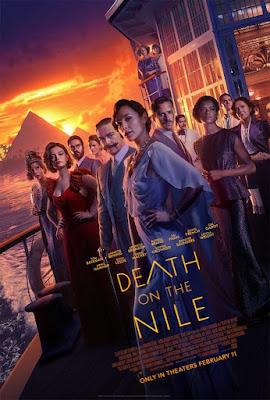
Death on the Nile: Film and Novel

The latest film version of Death on the Nile, directed by Kenneth Branagh, was so atmospheric that I wanted to stay in its world, so I read Agatha Christie's novel the same weekend. Now, I admire even more how Branagh and his screenwriter Michael Green treat Dame Agatha's work with the seriousness she intended even as they make major changes.

The core of Christie's novel is intact in the film. Jacqueline de Bellefort (Emma Mackey) introduces her adoring fiancé Simon Doyle (Armie Hammer) to her close friend, the fabulously rich and beautiful Linnet Ridgeway (Gal Gadot). Six months later, it's Simon and Linnet who are honeymooning in Egypt with friends and family, and Jacqueline who crashes the party. Linnet engages the sympathy of detective Hercule Poirot (Branagh). Besides being rattled by her stalker, she confesses that she fears that everyone in the party hates her.

Though Christie's whodunnits have been criticized for being formulaic and shallow, I've found that she brings psychological and theological depth to her work. Poirot reminds Linnet of the Old Testament parable of the rich man who steals the poor man's ewe. Unlike King David, Linnet refuses to see herself in the story. But Poirot takes her fury at Jacqueline to be a sign that, deep down, Linnet knows that justice is on the side of her ex-friend. Then, confronting Jacqueline, Poirot urges her to use the power she has in this situation, to forgive. If not, he warns, the evil that you're allowing to grow will take you over. To both women, who each claim that they have no choice but to act as they do, Poirot says, "you do have a choice."

Branagh and Greene lop off parts of Christie's plot to focus on those relationships. Gone from the film are subplots that involve a secret agent, an alcoholic, a kleptomaniac, a jewel smuggler, a brutish engineer with a grudge, and three different romances that Poirot helps along as matchmaker.

What Branagh and Greene add is Poirot's backstory in a battle episode during the Great War. An explosion puts him in the hospital. Visited there by his fiancée Katherine, he tells her that he failed to save a close friend and that he is afraid to show her his own disfigurement. She delivers an intense sermonette on what love means that resonates throughout the movie, especially when the character Rosalie Otterbourne (Letitia Wright) accuses Poirot of self-absorption, arrogance, and inhuman coldness. Annette Bening's character Euphemia mocks the famous passage on love from 1 Corinthians 13, evidently from bitter experience with an ex-husband: "Love is NOT patient and kind...."

Branagh and Greene also alter Christie's original characters, combining some, reimagining others. The most inspired of these changes is to turn the character Salome Otterbourne from a dotty white English writer with a disapproving daughter to a canny black Blues singer with a disapproving daughter. A sexy dance between Jacqueline and Simon at Salome's jazz club sets the baseline for everything else that happens.

The film startles us more than once with shots of breathtaking beauty from the banks of the Nile, on it, and under it.

After I read the novel, I still wanted more and viewed Branagh's earlier Christie adaptation of Murder on the Orient Express. I've been a lifelong fan of the 1974 version, so I approached it with some skepticism; it won me over.

[See my blogpost of 10/2014 about Christ in Christie. I compare Orient Express, Finney's film version, Suchet's TV film version, and the novel. In this article, I apologize for underappreciating the richness of Christie's work. See also my page Crime fiction.]

Sunday, March 06, 2022

"Carving the Language": Sondheim Talks Poetry, and Other Surprises

What's left to learn about composer Stephen Sondheim after you've read everything published about him since 1974? (Don't believe me? See my Sondheim page) I've run across some bits I hadn't heard before in articles printed since his death in November, a lot of them in an interview by D. T. Max in The New Yorker (February 14, 2022). Sondheim met with Max over a period of five years.

For me, the headline is Sondheim's expressing appreciation for works that have appeared in previous interviews only to be dismissed along the lines of, "I know it's good, but it just doesn't interest me." I'm thinking poetry, opera, Mozart.

The conversation takes a surprising turn when Sondheim gives credit to Larry Hart, whom he has often called out for shoddy workmanship. Sondheim tells Max, "If you look at songs prior to the nineteen-twenties, it’s all artificial. The point is that he started to infuse popular songs with the kind of daily talk instead of fancy talk." Max suggests a correspondence to poetry. Sondheim gets excited: "Yes! Oh, yes, absolutely right. William Carlos Williams!" But when Max says it's "painful" to read 19th-century verse because "they tried so hard," Sondheim comes to the defense of "fancy talk". He says, "Tennyson and Keats ... made artifacts that have nothing to do with contemporary speech. That was not what they were interested in. Poetry was about carving and decorating the language—and still saying something, but lots of rhymes, you know, all the artificial stuff."

Sondheim volunteers that opera is like that for him, too artificial. "[W]hen opera works for people it’s much bigger than real life, in the sense that you get real life the way you’re supposed to out of artificial art." He lauds the operas of Berg, and he calls Puccini "a master at psychological songwriting," adding, "I believe his characters."

Here are the other bits that I picked up:

  • Max contrasts the tranquility of Sondheim's converted farm in Connecticut to the convivial to-do at Sondheim's Turtle Bay condo, where assistants and friends kept interrupting.
  • Sondheim says his father "was a swell guy" but left him "in the lion's den." When Sondheim says he's told the stories of his grasping ego-centric mother enough to feel no pain in them anymore, he likes Max's suggestion that she became "material."
  • About the art of composing, Sondheim brings up a couple of composers that he hasn't mentioned in a lot of other places: What it amounts to is, music exists in time, so how do you make it cohere? ...I remember, [teacher Milton Babbitt and I] analyzed Mozart’s Thirty-ninth to see how he held it together. Why is this one symphony? We’re talking about different movements, so it isn’t like he’s using the same tune, and yet there’s a coherence. And, of course, Wozzeck and Lulu are great examples of that presented on the stage. Each one is one piece.
  • I especially enjoyed hearing that Sondheim feels the way I do about everyone else's favorite opera, Carmen, "just twenty of the best tunes you’ve ever heard in your life, but they’re twenty different tunes, you know? With a little fate theme that pops up every five minutes."
  • On collaborations with playwright David Ives, Sondheim discusses what I've heard before about the Bunuel project -- I'm not a fan of the source material -- but also that he and Ives got seven songs into another project based on a notion Sondheim liked, that any interaction of two people is really a meeting of competing committees. Sondheim regrets that he didn't develop the idea before the Pixar movie Inside Out did it. He was grateful to the film for the insight that sadness has to be in the mix.
  • Sondheim has never had much to say about popular music because most of it doesn't interest him harmonically. "The Beatles are exceptional because they were so original and startling," he says, and Radiohead.
  • Admitting that he feels old-fashioned, as he has done elsewhere, he hesitates to repeat a joke that his buddy Bert Shevelove made about their common friend Leonard Bernstein for imitating rock music in Mass: "Rip Van With-It." The joke's pretty mild; what's new here is Sondheim's scruple about repeating it.
  • What musicians usually call "modulation" from one key to another, Sondheim's tutor Milton Babbitt called "tonicization." Babbitt told him that, after several measures of a piece, “You’ve gotta tonicize something new.” Sondheim explained the technique: "So here you are in the tonic of A major, and now you’re going to the tonic of A-flat. It seems like an academic distinction, but it lays out the path more clearly if you think of it that way: that you’re temporarily making a tonic out of a completely foreign key." Max asked if surprise was the purpose. "What it’s about is making things surprising, but inevitable. That’s the great principle of all art that takes place in time. That can be true in painting, which does not take place in time, but, you know: 'Goodness gracious! What is that red spot in the middle of this blue painting?!'”

After I read that interview, I ran across another surprise at a classical music forum where an erudite string player traced Sondheim's lifelong relationship with the music of Ravel. The surprise for me had to do with Sondheim's accompaniment for the song "Liaisons" in A Little Night Music. For a grand Victorian woman recalling her flings with royalty, Sondheim wrote a colorful chord arpeggiated in different registers for each beat of a slow sarabande -- giving the effect of a ghostly procession of memories. Now I learn that Sondheim took that chord from the opening of Valses Nobles et Sentimentales, Ravel's tribute to the grand waltzes of the early 19th century.

In comments after the Ravel article, a troll sneered that Sondheim was an "amateur" who wrote ugly music. Remembering Peter Sagal's dictum that you don't change an idiot's mind by calling him an idiot, I thought through what this man could possibly mean. I myself have composed several hours' worth of music in my years, and I know there are only a few things that a composer must do. These are things Sondheim does so well, all discussed in Max's interview. Sondheim worked with tunes, harmony, variety, unity, structuring surprise so that it feels inevitable; he draws on a wide range of musical tradition. There are only two aspects of composition that didn't interest Sondheim: orchestration (because, why? The great Jonathan Tunick did that for him) and the human voice. If that, for the troll, makes Sondheim an amateur, well, I won't say what that makes the troll.

Monday, December 06, 2021

New Opera "Eurydice": Something Nice

On December 4, the Met broadcast in HD the new opera Eurydice, music by Matthew Aucoin, libretto by Sarah Ruhl, based on her play of the same name. The title character's name appears to combine the prefix eu- meaning "pleasant" with dice meaning "speech," reminding me of Mom's dictum, "if you don't have something nice to say, don't say it." So I'll be writing mostly about the captivating first hour.

Matthew Aucoin's orchestral prelude instantly created an atmosphere with delicate colors, a propulsive pulse, and ominous shifts of harmony.

The first moments with the title character and her lover Orpheus on a beach were sweet and a little puzzling in a way that intrigued us. Orpheus seems at first to be mute, drawing Eurydice's attention to the flight of birds with a sweep of his hand; she translates. Once a winged double for Orpheus descends from above, Orpheus and his muse sing his thoughts in harmony, Orpheus a baritone, his double a counter-tenor. By this very effective conceit, we understand that, while Orpheus may be affectionate and devoted to Eurydice, his attention is divided between his love and his music. For the rest of the opera, the energy in the interaction of these two voices generates a lot of good will.

[PHOTO: Eurydice, Orpheus, and his double.]

The story is well-known, so we appreciate the significance when Eurydice, teasing her lover, makes him walk ahead of her without looking back. Moments later, he sweetly ties a string around her ring finger to remind her of his love always. When string appears again in this story of loss and memory, we remember, and it's telling.

Another great invention of the librettist is to show us Eurydice's late father in the underworld. Having evaded his prescribed bath in the river of forgetfulness, the father retains his literacy and his love for Eurydice. Though he writes his daughter a tender blessing for her wedding day, he cannot deliver it. The plight of this character and, later, his care for Eurydice in the underworld, are strongly affecting throughout the opera, right up to his last words.

Hades, lord of the underworld, gets laughs for being so over-the-top creepy. Played by tenor Barry Banks, he's a plump and pasty bald man dressed like a Rat Pack wannabe. He seduces Eurydice to his swinging 60s bachelor pad, offering to show her a letter from her father. I've read on the website that he engineers her falling down the stairs to her death, a little detail that I totally missed.

In an interview backstage with host Renee Fleming, Banks admitted that he's challenged by a vocal part for which no entrance is lower than B-flat, but he also enthused about the logic and singability of the composer's lines.

The backstage interviews before the curtain and at intermission are always a highlight of these HD productions. These professionals are so collegial, and occasionally goofy in a gee-whiz-I'm-on-screen-with-all-these-great-stars kind of way. The principals and creative team expressed their appreciation for the music and libretto, and also their commitment to the project.

After intermission, the story went to hell. Still trying to say something nice, I'll list some intriguing themes that emerged:

  • The language of stones
  • The power of written language. Sometimes characters who seemed puzzled by pages of a letter stood on the paper, perhaps suggesting the limits of written language.
  • Memory loss. Some of the interactions in the underworld were like those that I see in my mom's memory care facility.
  • A woman's conflicting feelings for two men in her life, her father and husband.
  • The nature of love for a creative artist.
  • Loss.

Finally, I'll say something nice about a different musical theatre piece, Passion by James Lapine and Stephen Sondheim. Like this opera, its story is schematic, its characters on the edge of being mere illustrations of a theme: a soldier in love with a healthy beautiful woman whose name means "light" gradually comes to love a sickly repulsive woman whose name means "dark." On NPR's Fresh Air, Lapine explained the pains that he, Sondheim, and the cast took to help their audience to understand the characters' motivations for this unlikely story.

Like Passion did, this opera may need some tweaking. I'd work backwards from the moment in the libretto when Eurydice is asked to explain why, at the climactic moment of decision, she did what she did, and she answers, "I don't know." I felt cheated. I don't have anything nice to say about that.

Eurydice
Music by Matthew Aucoin, libretto by Sarah Ruhl, based on her play Eurydice
Conductor...Yannick Nézet-Séguin
Eurydice...Erin Morley
Orpheus's Double...Jakub Józef Orliński
Hades...Barry Banks
Orpheus...Joshua Hopkins
Father...Nathan Berg

Tuesday, November 30, 2021

Sondheim is Alive ( with links to Sondheim tributes )

Sondheim lives. At the time of his death last week, his shows Company and Assassins were on stage in New York, the new film adaptation of West Side Story was ready to hit theatres December 10, and he himself was a character in a film of Jonathan Larson's Tick, Tick, Boom that started streaming around the time. Sondheim shows play around the world 12 months of every year.

That may be surprising, as the "smash hit" always eluded Sondheim, and many of his shows lost money (a lot!) in their original productions.

But Sondheim will live because actors love him. That's the strong message that comes through in tributes since his death.

[PHOTO: Actors and fans gathered in Times Square after his death to sing "Sunday," Sondheim's anthem about art that transforms ordinary life into something that lives "Forever"]

On screen and in print, actors have testified how Sondheim's words and music are so particularly expressive, giving them so much to do. Bernadette Peters said that a quarter note rest in a Sondheim song is there because of something the character is feeling. Patti Lupone suggested to Sondheim that his acting in student productions carried over into his songwriting, and he agreed. When she asked about characters he'd created, he reminded her that his collaborators created them, but he explored them the way good actors do. (He admitted to her that Mama Rose from GYPSY was his favorite - such a monster, and "so full of life.")

In my teens, guided by critics, I loved Sondheim for all the wrong reasons. He revolutionized the art form, he dared to write dissonances in his music, he used the word "Goddam" in a musical, he chose dark subjects.  By touting the difficulty of Sondheim's music and the cleverness of his rhymes, I claimed my own sophistication. 

In the same way, professors and critics teach how Shakespeare advanced the art form, examined dark themes, and wrote dense poetry.  But Shakespeare has lived in spite of being reduced to quiz points and essay topics.   Since Shakespeare's grateful actor friends published his work in 1623, actors and directors have delighted in the challenges of his work. They've related to the characters; they've owned the insights; they've enjoyed opportunities that Shakespeare gives them to show off their range.

Likewise, Sondheim.

I've already seen well-regarded novelists, favorites of mine, fade into irrelevance within a couple of years of their deaths. I expect Sondheim to live on. 

[See my grown-up reflection on Sondheim's virtuosity in music and lyrics. See my Sondheim page for many more articles about him, his craft, shows, collaborators, friends, and competitors.]

Links to Sondheim Tributes

  • Central Synagogue in New York did a solemn, beautiful tribute with thoughtful words and a medley of Sondheim songs that fit the context of a religious service. Synagogue Tribute.
  • A British actor/musician has put together a wonderful video using clips from shows with animated snippets of piano score and lyrics to explain why Sondheim's work is so compelling. He ends with a heartfelt thank-you to Sondheim for the "humanity" (understanding, honesty, acceptance) that helped the author through difficult teen years. See Why Sondheim's Music is so Addictive
  • NPR's tribute by Jeff Lunden
  • NPR critic Bob Mondelo's tribute is both comprehensive and personal. The conclusion got to me: Sondheim always did "Move On," and "now we must, too."(My friend Susan and I chatted with Mondelo about Sondheim's Road Show during our visit to NPR HQ the day we saw that musical.)
  • A New York Times article celebrates Sondheim's lifelong mission to encourage theatre writers and performers, often with typewritten notes.  (I have four examples framed on my wall.)
  • Scott Simon on Sondheim's Essential Lyrics: A Soundtrack for Life is the most personal assessment, and strong. I especially appreciate how Simon draws from the song "Someone in a Tree" for Sondheim's celebration of the particulars in life that we hold in our hearts.
  • Broadway actors sing SUNDAY
  • Patti Lupone's tribute incorporates her interview with Sondheim at his home when COMPANY was about to open, just before the pandemic closed everything down. She focuses on his early experiences as actor, and there are surprises and laughs. She tries to tell him directly "thank you" for all of us and tears up, but he gets the message.
  • Max Freedman, journalist and former actor from a musical theatre family, creates a "playlist" of Sondheim songs by way of showing what the bard of ambivalence taught him in life. It's great!
  • Not a posthumous tribute, this compilation of teenagers telling what Sondheim has meant for them is very affecting. It's posted by the guy who does the wonderful YouTube series Musical Theatre Mash.
  • NPR's list of 10 Sondheim songs we'll never stop listening to
  • Video from PBS News Hour features Sondheim on rhymes, then an interview with critic Ben Brantley and theatre director Eric Schaeffer
  • New York Post obituary
  • Classical music figures including Jake Heggie and Renee Fleming share their tributes to Sondheim
  • An appreciation in LGBTQ Nation focuses on Sondheim's growth from closeted gay man to gay icon.
  • Michael Granoff wrote Sondheim and Me, personal memories of the composer, who was a family friend.

Friday, November 26, 2021

How Stephen Sondheim Responded When I Told Him His Impact on Me

Mr. Sondheim died at his home today at age 91. On his 80th birthday, I sent him my blogpost about him as my teacher (see my tribute).

His response, typed on the same tiny rectangle of stationery as communications going back to 1977, read "Dear Scott Smoot, Thank you for sending me the article. I blush."

I feel so much gratitude.

PS - Tonight my friend Jason sent this perfect selection from Sondheim's work:

If I cannot fly, let me sing.

See my Sondheim page for a curated list of articles about him, his work, his collaborators and competitors, and his impact on my personal life and faith.

Tuesday, October 26, 2021

"Fire Shut Up in My Bones": Opera Makes a Man

The opera Fire Shut Up in My Bones puts everything out there in the first three minutes. Before the curtain rises, we see a projection of a verse by the prophet Jeremiah from which the title comes, a signal that a truth "shut up like fire" will be spoken. The curtain rises on a young man with a gun singing to us "they're here," the tears and anger walled in since childhood. A woman enters his space but stays behind him as she urges him to use the gun to fulfill his destiny. We understand that she personifies Destiny, and that she is tempting him the way the Devil tempts Everyman in the medieval drama.

But where's the angel who should be standing on this Everyman's other side? When the scene is repeated in the dramatic context of Act Three, the identity of the character who fills that angel space has meaning and great emotional impact.

[I'd forgotten many specifics of the opera when I revisited this article months after the broadcast, but just re-reading the previous sentence brought back the impact full force, with tears.]

Based on the 2014 memoir by New York Times columnist Charles M. Blow, the opera's three acts tell of his childhood in rural Louisiana before an incident of "betrayal" by an older cousin, his adolescence after that incident, and his freshman year at Louisiana's Grambling State. In an inspired choice, the librettist Kasi Lemmons has grown-up "Charles" (baritone Will Liverman) on stage shadowing his childhood self "Char'es-Baby" (13-year-old Walter Russell III), to amplify emotions and interpret the significance of certain memories.

Lemmons writes mostly in couplets, the rhymes assisting us to follow the development of each thought. She re-introduces certain phrases throughout the story so that different scenes "rhyme" in a way, too. I recall Kiss me, hug me... You've got to break up the dirt to make things grow... sometimes you have to leave it in the road... love with a laugh [isn't worth much -- pardon my incomplete memory of this and the other phrases].

Composer Terence Blanchard propels the action with a variety of colors and tempos in the orchestra with incidental references to gospel, blues, and even disco. From repeated phrases in the libretto, he creates musical "hooks" that, like the opening scene, gain new meaning as they repeat in new contexts. Like rhymes, these repetitions serve as benchmarks for the development of the protagonist. For the specially-paired "Charles" and "Char'es-Baby," Blanchard has written vocal lines that the boy handles with power and self-assurance and the baritone enriches with his trained sound.

During the Live in HD broadcast Saturday October 23, different singers and members of the creative team spoke of what the piece says about perseverance and survival of trauma.

For me, the theme that emerged even more than perseverance is an exploration of what it means to "be a man." From the first time we see "Char'es-Baby," he's being told not to skip, not to be such "a mama's boy"; older Charles describes him as "a child of peculiar grace." For his father, being a man is about playing around. His sons echo him, showing their youngest brother that love is something men laugh and brag about.

His brawny uncle Paul models physical strength, but more than that, a man's responsibility to provide for his sister's family when the boys' father cuts out.

The mission to "make a man" out of Charles opens an opportunity for the traumatic betrayal. His older cousin Chester rooms with Charles and teaches him to steal candy, because, he says, a man makes up his own rules. Then Chester introduces a new "game" behind the closed door to Char'es-Baby's bedroom. The creative team makes the tension of the scene unbearable. There is no enactment: the actors stand apart from each other, facing the audience. But the effect is powerful and painful to watch (or recall). The music draws out the tension while lyrics repeat what the cousin said about a game, stealing candy, implying what's happening from an oblique angle.

[By coincidence, I saw the opera on the same day that I heard an interview on NPR's Fresh Air with actor/singer Billy Porter, whose stepfather abused him under the same pretext of "making a man out of him."]

Keeping the event as a secret shame, Charles continues to doubt his own manhood. When his brothers learn that he "got laid," they say, "You're a man, now." But he's disturbed by erotic dreams suggested on stage by an ensemble of male dancers, and thinks something's wrong with him. The Kappa Alpha Psi fraternity, step-dancing with their "Kappa canes," presents another model for masculinity that involves service, military discipline, and self-sacrifice for sake of brotherhood.

In the very satisfying resolution, being a man isn't about sex or sexuality, physical strength or dominance. Charles has the courage to be honest and the strength to leave those other games behind.

Terence Blanchard, composer / libretto by Kasi Lemmons
adapted from Charles M. Blow’s moving memoir
co-directed by James Robinson and Camille A. Brown. Brown also choreographed the production.
Baritone Will Liverman as Charles, soprano Angel Blue as Destiny/Loneliness/Greta, soprano Latonia Moore as the mother Billie, and 13-year-old Walter Russell III as Char’es-Baby.

Tuesday, September 28, 2021

Lapine, Sondheim, and "Sunday": So Much Love in their Words

"So much love in his words...forever with his colors...how George looks...he can look forever..."
(lines written by James Lapine, spoken during the reprise of Stephen Sondheim's song "Sunday" at the end of their musical play Sunday in the Park with George)

The distinguished Broadway musical Sunday in the Park with George wraps a love story in a lively conversation about art -- how we make it, why it matters. 

So does James Lapine's memoir of that musical's creation, Putting it Together: How Stephen Sondheim and I Created Sunday in the Park with George (New York: Farrar, Straus and Giroux, 2021). The starting place for both love stories is George Seurat's pointillist painting A Sunday Afternoon on La Grande Jatte - 1884.

Clockwise from top: Act One finale, 1984; Sondheim and Lapine on set, 1984; Sondheim studies La Grande Jatte, photo by Lapine.

The Musical
The love story in the musical arcs through two acts and 100 years. In the opening seconds of the show, as artist George Seurat sketches "Dot," the woman in the forefront of the painting, she pleads with him to notice "there's someone in this dress." She is determined to "get through" to the artist. But during Act One, she comes to recognize that she cannot have his full attention. He sings why in a reflection about himself,

... however you live,
There's a part of you always standing by,
Mapping out a sky,
Finishing a hat...
-(Sondheim, "Finishing the Hat")
Dot, carrying George's child, finds another man "simple and kind" who "makes a connection." With him, she immigrates to America, leaving Seurat with these words:
You have a mission,
A mission to see.
Now I have one, too, George.
And we should have belonged together.

I have to move on.
("We Do Not Belong Together")

In Act Two, another artist named George, descendant of Seurat and Dot, revisits the island of La Grand Jatte. He had planned to bring along his grandmother Marie, the baby in the painting, to celebrate the painting's centennial with a new art installation. But Marie has died, the island is encrusted with buildings and pavement, and he's having doubts about his own work. 

As he reads the notes that Dot wrote in her English primer, she appears to him in person. As if he were his ancestor Seurat, she thanks him for what he taught her about being "in the moment," not to worry over past or future -- a lesson that the modern George needs to hear. For his part, George sees in her "Things I hadn't looked at / Till now," her smile, "the way you catch the light," the "care / and the feeling." Now George and Dot sing in unison, "We have always belonged together." Dot inspires him to "stop worrying if your vision is new" and "move on."

The Collaboration
James Lapine reflects in his book that the two years spent creating Sunday in the Park with George "changed my life, and I would venture to say it changed Sondheim's as well." No doubt about that: Sondheim's memoir, part I, ends at a lowpoint in his career, but he adds, "Then I met James Lapine."

The two men were unsuited to each other like characters who "meet cute" in a rom-com.

Lapine, barely in his 30s, straight, with "commitment issues," was an out-of-work teacher of fashion design with a couple of writing-directing credits at an off-Broadway workshop for experimental drama. Sondheim, 52 and gay, was a multi-Tony-winner and "Broadway's Music Man" (Newsweek) but suffering the end of his fruitful collaboration with director Hal Prince after their show Merrily We Roll Along flopped in 1981.

When a common friend arranged for a meeting, Lapine didn't know any of Sondheim's work except for the 1979 masterpiece Sweeney Todd. Blocked by a nuclear protest, Lapine barged through the crowds to arrive at Sondheim's town home just on time. Sondheim put him at ease by offering a joint.

"I loved that you did that," Lapine says to Sondheim in the book. The transcripts of Lapine's reminiscences with Sondheim glow with many moments when the two collaborators express feelings they'd kept private at the time.

For example, Sondheim reveals that it was Lapine's play Twelve Dreams that kept him from quitting theatre altogether. Sickened by the glee that greeted the failure of Merrily in "so-called Broadway circles" (17), he wanted nothing more than to create video games. But Lapine's play inspired him.  "Really? I didn't know that," says Lapine in his interview.

Then Sondheim describes the moment that began their long working relationship. Over several meetings, they'd not found a subject of sufficient interest to both of them. Then Lapine laid down a postcard printed with Seurat's Sunday on La Grande Jatte, and the two found possibilities. It looked to them like a stage set; all the characters seem to avoid looking at each other. Then Lapine observed that "the main character is missing" -- the artist. Sondheim says, "Boing! All the lights went on" (23).

As in any good romantic comedy, there were doubts, more than either man knew at the time. Reading Lapine's first drafts, Sondheim felt superfluous. "This will make you blush," Sondheim tells Lapine, "but you are -- a poet" and Sondheim feared that any song by him would be "intrusive" (35). At the same time, Lapine felt that Sondheim always had "one foot out the door." Sondheim says,

I never detected any of that. ...Not only did I enjoy your company, but also I thought everything you were showing me was fun and good and stimulating. (35)
Sondheim's procrastination made it a pretty one-sided collaboration until the day when Sondheim seated Lapine beside him on the piano bench to turn pages while he sang the opening number. Lapine admits, "This is going to sound odd... Suddenly, we were shoulder to shoulder... It was a kind of an emotional moment for me." Sondheim was so nervous that he "attacked" the keys and oversang. He had to do it twice before Lapine "got it," and even then, Lapine apologizes now, "I'm not effusive" (44).

Their trust grew through re-writes, rehearsals, and preview performances when the audience sometimes responded badly. "Out of the blue," Lapine recalls, Sondheim said to him, "I want to write my next show with you." Lapine writes, "I had never felt that kind of trust coming at me." He reflects that his "commitment issues" vanished forever (121).

In an interview about this book, Terri Gross asked Lapine why he never wrote another show with Sondheim after Sunday, Into the Woods and Passion. "Are you still friends?" she asked. "Yes!" Lapine said, though they never found another topic that interested both of them. Lapine worked with Sondheim on a successful revision of Merrily, a stage revue Sondheim on Sondheim, and a movie mixing archival footage and new performances, Six by Sondheim. Now, he told Gross, writing this book has been another way to keep Sondheim in his life.

The Art of Making Art
The love stories in both musical and book are buttressed by dozens of thumbnail portraits of characters whose lives go into the making of the artworks.

In the musical, Seurat sketches the other figures of the painting between his encounters with Dot. Lapine's pithy bits of dialogue bring out their salient characteristics. In musical numbers called "Gossip" and "The Day Off," Sondheim distills Lapine's characters in brief songs. Though a couple of critics say there's "no life" in Seurat's art, Sondheim has Seurat sing along with portions of each portrait, showing how the artist enters into the characters' lives. Seurat even channels two dogs in a virtuoso duet for solo voice. In act two, Lapine and Sondheim interlace dialogue and lyrics to portray a slate of new characters from the contemporary art world who surround the 1984 George.

Likewise in Lapine's book, we get to know actors, producers, and designers. We learn how much the actors helped -- and prodded -- Lapine and Sondheim to flesh out their characters. In the roles of servants, Nancy Opel and Brent Spiner (subsequently "Data" on Star Trek) introduced German accents that gave Lapine and Sondheim ideas for character development (97). Lapine borrowed personality traits for his 1984 George from the technical designer Bran Ferren who created the laser-based sculpture called "Chromolume #7" (169).

Lapine also got a lot of pushback and resentment, especially during weeks of previews for audiences that grew restless and hostile. He learned about leadership from their pushback. Actor Melanie Vaughan remembers how she, Spiner, and Opel stonewalled Lapine, staring at him blankly while he gave them notes. They were thinking, just tell us what you want (98). Lapine reflects that, as both writer and director, he was still figuring out what he wanted (98). Actor Charles Kimbrough asks Lapine in the book if the memory of all that is painful. "I'm actually somewhat in awe of my younger self. At the time, I was just trying to keep my head above water. But when I look back now, I think: Boy, I had some chutzpah!" (242)

Sondheim felt mounting pressure to fill in gaps in the dialogue where he and Lapine intended the characters to sing. Bernadette Peters complained that "Dot" "kind of disappears" in the first act, pushing Sondheim to write "Everybody Loves Louis," about leaving Seurat for the baker, a peppy song with an undercurrent of sorrow: "We lose things / and then we choose things /...George has George, / and I need someone." Mandy Patinkin, already high-strung (the backstage crew wanted to kill him (218)) was on the verge of quitting. He pleaded for a song that would explain his character. Sondheim finally delivered "Finishing the Hat." Rehearsing it, Patinkin "lit up like a flare," remembers orchestrator Michael Starobin. The song explained "why [Seurat]'s so hard on his partner and also why he's so hard on himself. The piece didn't make sense until that song came in" (120).

Everyone felt even more urgency for Sondheim to produce songs for the second act. For the book, Lapine presses Sondheim for an answer to what took so long.  After all, he and Sondheim had discussed the characters, the moments, the themes; Sondheim had written page after page of notes; yet the audience and actors, too, were left to wonder why they should care about the second-act George or why "Dot" suddenly appears in 1984. What was the delay?

Sondheim finally admits that he has no answer, but it's clear that he benefitted from seeing the actors in their roles. Performing the role of "Marie," Peters spoke to Marie's grandson "George" with a South Carolina lilt that put Sondheim in mind of his favorite composer, southerner Harold Arlen, whose blues-inflected songs were "seductive...warm...yearning" (233). Sondheim wrote those qualities into a new song "Children and Art" in which Marie gently encourages her grandson to produce "the only two worthwhile things to leave behind when you depart this world: children and art" (368). 

That still left a big hole in Act Two where the modern George expresses himself.  Sondheim tells Lapine that he knew the contents of the missing number, but not the form, until he saw the little red book in George's hand, the primer that Dot used to learn English in the first act, a gift to modern George from his grandmother.  Alone in the park, George reads from the book: "Charles has a book... Charles shows them his crayons... Marie has the ball of Charles...." George keeps the primer's simple grammar going as he muses about the lost park and his uncertain future:

George is afraid
George sees the park
George sees it dying.
George too may fade,
Leaving no mark,
.Just passing through.
("Lesson #8")
Lapine tells Sondheim, "So when we finally got those last two songs in the show, Mandy said it best, it was like a magic trick" (240). Sondheim responds, "That's the miracle. ...When music is used correctly, then everything coalesces." Actor Charles Kimbrough gives the cast's perspective. They'd watched from the wings each night as the last scene fell flat.
But the addition of these songs laid that carpet of feeling under the moment. When Dot entered to the music of "Lesson #8," it was clear that this George had summoned her. It was pure gold. And then they sang "Move On" and that just killed. And then when the "Sunday" reprise came around, bam! (241)
Lapine and Sondheim stuck to their vision while producers and actors advised them to just extend act one with some audience-pleasing number and jettison the difficult second act. Lapine writes, "[We] had to stay true to our initial impulses and write the show we had intended, not the show these people [who walked out on the second act] had wanted to see" (127). Actors Mandy Patinkin and William Parry both remember Lapine, a very "controlled" and "internal" man, opening up and choking back tears after the last rehearsal, pleading with the cast to "trust" the show. "Believe in what we have made." And they produced something "remarkable."

Art, Love, and Death
Lapine and Sondheim both have discovered new things in what they themselves wrote. They have heard their own words come back to them in times of discouragement:

Anything you do
Let it come from you
Then it will be new.
Give us more to see.
("Move On")
Lapine says it's a letter to them from their younger selves (127).

Those words from "Move On" speak to me as an artist, too, but the moment that has always spoken to me as a man emerges from another arc in the story. There's a through-line of statements about art that tell us all why we should care about artists doing their work.

This other arc has to do with the death of what you love.

At the start of the show, Dot says, "If you want instead / When you're dead / Some more public / And more permanent / Expression / Of affection," then you want a painter or sculptor whose work will endure "forever." Near the end of the show, 1984 George fears that his life will have been "just passing through." In between, we've heard the admonition to "leave behind" either children or art, and we've heard the anthem "Sunday" that celebrates how Seurat's painting preserves a moment "forever."

But the song "Beautiful" reaches an emotional peak that affected me deeply, from the first time I heard it to the present moment nearly 40 years later.

This quiet song follows Dot's tumultuous aria "We Do Not Belong Together." While Seurat sketches his mother, the "Old Lady" played originally by Barbara Bryne, speaks of memories that are fading. Sondheim's music for her seems to be built on sighing, while an ostinato suggests the river nearby. She sings of regret that the Eiffel Tower is being constructed "where there were trees," and she mourns

Sundays
Disappearing
All the time,
When things were beautiful.
The accompaniment changes to cascades of notes when George tells her "All things are beautiful." In the earlier song "Finishing the Hat," he had expressed the joy of seeing this world through art "like a window...the only way to see." Now he demonstrates for his mother how the tower is "a perfect tree." He promises, "You watch / While I revise the world." Suddenly, she gets it, and her song becomes urgent, as everything is
Changing,
As we sit here--
Quick, draw it all,
Georgie!
("Beautiful")
"You make it beautiful," she says, eyes closed. As this quiet song subsides, the other characters enter, their confrontations with each other at the boiling point. Seurat freezes the chaotic action to compose all the players into the tableau we all know, Seurat's "perfect park" that continues "forever."

The song isn't mentioned in Lapine's book, but the 1986 edition of Craig Zadan's Sondheim and Company includes Mandy Patinkin's story of a two-hour conversation with Sondheim about "people that you love, things you'd like to say to them, ideal states of when you can communicate and when that communication can never take place again....And four days later, he came in with this conversation turned into a poem called 'Beautiful,' set to this simple, gorgeous music" (Zadan 305).

When the Old Lady says, "Quick, draw it all!" she speaks for all of us when we're suddenly reminded that people and places that we love will not last. Sunday gives us the reason to care about the making of art: it's an expression of love that distills, elevates, and preserves the object of appreciation.

As Lapine has done for that life-changing collaboration in this book.

Of Related Interest

Wednesday, September 08, 2021

"Hamilton" on Mute

Since the story of Hamilton is densely packed in Lin-Manuel Miranda's songs on the recording [see my review (06/2016)], do you need to see it for $400 to appreciate the story? Turns out, even if you watched Hamilton on mute, you'd get your money's worth.

[See my exclusive interview with Hamilton bassist Jordan Scannella conducted while riding fast on two bicycles along Georgia's Silver Comet Trail.]

Before the show, there's the set to admire. It's a three-story collage of façades - brick, wood, plaster. There are gangplanks and stairs, ropes, warrens, and skywalks for variety of entrances and exits. There's little room for pieces to fly in or scenery to drop so we're going to be looking at the same sepia-toned set the whole time. No crashing chandeliers or helicopters lifting off: spectacle and color are going to be scaled to what humans do in the space.

Once the show starts, the ensemble, barely present on the recording, is fairly ubiquitous on stage. Dancers outnumber the principals nearly three-to-one. They stretch, climb, jump, twist, flex -- anything a fit human body can do to draw our attention to shifts in the mercurial lyrics. They mime battles, a hurricane, even a split-second hanging. Their basic costumes are beige undergarments, but they occasionally don colorful clothes for a change of scenery. Often dancers flow in with chairs and tables for principals who sit just long enough to sign their initials before the next incident.

Then you see over time an "ensemble" in the larger sense of co-ordination and camaraderie. I'd heard Act One as mostly exposition of Hamilton's early years and of Revolution. Seeing the show, I understood that the main action of Act One is about bonding: "scrappy and hungry" Hamilton gains buddies in a tavern, a friend in Burr, the adoration of two Schuyler sisters, the patronage of George Washington, and a company of soldiers. The friends' reactions to each other, often reinforced by the ensemble's close interactions, make you feel a part of a team. Hamilton is a warm show, like Miranda's earlier In the Heights.

Thomas Jefferson reboots the show when he enters stage center in a purple suit at the top of the stairway at the top of the second act. Now it's all about Hamilton's confrontations with Jefferson, highlighted by two cabinet meetings played as rap battles emceed by George Washington. At the Fox, Warren Egypt Franklin's Jefferson appeared as a Goliath to his little David, diminutive Pierre Jean Gonzalez as Hamilton.

Contrast intensifies our focus on individual players when the ensemble clears out. For comic relief, King George gets to interact directly with "his" people in the audience. We don't need words to understand the emotion when Mrs. Eliza Hamilton, betrayed, burns her husband's letters. Dressed in black, Aaron Burr makes a brooding visual presence even when he isn't singing. We see how his resentment builds while he's shut out of the deal-making in "The Room Where it Happens."

Onstage, two meta-theatrical events make more sense seen than heard. In Act One, Angelica rewinds the scene in which Hamilton courts and marries her sister, replaying it with herself as the bride. The fatal gunshot is suspended in time for characters to re-enact bits of Hamilton's story, heightening the impact for us when the bullet hits him.

That's human-scale spectacle, worth the price of a seat in a live theatre.

from the Fox Atlanta Company's website:
HAMILTON is the story of America then, told by America now. With book, music, and lyrics by Lin-Manuel Miranda, direction by Thomas Kail, choreography by Andy Blankenbuehler, and musical supervision and orchestrations by Alex Lacamoire, HAMILTON is based on Ron Chernow’s acclaimed biography.

Atlanta presents the "Philip" cast, one of three official touring companies, with Pierre Jean Gonzalez (Hamilton), Stephanie Jae Park (Eliza), Jared Dixon (Burr), Ta'Rea Campbell (Angelica), Marcus Choi (George Washington), and Warren Egypt Franklin (Lafayette/TJ).

[While Lin-Manuel Miranda was still in grade school, I packed a rap song with history. See Rap About Magna Carta (09/2021).]

Wednesday, September 01, 2021

"Gypsy" Stripped

Gypsy would seem to be your basic showbiz musical. The 1959 musical tells how Rose Louise Hovick goes onstage a nobody and comes back "Gypsy Rose Lee," world-famous stripper. But, like the outfits she peeled on stage, there are layers. Even while you appreciate well-crafted scenes, snappy songs, and brilliant lyrics, you feel dread.

I was recently reminded just how entertaining and emotional Gypsy is when I streamed it from London's Savoy Theatre which starred Imelda Staunton as the driven stage mother "Rose" back in 2015.

[Photo Collage: Gypsy 2015 Savoy Theatre. Imelda Staunton as "Rose," Lara Pulver as "Louise," Dan Burton as "Tulsa" ]

Stephen Sondheim wrote the lyrics and wanted to write the music, but Broadway diva Ethel Merman preferred the veteran composer Jule Styne. Still, Sondheim looks back on Gypsy with immense satisfaction. The chapter of his memoir about Gypsy concludes

Jule Styne supplied the atmosphere of both the milieu and of musical theater itself.... Jule's score was redolent not only of vaudeville and burlesque but of the old-fashioned, straightforward, character-driven musical play, the model that Hammerstein had pioneered, of which Gypsy was one of the last examples and probably the best. (Sondheim, Finishing the Hat, New York: Knopf, 2010. p. 57)

Playwright Arthur Laurents held off on adapting Lee's memoir to the stage until he found something dramatic to top the inevitable striptease number. He got what he wanted in the stripper's mother, as Sondheim explains:

Rose was that dramatist's dream, the self-deluded protagonist who comes to a tragic/triumphant end. When an audience knows more than the character does, every line of dialogue and lyric has an edge.... [The viewers] wait in suspended anticipation of the inevitable moment when the character will be forced to face the truth. They think: I get it, why doesn't he? If they care enough about him, every moment of the evening is freighted, and when he finally does get it, it's both devastating and satisfying (56).

Before they wrote, Laurents took Sondheim to see a class at the Actors Studio. Laurents wanted his friend to appreciate how "subtext" is a silent "counterpoint" to dialogue that "keeps the text alive." For Sondheim, this was a revelation. He cautions writers, however, "you have to have something worth not saying."

What they're not saying in Gypsy is that Rose is living through her children's lives. Bullying, flirting, and conning people to keep her cutesy act on tour years past its sell-by date, she keeps her daughters and a raft of orphan dancing boys in perpetual childhood without lives of their own (compare Into the Woods, Witch and Rapunzel). It's all about Rose.

For Laurents, the thrilling montage of ever-glitzier strip routines for "Gypsy Rose Lee" sets up the dramatic moment that tops it, when Louise realizes that she has become the adult who must now take care of her parent. Sondheim observes that this is something everyone will experience but not something we like to think about, and that may be why this perfect show wasn't as big a hit as some with more palatable themes (Sondheim in Craig Zadan's Sondheim and Co., New York: Macmillan, 1974, p. 59)

Sondheim gives us the origin story for the spine-tingling finale called "Rose's Turn." Director-choreographer Jerome Robbins had imagined a ballet in which Rose would be confronted by all the characters in her life. But he'd run out of time. When Robbins called a meeting to find a Plan B, only Sondheim showed. Sondheim writes, "It was like every shimmering nighttime rehearsal scene I'd ever loved in the movies," in an empty theatre with just a piano and one lightbulb.

I suggested to Jerry ...the songs we'd heard all evening, colliding in an extended surreal medley consisting of fragments of the score. He asked me to improvise what I meant....As I pounded out variations on the burlesque music, Jerry clambered onto the stage and started to move back and forth across it like a stripper, but a clumsy one: like Rose doing a strip. (77)
Ethel Merman, Broadway comedy star making her dramatic debut, was uneasy about the music, Sondheim recalls. "'It's sorta more an aria than a song,' she commented doubtfully, halfway between a question and a complaint."

Yet Merman nailed it, and "Rose's Turn" has been a show-stopper ever since. much-imitated in its collision of songs. Cabaret comes to mind, and Sondheim's own Follies. For Hamilton, Lin-Manuel Miranda suspends time to replay key phrases from Alexander Hamilton's life before Burr's bullet finds him.

Directing a revival of Gypsy years later, playwright Laurents improved on the finale by having "Rose" bow over and over until Louise steps on stage in silent witness. The theatre goes quiet, and still Rose is bowing: our applause was a sound in the character's demented brain.

Sondheim makes no comment about his lyric for "All I Need is the Girl," so I'm stepping up to peel the layers off a favorite number of mine.

  • Layer 1, Song: Sondheim and Styne have created a song-and-dance number in the vein that Fred Astaire mined so memorably in "Top Hat and Tails," "Steppin' Out with My Baby," and "Shine on Your Shoes." The music swings and the lyrics sparkle with rhymes both tricky and natural. The character sings
    Once my clothes were shabby,
    Tailors called me "Cabbie,"
    So I took a vow,
    Said,"This bum'll
    Be Beau Brummel."
    Now, with his "striped tie" and "hopes high," all he needs to complete his outfit "is the girl." In the last lines, the meaning of the title turns around:
    And if she'll say,
    "My darling, I'm yours," I'll throw away
    My striped tie and my best-pressed tweed.
    All I really need
    Is the girl!
  • Layer 2, Character: "Tulsa," one of the grown-up "boys," rehearses this song for a nightclub act that he dreams of doing. Louise watches. In the world of the play, Tulsa presumably has learned the song from radio or sheet music; it's not the character singing his thoughts the way other songs in the score are. Still, the lyric fits him, a young man with ambitions to step out and have a life of his own.
  • Layer 3, Context: The number is both literally and figuratively a breath of fresh air. Near the end of Act One, following scenes in shabby rooms and gaudy stage sets, this number is set under the night sky behind the little troupe's lodging. It's also one of the rare scenes free of Rose, who sucks up all the oxygen in any scene.
  • Layer 4, Subtext: Louise, always self-effacing, always relegated to the background, is being drawn into the action. Tulsa tells her how he imagines putting a flower in his lapel, how the light hits, and, at a climax, how "she" appears upstage "dressed all in white." Tulsa takes Louise's hand and brings her into the dance. Elated, she's living the lyric; she thinks she's "the girl." But we can tell: Tulsa barely even knows she's there -- she's just a prop for his fantasy.
The next day at the train station, Louise, Rose, and their agent Herbie learn that Tulsa eloped with June and all the other "boys" have quit. Rose seems to have reached the end of the line. Herbie offers to marry Rose and live happily ever after with the remaining daughter Louise. Instead, she turns to Louise, the one she's always slighted, and sings "You'll be swell / You'll be great / Gonna have the whole world on a plate... Everything's coming up roses!" Sondheim wrote the number to be the kind of optimistic "trumpeting fanfare of a song" that had been Merman's specialty for decades, only with Louise and Herbie registering "the horror of the moment" as they recognize just how demented Rose is.

So, the layers are many, and watching them tear away gives this showbiz show its distinctive feel of impending doom. Let me conclude, then, with a couple of Sondheim's happiest bits of lyric fun. First, "If Momma Was Married," a duet for the two sisters mid-way through Act One, with deliciously interwoven rhymes, which include references to comedienne Fanny Brice and Alfred Lunt's family of actors:

BOTH: Momma, please take our advice!
LOUISE: We aren't the Lunts.
JUNE: I'm not Fanny Brice.
BOTH: Momma, we'll buy you the rice,
If only this once
You wouldn't think twice!
That Rose is notoriously cheap enough to need someone else to buy the rice for her wedding is a nice touch. Then, there's the song for three strippers who teach young Louise "You Gotta Get a Gimmick." Sondheim writes admiringly of Frank Loesser and Irving Berlin, how their jokes land even on multiple re-hearings. I'd say the same about this song, especially this rhyme: "If you gotta bump it, / Bump it with a trumpet."
[See my Sondheim Page for a curated list of my many, many posts relating to Sondheim, his collaborators, and his competitors.]

Tuesday, August 17, 2021

"The Green Knight": A Funny Thing about Honor

You go off on a quest, do some brave deed, and you're set for life: That's "honor?" That's it?

Dev Patel as "Gawain," hero of The Green Knight gives his questioner a look that says, "Uh, when you put it that way, it sounds pretty lame." Then he answers, pretty lamely, "Yes."

Although the Dark Ages are very dark in this film, shot on misty moors and rocky paths through gloomy forests, Patel's Gawain is funny, being more in the dark than anyone. When we first see him, he's a playboy splashed awake by his mistress (Alicia Vikander), unable to find his boots, affectionate and careless.

But he gets caught in a kind of medieval Matrix where everyone he meets, even a fox, is part of a plot devised by a controlling intelligence. His mother is the witch Morgan La Fay (Sarita Choudhury), sister to King Arthur. We see the siblings in a tete-a-tete, evidently conspiring to teach Gawain a lesson. At the king's Christmas banquet, Arthur (Sean Harris) primes his nephew to step up for the honor of knighthood. At the same time, Morgan conjures the Green Knight (Ralph Ineson) -- half man, half tree -- to deliver a challenge he can't refuse.

The challenge sounds like a fair fight: you win if you strike a blow against the Green Knight. The catch is, you must meet the Green Knight again a year and a day later, on his own turf, for payback. Seeing all the famous knights avert their eyes, Gawain jumps in. Instead of fighting, the Green Knight lays down his axe and bares his neck. Embarrassed, Gawain asks the crowd, "What am I supposed to do?" Gawain decapitates the knight, maybe to head off the anniversary rematch. To Gawain's dismay, the severed head warns him to keep his promise as the Knight rides away dangling the head in one hand.

Playful touches by the director David Lowery remind us all the way through that, despite the darkness and the threat, this is all a game.

  • The title cards try a dozen different medieval-ish fonts and sometimes make ironic comments about the story. For example, we jump ahead one "too quick" year later. "An act of kindness" is anything but -- involving a particularly annoying teenage boy (Barry Keoghan).
  • Images of Gawain undercut the idea that "honor" is just a matter of PR. Now famous for his encounter with the Green Knight, Gawain's portrayed in an over-blown heroic pose and also depicted as a foolish puppet who loses his head in a children's show.
  • When Gawain accepts hospitality at a manor house, there's a comedy of manners reminiscent of Edward Albee's Who's Afraid of Virginia Woolf? The Lord and Lady (Joel Edgerton and Alicia Vikander -- who doubles as Gawain's mistress) drag Gawain unwillingly into games that Albee called "Get the Guest" and "Hump the Hostess."
  • More images in the manor house make fun of him: His stupid gape-mouthed expression is captured in a camera obscura; he's woven into a tapestry that depicts his host hunting him like a fox.
  • When Gawain meets St. Winifred (Erin Kellyman), it's so awkward in a teen-aged way. First, he discovers that he's sleeping in her bed. Then she tells him to retrieve her head from the bottom of a spring. When he observes that it's right there on her neck talking to him, she all but rolls her eyes. She's exasperated when he asks what she'll do for him if he retrieves the head: "Why would you even ask that?"

The comedy ends when Gawain experiences life without honor. As Dev Patel plays him, Gawain has been drained of his vitality. My friend Susan said, "He's lost his soul." Painful to watch, this part of the movie makes us feel the importance of true honor by its absence.

Happily, the director and writers bring the story to a rounded, satisfying finish. Then they step one line beyond that -- leaving us laughing.

Saturday, July 31, 2021

"Nixon in China": My Favorite Opera

I recently devoured Michael Dobbs's book King Richard, a page-turner focused on 100 days between Nixon's triumphant landslide re-election and the day when he recognized that he had no control over the Watergate scandal that would lead to a vote to begin impeachment proceedings, followed quickly by resignation. I could not put the book down because of the weirdness of discovering just how incompetent Nixon and his minions were. Most telling is the way he kept repeating the mantra "It's not the crime, it's the cover-up" that made him a political star during the House Un-American Activities investigation of Alger Hiss -- only to get enmeshed in cover-up activities himself. He was so deep in denial.

That said, I'm glad to have a reason to pull together all the different reflections I've made through the years on the opera Nixon in China by composer John Adams, librettist Alice Goodman, and director Peter Sellars. The piece is so important to me that I'm astounded that the title hasn't been prominent in my blog so far. Today, I make amends! I'm stringing together comments I've made about Nixon in other contexts. Links to the original articles are listed at the end.

Nixon and Art
My friend John Davis, polymath and astute observer of everything, opined when the opera premiered that Nixon would long be a source for artists, while Reagan, Johnson, and most others never would be.

Why?  Davis suggested that, for a man so determined to control his own image, Nixon's inner conflicts and torments were always on view.  Nixon argued endlessly that he made all of his choices for the right reasons.  His good intentions make him tragic; his lack of self-awareness makes him comical.

I'll go out on a limb and say that the opera NIXON IN CHINA has become one of my favorite works of art in any medium. Here, I have special authority, because I was at the premiere. [I've since seen a very different-looking production by the Cincinnati Opera and a much grander remake of the original on the Live in HD Series at the Metropolitan Opera. SEE PHOTO]

In 1987, I drove the ten hours from Jackson MS to Houston TX to see the opera's world premiere. I admit that I got totally lost in the long bombastic scene with Nixon, Mao, Chou, Kissinger, and Mao's secretaries; that I was baffled (and bored) by the "ballet" in Act Two, and I had trouble staying awake in Act Three -- in which all the principals prepare for sleep after the final day of the summit, with six plain roll-a-beds, as if they're retiring to their cabin at summer camp.

As I walked among national TV crews and even literally ran into the entourage of the "kid wonder" director Peter Sellars, his orange hair standing straight up four inches -- I was thinking that the music was never less than pleasant, but I wasn't all that excited. I also couldn't decide what I thought about several places where the orchestra was reaching for big, ominous climaxes while the stage action was extremely banal, as when we watch Pat Nixon put on her hat and gloves for a day of touring. That seemed like bad staging to me.

Through recording and a PBS Great Performances video of that same performance, I grew to appreciate even those parts that baffled or bored me at the time. If I was baffled by Mao and his strident secretaries, well, so are Nixon and Kissinger. (Mao makes an oblique pronouncement and leaves Nixon -- the dogged student and striver all his life -- to interpret it as a statement of policy; Chou En Lai reassures Nixon: "It was a riddle, not a test.") If Madame Mao's propaganda ballet seemed to dissolve into chaos as Pat and Dick rush on stage to help the heroine with a glass of water -- well, I've learned to see this as an amusing theatrical trick that embodies the difference between Mao's hard doctrines about classes and systems and empathetic Americans' visceral response to personal stories.

The Cincinatti Opera's production made a backdrop from a bank of TV screens, and crowded the stage with replicas of those eerie hundreds of clay soldiers we've seen from China. Both added resonance to the wonderful opening of the opera. Adams's overture builds patterns over a rising a-minor scale; then a chorus of Chinese people in their Mao-fatigues sing incongruous phrases from his "Little Red Book" - "Respect women: it is their due...Close doors when you leave a house... roll up straw matting after use"

In 1987 and again on HD, the arrival of Airforce One is a delight. Adams's orchestra mimics the hum of an airplane engine; the chorus moves out of the way; the plane lands from the ceiling like an immense cardboard cut out; and Nixon and Pat appear at the open door waving--to rapturous applause and laughter.

Art and Americans
Adams, Goodman, and their director Peter Sellars caught some criticism from Nixon haters for presenting Nixon at his height of success, using only resources pre-Watergate, putting verse in his mouth that represented him as he might have seen himself.  Thus, Nixon sings in his "News" aria,
On our flight over from Shanghai,
The countryside looked drab and gray.
"Bruegel," Pat said.  "'We came in peace for all mankind,'"
I said, and I was put in mind 
Of our Apollo astronauts, simply achieving a great human dream.
We live in an unsettled time.
Who are our enemies?  Who are our friends?

... As I look down the road, I know America is good at heart...
Shielding the globe from the flame-throwers of the mob.
                  
                               (quoted from memory - apologies if I miss some words)
There we have laconic Pat, Nixon's pretentions and his goofy inability to separate personal from public.  (Biographer Stephen Ambrose tells how Nixon, kneeling beside a woman injured by his motorcade, crowd and cameras watching, asked what she thought about tax policy!  That's the Nixon we have in the opera, wanting desperately to be good, apt to orate, unable to connect to Mao or even to Pat.

Since composer John Adams's falling-out with librettist Alice Goodman is pretty famous, dwelt upon in another book THE JOHN ADAMS READER, I was especially interested to see how Adams treats her with respect and appreciation. He writes,


She could move from character to character and from scene to scene, alternating between diplomatic pronouncement, philosophical rumination, raunchy aside, and poignant sentiment. And she did all this in concise verse couplets, exhibiting a talent and technique that has nearly vanished from American poetical practice. (136)


His citation of lines from Pat Nixon's aria "This is Prophetic" brought tears to my eyes, as he focused my attention on an aspect of the words that I hadn't seen so clearly before. Here are the lines that he quotes, as Pat Nixon piles image of America on image in the form of a prayer :


Let lonely drivers on the road
Pull over for a bite to eat,
Let the farmer switch on the light
Over the porch, let passersby
Look in at the large family
Around the table, let them pass.


Adams comments, "It was part of Alice's genius to be able to handle images of Americans -- so routinely abused in magazine and television advertising -- in a way that recaptured their virgin essence, making them, when Pat sings them, not cliches at all but statements of a deeply felt, unconflicted belief." I'm pretty sure that Adams and I reach different conclusions about politics and religion, but it's clear that, in this book and in his art, he speaks what I believe, that humanity is deeper than all our economics and policies and creeds.

Chou En Lai's toast (sung originally with a silvery yet warm tone by remarkable baritone Sanford Sylvan), is one of Adams' slow rides across a vast landscape, with text that mirrors his method: "We have begun to celebrate the different roads that led us to this mountain pass, this 'summit' where we stand. Look down, and see what we have undergone. Future and past lie far below, half visible..." This aria succeeds in a way that's like no other piece of music I know, sweeping us up in pulsing and colorful accompaniment, long lines of melody, and gradual build up to a vision of "paths we have not taken yet" where "innumerable grains of wheat salute the sky," and a toast to a time when our children's children will look back on this moment. I get chills thinking about it even now.

And to what end?

Alice Goodman and John Adams give Chou En-lai this line in Act Three, never answered, never developed: "And to what end?
From Thomas May's book THE JOHN ADAMS READER, I see that the collaborators did not work well together, and the librettist Alice Goodman was miffed most. But I give her a lot of the credit for what's right in this show. She tried, she said, to represent each character "as eloquently as possible" in the way that the character would want to be portrayed.

As a writer and composer myself, I'm inspired by these two ideas: Let the characters speak eloquently for themselves; give the music movement and shape like the landscapes we drive past.