Thursday, July 10, 2008
"The truth shall set you free"
John 8:21-32 ...If you continue in my word, you are truly my disciples, and you shall know the truth, and the truth will make you free.
A picture of freedom opens up to us at St. James' ugliest spot. Just after we've agreed to "go in peace to love and serve the Lord," we're crossing that oily, littered gravel pit at the railroad tracks. Through a break in the trees we see, ahead and a little to the right, a plain church spire pointing to the peak of Kennesaw Mountain. Beyond that, it's a vast uncluttered sky, and, beyond that, a long unscheduled stretch of afternoon. We may be thinking of walking the dogs up that mountain, or lunching on the Square, or taking a nap; but for that moment, we're free. Of course, then we get in the car, we're waiting on the Polk Street light to change, and we're thinking that we'd better prepare for Monday morning, and we're remembering to stop by the hardware store on the way home . . . .
When the audience asks Jesus, "free from what?" Jesus answers that he means "free from sin." That bothered me as a teenager, because I knew the truth by heart -- see John 3:16 -- yet still did things I regretted. The truth wasn't doing its job! I settled for believing that knowing the truth set me free from the punishment for sin.
Now I appreciate the context. Jesus tells us that, "continuing in" his word, we are free to be disciples. Does that mean serving at the Extension? phoning my aged aunt? reading a spiritual text? preparing meals on wheels? Whatever it is, we are free to stop worrying about Monday and free to use Sunday afternoon, and all our days, to be his Body, his hands and feet, eyes and ears, on earth. We are free, as the prayer book says, "to love and serve the Lord with gladness and singleness of heart."
Wednesday, July 09, 2008
Sacrificing Sons
Abraham replies to his trusting son, "God will provide himself the lamb for a burnt offering." Isaac's reactions after that aren't recorded. Did he fight when his father bound him to the altar? Did he cry? Did he say, "Father! Why have you forsaken me?" It's easy to see why our Prayer Book assigns this story on Good Friday when we remember God's Son dying as a sacrificial lamb.
Any story of a parent's killing a child is hard to take, whether it's in ancient texts or headline news. Picture it happening to a familiar child, such as one of our smaller acolytes struggling to hold up the cross, and our imagination refuses to accept the image. So we soften the story a bit: We take Abraham's words as a clue that he knew all along that God would halt the sacrifice in time. We secretly imagine that God the Father and God the Son worked out all the details of the crucifixion in advance.
Yet these two stories of fathers' sacrificing sons are at the heart of our faith. If they were staged to teach a lesson, then our faith is as hollow as Peter's empty boast to Jesus. He says, "I would lay down my life for you, " but chokes when a mere kitchen maid asks if he's a disciple. Peter soon grew in faith, and bravely faced torture and martyrdom, along with the hundreds of others referred to in today's epistle reading.
As Father Ray reminded us in a sermon on this reading, it's not so unusual for sons to lay down their lives for their fathers and mothers: We have generations of veterans at St. James who did just that. As I write this, one of our acolytes, now grown, serves us in Iraq.
For the rest of us, the scariest thing we face in a typical week may be a phone call to an angry client, parting with money, saying "no," or saying "yes." What sacrifice or risk tests your faith now?
Tuesday, July 08, 2008
When You're Not Afraid to Die, You're Not Afraid to Live
Sunday, July 06, 2008
Secular Psalms and Sermons
Suppose you knew that today would be the last day of the world: Would you clean the dishes in the sink? Would you enjoy one more walk around the park with your dogs? Would you phone everyone you know to tell them how much you loved them? Would you do anything differently? An imaginative and humane poem "Silent Prophet" by Carl Dennis in the July/August 2008 "Summer Vacation" issue of POETRY helps the reader to think through that situation. What strikes me after reading it is how this thought experiment is a kind of agnostic sermon that touches on the essential religious question, "Why bother?" Likewise, an ealier issue of POETRY (November 2007) contains some verses that strike me as being secular psalms, seeing details of the world as part of a gloriously and painfully unified whole.
The Silent Prophet decides not to tell the mailman what he knows, reasoning,
If yesterday it made sense for letter carriersAfter considering other public servants in quick succession, the poem slows down to consider people closer by. There's the "cautious investor" who takes a big risk "To back a grocery in a battered district," and the grateful small businessman's celebrating the loan and making their big plans with his friends, family, and the lender. What an appealing and rich story, put together in one stanza. It leads the "silent prophet" to muse that "dreams impart to the day contour and substance," and that a day can "expand to include the days" to come -- even if those never do come. Dennis finds another image for the idea, when he turns to another remarkable short story in that same "battered district," that of a single mother, a teacher nearly burned out, learning viola "from scratch" (ha ha):
To carry letters from door to door,
The job still ought to be worth doing.
Why tell what I know and risk a walkout?
Should I sit on a stone and lamentThis secular sermon denies that "the future / Depends on the flow of time to give it substance...."
That the day is her last if it still contains,
Scrolled up within it, the years she'll need
To master the art of voicing feelings
Not now expressed. . . ?
Of course, this is what many poems (all poems?) imply, that each day, each moment, any particular little scene, carries "scrolled up within it" its past and future, and is in itself significant.
The November 2007 issue prints several poems that deal also with what's wonderful and lasting in the mundane and ephemeral:
- Tiny "Leaf Litter on Rock Face" by Heather McHugh plays with words cleverly while digging into a simple image: dead leaves (once-living) scattered on rocky surface (never-living), when, "The wind wells up / to spill a trail / of onces off the nevers." Her meditation brings her to a sense of something shared among the onces, the nevers, and the living being perceiving them. This is one of many secular poems that hint at religious language and ideas. This one is about "spirit."
- "Adam's Prayer" by Amanda Jernigan develops in Adam's voice from the Biblical curse, "In the sweat of the face shalt thou eat bread." It turns into a contemplation of work, art, and the seed contained in the fruit of the tree -- another image of the future scrolled into the present.
- "Just Now" by Peter Campion opens up from a tiny and wonderfully made ladybug that lands on the speaker's watchband while he's feeling anxiety for himself reading news about terrorist violence on the other side of the globe. The juxtaposition helps him to put death and pain in cosmic perspective, and it develops into a prayer for life, even for this "insectile soul" so recently formed from elements to which it will soon return.
- "Cat, Failing" comes close to being something you'd put in a condolence card for someone mourning the loss of an old sickly pet, but it reaches beyond "awww" to "ah!" when it touches on something essentially human in the experience of approaching death.
- The idea of a secular psalm first hit me when I read "Easy as Falling Down Stairs" by Dean Young. Like McHugh's, it starts with a short meditation on how even inanimate objects are in motion, and it becomes a long list of things that are "like the human heart," each item suggesting the next by sound or pun. The reader's imagination is forced to zigzag from one end of the world to another, and, by interrupting his poem with the instructions " (see above) (now get back here)" he even sets the reader's eyes to zigzagging across the page. Like a psalm, it encompasses the vastness of creation before it seems to focus into a kind of love poem.
- Young's "Undertow" is even more fun. It begins in the third person point of view with a thesis, "People looking at the sea, / makes them feel less terrible about themselves" because the sea behaves "abominably." Then we get thumnails of different people responding to the sea: a vice president, an analyst, an adolescent boy, and even a dog: "Nothing can stay long, cogitates the dog, / So maybe a life of fetch is not a wasted life." But then the poem gets into the point of view of the sea itself, thinking how it has been "kissing all those strangers / forgiving them no matter what." It's a secular image for God, suffused in its depths with "a million fishes seemingly made of light." There's an "undertow" in the poem, too: lots of word choices suggesting violence and illness, references to pollution in the depths, and, finally, how those lovely fishes are eating each other. It calls to mind, not the Christian God, but something more like the Hindu pantheon, with creator and destroyer being equally God.
I wish to remember these poems for the pleasures they celebrate, and the pleasures they give. I'm afraid that nothing much struck me in the issues of POETRY between November and now, but maybe I was too immersed in school work to appreciate what was there.
Thursday, July 03, 2008
Why Jerusalem 2008 is not Philadelphia 1776: Tradition isn't What it Used to Be
This much is similar: the American patriots also believed that they were acting in defense of traditional values. To write the Declaration, Jefferson took century-old ideas and phrases that John Locke coined to justify the overthrow of James II. Locke cited documents from the previous generation's case against Charles I. That generation cited recent precedents under Elizabeth. They also cast much further back to Magna Carta.
But "traditional values" are never what they used to be. Magna Carta, hailed now as the bedrock of our freedom from arbitrary government, was originally written by barons, of barons, for barons, to protect rights they'd had as peers of the king, back when the king was just one landlord among many. King John signed it under duress in 1215, and, within a year, he was resurgent, and he disavowed the agreement. It was forgotten and superseded by new agreements that made their jagged way towards something like a constitutional monarchy. In the 1600s, the lower house of Parliament had to argue principles found between the lines of the original document in order to make it apply to mere commoners like them.
In the same way, the meaning of the Declaration's phrase "all men are created equal" has expanded far beyond what most of its signers had in mind. In the two centuries since 1776, we've seen the phrase expand to include spokesmen of the minority party, men who didn't own property, men of African descent, Catholics and Jews, and women. Of course, four score and seven years after it was written, Lincoln made it the centerpiece of his war to put down the Southern secessionists (even while they cited the same document as the model for their declarations of independence from the Union). Since we crossed the Atlantic in 1917 to "make the world safe for democracy," we've invested blood and treasure in expanding the phrase to include others in the world.
While our American sense of what's fair and right has expanded over the centuries, the same thing has been happening in England, even while we were declaring independence. Yes, King George III and his followers in Parliament were foolishly abusing their authority, but there were eloquent spokesmen on behalf of the Americans in the opposing party and in the English press. I think particularly of my favorite conservative, Edmund Burke. The Patriots represented nothing but good old English values, with a little fire added by businessmen inhibited by British mercantile policy. It was the establishment, meaning the King and his partisans , who were stepping outside of tradition. The Loyalists, a group that included Ben Franklin and George Washington right up to the beginning of hostilities, were willing to wait on the natural processes that would bring the government back in line with the tradition -- the evolving tradition of the rule of law.
Traditions in the Church of England developed in parallel to this redefinition of the King's authority. Before Martin Luther was born, the English church already "protested" the Pope's authority. Within the English church was a proto-Protestant movement to translate the Bible into English, suppressed by conservative authorities the old-fashioned way, burning the translator alive.
Two generations later, when King Henry declared independence for the Church of England from Rome, Church leaders (not counting Rome's agents) were ready to reform, because, under the surface, the fissures had already opened. Henry's daughter Mary was unable to restore the Roman connection, despite violence to enforce "tradition":the Church of England had moved on. In her day, just a century after burning a man alive for translating the Bible into English, priests in the Church of England went to the stake for promulgating the English translation!
A few decades later, during the troubled reign of Charles I, it was Puritans who led the charge against him for reasons religious as well as political. According to them, Charles had led the Church of England away from true religion, and, incidentally, Presbyterians' religion wasn't true enough for the Puritans, either. The Puritans' efforts resulted in civil war, the king's decapitation, slaughter of Irish Catholics, and a dead end: the Puritan regime did not outlive its "Lord Protector" Oliver Cromwell. During the same period, Puritans settled in America to show the Church of England their idea of real Christianity -- only to suffer immediate and continuous conflict with factions who thought they were purer than the Puritans.
So it is with good reason that Presiding Bishop Katherine Jefferts Schori calls this latest event with GAFCON merely "another chapter in a centuries-old struggle for dominance by those who consider themselves the only true believers" (Jefferts Schori, statement of June 30).
Do these "conservatives" hark back to an earlier, more faithful church? They claim to do so. Their pretext is the gay bishop in New Hampshire, but the context is their fear of giving up a literal reading of Scripture. But it's that literal reading that's new, developing in the late 19th century as a fearful reaction to Science, social change, and textual criticism (with parallel development of fundamentalism within Islam and Hinduism -- see works by venerable scholar of American Protestantism Martin Marty). Before that, faithful people took Scripture as nothing more than a starting place. During the Middle Ages, there was a tendency to interpret not only Scripture as allegory, but human experience as allegory, too. Paul himself is highly selective and idiosyncratic when he pulls Scriptures out of context to buttress his arguments. The Episcopal church learned with the rest of humankind to value more critical thinking, more respect for experience (i.e., experimental data), more openness to change. It also learned, maybe late, to despise slavery, where once Scripture was said to support it. Ditto, racial segregation. Ditto, shunning of divorcees.
And, certainly from its earliest days, the Church of England has had a tradition of dialogue, moderation and patience regarding internal conflict. They have put confidence in Scripture, but also, and equally, in tradition (as an evolving thing) and reason. The upcoming Lambeth conference has been structured in a new way so that, in Schori's words, there won't be winners and losers. Her companion at a news conference, a Professor of Church History named Douglass, took issue with a reporter's characterization of the Lambeth conference's structure -- which emphasizes small group discussion and study, and avoids issuing definitive documents -- as avoiding hitting the Church's conflicts head on. Douglass preferred to think of it as meeting the conflicts "face to face." This is easily skewered as mealy mouthed, but, sorry, it's also sensible and respectful.
It's the "conservatives" who are bucking tradition. Those of us who are Episcopalian believe that something we call the Holy Spirit has been at work from the time of Jesus' death. How did the early church decide how to choose gospels and letters from others circulating in the first centuries? They reached a consensus, literally a "feeling together" of what the Holy Spirit really meant, and they tossed out the ersatz-scriptures that didn't fit with the tradition as it had already evolved. Today, we believe that spirit has nudged us into outgrowing old fears, away from idolizing Scripture -- as if words written by men with the first century's outlook on the world weren't also limited in some ways by their time. We believe that the evolving tradition is a visible evidence of the spirit's nudging us along as we were ready for growth.
If the Church, reading Scripture with reason and with benefit of cumulative experience that we call tradition, is gradually moved to speak clearly on one issue, or to withhold judgment on another -- then it's time for those breakaway "traditionalists" to listen to the church.
Wednesday, July 02, 2008
James: Henry and P.D.
The actor portraying Commander Dalgliesh of Scotland Yard committed an unthinkable act of disloyalty to P.D James. She's the woman who created Dalgliesh in a series of novels going back to the 50s. The actor, last name Marsden, remarked, "Well, her characters are a bit received, aren't they?" I was startled. This was in an interview ostensibly promoting his collaboration with her in a BBC series. Also, up to then, I'd thought her characters were particularly rich.
I'd thought of her as another James. Stack her writing up against Agatha Christie, and her stories are so much richer in texture and darker in tone that P.D. James is to Agatha as Henry James is to, umm, O'Henry. I rushed out to buy A TASTE FOR DEATH when I heard her read aloud the eerie, stagey, gruesome scene of discovering two bodies -- a pauper and a prince of business -- lying at the altar of an old church, their heads sliced off and traded. Her second most stiking death scene is in an early novel, in which a rowboat washes ashore bearing a corpse in neat business suit, its hands neatly sliced off at the wrists. In all her novels, politics and faith, class and language figure.
But since Marsden's remark, I've read her a little more critically, and I see what he means. Commander Dalgliesh himself is meant to be a richly complex character who develops from novel to novel. But the complexities are schematic, as if James made sure that every corner of his life has its opposite: He is an unbeliever, but the son of a church rector. He has the upper class manners and education, but he has the bourgeois career. His work calls for unemotional logic and clarity, but he is also a famous poet. In several of the books, he strings a woman along (Emma Landingham, since DEATH IN HOLY ORDERS, and someone else in the 60s), but he regretfully keeps her at a distance because his work takes precedence. How much richer can a character get?
Here's where James is limited by her genre. In THE LIGHTHOUSE, Dalgliesh's love affair with Emma Landingham is reviewed in the prologue, and later it gets one chapter to itself. But, in the midst of hot pursuit of the villain, James keeps this chapter short, only two pages long, eight pages shorter than the average. At that length, I was still impatient to get through it, and skimmed to get back to the investigation. (And I skimmed the Epilogue about their relationship, too.)
It's another feature of the genre that we must meet a pretty large cast of characters, and they all have to be in place, with hints of motives, before the killing. After all, it wouldn't be much of a detective novel if, some chapters after the killing, an interloper unrelated to the story turns out to have done it. So, for efficiency's sake, it behooves James to give each character some exaggerated trait to help the reader recognize members of the whole cast with minimal description. Thus, in LIGHTHOUSE and HOLY ORDERS, we have some characters I still remember: the sexy but cool wife of the tragic surgeon, the tough but gay sailor, the pretty boy orphan raised by monks, the faithful but fiercely controlling abbot.
James herself says that her notions for novels always begin with a place. Once she has imagined the location, its history, and the people who might live there, she begins to have her story.
Those who disdain genre fiction have a case: These authors are all working within a clearly defined form, and they generate the characters and locations to fit the form. But how is that different from writing a symphony or a sonnet? James gives us variations on a theme, playing with characters and plot elements the way that a composer plays with themes and certain orchestral colors.
P.D.'s namesake Henry certainly did so, too, but at a stately pace that requires patience. Even his shorter ghost stories are long, densely textured pieces. The payoff is commensurately greater for the longer form, measured in moments remembered and treasured ( I still shudder when I say the names "Quint" and "Miss Jessel" from TURN OF THE SCREW), and discussions possible (I myself having at Duke written forty pages about how frequently characters say "no" in THE AMBASSADORS).
But we always read to be immersed in a world that is both recognizably ours and pleasingly different. Both Jameses get us there. How long do you want to stay?
Friday, June 27, 2008
Jesus and Church Can Transcend Politics
John 8.12-20 Whoever follows me shall not walk in darkness.
Imagine Jesus running for office in Cobb County. Asked for his program, he says, "I am the light of the world." Asked for specifics, he says, "Whoever follows me shall not walk in darkness." Asked why we should trust him, he says, "I bear witness to myself."
Instead of a program, Jesus offers a vision of how to live with courage that comes of knowing what matters and what doesn't. He sees past the fears and group identifications that motivate the parties of his day. He attends to the individual. In the previous chapter alone, he scandalizes one party by saying that Sabbath regulations matter less than making one man "whole," and he shields a sinful woman from a crowd of self-appointed enforcers of the Ten Commandments -- before telling her to go and sin no more.
At St. James, judging by bumper stickers where we park, our politics and group identifications are all over the lot. We're for Democrats, Republicans, animal rights, gun rights, fair tax, public radio, talk radio, Georgia and Georgia Tech. We drive Hybrids and SUVs. Does it seem strange that people of such diverse views share one bread, one cup, at one church?
I take that as a sign that we are willing to put aside the world's agendas and judgments. We come to church for spiritual refreshment, to touch base with what matters and what lasts, so that we can go out into the world and be Jesus to people who are not like us.
God Offers Water; Do We Drink?
"Here," God says to his people, "I give you fountains, yet you lick the bottom of a leaky basin." Isn't this the only plot in the Bible? Think of other examples: Here's a garden with everything you need. . . Here's a rainbow and a second chance . . . Here's the promised land . . . Here's a new covenant . . . Here is my beloved son. . . .
God is like the parent whose child says, "I'll do it my way! Leave me alone!" It's amazing that the parent loves the child anyway. We've all been in the position of that parent, and we've all been in the position of that child, and it doesn't always get better when the "child" has grown to middle age.
Isn't this also the plot of our daily lives? Here's exercise that will improve your health . . . Here's a plan to control spending . . . Here's a chance to speak honestly . . . Here's the time you need to complete that homework . . . Here's a way to resolve this conflict without venting your anger . . . .
Our church's Journey to Adulthood program (J2A) helps our younger parishioners to break through this pattern in their own lives, but those of us who've made it to adulthood still need that lesson. What message do we hear at St. James?
Here is quiet time for prayer to get closer to God . . . Here is regular worship to start your week. . . Here is a group working to help our community . . . Here are daily devotions on line . . . Here is a class for discussion and growth . . . Here is access to confession, counseling and a weekly service of healing . . . Here is ______ (fill in the blank: music, a meal, a movie, a game, a knitting group) to share with others on the same journey to growth.
Wednesday, June 25, 2008
Individual v. Community: False Choice
Some Conservatives I knew used to cite Ayn Rand's novels to justify their rebarbative and callous individualism. I read her ANTHEM, in which an escapee from a collective utopia stumbles upon a holy book in a ruined church, and discovers the pronoun "I."
Conservative icons Margaret Thatcher and Ronald Reagan never thought that way, and, while reading about them, I heard resonance with an icon of new age new medicine, Dr. Rachel Naomi Remen.
Here's Thatcher, p. 80 in Wapshort's book, speaking to her constituency in 1975, declaring her support for...
compassion and concern for the individual and his freedom; opposition to excessive state power; the right of the enterprising, the hard-working and the thrifty to succeed and to reap the rewards of success and pass some of them on to their children; encouragement of that infinite diversity of choice that is an essential freedom; the defense of widely distributed private property against the socialist state; the right of a man to work without oppression by either employer or trade union boss.
Remen, an M.D. who pioneered "holistic" medicine, looking at the spirit as well as the body, seems to be veering a bit left of Thatcher when she tells host Krista Tippett, "We know that property and success do not keep us safe; all we have is each other. We all know this -- but we don't live there."
Hearing both, I wrote these notes on a pad -- and I confess that I don't know from my notations whether these came from Remen, Thatcher, or me:
Religion teaches us to treat each other as individuals (Jesus's encounters with Simon, woman at the well, the rich young man) and to think of ourselves as parts of a community that depends on us.
If we apply that approach to public affairs, we get a McCain reaction: Even prisoners and illegal aliens are individuals first, each with his own story. There must be some room in our response to them at least to hear their stories.
The book about Reagan and Thatcher includes, somewhere (again, I didn't cite the page), this charming notion from Reagan, that "an unanswered question is a fine travelling companion. An answer is an invitation to stop thinking. My magic words turn out to be 'I don't know.'" Surprising words for a man derided for being incurious and ignorant.
Tuesday, June 24, 2008
Obama v. McCain: Un-Distinguished Senators?

While the parties try to distinguish the two Senators as sharply as possible, I see a blurring of lines.
The editors of the conservative news magazine THE WEEKLY STANDARD show grudging admiration for Barack Obama. They lauded Obama's memoir about his absentee father. For several weeks, they wrote of him as a stirring and credible speaker. They derided his campaign book for not measuring up to his memoir's standard, citing passages to show that he had diluted his prose and clear thinking to please the Left.
Even now, their attacks on Obama are mostly indirect, making fun of his followers for being (1) loony Lefty and (2) breathlessly worshipful. One cover caricatured Obama with a halo. The most recent ( by C. F. Payne, reproduced here from http://news.cincinnati.com) has him at a coffee house with recognizable Left types -- the butch Maoist, the earringed ex-hippy, the prim bow-tied profesor, the ersatz Black Panther with chi-chi Che tee -- with a Chomsky tome. The article, "Mr. Obama's Neighborhood," tells of the odd up-scale left-wing haven around the University of Chicago where Obama moved when his books made him wealthy. Another article, "Their Intended: Obama and his Fans" again attacks him indirectly. The quotes from Obama are all balanced -- we must stop Al Qaeda, but we must also end the war in Iraq -- but the article is about how his fans "go nuts for pretty much anything Obama says." He's okay, they're bonkers.
The two candidates' responses to the Supreme Court's ruling on prisoners' rights looks like a sharp contrast. Obama commented that the decision was an important step toward "reestablishing our credibility as a nation committed to the rule of law, and rejecting a false choice between fighting terrorism and respecting habeas corpus'' McCain said it was "the worst decision" and misguided. So far as those quotes go, I'm with Obama. For that matter, so is Libertarian Bob Barr. What could be more un-Conservative than to acquiesce to our own government's using an amorphous "war on terror" to claim authority to incarcerate anyone that they want to call an enemy? What human being should be subjected to prison without end, without charges, without questions allowed, without protection? One reason given for declaring independence in 1776 was that the King's agents could take anyone from the colonies to places "inconvenient" and far from witnesses and evidence to face military tribunals; we're smart enough to come up with a better plan, and that is indeed a false choice.
But it gets murkier as we dig deeper into what the two Senators have said. Two years ago, when an earlier Supreme Court decision overruled the Administration's policies with "enemy combatants," McCain was the one who led the charge for rule of law, against torture, against indefinite imprisonment (having experienced both). He argued then, as Obama argues now, that the US should be above such behavior. He co-authored legislation to cover those concerns while still allowing the Administration leeway to deal with dangerous detainees. Now, seeing that effort struck down as well, he draws this line: "we made it very clear that these are enemy combatants, these are people who are not citizens, they do not and never have been given the rights that citizens of this country." Those who may be released are a danger to us, he says.
Obama acknowledged as much when he commented that McCain's legislation was so "sloppily written" (a lawyer's comment about a lay senator's legislation) that it did not do what McCain claims, and therefore deserved to be struck down.
The real difference has to do with the candidates' personal qualities, as delineated in regards to one decision, subject of a substantive and respectful article from that same issue of WEEKLY STANDARD. It's an editorial, "Voting for Commander in Chief," by military historian Frederick Kagan. He quotes both Obama and McCain from speeches last year when the debate concerned this year's "surge" strategy. He reports on what reasons and sources Obama and McCain cited for their decisions. He also reports the two candidates' remarks recently, now that the surge is paying off with short-term successes and signs of long-term improvements. Kagan concludes:
For any voter trying to choose between the two candidates for commander in chief, there is no better test than this: When American strategy in a critical theater was up for grabs, John McCain proposed a highly unpopular and risky path, which he accurately predicted could lead to success. Barack Obama proposed a popular and politically safe route that would have led to an unnecessary and debilitating American defeat at the hands of al Qaeda.
So I disagreed when a friend said, "I don't think America is ready for Obama," by which she probably meant, "America isn't ready for a black President." My retort was. "Obama isn't ready for the Presidency... but he'd make a great talk show host." I've heard him think on his feet, keeping his balance and good humor. Like Bill Clinton, he excels at parsing complicated issues and respecting opposing views.
I appreciate that, but what I want in a President is a stronger core. That's what was speaking in McCain when his first response to a leading question about immigration -- in front of an anti-immigration audience -- was "First, they are God's children, too." Ditto, when he stood against the Administration on torture.
Friday, June 20, 2008
Sondheim's Lifetime Achievement Award: Speech
Thank you all, but this award has to be shared with Julius Epstein, Arthur Laurents, Burt Shevelove, Larry Gelbart, George Furth, Jim Goldman, John Weidman, Hugh Wheeler and James Lapine. These are the men who created the characters that sang the songs, the situations that gave rise to the songs and the criticism that improved the songs. They were my collaborators. They are called playwrights. They invent. They make whole cloth out of nothing. They make a hat where there never was a hat. And they don’t just write musicals.
Oh, and if you’re wondering why I’m not sharing this Award with Hal Prince, it’s because he already has one.
Lifetime Achievement has a deadly sound to it, a ring of finality, a faint whiff of "You’ve outlived your usefulness." And, as you get older, you start to believe that. At least some writers do, including me.
The problem is that the more venerable you get, the harder it becomes to avoid the fear of not living up to the expectations and praise that are bestowed on you -- as in the form of a Lifetime Achievement Award. Nevertheless, buoyed by your encouragement, with more Lifetime I -- we -- promise you more, if not higher, Achievement.
Thank you all again.
Saturday, June 14, 2008
Composer Golijov's Isaac the Blind in Atlanta
Let's add Osvaldo Golijov to my list of favorite composers. It's his 1994 piece The Dreams and Prayers of Isaac the Blind that tipped the balance in his favor.
Thanks to Robert Spano, this Argentinian Jewish professor at Juillard is nearly Atlanta's favorite son composer. I've seen several of his pieces here in Atlanta: Oceana (twice!), his St. Mark Passion, and Ainadamar. Several times, I've seen him in person, accepting accolades, or being questioned by Spano. All of those are dramatic vocal pieces, and I have to admit that my lasting impressions of each are of fascinating and appealing sections marred by strident vocal sounds.
In this piece, soloist Todd Palmer played an array of clarinet-family instruments with a string orchestra. The program notes tell about the music's relationship to the ancient blind rabbi of the title, but it didn't help to learn that the clarient is playing in Aramaic, Yiddish, and Hebrew, and that the musicians should ideally be playing by memory so that they can play "blind" like the ancient rabbi. The only practical advice I got from the notes was to expect Klezmer sounds in the middle section, with slower outer movements. To me, that means to expect some wailing on the clarinet, and a lot of noodling in a minor key over a slow boom-chika-boom accompaniment that gradually picks up to whirling speed. (I arranged a pastiche in that style just last week.)
Golijov delivered on expectations, and transformed them.
The strings laid down a very quiet, tense sound. Often, Spano conducted, not by beating, but by lifting fingers one, two, three, as high as six, cuing shifts from one uncounted measure to the next. Strings responded by adding a new note to a growing cluster, or sometimes adding a rhythmic figure to the mix.
The clarinetist began very quietly with very long, sustained notes, none quieter than his first very low note, so quiet that I wasn't sure that he was playing at all until it slowly bloomed. Yes, there were some wails, and Golijov made sure that each of the different clarinets was stretched to its extremes. If these had been voices, it might have struck me as strident: Golijov is obviously capable of being a showman, and he knows that the biggest applause goes for the highest notes.
The stereotyped boom-chika accompaniment first showed up, not just slow, but stretched out over a dozen measures, ten times slower than expected. Eventually, in the middle section, we did get exactly that klezmer sound I expected. But Golijov surprised us -- and Spano suddenly cut the fast action off mid-phrase. It built up again, and was cut off again. Now that Golijov set up that expectation, it was time for him to find another variation on that trick -- and found one again. A couple of the cut-offs were funny; the last one merits a gulp.
This was masterful writing that put on a good show of virtuosity for soloist, conductor, and orchestra, and turned expectations upside - down, and yet also delayed gratification, requiring patience and attention from the audience.
Last week, Spano and pianist Jean - Yves Thibaudet premiered a piano concerto by Behzad Ranjbaran, an American composer of Iranian family background. That, too, was lots of fun, and a great show. Occasionally, the composer brought out sounds that reminded me of any scene in any scary movie when the monster rises up out of the darkness; and the last movement, jogging along in six-eight time, had a minor melody that made me giggle because, in feel, it was sort of "the Teddy Bear's Picnic." But often, the composer brought the volume down and let the harp, piano, and some other instruments play with motifs, and those long stretches were luscious.
Last week, we heard Rachmaninoff's Third Symphony, and last night, Stravinsky's Firebird. Nothing new to say about those, except, Gosh! What colors! What variety! What showmanship! And, re: Firebird's final movement: "Man, Stravinsky sure knows how to write a tune you can hum!"
Sunday, May 04, 2008
Mozart meets Iron Man
![]() | ![]() |
At the opera Friday night, the house glittered with grey hair and jewelry. At the movie theatre Saturday afternoon, it was tee shirts, low-riding pants, and sports shoes. I wander into both venues feeling out of place. Where is my demographic, those who know Tony Stark as well as they know Count Almaviva?
For movies like IRON MAN are grand opera in the original sense of that phrase, "huge operations" that re-tell myths. In one way, the movie is like a chamber drama, because most of the screen time is devoted to close ups of four actors and one lovely actress, with time out for panoramic views of metallic suits flying supersonically, and some huge explosions. But the end credits, though rolling by faster than a guy can read them, take nearly ten minutes to scroll past, crammed with names of technicians, artists, and plain old gofers who made the story happen so convincingly on screen. In the same way, Mozart and his librettist Da Ponte put together FIGARO a 250 years ago, and their four-hour entertainment has only eight or nine characters. But behind them are several dozen musicians, coaches, designers, builders, managers, etc. etc.
All their planning pays off. In FIGARO, we might not appreciate all the concentration that goes into the very soft sustained note that the Countess sings in her lament for love lost, or the precision in the ensemble singing, or the physical mannerisms that made me forget that "Cherubino" was a woman playing a boy. In IRON MAN it was the editing that made the process of Tony Stark's piecing together his iron suit -- well, riveting. Both operas plant seeds in early scenes that pay off much later: the lack of a seal on an official document and a hair pin in FIGARO, a tendency for the iron suit to accumulate ice at 85,000 feet in IRON MAN. There's skill in the making, and fun in the skill.
The fun touches us also because it touches on deeply-held myths. In FIGARO, it's the myth of romance, a pleasant belief that affairs of the heart are all that really matter, and the characters fall neatly into the usual categories (foolish youth, romantic leads, jaded and unfaithful middle age, and foolish age). Besides that, there's political resonance to FIGARO that got it banned in Mozart's day. This Atlanta production emphasized the opera's setting in time by placing all the action between walls plastered with enlargements of two Declarations from two Revolutions, that of America's Independence (1776) and France's Rights of Man (1789). The libretto makes comic use of the aristocracy's ancient rights to control the lives, wives, and daughters of their vassals. So the story is also an even older myth, the story of the little guy (servant, trickster) who thwarts the powerful one.
IRON MAN's first act focuses intensely on stripping arrogant billionaire munitions inventor Tony Stark of all his power and possessions so that he can become the David facing a corporate Goliath. There's another myth, here, too: the careless free spirit whom the gods raise to a heroic fate. It's Prince Siddhartha becoming Buddha, it's David becoming King, it's Orestes, it's the Scarlet Pimpernel, it's George Washington, it's Joseph Schindler.
Like FIGARO, this movie also fits itself snugly into our world-view today. The filmmakers' first scene is remarkable for how quickly it situates this 60s comic book hero into America's view of itself in the world today -- and I think it does this without leaning to political right or left. We see armored vehicles, highly armored soldiers of both genders, and we see all of them as likable, good-intentioned, dedicated, professional, and strong, driving their convoy through dangerous territory in Afghanistan. They are sheltering supremely self-confident Tony Stark, who is about to be humbled by villains using his own weapons. Shortly, he becomes the armored one with good intentions, and he again suffers unintended consequences when he faces off against a super-sized version of his own super-suit, animated by the malevolent chairman of the board. This is, I think, how we all see America now: good-intentioned, guardian of all, technologically armored, and facing hostile nefarious forces that are using our own technology against us every way they can.
Both of these "operas" pause three-fourths of the way through, after non-stop action and laughs, to allow their principals to reflect on themselves. In FIGARO, the Count and the Countess each get a long time on stage alone to sing their thoughts about what they've lost and what they hope to gain, giving more meaning to the last act's farcical disguises and plots. In IRON MAN, our playboy Tony has been brought down to the point where he discovers just how naive he has been and where he must depend on his supporting cast (a Girl Friday named Pepper Potts, an air force general, a rep from a mysterious US agency SHIELD) to get through to the finale.
I never stayed awake all the way through FIGARO (it's put me to sleep since 1976, when it was the first opera I saw), and I always thought IRON MAN comics to be a downer (an alcoholic hero with heart trouble, treating his only friends like dirt to protect his secrets). But these were fun.
Sunday, April 27, 2008
Opera and Obama: Teary - Eyed
Hillary Clinton is not Barack Obama's problem. America is Mr. Obama's problem. He has been tagged as a snooty lefty, as the glamorous, ambivalent candidate from Men's Vogue, the candidate who loves America because of the great progress it has made in terms of racial fairness. Fine, good. But has he ever gotten misty-eyed over . . . the Wright Brothers and what kind of country allowed them to go off on their own and change everything? How about D-Day, or George Washington, or Henry Ford, or the losers and brigands who flocked to Sutter's Mill, who pushed their way west because there was gold in them thar hills? There's gold in that history.
John McCain carries it in his bones. Mr. McCain learned it in school, in the Naval Academy, and, literally, at grandpa's knee. Mrs. Clinton learned at least its importance in her long slog through Arkansas, circa 1977-92.
Her reflection jives with mine. Someone I know who adores Obama asked me what I like about John McCain, as if I must be kidding. It was a friendly social situation and I demurred. Shortly after that, he made some comment about 9 - 11 as being well-deserved "payback" from the rest of the world for US policy. I thought, "If you said that in front of Barack Obama, he'd be able to make sounds of agreeing with you in spirit while taking care to show another side. Mr. McCain would punch you out."
Mr. Obama's real calling is to be an entertainer. He'd make a good serious talk show host, with his easy banter and earnest but unremarkable pronouncements about the world. Like Bill Clinton, he is adept at setting out unpleasant extremes and then saying that we must find something in between. No harm in that; it's what educated people do, researching all sides before making an informed decision. McCain has been waffling on economic policy recently, and he's triangulating between criticism of our strategies in Iraq and faith in our mission. I prefer Mr. McCain's searching to Obama's, because, as Ms. Noonan says, there's something "in his bones."
Now, on an almost unrelated tangent, I want to figure out why I teared up during the High - Definition broadcast of Donizetti's LA FILLE DU REGIMENT yesterday. I understand tearing up when the friends realize that Mimi has expired in BOHEME; you identify with them, and you feel what they are feeling. I've also analyzed why so many viewers tear up without knowing why at the end of Act One of SUNDAY IN THE PARK WITH GEORGE: it's the delight at seeing so many ideas come together in one perfect image, combined with the knowledge that the moment is passing even as we watch it, just as the song says exactly that (" ... forever! On an ordinary Sunday . . . ").
But in FILLE, the characters are all stock ones: tomboy "daughter of the regiment," bumptious sergeant, snobby old maid, fresh-faced country boy. The plot? All the usual comic stuff: young love, consent to marriage denied, low - class tomboy girl schooled in manners, some fol-de-rol about an inheritance. There was marching (with the regiment's longjohns on a pair of impossibly long clothes lines), mock-ballet, and a little old-soft-shoe.
Yet tenor Juan Diego Flores brought tears to my eyes singing that famous aria with the nine high C's in it. I'm not even sure what the words are, something about "Oh, I love her, and I'll get her back." I thought immediately, "It's just the sound of his voice." But why would that make someone cry? The sound of the voice as an expression of romance that everyone knows is made up, but everyone believes in anyway? I'm sure that seeing the earnest face, and knowing the vivacious soprano about whom he's singing, helps. When he finished, he froze in character while cheers and applause washed over him. Slowly, he broke character to bow. Then the action moved on. Was it another case of a perfection reached for just that moment, then passing?
I still don't know. For that matter, why do John McCain, Peggy Noonan, and I get "teary - eyed" over the Gettysburg Address or D-Day?
There's more here to figure out.
Sunday, April 20, 2008
Backward, Day by Day
(a look back on the FORWARD DAY BY DAY pamphlet for February - April 2008. As always with this publication, the author is anonymous.)
Whoever wrote the daily reflections for the FORWARD DAY BY DAY booklet this past time is wise. Many mornings I marked the pages to remember them later. Here's what struck me:
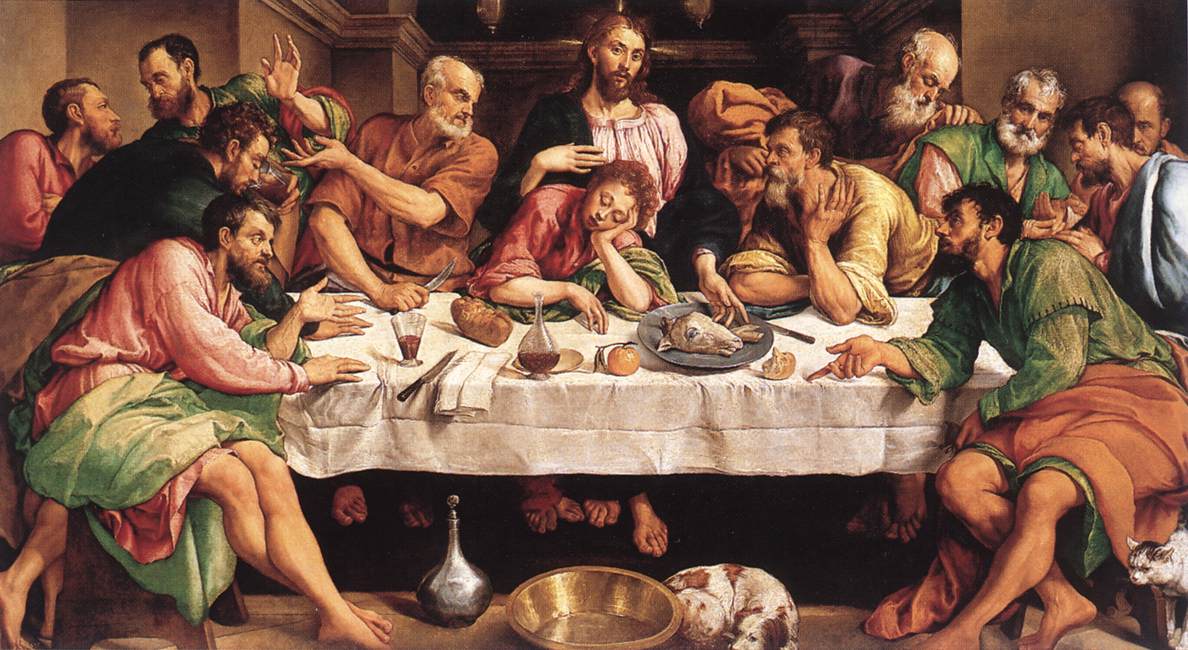
Friday, Feb. 8, John 17:9-19 "I am asking on behalf of those whom you gave me . . ." Jesus prayer on behalf of his disciples, who don't seem to be able to pray for unity themselves, makes the author think of a Last Supper painted by Bassano: "Jesus sits in the center, gazing steadily at the viewer, surrounded by all of the [quarrelling, distracted] disciples, not one of whom is looking at him."
Monday, Feb. 11: Genesis 37:1-11: "When Joesph's brothers saw that their father loved him more than all his brothers, they hated him." The author reflects that Jesus, beginning his ministry in the Gospel assigned for this day, would have grown up hearing the story of Joseph and his envious brothers, and would know how the painful story ends in redemption. The author writes, "May God open our hearts to stories within stories, hope hidden in darkness, providence at the bottom of even the darkest pits."
Tuesday, Feb. 19: Psalm 62: "God alone is my rock and my salvation." The author thinks about images of God as a rock and fortress, and adds: "But the Christian tradition has always insisted that God both shelters us and sends us out.... 'Send us now into the world,' we ask."
Tuesday, March 4: Psalm 97: "Let the many coastlands be glad" (RSV) The author remembers a coastline in Scotland: "The same wind blew a low stinging cloud of sand from the hard-packed beach: sand and sea racing toward each other in an encounter as powerful and primitive as the collision of stars. " He concludes, "May the many coastlands remind us that our gladness too may sometimes be not just a sedate thank-you, but racing like the wind to meet our God."
Wednesday, March 12: 2 Cor. 2:14-3:6: "You are a letter of Christ." The author writes, "I confess I love this epistolary imagery (especially from such a famous epistle writer): the idea that each of us, in ourselves and in our communities of faith, are Christ's open letters to the world."
Thursday, April 3: John 15:12-27: "This is my commandment, that you love one another." "How, our sentimental-romantic culture wonders, can love be commanded? Surely it is something one helplessly (and pleasurably) feels, not something one obediently (and possibly with difficulty) does?" But no... It is an order.
Monday, April 7: Exodus 18:13-27: "You will surely wear yourself out." "Moses's sense of victimized indispensability might sound familiar to workaholic leaders everywhere. ....It is tempting to believe that without me, nothing would get done, and that no one else could do what I do for God. ...God commands us to stop thinking we are called -- or allowed -- to bear our burdens alone."
Thursday, Psalm 37:1-18 "Do not fret yourself. It leads only to evil." The author remembers a friend, afraid of flying, who cheerfully admits that, deep down, she must believe that "it is her white knuckles alone that keep planes in the air." And our fretfulness is no more useful.
Saturday, April 12: Col. 3:1-17: "Let the peace of Christ rule in your hearts." The author searched for another translation where the peace would "rest" or "dwell", but it's unequivocally "rule." The author recalls William Alexander Percy's poem-hymn, "They Cast Their Nets in Galilee," which demonstrates that the "peace of Christ" is "No peace," leading to crucifixion, stoning, loneliness. "Yet let us pray [for] the marvelous peace of God."
Wednesday, April 16: Exodus 33:1-23: "My presence will go with you, and I will give you rest." The author recalls a dream of water skiing in rough waters, and letting go of the bar to sink in "suddenly, blessedly, silent water." It was a comforting dream of contemplative prayer.
SUNDAY April 20: John 14:1-14: "No one comes to the Father except by me." Author quotes C. S. Lewis: "God has not old us what his arrangements about other people are." We do not know that only those who KNOW him can be saved through him. "Grace is a mystery, not a formula, -- and not subject to our prior approval. ... The Spirit blows where it will. ... In hidden ways we cannot see, control, or imagine -- even in other religions -- Christ is bringing the whole world home to the Father. . . ."
Monday, April 14, 2008
Glass Full : Gandhi Opera at the Met

The young man sitting next to me in row K of the Metropolitan Opera for the premiere of Satyagraha liked it much more after our chat at intermission. What helped my neighbor was to think of it not as a story, but rather as ritual re-enactment of episodes in M. K. Gandhi's discovery of the "strength of truth" (roughly satya + agraha in Sanskrit).
My neighbor had nodded off several times during Act One. No wonder, since he didn't know anything about Gandhi's career or about the Bagavad-Gita. He was frustrated by the director's choice not to translate the words, except for bits and pieces projected on the set sometimes near the end of a piece. Naturally, he also expected something with a story.
Since first hearing the opera on record in 1987, I've thought of it as a religious work of art, easily my favorite Glass piece. Writing yesterday in the Boston Globe, critic Jeremy Eichler explains why:
Conceived and written in the late 1970s, it manages to maintain the early integrity of the composer's signature style while annexing the sumptuous vocal and instrumental textures of traditional opera. It is full of supple writing for solo voice, for small ensemble, and often for full chorus. In a sense, it represents an elusive way station in Glass's overarching journey, a moment of perfect equipoise between his past as an austere minimalist pioneer and his future as a neo-Romantic populist. He never again achieved this precise balance. ... Those open to a meditative listening experience that obeys its own laws of glacial pacing will find a visually rich presentation of a landmark Glass score [in the Met's new production], one that flows by with a moving and serene grandeur unique among his oeuvre.Its religious text is 2000 years older than the events depicted on stage. I explained to my neighbor: It's as if someone wrote an opera about the SCLC in Alabama in 1963, but, rather than give Martin Luther King and Reverend Lowry and Bull Connor dialogue from their story, extracted all their words from the King James version of the Book of Acts. My explanation was lost on him: he's Muslim. Anyway, when bullies confront Gandhi, their text is from the Bagavad-gita, something like, "Ha ha! This I have gained today, this whim I'll satisfy. I am young and rich and strong. Who else can match himself with me?" The soprano who saves Gandhi sings something like, "The devilish folk... they have no other aim than to satisfy their pleasure, convinced that is all. So speak fools."
The opera's religious quality comes from the music even more than from the text. Glass's music has been used in movies to suggest desolation, despair, or anxiety (as his song "Facades," his score for the documentary Koyaanisqatsi and the commercial film The Hours), but in Satyagraha, it expresses serenity, resolve, and joy. Glass builds each movement over a repeating bass line, borrowing the technique from Bach, in itself an expression of eternity. The notes all sit comfortably in the ranges of the singers, and these singers projected with ease and warmth. Richard Croft as Gandhi invested repeated lines with vitality, and all the singers made variation in dynamics when there was no variation in the melody.
The middle scenes have pleasing fast-paced motion and slow dramatic build, as Glass builds variety by revoicing the harmony, mixing and matching different lines at the climax of a movement; but I've always been most partial to the last movement. It's the longest, I believe, and it accompanies the least action: a march of miners gathers adherents despite threats of violence, while Gandhi and others meditate on the way that Truth is reborn when there is trouble, generation after generation. The act begins with an off-stage chorus singing, a cappella, a pulsing "ba - ba - ba - ba" d minor chord that shifts to f minor and back. The orchestra takes up those two chords with upward arpeggios; two women sustain long notes over the same pair of chords and the same pulse; Gandhi eventually sings it, too. When he's alone on stage, several minutes later, the music shifts to a major chord (C major, I think) and he sings a C major scale, from E to E, in plain old quarter notes, many, many times, slightly out of sync with the arpeggios. Oldest trick in the book, switching from minor to major, but it works, and Croft's voice is like a balm.
Of course, I knew all this before I went to see it. The visual aspects of the production were striking, and very much in the spirit of the music and text. Here are some highlights:
It opens in silence, moments after the event in Gandhi's sojourn in South Africa that changed his life: He was literally kicked off of a train for refusing to give up (on account of his color) a seat that he had paid for lawfully. Gandhi picks himself up, shaken. He then opens a small book that he finds near his suitcase -- evidently a copy of the Bagavad-gita -- and begins to sing before the orchestra joins him.
Crowding the stage were characters dressed as descendants of Europeans in South Africa, all carrying newspapers, and their Indian lower class, all carrying baskets. As the song built, its text concerning impending battle between factions of a single family, giant (20 foot high) humanoid monsters rose up behind the respective camps, made of newspaper and baskets.
Divestment of clothing came to represent sacrifice to join the movement - so, everyone in cast and chorus took off their shoes at the end of the first scene, and later placed their coats and wraps on hangers that lifted the clothing to the ceiling fifty feet above the stage. (I enjoyed watching the chorus come out at intermission to claim their own shoes!)
During a turbulent instrumental interlude, a whole monster - movie cityscape with giant puppets gathered behind Gandhi to menace him, and disappeared as suddenly, all during the scene of Europeans bullying Gandhi. Another cool element of that scene: Shoe shine "boys" caring for every chorus man's shoes, bowing and scraping while the men sang their arrogance. A very literal image, but effective: every chorus member and cast member comes forward to cast their hated government-issued identity cards into a hole in the stage floor, which Gandhi at last ignites, while the chorus sings triumphantly about the resolve to accept pain if it is a consequence of duing duty.
Finally, the semicircular wall of corrugated steel split in the final scene, revealing a projection of clouds on blue sky, while we see "Martin Luther King Jr." in his pulpit (seen from behind) as he gestures to an unseen crowd, while Gandhi sings "Whenever the law of righteousness withers away... then do I generate myself on earth... for the protection of good, thrusting the evil back and setting virtue on her seat again."
Concluding his review in the New York SUN, critic Jay Nordinger asks,
Is Satyagraha really an opera? Or is it more like an oratorio or cantata, with a production around it? There is certainly a sense of ceremony about this work. It has an air of churchliness, dare I say. (Templeness?) And a cynic may find it culty and naïve, not to mention pretentious. But there is a less cynical, and better, view. .... We owe this to the minimalists, if nothing else: At a time when beauty in music was under attack — vilified as a bourgeois indulgence [i.e., during the hegemony of serialism in the art music and jazz music of the 60s and 70s] — they stood up for it.After that uplifting performance (boy, did you ever leave the theatre humming the tunes!), I have to report being let down by Prokofiev's The Gambler. The scenery was promising, at first: a green felt curtain, and a stylized setting for a cramped apartment elongated way out of proportion, suggesting a wall built of cards. But a little more minimalism would have helped this one: too much variety is as stultifying as too little. I'll admit that I dozed off several times. Every time I awoke, the characters on stage were continuing to discuss the same basic thing: "I need money to pay a gambling debt." The second act was more interesting, as the protagonist bets repeatedly on red, to win money, to serve the girl he loves. The stage becomes a giant roulette, and a chorus sings and dances across it, but it all comes down to this: He wins a lot of money. He offers her the money. For reasons that have something to do with pride or integrity (why should she bother with those now?), the love interest rejects the money and him. Opera over.
That night, I saw the much-touted London production of Sunday in the Park with George, about which I've written often on my web site and on this blog. All I can add is a fresh appreciation for James Lapine's deft characterizations of people in just a few lines of dialogue, and the wonderful work of actors to make such minor characters seem totally real during their brief times on stage. (This is especially noticeable in the second Act, where most of these characters appear only for one song and the scene that follows.) The computer-generated background was cool, but not so much more cool than ingenious cutouts or the production in Washington that utilized giant easels and canvasses as scenery. The actors in the lead were endearing and real, energetic and playful. The piece was affecting as always, in the same ways as always... so I rather wish that I'd spent my precious two days in NYC sampling a couple of new productions on Broadway instead of The Gambler and Sunday. Oh well.
(Reflections on the Metropolitan Opera's premiere of SATYAGRAHA, composed by Philip Glass, who collaborated with Constance DeJong on text, adapted from the Hindu scripture The Bagavad - Gita. The production was designed and directed by Phelim McDermott, Julian Crouch, and others from London's theatre company IMPROBABLE. Also, brief comments on the Met's production of Prokofiev's THE GAMBLER, and Roundabout theatre's production of Sondheim's SUNDAY IN THE PARK WITH GEORGE)
Thursday, April 10, 2008
Nyman's HAT: Nothing Minimal About It
Reading John Simon's dry review of Sondheim's SUNDAY IN THE PARK WITH GEORGE in the week of its premiere in 1984, I ran across a name I'd never seen before. Simon was dismissing Sondheim's music as pastiche of "Steve Reich's minimalism." That was enough for me, and soon, I was purchasing recordings by all the minimalists I could find: Reich, Glass, Adams, Riley, and a latecomer, Michael Nyman. They taught me one important lesson, from which many others flowed: there's more to music than melody and harmony. They also gave me courage, because I'd despaired of ever catching up with Sondheim who knew counterpoint and harmonic progressions by heart. Hearing the "Opening" to GLASSWORKS, thrilling DESERT MUSIC by Reich, affable "In C" by Riley, and the stately first movement of "Grand Pianola Music" by John Adams, I thought, "I could do that!" Or, in the words of Peter Schickele, after Ellington: "If it sounds good, it is good."
This week, I'll see three different pieces of musical theatre that I've known mostly from recordings since then. Tomorrow, it's SATYAGRAHA by Phillip Glass at the Metropolitan Opera. Saturday, it's SUNDAY IN THE PARK WITH GEORGE. Last night, it was THE MAN WHO MISTOOK HIS WIFE FOR A HAT by Michael Nyman, with libretto by Nyman and Christopher Rawlins, based on the essay by Dr. Oliver Sacks.
HAT is a "chamber opera," and I'd say it was a great success at its performance at Emory's Cannon Chapel last night. The audience included as many medical students as arts lovers, as it was sponsored by Emory Health Services. They were prepped to be fascinated by the uniquely focused plot: a nuerologist conducts tests to diagnose a patient's problem.
Yet it wasn't "clinical." In spoken lines at the start, "Dr. S" tells us how neurologist's jargon is all phrased in terms of loss, but tells us nothing of what the patient has; it's all what, not who. We were all moved, I think, by the plight of a man who seems at first to be healthy and happy, attended by his doting and energetic wife. The doctor (Oliver Sacks, generalized) is at a loss to understand why the man ("Dr. P") had been referred to a neurologist at all... until the man, finished with tests, dresses to go. I teared up at the moment when the wife and the doctor realized that the affable Dr. P has put on only one of his two shoes. Asked where his other shoe is, Dr. P points to his stockinged foot and sings, on a monotone, "That is my shoe." Dr. S(acks) sings back on the same pitch, "That is your foot. There is your shoe." Dr. P, embarrassed, pretends that it was just a joke. But the more that Dr. P hummed and smiled, the more horrified the wife, and the Doctor, and the audience felt. This man is somehow, in some way, perceiving the world very wrong, and it must be a nightmare, and he doesn't seem to know it.
Some moments are funny and touching at the same time. Dr. P sees a rose, and says that it is a "convoluted red form" with a "green vertical appendage." He struggles to figure out what to do with a glove, which is a "continuous surface...with five outpouchings" used, he guesses, for storing coins of five different sizes. He mistakes Bette Davis's close-up for a battlefield or contest. And he cannot recognize his wife's picture, or his own, or the difference between a photo of his face and a mirror -- while his wife looks on, losing her ability to deny that something's wrong.
I wonder, would we have had the same experience, or a better one, had there been no music? Would an enactment of Sacks's essay be just as moving?
Nyman reiterates one sequence of chords for ninety minutes, varying riffs (no doubt) and the key (I'm pretty sure). It was the carpet of sound under which the three characters sang lines that very often overlapped. Sometimes, we watched the three doing their business silently (collecting pictures for a test, stirring tea, arranging chairs) while music continued. In this way, we got Dr. P's intense efforts to put his perceptions into words, his wife's excuses for his odd behavior, and his doctor's analysis, all at the same time. The repeated piano figures with steps up and down the scale increased tension during a few sequences, most notably the scene when the impaired patient beats the doctor in a game of chess ("Bishop to Q4" is a typical line). The soprano's highest notes , 4/5 of the way through the opera, shock her husband into silence. There's a refreshing scene where the patient and doctor join in a performance of a song from Schumann's DICHTERLIEB, its pulsing accompaniment fitting in well with the rest.
Near the end, a distinctive slurred triplet in the piano's bass line recurred, and I recognized a connection between the music and the text. Dr. P may not see the whole, but he recognizes a feature (Durante's nose, Hitler's mustache, his brother's big teeth), the way we might perceive that we've heard this music before because of that little slurred triplet or a particular interval.
There's another element that the music brought. It's hard to imagine the performers' characterizations without the soprano's chirpy vocal lines, the doctor's vulnerable and incisive tenor notes, and the patient's stolid bass -- or, in one wonderful and disturbing passage, his lyrical baritone describing a photo of a lovely scene at the shore (only it's some machine, not people at the shore at all).
The performers were young for their roles, but perfect in voice and just fine in characterization: Jessica Stavros, Gideon Dabi, and Daniel Gerdes of the Boston University Opera Institute. Pianist Jeffrey Stevens never flagged in ninety minutes of unremitting, pulsing notes.
Until the end, we never applauded, and few laughed (I did). I suppose no one was humming any of the lines. But the music propelled, colored, punctuated, and structured the theatre. Having greatly enjoyed maximalism at the Met's HD broadcast of BOHEME last weekend, I can attest that the label makes no difference in the drama.
Tuesday, April 08, 2008
Bearing Fruit, Increasing in Knowledge
Every year at this time, I'll pull out of my driveway worrying about work and schedules, and be startled by shades of pink and bright green in the trees. While I've focused on my hectic winter routine, there were forces working under the surface, with sunshine and rain and nutrients in the soil, preparing all these buds and blossoms to appear seemingly overnight.
The readings for today start with some kind of cleansing to dedicate a community to God, and then look ahead to "bearing fruit." It's comforting to think that God can be working under the surface in my life, too, even while I'm distracted with errands and meetings.
Still, Paul connects growth to "increasing with knowledge of God." I'm old enough to have heard every word of scripture at least once, but I hope that doesn't mean I've no room to grow in knowledge of God. I think that's why the Scripture emphasizes community so much: we need to teach and work with each other to grow beyond book knowledge.
Thinking of these things, I now imagine walking from the sanctuary down the long corridor as if I were traveling from the roots of a tree up the trunk. In the Parish Hall, I see children, adults, and seniors conversing over coffee and snacks, while Father Ray's Power Point flashes all kinds of learning, worship, service and fellowship opportunities that engage our community every week: branches that shoot off in all directions, bearing fruit.
Monday, April 07, 2008
Updike's Witches
John Updike's upcoming novel returns to some old characters for THE WIDOWS OF EASTWICK, so I've pulled out my old paperback of the 1984 novel THE WITCHES.... The main thing that strikes me, so soon after re-reading COUPLES, is how the books' lines run parallel:
We meet an insular community within an insular community (the couples' group within the suburb of Tarbox, MA, and the coven within the small town of Eastwick, ME). As we get to know them and their routines and lovers, a newcomer disturbs the equilibrium (Foxy Chapman in COUPLES and Darryl Van Horne in WITCHES). Long story short: the pleasures that ensue contain the seeds of the community's disintegration. In both novels, the dissolution of the community is not the end of the world, and life goes on for the individuals, away from each other.
I enjoy, as always, simply being immersed in the lives and sensations of these characters. There's also the tricky way that Updike plays Hawthorne's game of giving us magic that might also be mere rumor, or coincidence, or dream, or metaphor. One witch shriveled her husband to nothing, and she keeps his dust in a jar among the tomatoes; another turned her husband into a doormat. One shares a vision of flight. One casually kills a squirrel with her evil eye when she sees him raiding her bird feeder. Together the three witches wish cancer upon a rival -- but the young woman already said she felt a growth.
Written in 1984, the novel looks back with more than a hint of satire on the hippie - feminist - Weatherman currents running through the culture in 1969. Betty Friedan's THE FEMINIST MYSTIQUE referred to men's pretense of protecting women's mysterious closeness to nature, saving them from the rough world of male business and government. Updike catches a whiff of that in later feminists' own extolling of sisterhood. So there's this sisterhood of women who would certainly agree with the once-popular feminist bumper-sticker that "a woman without a man is like a fish without a bicycle," and yet they're all thrown into a tizzy of excitement and jealousy by meta-male (and Satan) Darryl.
I especially enjoy Updike's nearly plausible explanation of a magical thunderstorm. It's willed by the witch Alexandra Spofford to spite the sun-tanned and fit young adults whose frisbee and radios spoil her walk at the beach. Updike observes that the weather certainly has an effect on our moods; Alexandra simply reverses the process.
Updike is particularly rough on a Unitarian power couple of liberals, and Felicia, a literally sharp-tongued community activist (she spits up tacks, sticks, and feathers under the spell of her enemies). He usually shows empathy for all of his characters, but not with these. "Felicia had a considerable love for the underprivileged in the abstract but when actual cases got close to her she tended to hold her nose." The pompous Unitarian preacher - turned - terrorist blows himself up; his wife becomes leader of a rival coven and spits up pieces of insects in the pulpit, and Felicia's husband bashes her head in mid-screed. Updike slowly builds that scene of the murder by filling in the husband's reflections on the past and present between lines of spoken dialogue. After the crime of passion, someone (husband Clyde, or Updike's vaguely situated narrator -- who sometimes speaks for Eastwick) reflects, "Marriage is like two people locked up with one lesson to read, over and over, until the words become madness."
There's another set piece near the end: the devil's sermon, delivered in the pulpit of the Unitarian church. It's a stick in the eye of all who say that creation is good, pulling out of an encyclopedia the horrible slow deaths caused among wildlife by certain insect poisons and ghastly parasites, with gratuitous (even circuitous) processes that seem way out of range for evolution to explain. (Begins p. 321 in the Fawcett paperback of 1985.)
There's no way for me to read the book without flashing back to the movie, which starred Jack Nicholson as Van Horne, Cher as Alexandra, and Susan Sarandon and Michelle Pfeiffer as the other witches. Cher's performance was particularly memorable in a scene that doesn't occur in the book: Alexandra rebuffs Van Horne's crude seduction with self-assured amusement, ending her list of his faults with, "And you smell." But Van Horne retorts with a description of Alexandra's life, her truncated expectations, her unexpressed dreams, and her self-delusions. He circles, while the camera closes in on Cher's face, and we watch as her smug smile freezes into a grimace and tears form in her eyes. The end of the movie is pretty silly.
John Williams' score for the movie is a favorite of mine. His main theme is a pastiche of Lizst's Mephisto waltz, and its recaps grow old; but the long seduction sequence is eerie and fun; and I love especially the piano toccata that Williams uses for a magical tennis game.
Thursday, April 03, 2008
Cabinets, Committees, and Me
During our meetings, the more we wished aloud for other options and chased other possibilities, the more we saw a wall with no other ways through, and its narrow gate closing. For all that, we also felt like we were taking a gamble.
We've made our decisions, for better and for worse, and consequences are rolling in. "It's socialism for the rich," says one about the Fed's recent decision to assist the buyout of Bear Stearns, while another says, "A failure to act would have been economic disaster for everyone." Al Maliki misjudged the strength of his forces and misjudged the time and has irrevocably weakened his floundering government in Iraq, or else he has finally demonstrated his will to break the stronghold of tribal militias in Iraq. We have hurt church programs and slapped faithful staff in the face, say some; and we have responded sensibly and hopefully to current circumstances, within parameters set up by decisions made years ago say others.
Cabinets and committees have run the world for the last two or three hundred years. I've taught about it, and read about it; now I'm in it.
The feeling recalls Abe Lincoln's fit of temper when accused of ruining his party's chances out of pure personal ambition. "I have tried to do what's best, you know how I have, and now to be accused of doing it for selfish reasons. . . !" His secretary wrote that Lincoln mastered his temper at this point: "Well, things could be better, they could be worse. All I can do is what appears to be right." (Quoted from memory.)