Wednesday, June 15, 2016
As If Hamilton Needed More Raves
I've only heard the full cast recording once, and only Act One straight through, but every single minute had me smiling at clever turns of phrase, perceiving new facets to characters, and marveling at how creator Lin-Manuel Miranda compressed history without lopping off parts that don't fit neatly.
Miranda's vocabulary, both musical and verbal, is contemporary without cute anachronisms.* He gives us resonance to contemporary politics without sloganeering. He gives us songs ecstatic and / or tender when dealing with romance and parenthood, without goopy, generalized sentiment. And did I mention that it's funny?
In the act one finale, as Hamilton moves on to the work of making a new nation, Miranda layers all the characters' themes together in ways that take on new resonance. We hear rivals, buddies, and loved ones sing refrains from different songs: "Wait for it... You're running out of time... You're never satisfied... Look around. Isn't this enough? ...History has its eyes on you."
We also hear "I am not throwing away my shot," which Miranda uses at least three ways. It first meant, Hamilton would not throw away his shot at success. Later, he makes soldiers throw away bullets when a misfire would alert the sleeping enemy. In the fatal duel with Burr, Hamilton will aim away from his longtime friend, as a gentleman was expected to do.
I've seen photos and bits of video; the color and movement must add so much. But propulsive forward movement and contrasting shades in characters and their moral choices are all there in the music and lyrics of Lin-Manuel Miranda.
Next: Act Two.
Miranda takes three threads to their conclusions: how does Hamilton set up America's future prosperity and stability, what motivates Burr to kill Hamilton, and how will the romantic tension resolve between Hamilton, his wife Elizabeth, and her sister Angelica? Hamilton's affair with a married woman brings a big emotional blow up and pathos. When Jefferson says, "Can we get back to politics?" it's comic relief. In pithy rhymed dialogue, Hamilton fights the "Democratic Republicans" through the first partisan battles of our history. Miranda makes Burr sympathetic, even while we can see that Hamilton is right; the final duel has accrued emotional power by all the preparations we've had for the moment, including two previous duels.
Reprises are nothing new, but here Miranda planted ideas early for the ways he can transform them in the end. There's a motif of counting to ten that Miranda uses for different effects in act two. There's a theme of Hamilton's writing and working as if he has no "time," tied with a growing concern for his legacy in act two. Eliza Schuyler Hamilton's telling young Alexander in the first act to "look around" at how far they've come turns into a theme for reconciliation. "Rise up" originally referred to Hamilton's ambitions; the phrase returns with emotional resonance at the fatal duel.
This score is endlessly interesting, and so are the historical characters. So, here's my rave, as if Hamilton needed it.
*Okay: one allusion to a model of the modern major-general is 100 years ahead of Gilbert and Sullivan, but it fits Washington so well; and one song "rewinds," but it's a meta-theatrical technique, and the word itself might as well be 18th century, for all that today's teens know of it.
Alone on Two Wheels around Atlanta
Yesterday, I took this photo of a turtle on the Silver Comet Trail some twenty miles west of Atlanta. Solitary, shielded, shy, steady on a long road: I feel strong kinship with this little creature, helmeted, wrapped in my own thoughts for hours, trying to average 16 m.p.h.
I started riding in 1991 with Jason, a bike enthusiast in my class of 8th graders. I needed to lose weight, so he repaired my bike and showed me places to ride where we lived in Mississippi, especially on the Natchez Trace, in Vicksburg battlefield park, and around the Barnett Reservoir. (We met again for rides last year.) Lose weight, I did, but I also learned how suited cycling is to my temperament.
A smart phone adds a soundtrack to the experience. Sometimes it's music -- I favor Broadway and "80s Cardio" -- but more often I have Atlanta's NPR station WABE along for the ride. Good-willed, thoughtful conversations concern politics, science, religion, literature, movies, sports, and -- well, all things considered in this American life. On Saturday mornings for the past six years, pedestrians and drivers along the way from the Martin Luther King Center downtown to the Stone Mountain Park have seen this lone biker laughing out loud during Car Talk and Wait, Wait, Don't Tell Me. The ride has become a ritual that helps me let go the anxieties about personal and world affairs that build up during a typical week.
Riding my bike is the only thing I do that feels like the only thing I should be doing.
Monday, June 13, 2016
Updike's Couples:
What's Adult in Adultery?
[See my John Updike page for many more posts about his work. See especially my essay "More Fun with Couples." ]
Adultery among two or three couples makes your basic bedroom farce; but with ten couples, John Updike made an epic. I happen to have read his 1968 novel Couples around every ten years since age 27, an experience like returning to a favorite vacation resort: while there's pleasure in the familiar, I notice things differently. This time, from page one, I was thinking about the man writing it.
Anyone who sees Updike's photo on the book flap must wonder what he's up to with the first character to speak, Piet. The author, tall, thin, pale, and beak-nosed, describes in Piet his physical opposite: short, broad, reddish, flat-nosed (3). But the dissemblance ends there. Like Piet the carpenter, Updike's work made him available to the women in the suburb where he lived (Ipswitch, MA) while the men worked in Boston all day. Like Piet, his affair with a married woman broke up two marriages. Also, like Piet, his attendance at the congregational church was, in his circle of sophisticated couples, eccentric. So Updike has barely disguised his connection to the story.
Updike and Piet share one virtue. We are told right away that Piet is "in love with snug, right-angled things" (4). Even making love to Georgene, his mistress when the story starts, his attention is divided between the construction of her body and that of her "gambrel-roof late-Victorian" home "with gingerbread eaves and brackets, scrolling lightning rods, undulate shingling, zinc spouting, and a roof of rose slates" (64); restoring a home for Ken and Elizabeth "Foxy" Whitman is his entree to their marriage. Piet's appreciation for old-fashioned workmanship puts him at odds with business partner Matt Gallagher, now developing cookie-cutter homes (67). Only in his craftsmanship can Piet claim to have any integrity; it's his one saving grace.
Updike's own love for "snug, right-angled" finishing touches extends throughout his career. After three decades, his novels about "Rabbit" Angstrom end where they began, on a neighborhood basketball court. The marriage of the Maples, depicted in short stories over decades, ends in divorce court with a reference to their wedding, in a gesture so unexpected and so appropriate that it seems Updike had planned it all along. Chapter by chapter, The Widows of Eastwick mirrors The Witches of Eastwick , effecting a kind of atonement. In a long poem called "Midpoint," Updike asked questions about his life at 40 that he answered beautifully on his deathbed in "Endpoint," a long poem that ends as it starts, with gratitude.
So Updike exercises the same care to lay parallel channels that will guide us through the messy events of his epic. He lays the tracks down on the first couple of pages. We read, first, "What do you think of the new couple?" It's a night in spring. Thirty-something Piet Hanema and his wife Angela undress for bed following a party. The "new couple" are the Whitmans. Piet's question implies that a new couple might be good or bad for the established couples, as yet unnamed.
So, the spring night sets the story on a time track, as seasons will advance, lovingly described, from Piet's budding interest in Foxy to a heated affair in summer, to parts of the novel subtitled "Thin Ice" and "Spring Again." Updike reinforces his time track with allusions to current events of 1962-1963, with special focus on the young couple in the White House.
Other tracks of the first page will take us from this bedroom to others, and from this party to others: a party involving all the couples provides a climactic show piece in every section of the novel, among informal gatherings for basketball, skiing, and sailing. Supporting it all is the arc of Piet's affair with Foxy, with collateral damage to all the couples' lives together.
Keeping score for ten couples could overwhelm the readers, so Updike gives each pair a member with an identifying shtick. It's speaking French or quoting Shakespeare; being sweaty, scientific, or dedicated to social causes; being a shy Korean, an earnest Jew, a crude Greek, or a moralistic Catholic. Once we've met everyone, Updike doubles back to fill in back stories for the Applebys and Smiths, in a section called "Applesmiths and Other Games." Later, we learn more about the Saltzes and the Constantines (or "The Saltines"). When dissolution and death come to the couples, Updike gives us a deeper look at the Gallaghers and Ongs.
But after the Hanemas and Whitmans, he focuses most of our attention on the Thornes: Piet's mistress Georgene, and her husband Freddy, Piet's "thorn" in the side. Freddy is a dentist and lewd clown. With a thread of images, Updike makes this atheist a kind of priest who presides over couples that he calls "a church for each other" (9). Freddy preaches a dentist's gospel that sex (176) and self-deception (292) anesthetize the couples against decay and death, He serves up ham with the eucharistic formula "Take, eat ... this is his body given for thee" (386), appears "sacerdotal" in his white dentist coat (431), and encourages confession (434). By the novel's end, he has taken a grave professional and personal risk to help Foxy.
All angles of the novel meet at the spire of the town's congregational church. Describing Piet in bed on the first night of the story, Updike uses the obvious pun to connect Piet to the cock on the weather-vane atop the town's highest steeple (18-19). At the end, when lightning sets the structure afire, the couples gather to witness the event. Piet, now separated from Angela and the other couples, stands apart. If the lightning is the judgement of God, or maybe a deposing of a false god, Piet doesn't feel it that way: "Piet wondered at the lightness in his own heart, gratitude for having been shown something beyond him , beyond all blaming" (539). Immediately, he spies a pamphlet washed out of the church by fire hose. Dated 1795, its message encompasses more than his personal gratitude:"But if there be any nation [with reason to thank God], the United States of America are that nation." Days later, when workmen remove the cock from its precarious perch over the town, Piet happens to be standing where he first saw Foxy. There's that symmetry Updike appreciates so.
The first time I read Couples, I felt the pleasure of discovering what the world was like for the grown ups who reared me, taught me, and awed me. Now, at twice the age of Foxy Chapman, I'm sensitive to the childishness of these young adults: whatever Freddy Thorne says to elevate adultery, it comes across as just another competition (487), like one more party game; Piet is disappointed to realize that the "first whiff" of adultery is best (354) before that relationship, too, traps a man in responsibilities. Updike lets us see that there's nothing adult in adultery.
I'm still left with the Piet problem. As Piet betrays loved ones, bullies friends, and says hurtful things to his little daughters, Updike clearly doesn't shield his protagonist from our dislike. Was Couples Updike's 500 page rationalization? A plea for understanding?
In "Endpoint," Updike wrote of his pride in seeing his books, one for each year, lined up on a shelf. His daily work transforming experience with his loved ones also supported his loved ones. Couples wasn't Updike's defense, or his therapy. He simply calculated that an erotic expose, based on personal experience, layered with religious and social implications, would make both a popular best - seller and a literary reputation so that he could provide for his family ever-after.
References
Updike, John. Couples. New York: Random House Trade Paperbacks, 2012.
"Eric" at GoodReads.com felt the last section of the book redeemed much that he detested in the rest. The whole year of the story is "just a blip" in the lives of the community. See his excellent review here.
Thursday, June 09, 2016
Producer Scott Rudin Talks Sondheim
on Fresh Air
"I was with him most of yesterday," Rudin replied, "and we were working on his next show."
In 2002, a lawsuit and counter-suit had concerned the musical that eventually became Road Show. Rudin had publicly expressed disappointment with the way it was shaping up. He told Terry Gross that he hadn't recognized that Sondheim "was in his own process, frustrated that the show wasn't working...." A couple years later they settled out of court. Still later, delighted by Road Show in its final form, Rudin wrote to Sondheim, admitting that he had been wrong. They "re-introduced themselves," and Sondheim consulted Rudin for the chapters on Road Show in his memoir Look, I Made a Hat. [See my reflection on Road Show.]
It had been a painful episode. "[Sondheim] was a huge reason that I got involved in theatre," Rudin said. "I saw Company 12 times and Follies 13 times."
He says Sondheim's new show, with book by David Ives, is based on Luis Bunuel's movies The Discreet Charm of the Bourgeoisie and The Exterminating Angel. Rudin says the new show is "bracing ... shocking ... political ... really smart ... as good as anything he's done." He hopes to see it at New York's Public Theatre in 2017.
At Terry Gross's invitation, Rudin chose a song by Sondheim to discuss, "Loving You" from Passion. Its addition during previews, he said, changed the audience's perception of the character Fosca:
Loving you
Is not a choice,
It's who I am.
"She had been introduced to the audience as a figure of scorn and derision. This song was designed to turn the audience towards her. She's fearsome ... but the song gives you insight into her character."
Loving you
Is why I do
The things I do.
Loving you
Is not in my
Control.
But loving you,
I have a goal
For what's left of my life...
I will live,
And I would die
For you.
"This is what musicals do," Rudin said. "The moment is lifted up by being sung. "
[Photo: Donna Murphy as "Fosca" in the original cast of Passion, with Jere Shea as "Giorgio."]
Wednesday, June 08, 2016
Flannery Would Love It
My friend Susan and I thought we'd go down for a look-see last week. We
know Flannery would have loved the sign there on the highway to Milledgeville,
GA, across from the Honda store. It's the font they might have used to announce King Kong, not what we literary groupies expected on
our way to a shrine.Flannery: We're on a first-name basis, all who have read her stories. We trade fond memories of her fiction, as if we were remembering a close friend. Her voice is so clear in her fiction and assorted prose that we feel like we know her. The immune disorder lupus killed her in 1965, but she's still a part of our lives.
[Read my review of the film Wildcat about Flannery at the time of her diagnosis.]
The gravel drive lined with trees, a pond, fenced field, a barn -- all call to mind stories of a charging bull, boys dancing in a burning meadow, a hayloft where a Bible salesman lies with a woman who has a wooden leg. We parked in grass, and meandered through the yard to the screened in front patio. We heard chirping
birds, whirring insects, and, from across the highway, amplified calls for "Honda agent so-and-so,
pick up line 2."
The farm home was built before the War (in Georgia, they mean the Civil one), with major additions in 1959. Flannery's mother ran a dairy farm here while her daughter, suffering with lupus, wrote and read in the downstairs area. Our sweet teenaged guide emphasized that Flannery was no recluse, and we saw the cocktail shaker and ice crusher to prove it.
Out back are a young peacock and old peahen, behind chicken wire. Thanks go to the Flannery O'Connor Society for providing this must-see nod to the days when the author's flock roamed her mother's farm. Her essay about "The King of the Birds" in Mystery and Manners described what we saw last Friday:
The cock, his tail raised in a shimmering arch around him, will turn this way and that, and with his clay-colored wing feathers touching the ground, will dance forward and backward, his neck curved, his beak parted, his eyes glittering. Meanwhile the hen goes about her business, diligently searching the ground as if any bug in the grass were of more importance than the unfurled map of the universe which floats nearby. (MM 14)
As usual with Flannery, we laugh at the peafowls' manners even while we get a hint of the mystery in the universe -- read, immanence of God in our world.
"Many people love Flannery for the wrong reasons," said novelist and critic Greg Johnson to me during a writing seminar he led several years ago. He never elaborated, but I guessed he meant that she's good because her writing is good, not because it expressed her Christian faith.
I take his point, but Flannery herself affirms that "moral judgment is part of the very act of seeing" (31). She writes what she sees, and her theology informs her vision. Basic theological questions are, "What is the nature of Creation? What is Sin? What is Redemption?" Peacocks are a sign of the goodness of God's Creation. About Sin, Flannery doesn't hang up on "sins" in the fundamentalist sense of choices made in bars and beds, but writes of "distortions" in "modern life": the "problem" for her "will be to make these appear as distortions to an audience which is used to seeing them as natural" (33).
And Redemption? Inspired by our trip to Andalusia Farm, Susan and I downloaded John Huston's film adaptation of Flannery's Wise Blood from 1979, whose protagonist (emphasis on agony) Hazel Motes focuses obsessively on the question of "redemption." The role was a breakthrough for the young actor Brad Dourif whose thin frame and boyish face are rendered striking by his eyes: grey, narrow, expressive, unblinking for long stretches of film. [Photo: Brad Dourif as "Hazel Motes," left; Dan Shor, as "Enoch," center; the hand of Harry Dean Stanton as false preacher "Asa Hawks."]
Flannery surely chose the character's name purposefully to emphasize vision. What other use of "mote" is there in our language besides the familiar saying of Jesus, "Why do you concern yourself with a mote in your brother's eye when you have a beam in yours?" "Hazel" associates naturally with "eyes." Then, in the novel, Flannery consistently abbreviates his name to "Haze," suggesting unclear vision. The through-line of the story is Hazel's fascination with a preacher in dark glasses who claims to have blinded himself in a demonstration of faith. Flannery, who expected her readers to come to her work with "experience, literary and otherwise" (MM 138), borrows a trope from Sophocles and Shakespeare, whose characters Orestes and Gloucester lose their eyes at the moment when they recognize how they've been blind to the truth about themselves.
Now, exactly what Hazel has seen, I'm not sure. I saw the film when it was new, and my date left shaking her head. "How can you say that was written by a Christian?" she asked, near tears. "All I saw was pain and suffering. Where was the redemption in that?" I had no clear answer, then. Over the next couple of years, I read all of Flannery's work, and felt I had a pretty good grasp on most of it, but still not on Wise Blood. 37 years later, it was the same experience.
Here's what I know: Every frame of the film is part funny, part creepy, beginning with the shot in a Macon, GA cemetery of a granite-carved phone over the epitaph, "Jesus called." I notice that every character encountering Hazel for the first time mistakes him for a preacher. Sympathetic characters instantly see him as a personal savior: the dim-witted eighteen-year old Enoch (cf., Genesis, son of Cain) somehow sees in the preoccupied young stranger a potential friend in the unfriendly city, the preacher's daughter "Sabbath Lily" sees him as a man to take her away from her mean father "Asa Hawk," and the widow who lets a room to Hazel finds purpose in life taking care of him.
But Hazel rebuffs all of them, interested only in refuting his grandfather's sermons of sinfulness and hellfire, so terrifying that young Hazel in flashback, cringing under his grandfather's gaze, wets his pants. Also in flashback, we see young Hazel, having peeped at a naked woman in a side show tent, tearfully filling his shoes with rocks as penance. Now, as an adult, Hazel fiercely preaches that we don't need salvation, and there is no resurrection: "the blind don’t see and the lame don’t walk and what’s dead stays that way."
The film arouses strong feelings, mostly veering between pity and fascinated amusement. So much of what the characters decide to do makes no sense, except in the characters' peculiar understanding. For example, when Hazel preaches that we need a new Jesus "that's all man, without blood to waste," Enoch steals for him a desiccated shrunken corpse from a display in the local museum.
Near the end, Hazel hears a confession from a dying man. Hazel himself ran the man over in his car, but all the victim wants to do is unload all his guilt going back to when he made life hard for his mama. His last words are "Jesus hep me." Against all his efforts to escape Jesus, Hazel seems to have become, in the end, an agent of Jesus. Over the next few scenes, we see Hazel's attempts to atone: stones in his shoes, barbed wire under his shirt, and the self-blinding that Asa Hawk never had the courage to accomplish.
What does it all add up to? Remembering Greg Johnson's warning, I'll say that it doesn't have to "add up" to anything, only to carry us along in an experience of emotion and images, still fresh after 37 years. But Flannery herself tells us that she's up to something else: "Redemption is meaningless unless there is cause for it in the actual life we live, and for the last few centuries there has been operating in our culture the secular belief that there is no such cause" (MM 33).
An essay by Francine Prose tells us that the atheist John Huston thought he was filming a hilarious send-up of "religious mania" in the South. When Brad Dourif asked Huston about nuances in his character, Huston said to forget nuances, "Hazel is a one-note character." But Dourif and Huston were both stumped by the last scenes. Prose writes:
According to Huston biographer Lawrence Grobel, a hasty script conference about Hazel’s fate persuaded Huston that at “the end of the film, Jesus wins.”...How Flannery O’Connor would have loved that. And though she was the most unsentimental Christian, you can’t help thinking that she would have seen it as a sign—a sign of the truth (or, in her view, the Truth) asserting itself and making itself known. Perhaps she would have thought that the progress of the production had, in some mysterious way, paralleled the plot of her novel. In spite of himself, the director had made a film about a Christian in spite of himself, groping his way toward redemption.
Yes, how Flannery would have loved that.
Prose, Francine. "Wise Blood: A Matter of Life and Death." Web site: The Criterion Collection. https://www.criterion.com/current/posts/1132-wise-blood-a-matter-of-life-and-death
Tuesday, June 07, 2016
Playwright Sees God: Remembering Peter Shaffer
With news yesterday that playwright Peter Shaffer had died came expected mention of award-winning plays Equus and Amadeus, their film versions, and Shaffer's exploration of conflicts between strong-willed men. One report mentioned something I hadn't known, that he was a lapsed Orthodox Jew. That fact fits with a third character in Shaffer's plays, omitted from the commentaries I saw: God. To this day, a single moment in the original production of Amadeus is the strongest image I've ever seen (and heard) of the Divine.
Before he found God as his theme, Shaffer had done moderately well around 1960 with domestic dramas and comedies, the outstanding one being the farce Black Comedy, which begins with animated dialogue about a lovely apartment and beautiful paintings, all spoken in total darkness. When the lights come up, we see the actors, frozen. One asks, "What's happened to the light?" In the rest of the play, an artist, his fiancee, and his mistress, among others, blunder around as if in total darkness. (I considered making a musical version, if only so that I could name it Light Opera.)
Then Shaffer hit on the theme that took him to his pinnacle with Amadeus: a self-possessed middle-aged man of intellect, drawn to a God-possessed younger man of passion, destroys him.
Shaffer explored the love triangle of older man, younger man, and God in plays before Amadeus. My favorite was Equus (1973). Psychiatrist Dysart, academically interested in mythology, confronts Alan Strang, a teenage boy possessed by a mythology of his own creation about a horse-god Equus. Earlier, in The Royal Hunt of the Sun (ca. 1965), a conquistador who has lost his Catholic faith encounters the young god-king of the Incas, whose charisma shakes the older man's cynicism. In between, Shaffer wrote Shrivings, a slight variation on the theme: a cynical younger man goads a prominent pacifist into violence. I hear that the play following Amadeus, called Yonadab, set in Hebrew testament times, was same-old same-old. His final hit, Lettice and Lovage, was a genteel version of his theme, featuring two middle-aged women, one imaginative and spry, the other strait-laced.
But Shaffer's best exploration of his theme was Amadeus. Even the title, Mozart's given name, is a statement, translating literally as "God-loved." Then, during the play's very first moments, Shaffer grabbed me and the rest of the audience. For the original production in 1980, director Peter Hall dressed the Olivier Stage of the National Theatre as an abstracted 18th century salon of shimmering tile, royal blue panels and ivory white trim. The house dimmed, and light on a scrim threw into relief a figure who'd hunched in a wheelchair upstage unnoticed while we'd settled into our seats. We heard amplified whispers in counterpoint, building to the conclusion that composer Antonio Salieri, near-death, claims to have poisoned Mozart - and no one believes him.
The old man in the wheelchair turned to address us in his piping, insinuating voice. It was Paul Scofield as "Salieri," drawing us into his confidence. He promised an opera of his imagination, "The Death of Mozart, or, Did I Do It?" Mid-sentence, Scofield rose from the chair, dropping his old-man's shawl to the ground and his voice about two octaves, winning instant applause and laughter. His whispering servants dressed him in the suit and wig of Mozart's time while Salieri launched into Peter Shaffer's play.
This interplay of Salieri and audience makes a live performance more vibrant than the movie could ever have been. Scofield seemed to have an extra set of eyebrows, intimating with sidelong glances to us his unspoken bemusement, dismay, contempt, or fury. We could read Salieri's thoughts as, concealed in a high-back chair, he overheard Mozart (played by Simon Callow) play cat-and-mousie-wousie with young wife Constanze. His words to us were icing on the cake: "Before I could rise, it had become difficult to do so." Soon, Mozart shows the older composer up, and Salieri asks us, "Was it then -- so early -- that I began to have thoughts of murder?" [BTW - Shaffer's words made such an impression 36 years ago that my quotations from memory differed by only a few words from what I found in the script when I revised this post.]
Salieri tells us how he, a tradesman's son, bargained with God: "Signore, let me be a composer! Grant me sufficient fame to enjoy it. In return, I will live with virtue [and] honor You with much music all the days of my life." Then, sitting in that same high-backed chair, Salieri talks us through his thoughts as he hears Mozart's music (Adagio from K.361) for the first time:
It started simply enough: just a pulse in the lowest registers -- bassoons and basset horns -- like a rusty squeeze box. It would have been comic except for the slowness, which gave it instead a sort of serenity. And then suddenly, high above it, sounded a single note on the oboe.Here's the moment when Shaffer, with help from Scofield and Mozart, created an indelible image of God. Scofield's Salieri raised his hand, palm down, to show the high note from the oboe, and followed the shape of the musical phrase, while he explained how we human beings experience God:
It hung there unwavering, piercing me through, till breath could hold it no longer, and a clarinet withdrew it out of me, and sweetened it into a phrase of such delight it had me trembling. ...I called up to my sharp old God ... "What is this need in the sound? Forever unfulfillable, yet fulfilling him who hears it, utterly. Is it Your need? Can it be Yours?" ...It seemed to me that I had heard a voice of God - and that it issued from a creature whose own voice I had also heard -- and it was the voice of an obscene child! (end of Act One, Scene 5)
At the end of Act One, Salieri prays again to his God, "Grazie tanti!" Italian for "gee, thanks a lot." He vows to destroy Mozart. At play's end, calling himself "the patron saint of mediocrities," Salieri pronounces benediction on all of us.
Shaffer himself appeared to be the middle-aged, middle - of - the - road playwright at the time of Amadeus. Harold Pinter was more challenging, Tom Stoppard more brilliant, Alan Ayckbourn more prolific and popular. Was Shaffer absolving himself as a mediocrity? Tributes I saw yesterday upon news of Shaffer's death all seemed to agree that, at least with Amadeus, Shaffer created one lasting treasure.
Myself, I appreciated Shaffer's focus on men of good will with good education and good minds who tried but didn't hear God speaking directly to them in the way that He seemed to speak through others.
I have a couple more personal notes. A year after I saw the original cast, I traveled with friends to D.C.'s National Theatre to see Ian McKellan as "Salieri," Tim Curry as "Mozart," and Jane Seymour as "Constanze." It was a Saturday matinee preview to a small crowd. Afterwards, we encountered the three leads leaving the dressing room for lunch, and shook hands all around. I'm not a big guy, but I was a head taller than all three.
A few years after the Amadeus movie won the Oscar, I got a phone call from composer Leonard Bernstein. Impressed with an appreciation of his music that I'd written at a time when he'd not been getting much love from the critics, Bernstein proposed that I take over from Peter Shaffer, who had withdrawn from an unnamed musical project they'd begun. It was not to be; and Bernstein passed away the next year.
P.S. Requiescat in pace.
Wednesday, June 01, 2016
Seeds and Weeds in the Gospel of Matthew:
Images for the Inner Gardener
McFadden cites a sermon on Mt.13:3 by Rev. Scott E. Richardson, who asked, "What if you saw yourself as the whole field rather than one specific type of soil? ...Integrating the many aspects of self, or our four kinds of soil, may be our real work in life...." Today, with "faith" connoting one feature of personality rather than denoting socio-political class, as in the days of Jesus, this reading of the parable is relevant and appealing.
I'm reminded of another interpretation that emphasizes the Sower's prodigality. What a waste, it seems, to throw it all out there without regard to the where it lands! But that's an image for the vast generosity and love of God.
Reading the story of weeds and wheat (Mt 13:29-30), allowed to grow together until they can be easily separated at harvest, McFadden again takes the opportunity to point out a truth in our personal lives. As she writes,
Very often, the core of our [personal] stories begins in childhood, and over time we sort through experiences, aligning them with that core of discarding them. We compose a narrative line, cobbling together even the most disparate of fragments, weaving meaning and purpose into our stories. Over time, we create a cohesive tapestry of identity for ourselves.
That's true of us all. McFadden pushes us to compose our own stories one more time, but "with intention and keen awareness, with prayer and the perspectives of others, throwing out those bits that keep us in unhealthy patterns and mindsets."
We start each year telling our stories to each other for the seminar Education for Ministry, an extension program of the theology school of the University of the South, Sewanee. (See our class blog.) We're told to tell a "spiritual" journey; this idea of "weeding" our stories might be an inspiration.
Friday, May 27, 2016
What's Funny About The Comedians?
Brown owns a hotel in town, big, luxurious, empty. While in the US, he didn't meet any buyers for the hotel, only promoters for martini-flavored toothpaste. Delighted to have Jones and Smith for customers, he rushes home to discover a big to-do list: Jones has been arrested; of the hotel's staff, only the bartender remains; the electricity's off, and there's a body in the pool.
Wouldn't you know, the lights go on to reveal the bloody mess just as Smith approaches the pool? Smith, who ran for President of the United States on the Vegetarian ticket, would like a swim. Brown diverts him with the story that Erroll Flynn may have once stayed in Smith's suite. Did we mention that Brown is also concealing his love affair with the gorgeous young wife of the stuffy German ambassador?
That's just the set up. As they say in the synopsis for every farce, "complications ensue." Jones, a diminutive braggart-warrior, having arranged to sell useless guns to the regime for kickbacks to the munitions minister, has been found out -- his Haitian patron is the guy in the pool. The minister's son, an art student who has never held a gun, decides to take up arms against the evil dictator Papa "Doc" Duvalier, and he wants Jones to be their leader. With Brown's help, Jones escapes in drag and black face to the German embassy, where he flirts with Brown's mistress -- with, of course, complications. Twist follows twist, and, by the end, Brown is the one urging on a band of unarmed rebels who don't understand his English as he cheers, "You are fools! We will all get killed!" They shout "hooray!"
That, in brief, is Graham Greene's book and screenplay for The Comedians. The cast included comical Alec Guinness as "Brown," Paul Ford lumbering around in a beige Hawaiian shirt as sententious "Smith," wonderful Lillian Gish as his chipper little lady, and Peter Ustinov, perfect for the stuffy ambassador. To play Haitians, the movie had a cast that included sonorous James Earl Jones as the politicized doctor, and, as the silent tonton assassin, South African Zakes Mokae, familiar to me for his work with Athol Fugard. With all that potential, why is the 1967 film so tedious?
I understand that Richard Burton and Elizabeth Taylor (as Brown and mistress) had a great deal of creative control over the project, and neither of them, I suspect, had much sense of humor. (I've read Frank Langella's memoir.) They wanted to be the serious artists who made Who's Afraid of Virginia Woolf, not the celebrity adulterers who made Cleopatra. Perhaps it was for them, or for deference to Greene's heavyweight literary rep, that director Peter Glenville blunted the sharp funny bits with long stretches of medium range camera shots and earnest talk about lovelessness, politics, and faith.
Certainly, there's a serious theme here. The title isn't a reference to comedy, but to playing parts. The Ambassador says, "We all pretend," in a diplomatic way, just to get along. His wife delivers a line to her lover, "We are real people, independent of you. We don't just play the parts you assign us." Well, yes: isn't recognizing that the essence of growing up? Even more strongly, there's the theme of "not getting involved" where one is already complicit. As my philosopher friend Susan Rouse points out, that's a theme strong in Sartre, haunting the World War II generation as far back as Casablanca.
One scene stands out for what could have been a great movie, where the horror that truly was Duvalier's Haiti meets the absurdity of the USA's supporting Duvalier as a "bulwark against Communism": Smith and his wife, out shopping at night, seeing a procession of singing children in white with priests and street musicians, follow. "It must be some sort of festival," says Lillian Gish's "Mrs. Smith" with her characteristic twinkle. But it's a mass execution, and Mrs. Smith turns away gasping, instantly in tears. They leave the next day.
Greene often wrote of men who, like Brown, having lost faith in God and all causes, find themselves fighting God's battles, sometimes finding courage and God Himself in the end. It's ironic, and it's there to enjoy in Greene's novel. Too bad the movie didn't live up to its potential.
Posts of related interest on this blog:
Saints in Spite of Themselves: Characters in Graham Greene's Novels.
Escape Clause: The Heart of the Matter.
Thursday, May 26, 2016
Stephen and Steve: Sondheim Appreciates Reich
Onstage at Lincoln Center for a concert - with - conversation earlier this year, Steve Reich and Stephen Sondheim fairly bubbled with shared enthusiasms and mutual admiration. (watch: Reich and Sondheim: In Conversation and Performance.) One composes music that repeats with only minute changes over long stretches of time, while the other compresses vast stretches of story in song with dramatic music and incisive lyrics. But the connections are clear to longtime fans of Sondheim.
First, as Sondheim himself says during the discussion, "we both are interested in harmony." Both vary the harmony under repeated phrases. Both men agreed that there's been little harmonic variety in popular songs for the last fifty years or so, which have depended on beat and production values for interest. Sondheim said that rock music did Broadway composers a favor by freeing them from the pressure to write popular songs; he and his colleagues were free to write for the drama. But both men found interest in the rock group Radiohead. Reich explained how his latest piece is based on an odd harmonic pivot under the phrase "everything's changed" in a Radiohead song.
Second, in Sondheim's words, both like "vamps." In Tin Pan Alley-speak, that's a bit of accompaniment that introduces a song and repeats under the melody: Think the rolling chords under Sondheim's "Send in the Clowns" or the intro to Kander and Ebb's "New York, New York." At the end of the Lincoln Center show, we hear a single vamp repeated with little variation during a performance Sondheim's "Someone in a Tree" from the musical Pacific Overtures. Sondheim adds elements to fill in gaps of the vamp as it repeats, while each singer adds a different perspective on a slice of Japanese history. The description may sound dry; the song feels joyful. This, Sondheim tells us, was composed under the influence of his first exposure to Reich's music.
I soon added to my collection Reich's exhilarating Tehillim ("Psalms"), Variations for Orchestra, Eight Lines, and Violin Phase. I branched out to composers who, different as they were, shared with Reich the label "minimalist": John Adams, Philip Glass, Terry Riley, Michael Nyman. When Reich in album liner notes mentioned 12th-century composer Perotin and jazz great John Coltrane, he opened up other musical vistas for me.
In those pre-internet days, I sat in the public library to read cover-to-cover a pamphlet Reich published around 1970 to explain that listening to his "process music" was like watching the patterns that shift in sand between our feet as waves recede. Over time, changes accrue to create something quite different from what we saw at the start. His early music for tape loops, clapping hands, or blocks of wood best fits that description, culminating in the pulsing, shimmering Music for 18 Musicians.
Reich's later music, such as his "counterpoint" series, interweaves ten or so lines pre-recorded by the soloist to make a kind of trampoline from which the live performer can spring into improvisation. Vermont Counterpoint for flute, New York Counterpoint for clarinet, and Electric Counterpoint for guitar, all sharing musical material and structure, each has its own character, thanks to the colors of the instruments.
Still later, Reich used sampling technology to make music from the notes of spoken phrases, adding up to a kind of dramatic collage, as in his marvelous, emotionally touching Different Trains. Adding video to the mix, with his wife Beryl Korot, he created The Cave, a kind of musical documentary. They co-wrote Three Tales, a video documentary with live chorus. This, he said, was as close as he would ever come to writing musical theatre -- although I found a lot of theatrical pleasures in a live performance of Drumming, an austere piece of absolute music (see my appreciation of Drumming in live performance.)
Mutual Appreciation
...a constant delight, by turns dramatic and joyful, its energy infectious, its surprises exhilarating. It is not a coincidence, but astonishing nonetheless, that he comes from a show business family. Show business may not produce much art but, on occasion, it can produce a first-rate artist, even if indirectly, as this award attests. - Recorded for the May 16, 2012 award ceremony where STEVE REICH received the Gold Medal for Music. Mr Sondheim was in China.Reich returned the compliment by contributing to pianist Anthony De Mare's massive project Liaisons, a program of composers' piano pieces inspired by Sondheim's music. (See my reflection on Liaisons.) Naturally, Reich chose "Finishing the Hat" from Sunday, with its lyric about the creative process, and Sondheim's accompaniment composed of repetitive small cells of music, Sondheim's version of Reich's music being a good analog to painter George Seurat's pointillism. First the song, then Reich's response to it, opened the Lincoln Center concert.
For me, the pleasures of the evening were many. The performers, including singer-actors Alexander Gemignani (whose father is longtime Sondheim conductor Paul Gemignani), Kate Baldwin, and Michael Cerveris sang in character(s), note-perfectly. The two composers were jovial and eager to tell how they wrote what they wrote.
If there's a negative, here, it's that all their talk is about stuff they did years ago. To quote "Dot" in Sunday, I send out this plea to both Steves: "Give us more to see."
Saturday, April 30, 2016
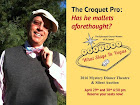
What Slays in Vegas: Mystery Dinner Theatre
by and for Episcopalians
Director/Author’s Note for the Program of What Slays in Vegas
But every writer fears that the lucky streak will end. When the actors for tonight’s show met with me in August, we had little to work with, aside from Suzanne Swann’s notion that the choir might get a gig in Las Vegas. We had news of spats over sports arenas going up around Atlanta. We had closings of venerable theatres in Marietta. We had an actress from Brooklyn.See my photo collage of the show.
| | |
| | |
| | |
![]() | ![]() | ![]() |
It’s casino night at St. Martin’s-by-the-Chicken to fund the choir’s trip to Las Vegas. But an ex-chorister crashes the party to promote sale of the church to build a sports arena. Minutes later, she’s pegged through the heart with a croquet mallet. Who did it? Her resentful boy toy? His jealous ex? The diva? The socialite? The domineering Verger? The scheming former flower child? The Yankee with a sketchy past? When police are detained, it’s up to the Kindergarten teacher, with audience help, to discover whodunit!Church and Theatre: Laughing Matters?
Mystery Dinner Theatre for Episcopalians: Post-Mortem.

Photos by Kevin Triebsch, from top:
Trio sings "Onward Christian Soldiers" in my Las Vegas arrangement, l-r Tonya Grimmke, Mary Nimsgern, Suzanne Swann, and, barely visible, understudy Deb Kemp.
Scott Smoot as "Percival Darcy III" discovering his old 7th grade girl friend.
DeeGee Reisinger as "Gabby Krueger, real estate developer."
Mother and daughter Tonya and Emma Grimmke before the show posed in character as "Addie Haden" the choir-and-kitchen director and "Duh" the teen volunteer. Decorations provided by the Episcopal Church Women of St. James' Marietta.
Mary Nimsgern as "Marilyn DuVain Gross," enacting a speech from her one-woman musical about Queen Elizabeth I, "Hello Raleigh."
The role of "Serena Nightingale" was created four years ago by Leslie Thompson, and reprised triumphantly on Friday. Leslie fell ill on Saturday, and theatre student Deb Kemp took on the role with fifty minutes' notice, reading from the script and sight-singing the trio.
Sunday, April 24, 2016
Mahler Wins Teen Night at ASO
From row "C," close enough to see a violist's socks slide inches below his pants' cuff, I appreciated how Mahler tamed a restless crowd in a bad situation. Conductor Donald Runnicles waited until the coughing died down to begin Mahler's 9th, so quiet at the start that I had to lean in to hear. Then from the percussion corner of the orchestra arose an assertive melodic motif, played by a cross between a honky-tonk piano and a zither -- a cimbalon, maybe? -- immediately answered by low strings on the opposite side of the stage. I might forget the tune among so much of the music that followed, but that wide-spaced dialogue of sounds, though a little different each time, held the first movement together through wide swings of mood.
In the pause before the second movement, we heard the traditional coughing, more than usual. That begat more coughing, and giggles from the teen gallery down to the stage, where players looked up at the house and smiled and exchanged wise-cracks with the conductor. Then Mahler threw us dance music, fast and light, interrupted by a rougher dance tune played with percussive force by violists, interrupted again by a ruder, faster dance. This pile-up was funny and a little delirious.
I should mention that Mahler gave us a spectacle, rows of musicians bowing furiously, furrowing brows in concentration, then sitting still while a single instrument played a melody.
Again, at the end of the second movement, there were coughs; then came a louder, faster, more chaotic third movement, called "sardonic" in the program. That shut us up: Not a sound at its end.
The fourth movement seems to end several times, but melody arises yet again, like a sigh, from different areas of the orchestra -- the first cello's melody was especially pleasing -- until we perceive that just about every one of the hundred-plus musicians may get a solo turn. But the audience was patient: I stayed awake, and didn't need to resort to the cough drops in my pocket.
The very quiet music faded to nothing. Conductor Donald Runnicles held his hands up in long silence. When he dropped them, the crowd erupted in applause.
The program tells us that Mahler was haunted by death, especially in this ninth. No argument; but "death" was not what I heard. Having the symphony wash over us was like watching a movie, though it required more concentration. I didn't know the story, or the characters, but I felt as though I was going to different places, experiencing extremes of emotion and drama, and, in the end, it was all beautiful.
I'm naturally reminded of another crowd pleaser, Prince. This week of his unexpected death, many commentators referenced his SuperBowl performance in 2005 for his ability to generate excitement. Garrison Keillor, in his tribute, told us that the producers called Prince ahead of the game to warn him, "It's raining." Prince replied, "Can you make it rain harder?" Yet this guy stayed largely private his whole career, while cultivating a mystique wrapped in androgyny, eroticism, religion, mixed race parentage.
Mahler's fascination with songs of death is his mystique; he knows how to tease the audience, how to build variety and contrast into his vast symphonies; and he doesn't settle for rain - he makes it rain harder.
Saturday, April 23, 2016
Ten Years of this Blog: Progress?
This blog, at first, was to be a place for spontaneous notes, like a journal. As soon as Blogger showed me that seekers across the globe at least glanced at my stuff, I put more time into it. But then I felt guilty for the time I spent in this space, remembering that John Updike eschewed journaling because it uses up life material that should go into something productive, i.e., publishable. Eventually, I realized: this blog is my garden. It's a narrow plot, where I return weekly to weed out errors and to tend to subjects of perennial interest to me: Episcopalianism, Updike, mysteries, and Stephen Sondheim.
While I've tended this garden over ten years, much has changed: I lost Uncle Jack Maier in 2005; leafing through the hardback collections of my blogposts, I find references to the passing of all the grownups of my youth: Aunt Harriet, Aunt Blanche, Uncle Jack Smoot, and Dad; only Mom and her cousin Pat remain. In 2006, my dogs Luis and Bo were vigorous companions, now gone. In 2006, I was riding my bike nearly every day from May to August, averaging 18 m.p.h.; last summer, I averaged something under 15 m.p.h.
But I'm in the same house, weighing about the same, looking about the same. My car still travels the same routes all week, from home to church (choir, worship, meetings) or to school. (Since 2012, I've added Mom's retirement community, but it's on my way to town.) My salary has barely budged since 2006. Back then, the US was enmeshed in two wars, and I'd never felt politics to be so vicious; now we're still not not enmeshed, and political discourse has reached a new low. I'm still listening to NPR, enjoying the Atlanta Symphony and occasional plays.
In my teaching, I'd say 90% of my time with students is as fun as ever, interacting with them over literature (historical texts, then; fiction and poetry now; scripts, always). There's always that problematic 10%, and I'm just as surprised today as I was the first year I taught when students don't want what I offer.
And on this tenth anniversary of my first blog post, when I sat to write about a wonderful short essay that had just made me laugh and cry, that essay turns out to deal with essentially the same topic as the first one ten years ago, in which I responded to a preacher who boasted that his church was true to God because he treats the Resurrection as a "fact," not a metaphor (link).
The essay that I read this week was by Rabbi Bradley Hirschfield. He tells of a taxi driver, ex-stoner and gung-ho evangelical Christian, who peppers him with questions about Jesus. When the Rabbi explains his belief that Jesus was one of history's greatest human beings and teachers, the cabby asks how the Rabbi can have such respect for Jesus without believing Jesus is God. The Rabbi surprises himself with a neat formulation: "You don't have to be wrong for me to be right." The cabby swerves off the road in his excitement. Then he asks what to do about his wife, a non-believer who has stuck with him through years of rehab and turmoil; his pastor has told him to leave her if she won't accept Christ. The Rabbi essentially repeats his earlier answer: both wife and faith are a blessing; the man should not give up either one. The story ends in a tearful bear hug.
It's a beautiful story that illustrates a quote from Rumi (via Coleman Barks) used as epigraph for an essay in My Neighbor's Faith: "Out beyond ideas of wrong-doing and right-doing,/ there is a field. / I'll meet you there" (228). (see more about My Neighbor's Faith.)
My earliest essay in this blog looks for that field, too: Whether Jesus's resurrection is a hard historical fact or something else, it's all in the realm of literature and imagination, now. What we do with the story, how it colors our responses to our world: these are what matter.
So, am I stuck in a rut on the road to life? I prefer to think that I'm like my friend Bill L., who has worked the same property for years, building a house and then tending a garden. Flowers and shrubbery come up, some die, some overcrowd the others, and he re-works that plot.
I'm working this plot of cyber-space, responding to literature, belletristic and otherwise. I enjoy the writing; I enjoy knowing when others have seen what I do; I enjoy weeding out awkward phrases and mistakes when I catch them in old postings; but I most of all enjoy going back to read things I wrote long ago that strike me as fresh, even now (see personal bests).
So, should I be concerned that I see repetition in my blog over ten years? Our Episcopal Church itself arranges time in recursive events, readings, and processes. John Updike returned to his childhood experiences from first story to last poem, always finding life in them. Stephen Sondheim's collaborators have pushed him in very different directions, but his music for each show builds on a restricted set of motifs. Layers of memory and intra-volume references are part of what make Wendell Berry's novels wonderful, all concerned with the denizens of one rural Kentucky town.
There's nothing wrong with enjoying perennials.
Source
Bradley Hirschfield, "Finding Faith on the Road: Where Deep Commitment and Genuine Openness Meet." In My Neighbor's Faith: Stories of Interreligious Encounter, Growth, and Transformation. Edited by Jennifer Howe Peace, et.al. Maryknoll, New York: Orbis Books, 2013.
Friday, April 08, 2016
My Neighbor's Faith: NPR's Theology?
It's not a joke, but the premise behind My Neighbor's Faith: Stories of Interreligious Encounter, Growth, and Transformation, edited by Jennifer Howe Peace, Or N. Rose, and Gregory Mobley (Maryknoll, NY: Orbis Books, 2012). The book is part of the curriculum for Education for Ministry (EfM) out of the School of Theology at The University of the South, Sewanee, an Episcopal seminary. Around fifty short essays tell of faith discovered, challenged, or reinvigorated by encounters between traditions.
The thing is, I hear stories of such encounters every day on NPR, where voices represent a wide range of religious / political / cultural views, mediated by erudite, respectful, curious correspondents. I find myself wondering, so long as we have NPR, who needs Church?
During a break in the program, we heard that NPR is sponsored in part by the Gates Foundation, its tagline a precis of this statement from the Gates website:
We seek to unlock the possibility inside every individual. We see equal value in all lives. And so we are dedicated to improving the quality of life for individuals around the world. From the education of students in Chicago, to the health of a young mother in Nigeria, we are catalysts of human promise everywhere. (www.gatesfoundation.org)
Of course, this secular faith in the worth of the individual derives from a thread running through the major religious traditions. One of the essayists in My Neighbor's Faith cites the Tibetan saying that "everyone was once your mother" and the Jewish story of Adam and Eve as expressions of the same idea that we all are interconnected and worthy of respect (Kamenetz 189-190). But the idea, self-evident, no longer needs religious scaffolding.
The closest direct answer comes in an essay by the son of Baptist preacher whose family befriended their neighbor the Rabbi and his family. Later studying at a secular, lefty college during the secular, lefty late 60s, author S. Mark Heim found "allies" in classmates of any religious tradition: "History was choosing sides," he writes, "and we had chosen the losing one" (193). His few curricular encounters with religious writers, regardless of tradition, were "precious evidence that intimations of transcendence and the integration of faith and reason were matters worthy to occupy the wise." Then he writes:
On the great moral challenges of the antiwar and civil rights movements, the churches...seemed like weak and hesitant echoes to the vibrant campus consensus [but] as I struggled to make my own decisions... it was religious convictions that finally counted.... [I observed] a steadied endurance to the engagement of many religious people I knew that contrasted dramatically with antiwar passions that evaporated with a low draft number.
Heim became a student of religious pluralism, and wrote a book that "seems now embarrassingly backwards" because it "treated religions in terms of ideas" (194). The remainder of his essay tells of a breakthrough experience of moksha or "release" from self. "But I was not sad to see [the experience] end" and "it was not...a vision with a moral." He concludes "that behind each tradition in principle there lies something of this same order of otherness and wonder" (196).
The "morals" and the "ideas" of religions are what overlap with NPR and all humane entities; what faith seems to add is power. It was a staying power that Heim observed. A Rabbi, co-author with an evangelical Protestant, writes, "Faith for me is not a confidence that Something Really Nice will happen later, because Someone I can't see is taking care of things. It is about finding the ability to give love now, in this life," something he and his friend have both found in taking care of severely handicapped daughters (Gottlieb and Leonard 90).
The source of power may be "a generalized sense of a meaningful and life-affirming connection to a transcendent reality" (95), writes Jeffery D. Long, a "born-again Hindu" raised Catholic (98).
The Episcopal Book of Common Prayer would tell us that the faithful are empowered by an actual Spirit bestowed by that Transcendent Reality, not from a mere "sense" of connection. Some of these essays do tell of mysterious or mystical moments when the authors felt or witnessed something outside the physical world. Besides Heim's moksha, Ruben L. F. Habito writes of a similar breakthrough in "A Christian Confronts a Zen Koan" (165); and Roger Kamenetz, an American Jew, gives us a "shaggy dog story" about his dog Taxi, so taken with the teachings of a visiting guru that he runs away after his new teacher, and, months later, follows him into death -- presumably to be reborn with him to pursue their dharma together (191).
I can see that power -- for good, and for evil -- comes from identity, the feeling that one belongs to a defined community, that one "stands" for the people of that community. The word doesn't come up much in these essays, though Paul Raushenbush, a Christian preacher, writes of pride in his family's Jewish identity, stronger than doctrine: "To put it bluntly [about afterlife]: if I can't hang with my Jewish cousins up in heaven, then it doesn't sound much like heaven to me" (108). A Jewish woman who has always seen herself as an outsider in US society is shocked when Black classmates see her as an insider who can "pass" for White anytime, while they "always carry their black identity with them front and center" (Boys 141).
Narrative gives power to ideas. While one can haggle with one's conscience over an idea -- "What exactly does justice mean in this instance?" -- it's harder to argue with the vivid parable of the Good Samaritan or the example of Jesus stepping between a woman accused of adultery and the mob intent on stoning her. In My Neighbor's Faith, an Episcopal priest tells of a Sikh peacemaker motivated by Jesus (Gibbs 180). A Lakota man finds a way out of hatred of Whites and his substance abuse through the story of Jesus' life, though he refuses to choose the RSV, NRSV, KJV, NIV, CEV, or NKJV, or to accept that "to become a new creation" must mean "to become white" (Twilly 161). Two essayists give credit for life-changing decisions to Prince Arjuna's story in the Bagavad - Gita, how he hesitates to launch a battle that can have no good outcome (Long 93, Makransky 197).
One essayist sees power in the "discipline" of ritual. This is a Muslim, familiar with the act of prostration, stunned to see Orthodox Christians bend themselves in the same way (Ziad 117). He relates the "pain" of bodily discipline to Mary's pain in childbirth, giving us words by Rumi: "The body is like Mary. / Each of us has a Jesus, but so long as no pain appears, our Jesus is not born." The author continues, "all ritual is imitation," a way into prayer and unity with God.
During our EfM seminar meetings, we have often heard each other attest to the power of liturgy to comfort or move us, and we've told stories of how memories from these words and rites have motivated us at critical moments in our lives.
Having read most of My Neighbor's Faith, I can stand with that Protestant preacher Bill Leonard, who writes that he and his friend the Rabbi are "both people of faith, at times coloring outside the canons of our respective Jewish and Christian traditions, but stuck with and in them nonetheless" (89).
That sounds right to me, "stuck" as I am "with and in" the traditions of the Episcopal Church. When I doubt myself, or my path, when I'm most vulnerable, even the most reasonable voices of NPR vex me with news of strife and intractable problems. I turn off the radio, and go to my "go to" sources -- the prayer book, the music, the writers, the Bible, the Church itself.