Saturday, July 21, 2018

Dementia Diary: Mom's Great Escape

Mom laughs when I tell her how she eluded staff, security locks, and alarms to get into the closed "Evergreen" area and out into the garden undetected.  She laughs even more when I tell her that, the very next day, she somehow got out again, this time to take another resident across the street to see Mom's old Cincinnati home.  We're in Marietta, Georgia.  

[Photo: (top) The bank and driveway across the street from Mom's facility remind mother of (bottom) the library near her alma mater Walnut Hills High School in Cincinnati.]

But, for the staff, Mom's "elopement" was no laughing matter.  Their solution was to put Mom in Memory Care, just what my brother and I wanted to avoid.  "When you go there," I explained to Mom, "you'll be beyond caring.  I'll come to water you twice a day."  That got another laugh from Mom.  We didn't expect Memory Care for a few years, yet. Nothing gets her hackles up faster than any hint that she's being "treated like a child."

The facility proposed a compromise.  She sleeps in her spacious apartment upstairs with all her beloved furnishings and closets of clothes; staff wakes her and takes her to the Memory Care unit for morning activities and lunch, until her Visiting Angel can assume responsibility for her.  At bed time, in her pajamas, she's not a flight risk anymore: she'd no more go out of her apartment undressed and unaccessorized than the Queen would.

After four days of her visiting Memory Care most of each day, I've heard from staff and Visiting Angel:  Instead of raging against locked doors and denying that she belongs in there with all those "old people," she is thriving on attention from staff.  Wherever she wanders in this extensive maximum-security wing, she meets staff members who know her, and she meets people like her.  During group activities, I'm told that her instinct as teacher of 3rd grade kicks in, and she encourages those less sentient than she.  [Photo: Mom enjoyed a visit by "Sammy Davis Jr." to the Memory Care wing Tuesday night.]

Also, during this week, there've been no phone messages from her about being lost, lonely, or angry. And, when I arrived around 8:15 yesterday morning, she was up and showering, in a great mood.

I've asked the management to show her a studio apartment that could become her home base in Memory Care.  The move must be her idea; dementia is quick to suspect that her sons are "putting her away."

[Photo: we visited the doctor Thursday, laughing about every problem.  "I have difficulty walking?  Oh, I guess I do.  I cut the compression stockings off with scissors?  Ha ha!"]


See other entries in my "Dementia Diary."

Friday, July 20, 2018

Forward Day by Day through Luke and Acts

Readers of the quarterly devotional booklet Forward Day by Day found something different in the issue for February - March - April 2018.  The readings followed straight through the Gospel of Luke during Lent and Easter, through Acts into Pentecost.  Friends and I who missed the usual lectionary readings also appreciated the continuity.

Here are some of the meditations that struck me most during those months.

Luke 5.18 Just then some men came, carrying a paralyzed man on a bed.... "There are two miracles in this story from Luke," writes Forward's deputy director Richelle Thompson. "The second is Jesus' healing of the paralyzed man.  The first is having people who will go to any lengths to show Jesus to their friend."

Luke 16.8 His master commended the dishonest manager because he had acted shrewdly.  Priest Lindsay Hardin Freeman admits this parable is "seemingly disheartening," until we see it "is not about money; rather, it speaks of preparing for the end."  She concludes, Our hands are never clean when we reach the end of our lives.  The steward improves the lives of the poor by reducing their debts and by closing the books so that all can move ahead."

Luke 24.42 Have you anything to eat?  I have to smile whenever I picture the apostles huddling together, stunned, while the resurrected Jesus chews his dinner.  After the meal, he goes to Bethany, site of a memorable meal with Mary and Martha, Mary's anointing of his feet, and the raising of Lazarus: Jesus evidently felt comfortable there.  Freeman concludes, "Joy, disbelief, and wonder combine with real events and real places to make up the core of our faith."

Acts 5.7  [Ananias's] wife came in, not knowing what had happened.  Why isn't this story read aloud for every stewardship campaign?  For Fr. Marcus Halley, Ananias and Sapphira die because they "live their lives divorced … from the reality of [the church] community."  Halley concludes that "community is not only a means to an end in God's economy -- it is an end in itself."

Acts 5.15  They … laid [the sick] on cots and mats in order that Peter's shadow might fall on some of them as he came by.  [See image]  Halley skips over the part about miraculous healings to meditate on Peter's many "shadows" -- "he's quick - tempered, impatient, prideful, angry."  Then Halley doubles back: "God uses our shadows to bear witness to the light that healing can bring."

A personal note:  The night that I read Halley's note about a personality's shadow, I dreamed about a student from another year, one who challenged me every day, cannily playing on every insecurity I have as a teacher and human being.  In my dream, I expressed how he had made me feel -- humiliated, angry, frustrated -- but also how I could appreciate and even admire him.  In my dream, he gave me grudging acceptance.

As Carl Jung would say, he was my "shadow," surfacing traits of myself that I work hard to keep submerged.  The dream brought healing, some relief from anger and shame that I've continued to feel years after that class.


Tuesday, July 17, 2018

Vacation to the High Museum in Atlanta

For a few hours, I commuted to Atlanta with my friend Susan, stopped worrying about Mom and politics, and learned once again at the High Museum's exhibitions "Outliers" and "Winnie the Pooh," that the pleasures of art begin with the question, "Oh!  What's this?" and deepen with more questions, "Why did the artist do it that way?  How did the artist do that?"

First, we examined three "waves" of artists the High calls "outliers," or self-taught, paired with trained "vanguard" artists who admired their work.  The "second wave" featured works from the late-1960s and the 1970s that were a vexation to my spirit; likewise the "third wave" from the past couple of decades, though Kara Walker's series of superimposed silhouettes of African American figures on 1880s etchings of the Civil War was fascinating in conception and execution.

But the first "wave" of so-called "primitive" artists made us laugh and marvel.  The earliest works in the exhibit were by Edward Hicks, including his biggest hit, "The Peaceable Kingdom."  Besides appreciating the vision from Isaiah of lions, wolves, lambs, and cattle making nice, we enjoyed how the painted shoreline shows through the image of William Penn making peace with Native Americans, evidence that Hicks added this latter-day Lion and Lamb image as an afterthought.  Other works of his were new to us, slices of life as he saw it in the early 1800s.  In one, we see in the foreground a herd of cattle, each one solid and differentiated with personality, looking placidly at the viewer; against a background of rolling hills and barn, we might miss the men, barely sketched in, who gesture in regard to the herd.  On another large canvas, Hicks preserved images of home, a textile mill, barns, river, animals, and one guy watching it all with a telescope from a clearing on the hill above the manor house.

We enjoyed wood sculptures by Jose Delores Lopez on the theme of Adam and Eve. One has them in carnal embrace, but she's looking over her shoulder.  In another, the tree's twisting branches camouflage the twisted serpent; while Eve reaches up to the forbidden fruit, Adam hangs his head as he reaches out for what Eve has -- "submissive," Susan said. Or maybe mournful?

Self-taught artist Horace Pippin (1888-1946) produced a couple images we loved of African Americans' homes in Pennsylvania.  One shows the boy on the left, kneeling in prayer at his bed; snow gathering in dark panes in the center; a woman sewing in her rocking chair at the right.  Another picture made us laugh out loud: no people in sight, but around sixteen ceramic dogs are collected on the mantel, arranged by height to mount towards an elaborate clock.  Details of the rug, chairs, even the grain of the wood paneling, are all lovingly preserved.


Pippin was an influence on "vanguard" artist Jacob Lawrence, whose wonderful picture "Sidewalk Drawings" didn't attract my attention.  Susan called me back to appreciate the perspective: We're looking down on kids making chalk drawings on black top.  Suddenly, I was enjoying layer on layer of fun images and incongruous juxtapositions.  [See photo]


                                                         We also loved "American Interior" by Charles Sheeler, 1934.  There's no story here, no person to identify with, not even a single perspective.  But, once more, we get the loving details of rug patterns and textures.  There's the artist's exuberance, where sunlight causes a corner of the whicker chair to jump off the canvas at us.  In the vase, we see reflections of the room, and, through those, we see the picture on the plate!  The more we look, the more we see to enjoy.  [See photo]

After that exhibit, we moved on to see first drafts of E. H. Shepard's drawings for A. A. Milne's classic children's books.  I admit that I've barely given Pooh a thought since I leafed through the books during "nap time" before age six. I couldn't read, but actor Maurice Evans read several stories aloud on a pair of LPs, and those I played over and over.  The exhibit's commentary helped me to appreciate some elements in the collaboration between writer and artist, how body language expresses each character, how sequences of drawings could prolong the comic effect in Milne's narrative, how the drawings sometimes helped young minds to appreciate irony in the words.


I noticed a preponderance of drawings from behind characters, a choice that makes sense: they're moving forward in their story, not at us.  Facing away, their postures tell the story.  Besides, the rumps are funny.  Again, we saw where Shepard erased, enlarged, and wrote notes to himself. [See two photos, by Susan]

After the High, Susan and I continued our self-education in the ways of MARTA, taking the train to Decatur.  It's like a college campus for grown-ups!  At Leon's, we enjoyed tasty vegetarian sandwiches, hummus, and midday cocktails.  [See photo]

Sunday, July 15, 2018

59th Birthday


I rode 59 miles on the Silver Comet Trail to celebrate my 59th birthday, averaging 16.1 miles per hour.   When I started this tradition at 34 years old, it seemed like a good idea.  My retired colleague Harry Guckert, seeing me at the Publix store after, said, "Your 90th birthday will kill you!" I said, "Well, that's kinda the plan."

[Photo: Me after a rain storm mid-way in my 59 miles]

Mom gave me a nice check and a coaster with the motto, "Martinis -- they're not just for breakfast anymore."  Perfect!

On the 15th, I read Amos in church, and we had a great sermon about the true meaning of church as expressed in Ephesians.  At the home, they lost Mom.  Somehow, she eluded the security systems and got lost in the garden of the "Evergreen" section of the home, reserved for hardcore memory cases.  She laughed and laughed!  I enjoyed seeing seven or eight blue-clad officials of the home searching everywhere for her.

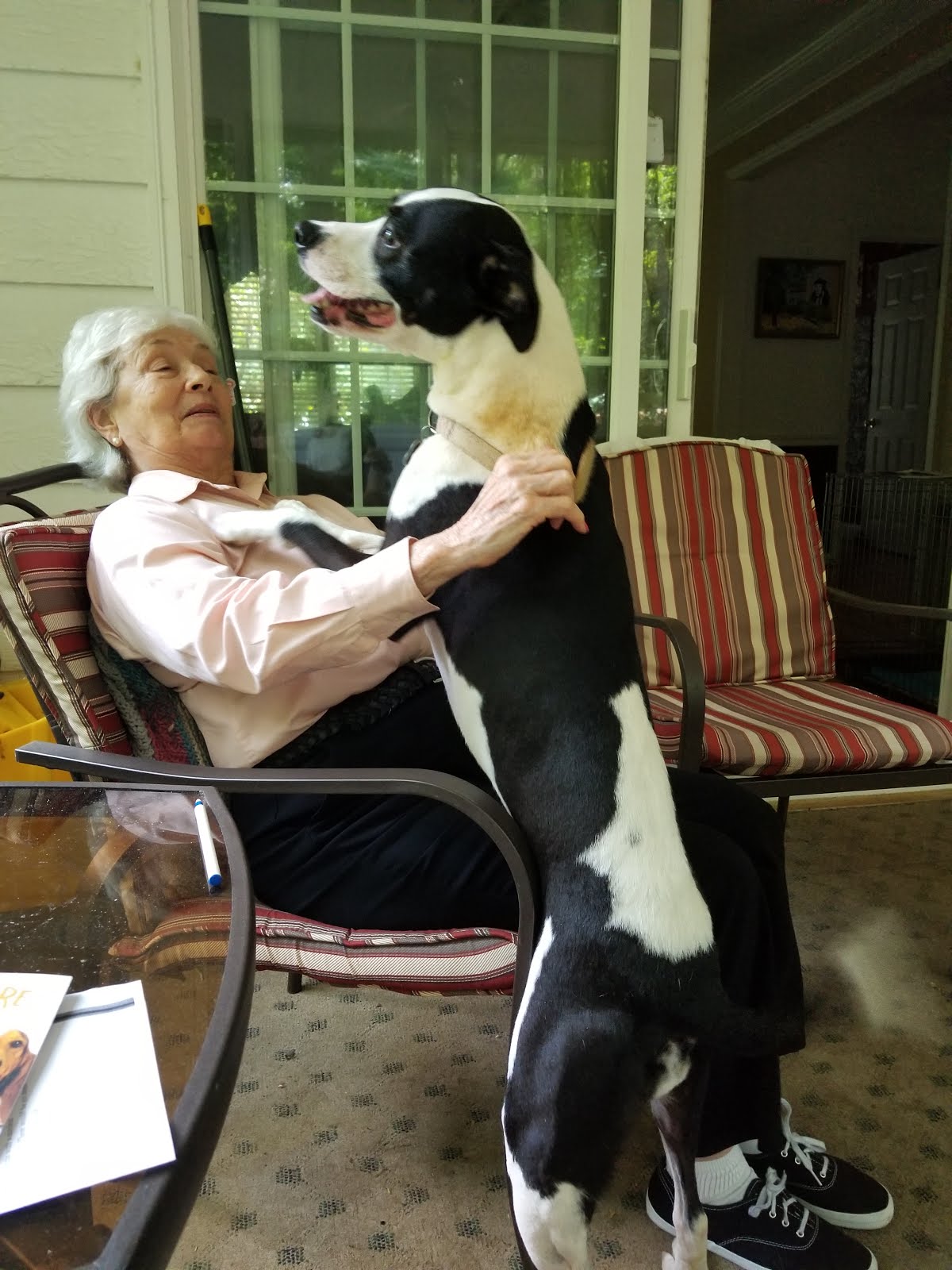
Todd and his wife Alice came to visit.  I read some poetry by Linda Pastan. The CBC's Jazz91 brought out an archived interview between gracious pianist Marian MacPartland and supreme vocalist/pianist Carmen McRae, two musicians I've loved since the late 1970s. Mia decided she wanted to sit on my lap.  [Photo]

 Then I enjoyed making pizza with Susan, listening to the CBC's jazz  station.

Fine 59th.

Reagan's Final Speech: "Your Best Hopes, Not Your Worst Fears"

His elegant farewell note lay a couple years in the future, when he would write with gratitude for those who would be seeing him through to the end of dementia; but he didn't make another public speech after his endorsement of George H. W. Bush at the Republican National Convention in 1992.  What he said in conclusion struck me more forcefully than anything else in the speech, and I've been surprised not to hear it quoted more often:

And whatever else history may say about me when I'm gone, I hope it will record that I appealed to your best hopes, not your worst fears, to your confidence rather than your doubts. My dream is that you will travel the road ahead with liberty's lamp guiding your steps and opportunity's arm steadying your way.

Dinosaur on Bastille Day


[Photo: The author, riding around Stone Mountain Park, GA, happened upon the park's "Dinosaureum."]

On July 14th, Bastille Day, I think of words about the French Revolution by a man of the time, Edmund Burke, Anglo-Irish parliamentarian who supported American independence.  He was spiritual patriarch of conservatism as I knew it, before I became the dinosaur that I am today.

Responding in the early 1790s to the Terror that quickly emerged from the euphoric chaos of Bastille Day, Burke told how he'd met the charming Marie Antoinette in her youth.  He deplored the revolutionary mob's treatment of her: "The age of chivalry has passed; the age of economists and calculators has succeeded."  He added, "To them, a Queen is just a woman, and a woman is just an animal, an animal not of the highest sort."

When I unpack those words, I find all the elements of conservatism that I value.  Economic theories take a back seat to humanity. Burke would have us all be courteous to royalty and non-royalty alike, with special care for the defenseless. [See my 2015 reflection on Burke and Bastille, "Logic and Faith: How to Judge Value."]

Unlike "etiquette," formalities intended to distinguish upper-class from lower, "courtesy" is an attitude towards individuals, essential to conservatism as I learned it.  Courtesy on a societal scale is "justice", and its partner "rule of law" applies up and down the social scale, to prevent both tyranny of the elite and tyranny of the mob.

I trace my conservatism back to Burke.  I see it in Abraham Lincoln's insistence that, while minority rule is unthinkable, the rule of the majority must be limited by laws to protect the interests of the minority. Theodore Roosevelt was gung-ho bootstraps and laissez-faire until activist Jacob Riis showed him tenements crowded with hard-working immigrant families trapped in a system that amounted to a slavery, and TR worked ever-after for a "fair deal."  The figurehead for conservatism in my first forty years was National Review's creator and editor-in-chief William F. Buckley, who counted arch-liberals among his close friends. (The Buckleys and the Ted Kennedys shared a ski vacation every winter.)

Early in the Reagan years, George F. Will wrote a book-length essay Statecraft as Soulcraft to lay out a conservative vision of a state that actively models, ensures, and inculcates the values that must be shared for democracy to work.  My list of those conservative values would include courtesy, openness to information and ideas, and  respect for prescribed legal and political processes even when the results don't go our way.  My list would not include tax - cuts - no - matter - the - situation,  or demonization of foreigners, the Media, or the other party.  This makes me a conservative dinosaur.

I'm not alone. In the past couple of years, prominent conservatives besides George Will, including members of Congress, have expressed alienation from the party they thought they belonged to.  Among these are historian Max Boot, Republican strategist Steven Schmidt, speechwriter and head of George W. Bush's faith initiative Michael Gerson, former evangelical activist Rob Schenck, and Bill Kristol, longtime editor at the National Review after Buckley.  

Like the dinosaurs, we're looking at a world we don't recognize.  Also like the dinosaurs, we have to admit that  the change has been a long time coming.  [I wrote about these feelings in 2013: Civics Lesson for Republicans]   Gerson's 2007 book Heroic Conservatism carries the subtitle "Why Republicans Need to Embrace America's Ideals (And Why They Deserve to Fail If They Don't)."  He didn't anticipate that the party's continuing to reject those ideals would result in electoral success, but he wasn't writing just about elections.

David Frum, another speechwriter for George W. Bush, saw the ground shifting under him in 2011:

America desperately needs a responsible and compassionate alternative to the Obama administration’s path of bigger government at higher cost. And yet: This past summer, the GOP nearly forced America to the verge of default just to score a point in a budget debate. In the throes of the worst economic crisis since the Depression, Republican politicians demand massive budget cuts and shrug off the concerns of the unemployed. In the face of evidence of dwindling upward mobility and long-stagnating middle-class wages, my party’s economic ideas sometimes seem to have shrunk to just one: more tax cuts for the very highest earners. When I entered Republican politics, during an earlier period of malaise, in the late seventies and early eighties, the movement got most of the big questions—crime, inflation, the Cold War—right. This time, the party is getting the big questions disastrously wrong.
Frum compares "conservatives" at the time of his article to those of just a few years before:
  • While Bush defended the "earned-income tax credit" from attempts to "balance the budget on the backs of the poor," members of his own party called low wage earners "lucky ducks" for not owing Federal taxes.
  • Bush "routinely invoked 'churches, synagogues, and mosques'" but in 2010 members of his party called it "an outrageous insult" to build a mosque near Ground Zero  
  • Conservatives attacked the Affordable Care Act, though it was modeled on a public - and - private health care plan proposed by Republicans in the Senate to be a conservative alternative to Clinton's proposal.
  • "Today, stimulative fiscal policy that includes tax cuts for almost every American is 'socialism.' In 2001, stimulative fiscal policy that included tax cuts for rather fewer Americans was an economic­-recovery program."
Frum concludes: "I can’t shrug off this flight from reality and responsibility as somebody else’s problem. I belonged to this movement; I helped to make the mess."

As dinosaurs, what are our choices?  One option is off the table, for me: the discourteous personal attacks on public officials going about their private lives at restaurants and movie theatres.

Historian Jon Meacham has written a book that may contain some answers.  The Soul of America: The Battle for Our Better Angels collects episodes from our history when, as now, the discourse degenerated.  He cautioned in an interview that his message was not, "We've been here before, so you don't have to worry," but, "We've been here before, and here's how we've gotten out of it before."

Okay, I'm ready to read.

Wednesday, July 04, 2018

Uncle Sam and Aunt Harriet: A July 4th Memory


My Aunt Harriet, so accommodating most of the time, insisted on celebrating July 4th her way. She had me load her walker into the car for a drive to the supermarket so that she herself could pick out the right buns, Brats (rhymes with "lots"), sauerkraut, condiments, and corn on the cob.  At sundown, she would supervise me at the grill, and we'd watch Public TV's Capital Fourth concert while we ate.

I was aunt-sitter in Chanhassen MN at the split-level home of my cousin Ann, whose husband Ken had outfitted the lower level for Harriet.  While Ann and Ken got away for a couple of weeks, I was warned never to leave my aunt for longer than an hour, because of her diabetes and the risk of falling.  Ann left us a strict schedule: blood sugar test at 7:30 a.m., pills, breakfast; mid-morning snack; lunch; mid-afternoon snack; blood test, pills and dinner.

Between these critical points, I re-designed my website, and walked Harriet's sweet and yappy little dog "Annie." I took a 52 - minute break each day to ride a bike around Chanhassen's streets, a route highlighted by a narrow trail through a nature reserve where, once, a tiny lemon - yellow Minnesota Gold Finch - first I'd ever seen - darted out of the brush and dipped in the air just ahead of my bike.

The routine of aunt - sitting might seem restrictive, but I look back on the two weeks as a golden time.  My life, like my recreational biking, has long been a steady round of predictable features: school semesters, seasons of the Church's liturgical calendar. But those two weeks out of my life made a charming passage, just as that little nature trail made a break in my daily round; and in that two - week passage, Aunt Harriet's special 4th was like the Gold Finch: an unexpected delight and a vivid memory. Our private celebration of national history enveloped her personal history, and still reminds me of so much that I loved in her.

Those brats and sauerkraut, so German, must've reminded Harriet of childhood in Cincinnati, where immigrant families in her neighborhood still spoke German. When she was born October 4, 1921, the German names of Cincinnati's streets had just been Anglicized in the patriotic anti-Kaiser frenzy attending our nation's entry into the Great War.

She and her younger brother lived well in the 20s, but everything changed with the Depression.  Her father, guilty of some shady dealing -- to pay for Harriet's medical needs, I've been told -- lost not only his job, but hope for getting another. Everyone else worked: Harriet sewed, her mother cleaned homes, and her younger brother sold newspapers and got work  at Proctor and Gamble.  In the Depression's worst year, her littlest brother -- my dad --  was born, asthmatic, requiring care, both constant and expensive. The rest of their lives, his two older siblings could get pretty bitter about what they'd had before the family lost it all.

But Harriet was a fighter.  Speaking at her memorial service in January 2009, my dad told the story of some bully at the bus stop lighting a match, its sulphur fumes setting off an asthma attack for him.  "Sis chased the boy all the way to his house, through his front door, up into his bedroom, and she beat him up."
[Photos: Harriet Ann, her mother Harriet ("Mamaw""), younger brother Jack, and youngest brother Tom, ca. 1990 and 1962 -- with their father Dewey Smoot ("Pop")]


She married a medical student named Bert, and, as she told it, she did all the studying to get him through Johns Hopkins in the late Forties.  By the time she met me, her toddling nephew, she was living the high life in LA, circa 1962, where her husband was surgeon to the stars.  (When Oscar - winning actor Spencer Tracy died on the operating table, Uncle Bert was one of the doctors.) Her life was still a struggle, involving alcohol, infidelity, and, by the 1980s, her husband's Alzheimer's. Her mother, recently widowed, came to help look after Bert; after he died, Harriet had to take care of her mother.

Up to that point in her story, I'd rarely seen Aunt Harriet.  I'd seen my mother's family in Cincinnati every summer of my life; but my California family was out of reach except for special occasions every few years.  Harriet liked to recall how, around age three, I tapped her awake in the middle of the night to whisper that I couldn't find my way to the potty.

Once she'd moved to the east coast, to North Carolina, I could drive up to see her and my grandmother pretty regularly.  We found we had a lot in common.  We were the family's only two Episcopalians, the only keyboard players, and the only fans of the composer Olivier Messaien.  We shared mystery stories, and she taught me some of the obscure little words and names that you need for crossword-puzzles  (ort, adit, Ara, and Ott). We loved dogs, and we enjoyed cooking, even with her restricted diet.

She moved to Minnesota when my father took my grandmother to a nursing home.

On the 4th, I asked if she minded my making a martini. Was that kosher, A.A. - wise?   No problem, she said, adding, "Gin was my drink."  I remember:  She let me have the olives from her martinis at my grandparents' 50th wedding anniversary.  In fact, I've always reacted to the aroma of gin the way others do to chocolate chip cookies or baby powder, as a whiff of a warm, loving childhood. She may be the source of that!

We enjoyed our Brats, tuned in the music on TV, and watched while the slow Minnesota sun took its sweet time to set.

Tonight, it's just me and Mia, and the mysterious neighbor whose home is dark and quiet except when he has buddies over for fireworks on New Year's and the 4th.  I've got my martini, my brats, my sides, and my gratitude for Aunt Harriet.

Tuesday, July 03, 2018

Baroque Passion

Music lovers I know draw their line at Baroque.  The music lacks emotion, they say.

Even Leonard Bernstein agreed. The great conductor / composer, in his teens failed to find in Baroque music any of the drama and passion that he sought in the swelling Romantics or the dissonant Modernists. He tried to spice it up adding his own dynamics and variations in tempo when he played Bach and his ilk.  Only later did he come to understand that Baroque composers expressed one emotion per movement.  (see Bernstein's book, The Joy of Music.)

I, too, have found Baroque music to be charming and brilliant as an eighteenth-century timepiece and no more emotionally involving.  I've enjoyed the Baroque for background music, tuning in to the radio program Sunday Baroque while I make breakfast or read, knowing that the composer will run a limited amount of material through a series of more-or-less predictable procedures to fill the air with music sometimes ebullient, grand, or contemplative, and always steady.

But this past year, Bach and Handel took me by surprise during live performances, and I felt them reach through the centuries to grab me in a way that struck me as modern.

First, the Cathedral Choir and Schola of St. Philips Cathedral, Atlanta, Dale Adelmann, conductor, teamed with The Atlanta Baroque Orchestra, Julie Andrijeski, director, to perform Bach's St. John Passion at Roswell Presbyterian Church north of Atlanta, February 24.   A soprano singing solemnly of Christ's suffering momentarily lapses into a dancing, bubbly celebration of what this means for us and for mankind, a victory over death!  Then, just as suddenly, she seems stricken anew by the immense cost borne by our savior.

Then, at Easter, our little choir at the Episcopal Church of St. James, Marietta, GA, performed Handel's Hallelujah chorus from The Messiah.  With organ, strings, and brass, we sounded bigger than we are.  Now, this is a piece I've known since I listened to Dad's LP before kindergarten, sometime around 1963, and I knew what to expect.

Handel does his Baroque thing: after we hear the phrase, "Hallelujah" a few times, at different pitches, and each voice has taken turns with it,  he throws a new phrase into the mix, and there's mixing and matching, along the same lines as before:   King of Kings and Lord of Lords!  And he shall reign forever and ever.

In the middle of it all, every time I sing this, I have to smile.  We basses sing snippets as punctuation when other parts take a breath:  "forever"  (long pause) "and ever" (longer pause) "forever and ever."  We concentrate on the counts or we'll gum up the works of this charming clockwork.

At Easter, just when I was thinking that, really, it's just too much, the trumpet came in with a descending run of sixteenth notes, coming down into "King of Kings!" at a higher pitch of the scale.  I burst into tears and couldn't sing for a couple pages.  It's energy, it's care and craftsmanship, it's full-hearted, full-throttle statement of belief and joy, and it's hugely communal, every part different, every participant concentrating, every note fitting just so into place, and all of it holding hundreds of listeners transfixed while we sweated every beat.

I love my modern composers.  I loved hearing Bernstein's Symposium at the Atlanta Symphony around Easter, with its openly emotional melodies, tugging undercurrents, and startling dramatic eruptions.

But I give the Baroque its due, too. 

Monday, July 02, 2018

Playful Dog

Just after sunrise this morning, when I asked Mia if she'd like to go for a walk, she'd already heard my car keys jingle, and she knew what was up. What followed happens every time: She jumps, her gleaming eyes meeting mine in mid-air.  She runs to fetch a chew toy to carry with her to the car but drops it when the hatchback goes up -- sniffing around the car is so much fun.

We walk in places where other dogs aren't liable to be, because she still reacts with hysterical yelps, jumps, and twists, despite thousands of dollars with different dog trainers.  The perimeter of the Publix strip mall is usually safe, and an odiferous delight for a dog with a liking for rotting food and the bread trucks unloading.  A driver tossed her a tennis ball this week, which she gripped in her jaws and held up proudly as she pranced alongside me.  Once this week, at twenty paces, she tugged straight to a thicket of bushes and dove in to produce a chicken bone.

At home, she loves keep-away, and she loves tug-of-war.  But most of all, she loves to retire under the table or on the stair, in my view, to chew her prize.

Her malignant tumor was removed in April, but cells spread still.  She's getting tumor-shrinking drugs and chemo every three weeks.  She doesn't know she's sick, except when nothing comes of her squatting.

I'm enjoying every moment with her that I can.  I want to learn from her how to play with such abandon, how to trust, how to enjoy what comes, how to accept what I must.


Some other postings about dogs on THE WORD SANCTUARY.
  • I've written about Mia before,in "Mia's Anima, a Dog's Soul" and, one of my most popular postings, "The Dogless Days of August," about the period when she was away being trained.
  • I enjoyed a few years with young Mia together with her older playmate, Luis. "Trying to Catch My Old Dog Luis," was my effort to "capture" his physical presence in words, while he was still with me; a year later, I wrote, "Luis, Rest in Peace."
  • "Dogs are Poetry" is a reflection on a spiritual dimension to dog ownership, focused on Dean Koontz 's faith-tinged memoir of his dog, Trixie, and a book by monks about the dogs they raise, supplemented by my own experiences with Luis and his mentor Bo. 
  • About Bo, there's "Remembering Bo," and, from a year earlier, an essay that began, "This may be Bo's last winter."

Monday, June 25, 2018

Worship and Ordinary Life: Flipping our Perspective


Finishing my bike ride one Saturday in June, I saw the artist making a portrait on a utility box at one corner of Atlanta's Old Fourth Ward neighborhood [See Photo].  Did he paint black stripes on a white background, or white stripes on a black background?  My knowing the answer doesn't make much difference; but the question flips the way I see the picture.

Father Daron Vroon has a penchant for flipping our perceptions of familiar doctrines and parables.  Preaching recently at the Episcopal Church of St. James, Marietta, where he's associate rector, Fr. Daron pointed out that a shepherd would be insane to leave the ninety-nine in search of the one; so Jesus doesn't mean "I am like a good shepherd," but -- flip! -- that a really good shepherd should be like Jesus. Explaining that the twenty-five Sundays after Pentecost, being counted by "ordinal" numbers, are called "Ordinary Time," Fr. Daron preached that our scripture selections in this season concern how we live with the Spirit after the miracle (the Exodus, the Resurrection), making this season -- flip! -- Extraordinary time. 

The common idea of worship needs flipping, too, writes Fr. Daron in our church newsletter (The Word, May 2018). We commonly think of worship as a retreat from real life, where we "recharge" before we go back into the fray, or as "nourishment" to fill us up for our real missions.  That's what we pray just before we "go into the world … to love and serve You with gladness and singleness of heart."

But Fr. Daron digs into the church's ancient history to find that worship was considered to be participation in God's foundational acts for the universe.  "Everything that happens outside of worship," he writes, "takes its meaning from worship."

So we think of worship as the black stripes painted on the background of real life.  Fr. Daron tells us -- flip! -- worship is the base; other business, the overlay.

The periodical Forward Day by Day presented the image of wedges - worship wedged into the day.  Fr. Marshall Jolly writes how his days at monastic retreat were punctuated by worship  at sunrise, in the morning, at noon, at sundown, and at night.  "Ordinary life is wedged into the space between my prayers" at the monastery, he writes. At home, "I spend my life trying to wedge prayer into the spaces between ordinary day - to - day moments."  (FDbD June 14, 2018).

The conflict between daily work and daily worship resolves in accepting that we participate in God's works of creation and salvation both by our business and our worship; worship is the context for the business.

Thursday, June 21, 2018

Mister Rogers was my Neighbor

In Atlanta's Tara Theatre to see the new documentary Won't You Be My Neighbor?, I had a sudden flashback to the day I met Fred Rogers in person. What stimulated the memory was archival footage of him in 1968, greeting a studio full of enchanted kids and their parents for a meet and greet.  He enters on the set of his show, waving to all, wearing his famous red sweater.

My family lived in Pittsburgh until I was seven, years when Fred Rogers developed Mister Rogers' Neighborhood there for WQED.  Our TV was black and white; what I suddenly recalled was my delight to see him in full color, and awe when he turned those intensely attentive eyes to me.

Did it really happen? For certain, I remember that Dad took me downtown on a Saturday to see another personality at the station, "Miss Jordan"; I believe, now, that Fred Rogers was part of that day, too.

Even if my memory is playing some kind of trick, the documentary is an eye-opener to what Fred Rogers offers, even today.

Mister Rogers offers courteous persuasion when he wins over a senate panel intent on de-funding the fledgling Corporation for Public Broadcasting in 1969.  Visibly bored, chairman Senator John Pastore announces that he won't waste any more time listening to a witness reading prepared text that he could read himself.  Rogers, prepared text in hand, smiles, and, sweet as always, makes a deal: "One of the things that a child in a healthy family learns is trust," and says that he trusts Senator Pastore to read the text, "because it is very important to me." Pastore is taken aback, and promises. Rogers then explains that educational TV offers kids the message that feelings are mentionable and manageable. For an example, he recites lyrics based on a boy who asked, "What do I do with the mad inside me?" The verse speaks to how the child can feel like he does everything wrong, like he has no control; but the chorus tells what you can do with those feelings: "You can stomp! stomp! stomp!"  Pastore says, "You just got your twenty million dollars!"

Mister Rogers models an age-appropriate way to reassure anxious children, without pretending that it's all okay.  The homely little hand puppet "Daniel the Tiger," voiced by Rogers, asks the adult actress on screen to blow up a balloon.  After watching silently awhile, he asks, "What's assassination?"

[At this point in the story, whether I've heard a recording, told someone about it, or written about it, I've teared up.  Telling Mom about it at a café, I wept copiously. I don't understand why.  Is it "Daniel's" voice?  Friends and family of Fred Rogers tell us on screen that his childhood self speaks through Daniel, and perhaps it's a universal inner voice.  Maybe it's a residual memory of 1968, a year I recall well for frightening escalation of war, two assassinations, and riots.  Or is it the timing?  After a period of silence, during the blowing up of the balloon, the question seems to come out of nowhere -- but we realize that "Daniel" had seemed distracted and down before. I think that's it: How many of us were afraid to speak questions because we knew that Mom and Dad would be uncomfortable answering them?]  

She explains that assassination is when someone gets killed in a "surprising way" that leaves everyone feeling sad and frightened.  NPR's Fresh Air played what happens moments later, not shown in the documentary. The actress lets air out of the balloon to explain death to "Daniel": the air goes out and doesn't come back in. The image is simple, familiar, non-threatening.

Mister Rogers confronts racism without saying a word about it, simply offering "Officer Clemmons" a chance to cool his black feet in a wading pool beside his own white feet -- an episode that aired during a summer when whites were furiously reacting to black teens' attempts to use public pools nation wide.  (The pools in Atlanta closed rather than integrate.) Emulating Jesus -- for Fred Rogers was an ordained Presbyterian minister -- he kneels to dry the feet of Officer Clemmons with his own towel.

That foot - bathing scene replays years later, with a different subtext.  The two grown men express affection for each other, and discuss how it's all right for men to say how they feel.  We learn in the documentary that Fred Rogers, upon learning that actor Francois Clemmons was gay, told him to keep the secret or be fired.  By the time of that replay of the wading pool, Fred Rogers had told Clemmons that the lyrics of his closing song were for him: "I like you as you are."

Mister Rogers shows us how to listen.  When he listens to little children in a crowd, or to adults (during his short-lived series Old Friends, New Friends for grown-ups), his eyes don't waver, don't even blink, while he waits for the other to finish. In fact, he waits even longer, silence encouraging the other to say more.

His most memorable interview, he said, was with a boy, wheelchair-bound, named Steve, in the week before last-chance surgery. Without a script, Rogers listens to Steve tell about his mechanized wheel chair, and about things he likes, and about how he sometimes "feels blue." "But I'm not feeling blue now," Mister Rogers says. And, to the surprise of everyone on the set, they improvise a duet.

Another memorable interview was with the famous gorilla Koko.  She peels his socks off, looks closely in his eyes, and hugs him. [News reported Koko's death on the day I saw the documentary.]

Mister Rogers teaches us to keep quiet.  In silence, he watches a turtle crawl towards the camera; he sets an egg-timer to show what a minute feels like. That was "terrible TV," comments one associate, but it worked.  Late in life, speaking to college graduates, he pauses for a full minute while his audience is asked to think of the people in their lives who made them feel special.  We see graduates moved to tears; when the documentary's director turns the same challenge to friends and associates interviewed for the film, some of them are in tears, too.  So are we.

Mister Rogers was an easy target for mockery -- Rogers tells us that the most memorable mocker, Eddie Murphy, hugged him when they met -- but I was not aware how viciously he was attacked for telling little children that they are valued as they are.  Conservatives blamed him for creating a generation of cry-babies who feel entitled.  They asked,  What about responsibility? What about hard work? What about doing something to make yourself worthy?  

Discipline turns out to have been as much a part of Fred Rogers as kindness.  We see his daily workout, a slow, steady swimming of one mile at an indoor pool.  Every day, for years, he maintained his weight at 143 pounds, a number that, for him, signified "I love you" -- one letter, four letters, three letters -- and he exerted will to keep the weight, to keep his cool, to maintain his message in the face of mockery and incomprehension.  

Wednesday, June 20, 2018

City on a Hill: Vision for America

Before sunrise, using the Book of Common Prayer's form "In the Morning" (BCP 137), I often choose for "a hymn or canticle" the Third Song of Isaiah (87) which fits the time of day:

Arise, shine, for your light has come,
    and the glory of the Lord has dawned upon you.
For behold, darkness covers the land;
    deep gloom enshrouds the peoples.
But over you the Lord will rise,
   and his glory will appear upon you.

[Photo: Sunrise over Jerusalem. omsi.edu]

Today, as the news media buzz around implementation of the President's policy to keep out "bad people, murderers, rapists," the words from Isaiah resonate with an alternative vision of America that we've heard time and again, from John Winthrop (1630), to John F. Kennedy (1961), to Ronald Reagan (1984), that we are to be a "city on a hill." Isaiah, writing when Israel was in exile, describes a new day for Jerusalem, literally set on a hill:

Nations will stream to your light,
    and kings to the brightness of your dawning.
Your gates will always be open;
    by day or night they will never be shut.

Jesus picked up on the image for his Sermon on the Mount, telling us that a city on a hill cannot be hid -- so be worthy of the privilege, and "let your light so shine" (Matthew 5.14).

For Isaiah, as for Winthrop, Kennedy, and Reagan, the light of "The City of the Lord" is about showing the world how a people can live together, recognizing human dignity, expressed in rights defined by law, mercy, and generosity, not by class, gender, or origin. Citing the prophet Micah's admonition to "do justly, love mercy, and walk humbly with our God," Winthrop intended that, in the Puritan colony of Massachusetts, "the rich must not eat up the poor," and the Massachusetts "Body of Liberties" soon included laws mandating decent treatments for "sojourners," women, servants, children, and even for animals. Kennedy spoke in terms of freedoms guaranteed and exercised, and sharing these with peoples overseas. Reagan embraced immigrants, even illegals, saying in essence, there's no one more American than someone who risks everything to make a better life for his family in a new country. Isaiah continues:

Violence will no more be heard in your land,
    ruin or destruction within your borders.
You will call your walls, Salvation,
    and all your portals, Praise.

Isaiah imagines "the sun will no more be your light by day; / by night you will not need the brightness of the moon." (I'm afraid that line, so beautiful in intent, conjures incongruous images of Las Vegas and Times Square.)

The Attorney General answered Christian critics with Paul's endorsement of Roman laws, implying that the Administration's policy of "zero tolerance" is ordained by God.  Of course, many laws in many lands are anything but, and "an unjust law is no law at all," as we've heard from St. Augustine and Martin Luther King, Jr.

Sessions could have found more apt scripture about keeping foreigners out of Israel, but Isaiah is part of a stronger stream of scriptures that say, in essence, it doesn't matter where they come from or how they got here: God is on their side, and you need to take care of them, even if that's costly or difficult.  Think of Jesus's story of the Good Samaritan.

I hear that today happens to be International Refugee Day.  I'm glad that I started it with something so positive and beautiful as this "Third Song of Isaiah."

[See a related article, Biking July 4: Does God Bless America? (07/2017)]

Postscript:  I ran across Ronald Reagan's benediction to the nation in a new book by historian Jon Meacham, The Soul of America: The Battle for Our Better Natures.  Reagan, leaving the White House in 1989, returns to these themes:

But in my mind, [the City on a Hill] was a tall, proud city built on rocks stronger than oceans, windswept, God-blessed, and teeming with people of all kinds living in harmony and peace; a city with free ports that hummed with commerce and creativity.  And if there had to be city walls, the wall had doors and the doors where open to anyone with the will and the heart to get here.  That's how I saw it, and see it still.... And she's still a beacon, still a  magnet for all who must have freedom, for all the pilgrims from all the lost places who are hurtling through the darkness, toward home.

Tuesday, June 19, 2018

Have Dog, Will Travel: A Guide Dog & Her Poet


Steve Kuusisto's memoir Have Dog, Will Travel includes scenes from 38 years of "creeping" through life to hide his inability to see more than light and a few colors; a history of reforms empowering the blind that reach apotheosis in the Americans with Disability Act (ADA) of 1990; and anecdotes that show the barriers that persist, due to prejudice and misunderstanding.  But more than anything else, he wants to immortalize in words Corky, the guide dog who brought him out into the world of crosswalks, airplanes, trust, and love.

We who read the book will remember seeing Corky "run full steam" into his arms at their first meeting: "She placed her large front paws on my shoulders and washed my face, and then, as if she fully understood her job would require comedy, she nibbled my nose" (50).  He reflects, "She was happy but she had something else, a quality of absorption.  She looked me over like a tailor," beginning for both of them "a lifelong process of learning to read each other."  We'll remember Corky temporarily non-plussed by aromas inside her first supermarket.  One time, a couple of young men inside a convenience store call her "hero dog" and tell Kuusisto a story from the Koran about a hero dog in heaven.  Another time, a policeman, seeing Corky pull Kuusisto up just short of a hole in the sidewalk out of sight around a corner, asks permission to rub her belly to express his admiration, and all the witnesses around join in. We'll remember how Corky falls in love at first sight with Roscoe, a black lab, and how they tug their owners into friendship that grows into marriage. We'll see Corky during a lecture by Professor Kuusisto, suddenly roll on her back, kicking all four feet in the air.

Between delightful stories of Corky, we get anecdotes of indignities that disabled people suffer. To the early 20th century, laws kept disabled people off the streets in deference to the public's sensibilities (205).  Attitudes began to change when soldiers were blinded by gas and guide dogs, "fought" alongside troops in World War I (82-83).  But prejudice and pity add insult to daily struggle for Kuusisto to this day. People stand over Kuusisto to pray for healing and forgiveness (161).  Others accuse him of using his disability to gain privileges (204). When one man screamed at him, Corky simply pushed between the two, de-escalating the situation.

Kuusisto learns from his dog.  "I was going to be enlarged," he realizes in his first days with Corky (41).  The power of praise for Corky opens Kuusisto to understanding the power of praise in human relationships (56). He writes that dogs can't "heal" us, but "draw us out into the world" (181), blind or not.  Corky was a "Renaissance dog," showing flexibility in five areas of canine cognition identified by Duke specialist Brian Hare: empathy, communication, cunning, memory, and reasoning (229). "A dog in class," Professor Kuusisto writes, "insists love and compassion are necessities, not luxuries" (233).

Kuusisto brings a poet's sensibilities to his memoir.  There's a rough chronology to the book, but some of the earliest memories pop up late.  For example, telling about an offer to work as spokesman for Guiding Eyes in his forties, he interpolates a story from his teens of being close to death from a self-loathing fast when, on impulse, he entered an Episcopal church; affected by the idea that the bread and wine could consecrate his own flesh, he decided to take, eat, and live (194); and he decides the job is a risk he can face.  He alludes to Buddhism, Duke Ellington, Jung, and King.

What I appreciate most is simply the gift of Corky, and the instruction from the Guiding Eyes staff whenever Corky did something well: "Love her up!"

[Photos: Just because I use any excuse to include photos of Mia, I include two from time on my patio mid-June.  In one, I love her up; in the other, she's loving up my mom.]


(All page references are from Stephen Kuusisto, Have Dog, Will Travel: A Poet's Journey. New York: Simon and Schuster, 2018.)


Wednesday, June 13, 2018

Forward Day by Day: Fear Not

Forward Day by Day publishes thoughtful responses to Scripture assigned for each day by the Episcopal Book of Common Prayer.  The flimsy quarterly booklet isn't meant to last; but some thoughts are striking enough that I mark them for preservation in my blog. (See many other digests of Forward on my page Those Crazy Episcopalians.)

Below are highlights from one issue of the past year, covering November and December 2017 and January  2018. [Picture: Roger Speer's design for Advent in a coloring book for adults created for the Forward Movement.]

I notice a strong theme of fear in the readings for all three months.  King Herod fears losing his power, segregationists feared acknowledging that their way had never been just, all of us fear rejection and humiliation. These meditations and scriptures speak to these fears.

from November 2017
meditations by Jake Owensby, Bishop of Western Louisiana
Mt. 14.20 All ate and were filled. It's a simple thought, but not always what comes to mind, that Jesus in drawing us to the Eucharist table, "also draws us to each other."

Mt. 14:29 So Peter got out of the boat, started walking on the water, and came toward Jesus. "Jesus urges us to do impossible things. Love our inconsiderate neighbor. Forgive the drunk driver who hurt our spouse.  Give the shirt off our back to the guy who just stole our shoes.  Feed the hungry." Owensby observes that we'd usually rather sink than admit that we have to reach out to Jesus -- which entails "admitting our limitations and facing others' snark." When we try to walk on water, Owensby writes, it's that second step that takes the "deeper level of courage."

Rev. 18.21 With such violence Babylon the great city will be thrown down. Owensby cites theologian Bob Hughes, who led a weekend retreat for me and my co-mentor Susan some years ago: "Wrath is what love looks like to a sinner."  Owensby adds, "For those who elevate themselves at the expense of others, Jesus' return will seem catastrophic."  Now, I've learned to associate the phrase "tough love" as an excuse for abuse when coaches, parents, and teachers take their authority personally and enforce their demands impersonally; but Hughes means something more along the lines of the way whites felt with the end of racial segregation in South Africa and in our southern states (see January, below). It's a thin line.

Mt. 25.18 But the one who had received the one talent went off and dug a hole in the ground and hid his master's money.  That one "refuses to take any losses," but Jesus's bottom line is that "the central business of being human is to take the wildest, most unreasonable risks."
  •  From theologians we've read in EfM, Diogenes Allen and others, I'm learning to think of the Trinity in terms of the risk that God the Father took in Creation; risk and pain and death of God himself is inherent in creatures who are allowed to grow their own ways.  Family, friends, and teachers take the same risk, and mustn't give up when, inevitably, things go bad.  
  • This message seems unexceptionable, but I'm aware that some of my friends see Jesus's bottom line as, "Believe I'm the Son of God, or go to hell."  That message won't transform the world, but only build a wall around believers, who fear that a tug on any brick in the wall will cause the whole thing to crumble.  (I borrow the metaphor of bricks from Robert Bell's book Velvet Elvis.) 

Rev. 21.3  See, the home of God is among mortals.  Owensby's divorced father moved away, and  Owensby spent his youth trying to attract his father's attention by accomplishment.  He naturally experienced God the Father in the same way. "As it turns out," he writes, "I had everything upside down. ...God is straining to reach us where we are.  Jesus didn't come to take us back up to heaven.  He came to transform earth by planting heaven at its very core."

Ps. 106.15 He gave them what they asked, but sent leanness into their soul.  Owensby lists as "idols" things that, though good, "always let us down" -- family, work, and possessions -- because "their promises are rooted in our capabilities and formed to our likenesses."  When we focus on those things, we're getting spiritually lean on a "soul diet."

Mt. 4.19 Jesus said, "Follow me, and I will make you fish for people."  This is the reading for St. Andrew's day, remembering the disciple who died on an X - shaped cross in Patras, Greece.  Owensby gives the etymology of martyr as witness, not anything about death.   Our martyrdom, then, is witnessed in "our compassion for others, our perseverance through hardship, and our humble pursuit of peace and justice."

from December 2017
meditations by Holli Powell, executive committee of the Diocese of Lexington, KY
Mt. 20.20 She said to him, "Declare that these two sons of mine will sit, one at your right hand and one at your left, in your kingdom."  Jesus gives a "countercultural" response, that the great must be servants to all.  Powell puts it in a way that would draw scorn from a lot of my students and from some teachers and coaches I've known:  "In God's estimation, we are all winners, and our greatness is achieved in serving each other."

Jude 16 These are grumblers and malcontents... bombastic in speech, flattering people to their own advantage.  Dealing with troublemakers within the church community, Jude gives Scriptural examples that all show God rebuking evil. Powell draws the lesson to "keep our eyes in our own lane.  Our job is to follow Jesus, not to punish those who don't."

2 John 5. But now, dear lady, I ask you... let us love one another. Powell relates this to another Scripture, "let us walk in love," and writes two aspects of "walking in love." First, "walking" implies "action" and "adjusting our own lives to stay in relationship with God and with one another even as … changes occur." Then, it means "fearlessness."  "Perfect love casts out fear" (1 John 4.18) and looks beyond the familiar to see God in others, "not just those who look like us or agree with us."

from January 2018
meditations by Ken Woodley, licensed lay preacher in Prince Edward Cty., VA
Mt. 2.3 King Herod... was frightened.... Fear, writes Woodley, "is the enemy of faith." Woodley relates Herod's fearful reaction to that of white - only government that closed down all public schools in Prince Edward County for five years rather than seat black children beside white children. "What did Prince Edward County fear? What did Herod fear?"  

In a later meditation on John 1.15, The light shines in the darkness, Woodley tells us that a beacon now sits atop the courthouse where the decision was made to close public schools rather than comply with orders to desegregate.  Called the Light of Reconciliation, the beacon honors Barbara Johns, a student whose activism in 1951 started the de-segregation crisis, and was dedicated a few years ago with apologies for "the barricaded dreams of our children."

Appendix:  Action Items
Forward Day by Day has lately instituted a tag to every day's thought, "Moving Forward." Some of these could serve the class I mentor for the program Education for Ministry, either as check - in questions at the start, or "action" responses to theological reflections at the close, so I list those, here:

  • The parable of weeds of the field occasioned this question: Can you think of any good that came out of one of your life's most difficult times?
  • Thinking of Peter, reaching out for Jesus' hand as he sinks: When have you been humbled enough to change your mind about something you have believed for a long time? Are you still putting that change of heart into practice?
  • "Listen to him!" says a voice to obtuse disciples at the Transfiguration: Share a lesson learned in elementary years that has remained with you. 
  • Jesus, kneeling beside the lame beggar, asks "Do you want to be made well?"  Could you this week write a note of gratitude to someone who was an agent of healing in your life? Share the story.

Tuesday, June 12, 2018

Reliving 40 Years of Sweeney Todd with Atlanta Opera

More than 40 years ago, I talked with Stephen Sondheim about Sweeney Todd.  I asked about a note I'd read in Variety about a forthcoming Sondheim "ballad opera." At first, he didn't know what I was talking about. "Something about a barber who kills his customers and eats them," I offered.  "Oh, that!"  He told me and my friends that he envisioned "an elegant entertainment" where people would "laugh their heads off" and then "throw up in the lobby."  Did he think that would have popular appeal? "I like to write shows that aren't like anything else I've seen." (See my Stephen Sondheim page for a picture of that conversation, and many articles about Sweeney Todd on stages and on screen.)

Since then, I've attended the tale of Sweeney Todd at live performances from the original runs in New York (1979)  and London (1980) to the Atlanta Opera's production this past weekend; sung along with four different cast recordings, learning the words for every role; and played keyboards in the pit for a production at the Walker School.  I anticipate favorite moments; I cry with the characters over the cruel ironies in their lives, no matter who plays the parts; I feel the adrenaline rush when Sweeney rages.  I no longer just watch a performance; I relive it!

Though I can never see the show with fresh eyes again, I kept my notes from that first time. With apologies for prose written under the influence of Henry James, I present my 20 - year - old self's first impressions of the show, split between a journal entry and "my version of the NY Times review" written at the request of my mentor Frank Boggs.  In brackets, I draw comparisons to the Atlanta Opera's production and reconsiderations of my youthful first impressions.


[Photos:  Above, Playbill from 1979, featuring Frank Verlizzo Fraver's (fraver.com) adaptation of a 19th century image of the Sweeney Todd character.  Below, an ad I cut from the New York Times that aggregated highlights from reviews in the first week.].

[from a journal entry, Thursday, March 15, 1979]
"Tuesday night was the big night I'd been waiting for since I first heard A Little Night Music in 9th grade: I saw a Sondheim show on Broadway.  In fact, the day after they recorded the album.  The Uris is as huge as I'd heard, and the set was hideous: stretching out above and to the sides, it embraces the audience, bringing it into a dirty factory, which soon becomes all of 19th century London.

"The show starts long before 8:00, when some scruffy-looking characters crank the massive machinery of the set into motion.  Two gravediggers shovel black dirt out of a coffin - shaped hole in the stage floor.  Above them stretches a tapestry depicting the 'Victorian beehive.'

[As the director of Atlanta Opera's production told  listeners to WABE-FM, it's eighty percent identical to the original, with a smaller replica of the 'beehive' and the actual Meat Pie Shop from the original cast's touring production.  The original designer Eugene Lee still gets the design credit in the program.

"Then a tall sinister - looking guy steps up to the organ downstage right bearing the banner, By the blood of Jesus Christ we are forgiven all our sins, removes top hat and gloves and, as the house lights finally dim, he strikes an appalling first chord, which made the audience giggle at its pompous solemnity and exaggerated portent.  He launches into an atonal fugue as a chorus of dirty - looking town dwellers wanders out of the shadows to eye the audience suspiciously.  Two men bring out a body wrapped in sackcloth as two workmen grab hold of the two lower corners of the 'beehive' diagram.  As the organ music climaxes, and they toss the body in the grave, and they tear the cloth from the high ceiling all at once, a piercing strident whistle screams out, and so does half the audience."

[The stage at the Cobb Energy Center is much smaller than that of the Uris, and the stage lacked the flying iron walkways that animated the original stage, and the trap with elevator.  They leave out the organ and business before the prologue; the drop of the smaller beehive had a smaller effect; the whistle, less piercing, gets a commensurate reaction.]

"The orchestra launches into 'The Ballad of Sweeney Todd' with suitably uneasy harmonies, and the chorus sneers the melody with suitable violence.  [Atlanta Opera, thank you for fielding a full orchestra to play Jonathan Tunick's original orchestrations:  the details and inner workings of Sondheim's music work well with small bands, but the richness of an orchestra envelops the action.] At a critical moment in the song, they back away from the grave where we see Sweeney rising, staring straight ahead and snarling his lyrics.  He's lit to be the only bright thing on stage, and even that's cold, cadaverous blue.

"[My friend Bess], who doesn't like musicals, said she was thrilled by every moment, 'there was so much to watch.'

[from my letter to Frank]
"The show is an opera, with three hours of music and only ten lines of dialogue. Unfortunately, all ten lines are bad, especially at the end of the 2nd act, before the final number saves the show."

[I suppose that I didn't count numerous lines spoken over accompaniment; the effect was of non-stop music.  Sondheim does admit that he regrets not composing music for the final scene. The actor playing Toby, left high and dry by the orchestra's silence, has to recite a nursery rhyme and cheesy lines about cranking the meat grinder "slowly... slowly... slowly....]

"Some have criticized it for Brechtian social comment, an invalid criticism, unless one is distracted by the social comment in My Fair Lady as well."

[I was writing with a scrap of the NY Times' Richard Eder's "Critic's Notebook" in my collection.  He lauded the music and lyrics, but asked what moral purpose motivated all this powerful storytelling?  While director Harold Prince has said that he needs to find a social relevance to any show he does, the creative team was content to tell a ripping good story.  But while we attend the tale of Sweeney Todd, the creative team underscores resonances between the world of the story and our own:  maniacal obsession, class resentment, official corruption, sexual predation, dehumanization of  industrialization, and serial violence.]

"[Angela] Lansbury is as funny as anyone could possibly be, especially in two of her songs 'The Worst Pies in London'  and 'A Little Priest.'  [Maria Zifchak nailed the comedy in Atlanta, too, with a stronger, richer voice across the range of her songs.  Since 1979, I've learned to love "By the Sea" for operating on several levels: music hall pastiche, Mrs. Lovett's fatal attraction to a man she doesn't understand, word play, and comic business. "Oo, Mr. Todd" (kiss) "I'm so happy (kiss) I could eat you up...."]

"Len Cariou radiates dark energy and is attractively chilling in his madness."  [Ditto, baritone Michael Mayes, who adds to the role his more imposing physical and vocal presence.] 

"Victor Garber is likable as the young sailor." [But Joseph Lattanzi brings a superior voice and ease to his singing.]

"The villains were villainous, and Ken Jennings, blessed with a splendid voice, is wonderful as the comic and touching young Toby.  His duet with Lansbury, 'Not While I'm Around,' is the one moment of affection and warmth in the show, and does indeed 'touch the heart.'  After this calm - before - the - storm, there follows an operatic sequence that pulls Sweeney Todd to its horrifying melodramatic conclusion with breathtaking speed."

[See, I thought of "Beadle Banford","Judge Turpin", and "Signor Pirelli" as THE villains of the piece. That makes heroes of murderous Sweeney and amoral Mrs. Lovett.  Forget about Brecht and social commentary: the real moral ambiguity is that we -- rooting for Sweeney's revenge, laughing at Mrs. Lovett's cheerful amorality -- are complicit in their crimes. In Atlanta Opera's production, Toby -- performed with innocent earnestness and sweet voice by Ian McEuen -- brought us back to our right minds. He vows to protect Mrs. Lovett, even while her face and a dissonant obligato tell us she's planning to kill him. We're not on team Sweeney after that.  There's a similar effect in Sondheim / Weidman's Assassins, when the song "Something Just Broke" snaps us out of accepting the assassins as endearing misfits.]

"But the greatest thrill of the evening is unrelated to the plot.  It is the ecstasy of discovering a superbly crafted and aggressively original work of art.  That is a joy more profound and satisfying than any number of average happy endings."  [Amen!  I'm surprised to see that I saw things this way so early in my life. I had believed that art had to deliver a good message to be good.]

"Two other facts," [I wrote in 1979]: (1) I've had three nightmares about the show since I saw it; (2) Beverly Sills sat across the aisle from us, and said that she had seen it three times already.  She wants to direct it at the City Opera!" [And the show has thrilled audiences in opera houses world wide ever since.]

Monday, June 11, 2018

Dementia Diary: Preparing for a Transition

For six years, I've picked up Mom Saturday mornings for breakfast at the French bistro where our late beloved Sassy could sit under the table (or, on cold days, in the car) and finish off Mom's potatoes.  Mom used to be outside with Sassy, waiting for me at 7:30.  That has gradually shifted to my arriving at 8 to rouse her from bed, where she lolls the way her son used to do: "I'm getting up in a minute," she'll say, making no move at all.  I do the old motherly things, saying "Rise and shine!" as I pull the blinds, turn on lights, play the news, and keep urging her.  It's another hour before Mom has found clothes, decided whether to wear a sweater (asking twice, at least, "Is it cold out?")  and has primped and preened to her satisfaction [see photos].
In these photos. we see one of several reminders typed by the staff to remind her that they -- not her controlling son! -- now require supervision for her, 24 / 7, "for her safety."  The change has come since a morning in April when Mom left the campus without signing out.  Staff found her a couple blocks away, unable to say where she lived, only that she was "going home."

Until this Saturday, I thought this was an over-reaction.  Mom has been walking that territory with little Sassy for six years, now, and she has never remembered to sign out or to sign in, and she has never known her address.  But this time, after our breakfast, as I signed her in, she asked me where her apartment is.  She didn't remember where to find the elevator, or what floor, and she was uncertain which way to go off the elevator. She thought that this was an amusing situation.

So, she does indeed need supervision.  But some nights, I'm getting phone messages of rage: "I see that they require me to have someone here 24 hours a day for my 'safety.'  I can't imagine why!...  I want this nice young lady out of my apartment!  I am not a child!"

Sigh.  I'm doing what I can.  By next week, she'll be in a new place where the staff will keep an eye on her 24 / 7 by a combination of eyes in the hallway and electronic monitoring.

[This is latest in a series of posts collected in my Dementia Diary]