Thursday, January 26, 2017
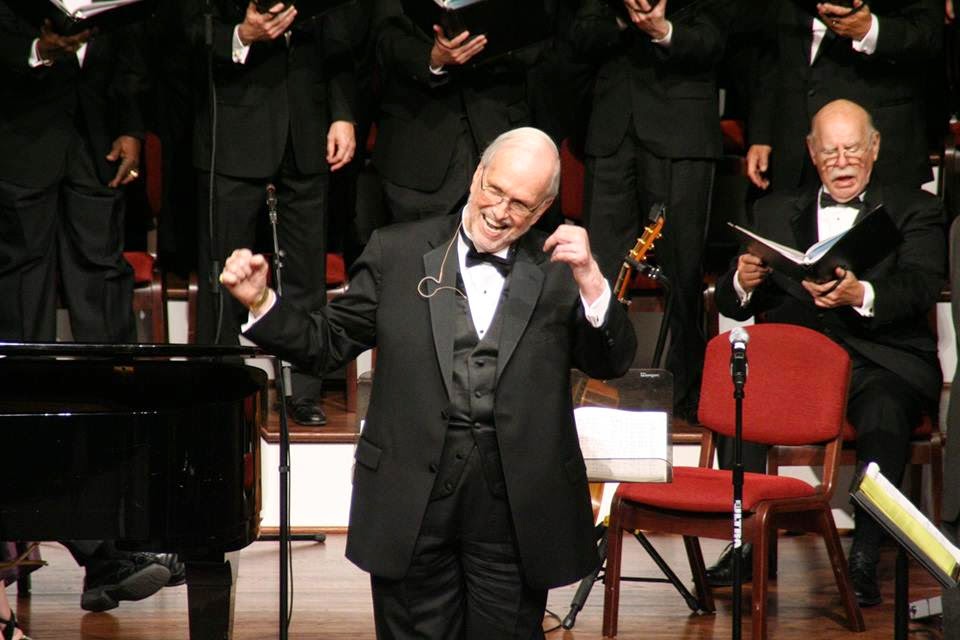
Frank Boggs at 90: Gospel Singer, Choral Director, Teacher
In 1977, for a concert at the Atlanta Civic Center, Frank sang “You Make Me Feel So Young” to his Westminster Ensemble -- me included, seventeen years old. Forty years later, I’m grateful for the occasion of his birthday celebration to return the compliment.
You seem to be so young,
So deep in voice and strong in lung,
And when you’re waving your baton,
You spur your chorus on – “like gangbusters!”
You still can have a blast
With anecdotes from ages past.
Sometimes you’re known to drop some names
Of stars, and queens, and dames.
Years go by
You still have a lot to give
Teaching and learning always,
That’s how you live:
Inquisitive!
You seem to be so young
With all these friends you live among,
with flings to be flung,
and many more songs to be sung!
And Frank, you’re like Methuselah:
It doesn’t matter how old you are,
‘cause your spirit stays so young!
composed by Josef Myrow, with lyrics written by Mack Gordon
parody by Scott Smoot to celebrate the 90th birthday of Frank Boggs, teacher and friend, January 2017
Monday, January 16, 2017
Good News about the Gospel of Biff:
Lamb by Christopher Moore
Here's the pitch: "The Gospel according to Biff, Christ's childhood pal." We instantly can see the whole thing, and we can also think: Life of Brian - been there, done that. Besides, everyone already knows the ending.
That's the risk Christopher Moore takes when he makes that pitch the subtitle of his 2002 novel Lamb. The good news is that Moore has spun a comic adventure better than what we imagine.
Because the Gospels skip from the manger to the wedding at Cana, there's a thirty-year gap in Jesus's life story to fill with boyhood pranks, teenage adventures, and gags regarding angels and miracles. So teenage Levi known as "Biff" and Jesus called "Joshua," the more Jewish version of his name, go out one night with stone cutter's tools to circumcise a tremendous statue of Apollo. Later, Biff does some serious research into "knowing a woman" giving a play-by-play report to his celibate buddy in the next room. Some bad puns have page-long set ups, like the Hindu joke ("holy cow") and the one about a non-violent form of martial arts developed by Joshua (Jew-do). Reading a list of descriptive names for six delectable concubines, you may overlook the one that comes from a Chinese take-out menu. My favorite scene depicts teenage Joshua in a crowded bazaar, jostling everyone he meets, leaving in his wake people cured of cancer, mental illness, and stinky feet.
The set up for the whole novel is a gag, when a hunky dumb-blond angel resurrects Biff to write this new gospel. They hole up in a Manhattan hotel. Biff tries to escape while the angel gets hooked on pizza and pro wrestling.
But in the tradition of Huckleberry Finn, Moore sends his youthful adventurers to some dark places. Moore imagines hitherto unimaginable poverty and describes violence with such blood-smeared and bone-crunching detail that the comedy comes to an end, at least for awhile. Worst is the massacre inflicted by fanatical devotees of Kali on families so far down in India's social structure that they accept the sacrifice of their children as their due.
The tone can shift, but the bond of love between the narrator, Joshua, and their girl Maggie (a.k.a. Mary Magdalene) never wavers. She is a memorable character, way more mature at twelve than either of the guys, believable and vital whether the story bends towards comedy or tragedy.
Moore doesn't sidestep the serious question that Biff poses to his pal the Messiah: "How can you drive out the Romans without killing?" Seeking answers from the three Wise Men of the East, Joshua picks up his answer a bit at a time. Violence in self-defense causes Joshua to scream "Stop this!" (139). Joshua earns the insight that freedom isn't something bestowed; it's internal (228). (I recognize an insight developed by Martin Luther King's mentor Howard Thurman, described in my blogpost Jesus and the Disinherited). Joshua learns from a Buddhist priest, but learns more from his encounter with the Yeti, who "loved constantly, instantly, spontaneously, without thought or words ....Love is not something you think about" (253). Joshua takes back to Israel a message of the Holy Spirit in all of us, and the religious authorities are threatened. Biff observes, "These legalists had worked hard to find their place in power; they weren't interested in change" (355).
Since I read Lamb last week, I have to admit that Moore's images and tone come to mind during my daily readings of Scripture. I now appreciate the social subtext of doctrinal differences between the working-class Pharisees and Sadducees born to their exalted priesthood. Moore's imagining of an ancient city brings Jesus's world to life better than any movie has done.
After a rollicking adventure along the Silk Road, Moore has to bring us to Holy Week. Moore tries to keep the story fresh, and he throws in some more jokes. But there's not much he can do, as each chapter is a day closer to a painful ending.
What about the Resurrection, you ask? Frederick Buechner once called the Gospel a "comedy" because of its unlikely, joyous conclusion. Moore follows a different logic to an ending that satisfies.
Page references from the Harper Perennial reissue, 2004.
That's the risk Christopher Moore takes when he makes that pitch the subtitle of his 2002 novel Lamb. The good news is that Moore has spun a comic adventure better than what we imagine.
Because the Gospels skip from the manger to the wedding at Cana, there's a thirty-year gap in Jesus's life story to fill with boyhood pranks, teenage adventures, and gags regarding angels and miracles. So teenage Levi known as "Biff" and Jesus called "Joshua," the more Jewish version of his name, go out one night with stone cutter's tools to circumcise a tremendous statue of Apollo. Later, Biff does some serious research into "knowing a woman" giving a play-by-play report to his celibate buddy in the next room. Some bad puns have page-long set ups, like the Hindu joke ("holy cow") and the one about a non-violent form of martial arts developed by Joshua (Jew-do). Reading a list of descriptive names for six delectable concubines, you may overlook the one that comes from a Chinese take-out menu. My favorite scene depicts teenage Joshua in a crowded bazaar, jostling everyone he meets, leaving in his wake people cured of cancer, mental illness, and stinky feet.
The set up for the whole novel is a gag, when a hunky dumb-blond angel resurrects Biff to write this new gospel. They hole up in a Manhattan hotel. Biff tries to escape while the angel gets hooked on pizza and pro wrestling.
But in the tradition of Huckleberry Finn, Moore sends his youthful adventurers to some dark places. Moore imagines hitherto unimaginable poverty and describes violence with such blood-smeared and bone-crunching detail that the comedy comes to an end, at least for awhile. Worst is the massacre inflicted by fanatical devotees of Kali on families so far down in India's social structure that they accept the sacrifice of their children as their due.
The tone can shift, but the bond of love between the narrator, Joshua, and their girl Maggie (a.k.a. Mary Magdalene) never wavers. She is a memorable character, way more mature at twelve than either of the guys, believable and vital whether the story bends towards comedy or tragedy.
Moore doesn't sidestep the serious question that Biff poses to his pal the Messiah: "How can you drive out the Romans without killing?" Seeking answers from the three Wise Men of the East, Joshua picks up his answer a bit at a time. Violence in self-defense causes Joshua to scream "Stop this!" (139). Joshua earns the insight that freedom isn't something bestowed; it's internal (228). (I recognize an insight developed by Martin Luther King's mentor Howard Thurman, described in my blogpost Jesus and the Disinherited). Joshua learns from a Buddhist priest, but learns more from his encounter with the Yeti, who "loved constantly, instantly, spontaneously, without thought or words ....Love is not something you think about" (253). Joshua takes back to Israel a message of the Holy Spirit in all of us, and the religious authorities are threatened. Biff observes, "These legalists had worked hard to find their place in power; they weren't interested in change" (355).
Since I read Lamb last week, I have to admit that Moore's images and tone come to mind during my daily readings of Scripture. I now appreciate the social subtext of doctrinal differences between the working-class Pharisees and Sadducees born to their exalted priesthood. Moore's imagining of an ancient city brings Jesus's world to life better than any movie has done.
After a rollicking adventure along the Silk Road, Moore has to bring us to Holy Week. Moore tries to keep the story fresh, and he throws in some more jokes. But there's not much he can do, as each chapter is a day closer to a painful ending.
What about the Resurrection, you ask? Frederick Buechner once called the Gospel a "comedy" because of its unlikely, joyous conclusion. Moore follows a different logic to an ending that satisfies.
Page references from the Harper Perennial reissue, 2004.
Friday, January 13, 2017
Photo with Mom: A Safety Deposit for Emotions
Twenty minutes before I took this photo, Mom called from the front office of her new assisted living residence very unhappy. She needed me to get over there right away.
When I arrived, she was sitting with her buddy Bill, watching TV, tossing the ball with her beloved Sassy, and surprised to see me. "I love it here," she said, "but let me look around at the notes I've written. Maybe I'll find what I was upset about." We laughed about that, and talked seriously about how you can't feel connected to people in the residence if you forget all your time with them. She said seriously, "There's nothing you or I can do about that." Some rolling around with the dog followed, and she told Bill about me, "He's a good boy."
Let me deposit that moment here in my bank of feelings, to save for the next rain storm.
See other entries in my "Dementia Diary."
When I arrived, she was sitting with her buddy Bill, watching TV, tossing the ball with her beloved Sassy, and surprised to see me. "I love it here," she said, "but let me look around at the notes I've written. Maybe I'll find what I was upset about." We laughed about that, and talked seriously about how you can't feel connected to people in the residence if you forget all your time with them. She said seriously, "There's nothing you or I can do about that." Some rolling around with the dog followed, and she told Bill about me, "He's a good boy."
Let me deposit that moment here in my bank of feelings, to save for the next rain storm.
See other entries in my "Dementia Diary."
Tuesday, January 10, 2017
Snow Days with Dog: How Happy Can You Get?
And, How can you get happy?
Little snow, but a sheet of black ice stranded Mia and me with nothing to entertain ourselves but a book, this screen, and her favorite toys. As I learned from her, what else does anyone need?
Mia teaches me every day that it's the promise and the pursuit that are most rewarding. She leaps and prances to her toy, throwing back at me a come-hither look over her tail. The whole body wags. She growls, tenses, and jumps at my hands, offering me a sporting chance to grab the toy out of her mouth. When I catch it, I pull her around furniture, up in the air, across the carpet, until it's time to let her win. She runs off to chew awhile, but soon comes back for another round. On a walk outside, she'll sometimes spring straight up, all four legs suspended in air, to look me full in the eyes. I'm so excited, this is so great, thank you!
Hard to believe it now, but there'll be a time when she can't do these things. I'll want to remember the whites at the outer rim of her eyes that are looking back at me; the prance, the pounce, the pursuit from room to room; the contented yawn and stretch when the game is over; the quivery anticipation when she sits and stays a couple yards from the food bowl, looking at me for the signal to dig in.
[Photos, clockwise from top left: At attention next to me on the divan, Mia scans the front yard for Jack the Cat. Under the table, Mia enjoys seeing me watch her chewing the "Flappy" toy. At my feet here where I stand at a lectern typing, Mia is warm and content.]
Little snow, but a sheet of black ice stranded Mia and me with nothing to entertain ourselves but a book, this screen, and her favorite toys. As I learned from her, what else does anyone need?
Mia teaches me every day that it's the promise and the pursuit that are most rewarding. She leaps and prances to her toy, throwing back at me a come-hither look over her tail. The whole body wags. She growls, tenses, and jumps at my hands, offering me a sporting chance to grab the toy out of her mouth. When I catch it, I pull her around furniture, up in the air, across the carpet, until it's time to let her win. She runs off to chew awhile, but soon comes back for another round. On a walk outside, she'll sometimes spring straight up, all four legs suspended in air, to look me full in the eyes. I'm so excited, this is so great, thank you!
Hard to believe it now, but there'll be a time when she can't do these things. I'll want to remember the whites at the outer rim of her eyes that are looking back at me; the prance, the pounce, the pursuit from room to room; the contented yawn and stretch when the game is over; the quivery anticipation when she sits and stays a couple yards from the food bowl, looking at me for the signal to dig in.
[Photos, clockwise from top left: At attention next to me on the divan, Mia scans the front yard for Jack the Cat. Under the table, Mia enjoys seeing me watch her chewing the "Flappy" toy. At my feet here where I stand at a lectern typing, Mia is warm and content.]
Friday, January 06, 2017
The Power of Liturgy: I've Heard it All Before
Habit is Heaven's redress; God gives us habit in place of happiness.
- Pushkin, from Eugene Onegin
At church several weeks ago, a lively discussion took off from an observation by George Bernard Shaw: "If history repeats itself, and the unexpected always happens, how incapable must Man be of learning from experience!" Our discussion of repetition in life ranged through Scripture, Buddhism, and cultural touchstones (including Groundhog Day). One of us spoke of "just going through the motions" of faith as a dry, habitual, tedious exercise, something to be avoided. We were led eventually to a consideration of ritual as an agent of change: even just going through the motions can change us.
Since then, every source seems to have something to add to that question, Is it a good thing or bad to be "just going through the motions?" Fr. Roger Allen preached Christmas Eve to people who don't usually show up at church, who had so much else they could've done that night, concluding, "You're here because you expect something to happen." But that "something" needs time to develop, in a habit of worship. Our Bishop-emeritus J. Neil Alexander, now Dean of the School of Theology at University of the South, Sewanee, wrote in a newsletter of the sinking feeling we all have these days of never being "done" with the "busy-ness" of our lives, so he's grateful to stop it all for Morning Prayer, Eucharist, and Evening prayer, time-outs that remind us how we're on God's time.
Just this past Sunday, Fr. Daron Vroon concluded his sermon with a plug for repeating the ancient Jesus prayer thousands of times a day, telling us how he says it while driving or changing a diaper: "Jesus Christ, Son of God, have mercy on me, a sinner." (Later, he announced a pop quiz, but a quiet train at our RR crossing blew its horn just as we were to recite.)
I can attest to that Jesus Prayer. My recent blog posts cover stressful situations when, driving in traffic, I have tried snapping the radio off to pray it. The words fit the ancient Kyrie chant, so I now find myself humming that chant as I hurry through the hallways at school. By repetition, the tune has become the prayer, making me re-mindful of the Big Picture.
Another source gives ample reason for increasing the "motions" we "go through" in the Book of Common Prayer. Inwardly Digest: The Prayer Book as a Guide to a Spiritual Life, a bestseller of the Forward Movement of Cincinnati, is by lay scholar Derek Olsen (blog StBedeProductions.com ). A runner, Olsen likens the habits of devotions by day, by week, and by season, to an athlete's training. A singular "high" or "surge" is never the point, but to "invest ourselves in a pattern of living" (14). He warns against the vanity of worshiping for the purpose of self-edification, though. Ephesians, admonishing us to share "the same mind... that was in Jesus Christ," gives us the point of all this exercise. Olsen adds, "Christian spirituality isn't just about you. Rather, your spiritual success is tied to everyone else around you... building the body of Christ" (15).
Olsen's gung-ho writing about the Lectionary spurred me now to read all the selections for each day, even multiple Psalms. He quotes Athanasius, who observed that other Scripture teaches us about law, about the Saviour's coming, about kings and prophets; "but in the Psalms, besides all of these things, you learn about yourself... [about] the movements of your soul, all its changes, its ups and downs, its failures and recoveries" (209).
Perhaps because of this focus on liturgy, my take-away from Cynthia Crysdale's Transformed Lives: Making Sense of Atonement Today (Seabury Books, New York, 2016) comes down to this: the habits of our lives constitute "salvation," not a one-time vicarious sacrifice of the Son to satisfy the righteous wrath of the Father. She puts aside Scripture's incompatible metaphors intended for different audiences (summary p. 65) and builds on St. Anselm's conclusion that "the essence of salvation -- what in philosophical terms we would call its formal cause -- lies not in the death itself" but in Christ's willingness to live in a way that would get him killed, the "unearned gift of obedience, not the death per se" saving us (78-9). Because evil lives on, "Christ continues to die and rise over and over again." How does that save us? "Embracing that story and willingly offering ourselves to it can indeed become part of the salvation of the world" (90). Crysdale surveys western intellectual history to get us to a point where she says (long story short) that theology, like science, lies "not in abstractions, but in lived religious transformation" (122), which suggests to me, again, habits of worship, habits of interactions with others, habits encouraging us to be upstanders willing to give for the needs we see in our communities.
As I drafted this article, I ran into three more angles on the message that salvation lies in the habits of liturgy during my morning readings in Scripture and Forward Day By Day. First, Hebrews 11, telling of heroes in the Hebrew Scriptures, speaks of faith in terms of slogging on through daily work or journeys, repetitive and unrewarded actions done with the assurance that it adds up to something or gets somewhere. This reminds me of something I read in Richard Rolheiser's book Sacred Fire, where he cites John of the Cross's advice to cloistered believers who've lost their initial enthusiasm for the routine of devotions. Rolheiser likens time spent with worship to time a grown child spends with his aged mother; the routine may seem tedious, even unpleasant (I write from experience, now), but the time builds relationship that can weather sudden storms. (See my reflection "Beyond Growing Up.")
The commentary this month in Forward is by Sallie Schisler, ordained at 60. Writing about how she needed time to accept the soldier called "father" who entered her life when she was two, she tells how we can become comfortable enough to call God "Abba" through "worship, prayer, study, and meditation" (1/1/2017). When an usher at her church told a homeless man, "Sir, you've already received," the man said loudly, "But I'm still hungry!" Schiller concludes, "Without meaning to, [this man] and God taught me that everyone who comes to the table will be ultimately satisfied -- whether it takes one trip or a thousand" (1/2/2017).
To me, it all adds up to affirmation of going through the motions.
- Pushkin, from Eugene Onegin
At church several weeks ago, a lively discussion took off from an observation by George Bernard Shaw: "If history repeats itself, and the unexpected always happens, how incapable must Man be of learning from experience!" Our discussion of repetition in life ranged through Scripture, Buddhism, and cultural touchstones (including Groundhog Day). One of us spoke of "just going through the motions" of faith as a dry, habitual, tedious exercise, something to be avoided. We were led eventually to a consideration of ritual as an agent of change: even just going through the motions can change us.
Since then, every source seems to have something to add to that question, Is it a good thing or bad to be "just going through the motions?" Fr. Roger Allen preached Christmas Eve to people who don't usually show up at church, who had so much else they could've done that night, concluding, "You're here because you expect something to happen." But that "something" needs time to develop, in a habit of worship. Our Bishop-emeritus J. Neil Alexander, now Dean of the School of Theology at University of the South, Sewanee, wrote in a newsletter of the sinking feeling we all have these days of never being "done" with the "busy-ness" of our lives, so he's grateful to stop it all for Morning Prayer, Eucharist, and Evening prayer, time-outs that remind us how we're on God's time.
Just this past Sunday, Fr. Daron Vroon concluded his sermon with a plug for repeating the ancient Jesus prayer thousands of times a day, telling us how he says it while driving or changing a diaper: "Jesus Christ, Son of God, have mercy on me, a sinner." (Later, he announced a pop quiz, but a quiet train at our RR crossing blew its horn just as we were to recite.)
I can attest to that Jesus Prayer. My recent blog posts cover stressful situations when, driving in traffic, I have tried snapping the radio off to pray it. The words fit the ancient Kyrie chant, so I now find myself humming that chant as I hurry through the hallways at school. By repetition, the tune has become the prayer, making me re-mindful of the Big Picture.
Another source gives ample reason for increasing the "motions" we "go through" in the Book of Common Prayer. Inwardly Digest: The Prayer Book as a Guide to a Spiritual Life, a bestseller of the Forward Movement of Cincinnati, is by lay scholar Derek Olsen (blog StBedeProductions.com ). A runner, Olsen likens the habits of devotions by day, by week, and by season, to an athlete's training. A singular "high" or "surge" is never the point, but to "invest ourselves in a pattern of living" (14). He warns against the vanity of worshiping for the purpose of self-edification, though. Ephesians, admonishing us to share "the same mind... that was in Jesus Christ," gives us the point of all this exercise. Olsen adds, "Christian spirituality isn't just about you. Rather, your spiritual success is tied to everyone else around you... building the body of Christ" (15).
Olsen's gung-ho writing about the Lectionary spurred me now to read all the selections for each day, even multiple Psalms. He quotes Athanasius, who observed that other Scripture teaches us about law, about the Saviour's coming, about kings and prophets; "but in the Psalms, besides all of these things, you learn about yourself... [about] the movements of your soul, all its changes, its ups and downs, its failures and recoveries" (209).
Perhaps because of this focus on liturgy, my take-away from Cynthia Crysdale's Transformed Lives: Making Sense of Atonement Today (Seabury Books, New York, 2016) comes down to this: the habits of our lives constitute "salvation," not a one-time vicarious sacrifice of the Son to satisfy the righteous wrath of the Father. She puts aside Scripture's incompatible metaphors intended for different audiences (summary p. 65) and builds on St. Anselm's conclusion that "the essence of salvation -- what in philosophical terms we would call its formal cause -- lies not in the death itself" but in Christ's willingness to live in a way that would get him killed, the "unearned gift of obedience, not the death per se" saving us (78-9). Because evil lives on, "Christ continues to die and rise over and over again." How does that save us? "Embracing that story and willingly offering ourselves to it can indeed become part of the salvation of the world" (90). Crysdale surveys western intellectual history to get us to a point where she says (long story short) that theology, like science, lies "not in abstractions, but in lived religious transformation" (122), which suggests to me, again, habits of worship, habits of interactions with others, habits encouraging us to be upstanders willing to give for the needs we see in our communities.
As I drafted this article, I ran into three more angles on the message that salvation lies in the habits of liturgy during my morning readings in Scripture and Forward Day By Day. First, Hebrews 11, telling of heroes in the Hebrew Scriptures, speaks of faith in terms of slogging on through daily work or journeys, repetitive and unrewarded actions done with the assurance that it adds up to something or gets somewhere. This reminds me of something I read in Richard Rolheiser's book Sacred Fire, where he cites John of the Cross's advice to cloistered believers who've lost their initial enthusiasm for the routine of devotions. Rolheiser likens time spent with worship to time a grown child spends with his aged mother; the routine may seem tedious, even unpleasant (I write from experience, now), but the time builds relationship that can weather sudden storms. (See my reflection "Beyond Growing Up.")
The commentary this month in Forward is by Sallie Schisler, ordained at 60. Writing about how she needed time to accept the soldier called "father" who entered her life when she was two, she tells how we can become comfortable enough to call God "Abba" through "worship, prayer, study, and meditation" (1/1/2017). When an usher at her church told a homeless man, "Sir, you've already received," the man said loudly, "But I'm still hungry!" Schiller concludes, "Without meaning to, [this man] and God taught me that everyone who comes to the table will be ultimately satisfied -- whether it takes one trip or a thousand" (1/2/2017).
To me, it all adds up to affirmation of going through the motions.
Monday, January 02, 2017
Bells Resonate in The Nine Tailors
The cause of death in Dorothy L. Sayers's detective novel The Nine Tailors (1934), not revealed until late in the novel, is so horrible to contemplate, that it exerts gravity over the whole story.
Until then, it's a cheerful fish-out-of-water comedy. Car trouble strands urbane Lord Peter Wimsey among rustic folk of Fenchurch St. Paul on New Year's Eve, where he has no choice but to enjoy the hospitality of affable, addled rector Venables, and to participate in a festive ringing of the church's nine bells. When a body turns up, Sayers gives the investigation a light touch. The inquest is presented comically, as we infer answers from ellipses between the officious examiner's questions (80). Locals complain how "eddication" has made everything "mysterious" with "fillin' up forms" (98). A chamber pot, referred to with delicate obliqueness as a "bedroom utensil," concealed the necklace that inspired the original sin in this plot (115).
Levi Stahl, in the blog "Ivebeenreadinglately" acknowledges that the detection part of the story could have been handled in thirty pages, but, "Wimsey likes these people and their odd rural interests--and so do we, so neither of us is in a hurry to be shed of them. His having a mystery to solve gives us both an excuse to stick around for a while."
Sayers makes a game of integrating the action with the uniquely English tradition of "ringing changes" on church bells. Change ringers follow intricate patterns to ensure that no sequence of tones will repeat until all permutations have been sounded. Sayers uses those patterns to create a secret message. She uses ringers' jargon for her chapters' titles, with amusing double-entendres, such as "Mr. Gotobed Is Called Wrong with a Double," and "Emily Turns Bunter from Behind." A line from ancient ringer's manuals or Scripture often seems to have inspired the action of a chapter. For example, the epigraph to the chapter "Lord Peter Dodges with Mr. Blundell and Passes Him" explains how "retrograde motion" is involved in "the hunt," which describes both a ringing pattern and a witness's filling in the back story to the crime. Another epigraph quoting from I Kings about the space between cherubim and "costly stones" above (219), hints to us where Lord Peter will find an important clue.
(I wonder if Sayers's titles make sense as sequential moves in an actual peal? If so, this would be a meta-fictional coup akin to the actual chess game that Lewis Carroll plays chapter by chapter in Alice Through the Looking-Glass.)
For all the humor and playfulness, The Nine Tailors also expresses what's dear in the Anglican Church to Sayers, a rector's daughter, who also published essays on the faith. The rector Venables, forgetful, chatty, and fussy about the aesthetics of the church (48), nonetheless shows genuine concern for the soul of the unidentified victim. He drops what he's doing to administer last rites to one of the church's benefactors, but also to the dying infant of a poor mother. Sayers goes into considerable detail to show Venables pulling the community together when a major flood is imminent.
Through Lord Peter's internal monolog, Sayers also comments upon the "genius" of the burial liturgy and upon the faith that motivated anonymous artisans who built the church and carved its cherubs (102). She lavishes vivid description on the beauty of the countryside in spring (55) before she goes on rather too long to describe the flower guild's work at the altar (57).
Not just a plot device, the bells mean something for Sayers. In her preface, she compares the "uproar of the internal combustion engine and the wailing of the jazz band" unfavorably to church bells, "the one loud noise that is made to the glory of God." She waxes poetic describing the bells "rioting and exulting high up in the dark tower, wide mouths rising and falling, brazen tongues clamouring, huge wheels turning to the dance of the leaping ropes" (29). She demonstrates how the bells have served their community broadcasting important messages. For instance, the "tailor" bells ring nine times to signify the death of a man in the parish - "Nine tailors make a man" (60) - followed by the ringing of his age, informing folks for miles around which parishioner has passed; and the bells alert surrounding towns to floodwaters' approach.
In a memorable passage, when Lord Peter visits the belfry alone, Sayers gives us strong, unironic prose to give us a sense that the bells, even in stillness, resonate as if alive and waiting.
There he stood for a moment, gazing up into [the bells'] mouths.... Presently their hooded silence oppressed him. A vague vertigo seized him. He felt as though they were slowly collapsing together and coming down upon him. Spell-bound, he spoke their names: Gaude, Sabaoth, John, Jericho, Jubilee, Dimity, Batty Thomas and Tailor Paul. A soft and whispering echo seemed to start from the walls and die stealthily among the beams. Suddenly he shouted in a great voice: "Tailor Paul!" and he must somehow have hit upon a harmonic of the scale, for a faint brazen note answered him, remote and menacing, from overhead. (200)
He, and we, are spooked. But, when justice is served, and atonement made, we sense in this place a Holy Ghost.
Sources
Page references come from the Harbrace Paperbound Edition, 1962, that I first read in 1979 [pictured]Before writing this post, I read other bloggers' comments about The Nine Tailors. Both were perceptive and helpful:
http://ivebeenreadinglately.blogspot.com/2008/03/nine-notes-on-dorothy-l-sayers-and-nine.html
and
https://vulpeslibris.wordpress.com/2012/02/03/the-nine-tailors-by-dorothy-l-sayers/
Moving Mom: "Worrying, You Suffer Twice"
She's lost her "independent living" apartment, 300 pounds of books, 200 pounds of kitchenware, 100 pounds of 1970s - era clothing, two massive analog TV sets, and two rooms of furniture that are now stashed in my basement. But she hasn't lost her sense of humor: on Day Three of her move to assisted living, I found a Post-It on the door to her apartment warning, "No radio, No TV, Enter @ own risk!"
[Top Photo: Just inside the apartment door is the bronze portrait of her by Julia Knight that I commissioned for her and Dad on her 70th birthday and their 50th anniversary. That's Sassy's leash around the base, and the "emergency call" pendant. I reminded her that she's supposed to wear it around her neck at all times. "Well, look: it is around my neck."]
The move was Mom's idea, as "independent living" had come to mean, for her, insecurity when the office staff went home, and isolation. She liked the promise of "assisted living" that staff would be on her hall 24/7, that someone would respond if she touched "0" on her phone, and that her buddy Bill was also relocating to a room just four doors down the hall.
But once the decision was made, she second-guessed herself. Just about every day in December, she has needed reassurance from my brother Todd and me that this is the right move. When she got that, she went back to being indomitable and funny.
I doubted the move myself on our D-Day, when a process I'd estimated at three hours dragged on to eleven. Todd drove 200 miles to be there. We took her to breakfast at 8:00, spent time with her and Sassy at my place, and went back to see if the new apartment was ready. Not even close. Todd stayed with her while the movers tried to stuff the contents of two bedrooms, two bathrooms, three closets and a kitchen into a one-bedroom apartment with sitting room and "kitchenette."
Worrying about all that, I found that a couple hours' physical therapy for acute arthritis was a relief. When I got back to Mom's residence, I handled some paperwork and payments. Todd stayed with Mom for her first dinner at the new place, while I went back home to pick up my dog before the kennel closed for the long weekend, in time to receive leftover possessions in my basement. Movers left around 7:30.
I woke at midnight, worrying if she was able to sleep the first night in her apartment, worrying if she had towels, her coffee maker, her cosmetics -- worrying how distraught she would be if these things weren't around. So I spent the next three-to-four hours sorting boxes, garment bags, and furniture, so that I could get her anything she wanted whenever she asked. [Photo: My basement, before I started sorting, and after.]
But that morning, she had already settled into routine. The friendly assistant, who'd looked in on her every hour of the night, reported that she'd slept well, though she was a little cranky when administered her daily pills. Mom greeted me as if no big change had happened, and all was right with the world when I stocked her small refrigerator with the necessities: yogurt, apples, and Pinot Grigio. We had our Saturday breakfast, our usual walk around the cemetery, and some time to organize stuff in a few remaining boxes. What she didn't see, she didn't miss.
So, all that worry, nearly a month of sleeplessness, got me nothing.
The worry did drive me to seek distraction at the multiplex, where I enjoyed J.K.Rowling's Fantastic Beasts and Where to Find Them, with its very appealing characters, both human and digital, inhabiting Rowling's meticulously wrought alternate reality of Manhattan haunted by magical forces in 1926.
Unexpectedly, I got some great advice, too, delivered by Eddie Redmayne as the geeky but kindly hero "Newt Scamander": "My philosophy is that worrying, you suffer twice."
Let that be my new motto.
[Photo: Sassy never lost her sense of humor, either, as we shuttled her around from apartment, to a walk in the park, to my home, and to the new apartment.]
[Photo: Mom visited my home to see what I decorated instead of a tree. That's the "rough draft" in clay of the bronze portrait.]
[Photo: Mom at breakfast on the first morning after the move.]
See other entries in my "Dementia Diary."
[Top Photo: Just inside the apartment door is the bronze portrait of her by Julia Knight that I commissioned for her and Dad on her 70th birthday and their 50th anniversary. That's Sassy's leash around the base, and the "emergency call" pendant. I reminded her that she's supposed to wear it around her neck at all times. "Well, look: it is around my neck."]
The move was Mom's idea, as "independent living" had come to mean, for her, insecurity when the office staff went home, and isolation. She liked the promise of "assisted living" that staff would be on her hall 24/7, that someone would respond if she touched "0" on her phone, and that her buddy Bill was also relocating to a room just four doors down the hall.
But once the decision was made, she second-guessed herself. Just about every day in December, she has needed reassurance from my brother Todd and me that this is the right move. When she got that, she went back to being indomitable and funny.I doubted the move myself on our D-Day, when a process I'd estimated at three hours dragged on to eleven. Todd drove 200 miles to be there. We took her to breakfast at 8:00, spent time with her and Sassy at my place, and went back to see if the new apartment was ready. Not even close. Todd stayed with her while the movers tried to stuff the contents of two bedrooms, two bathrooms, three closets and a kitchen into a one-bedroom apartment with sitting room and "kitchenette."
Worrying about all that, I found that a couple hours' physical therapy for acute arthritis was a relief. When I got back to Mom's residence, I handled some paperwork and payments. Todd stayed with Mom for her first dinner at the new place, while I went back home to pick up my dog before the kennel closed for the long weekend, in time to receive leftover possessions in my basement. Movers left around 7:30.
I woke at midnight, worrying if she was able to sleep the first night in her apartment, worrying if she had towels, her coffee maker, her cosmetics -- worrying how distraught she would be if these things weren't around. So I spent the next three-to-four hours sorting boxes, garment bags, and furniture, so that I could get her anything she wanted whenever she asked. [Photo: My basement, before I started sorting, and after.]
But that morning, she had already settled into routine. The friendly assistant, who'd looked in on her every hour of the night, reported that she'd slept well, though she was a little cranky when administered her daily pills. Mom greeted me as if no big change had happened, and all was right with the world when I stocked her small refrigerator with the necessities: yogurt, apples, and Pinot Grigio. We had our Saturday breakfast, our usual walk around the cemetery, and some time to organize stuff in a few remaining boxes. What she didn't see, she didn't miss.
So, all that worry, nearly a month of sleeplessness, got me nothing.
The worry did drive me to seek distraction at the multiplex, where I enjoyed J.K.Rowling's Fantastic Beasts and Where to Find Them, with its very appealing characters, both human and digital, inhabiting Rowling's meticulously wrought alternate reality of Manhattan haunted by magical forces in 1926.
Unexpectedly, I got some great advice, too, delivered by Eddie Redmayne as the geeky but kindly hero "Newt Scamander": "My philosophy is that worrying, you suffer twice."
Let that be my new motto.
[Photo: Sassy never lost her sense of humor, either, as we shuttled her around from apartment, to a walk in the park, to my home, and to the new apartment.]
[Photo: Mom visited my home to see what I decorated instead of a tree. That's the "rough draft" in clay of the bronze portrait.]
[Photo: Mom at breakfast on the first morning after the move.]
See other entries in my "Dementia Diary."
Wednesday, December 28, 2016
La La Land Honors Traditions, with Affection
Original movie musicals were most popular in the 1950s, at the same time that classic jazz was at its peak of popularity. In La La Land, writer/director Damien Chazelle honors both traditions. The movie is his answer to a question posed by a synth-jazz musician "Keith" (John Legend) to acoustic jazz purist "Seb" (Ryan Gosling): "How are you gonna be a revolutionary if you're such a traditionalist?"
Part of the answer lies in relating the tradition to the audience's experience. Seb draws Emma Stone's "Mia" into understanding what he loves about jazz by relating it to the dramas that she loves, likening it to friends engaged in lively conversation. The director draws his millennial audience into the idea that the world can be musical by panning through an L.A. traffic jam, driver after driver jamming to his or her own soundtrack from car music systems. It's not much of a stretch when frustrated drivers emerge from their cars to merge in a song-and-dance number that animates the interstate as far as the camera can see. Other dances and songs start from characters' movements and dialogue; after a dance duet ends, Gosling naturally does a little soft-shoe as he walks away alone.
Those of a certain age will recognize the sound-stage setting from Singing in the Rain, the dance duet in a darkened park from The Band Wagon, and an art-inspired dreamscape from An American in Paris. The story, in fact, is boiler-plate, familiar from iterations of A Star is Born and the recent Last Five Years: "Mia" dreams of acting; "Sebastian," dreams of playing piano in a jazz club of his own; they support each other until the divergence of their two careers threatens the relationship. (See my reflection on The Last Five Years.)
But Chazelle puts a contemporary spin on those traditions. It's not just the cell phones, the fashions, and the occasional four-letter word; it's also playing with time, wrapping different strands of the story around a single incident, so that we come at it from different perspectives (another element shared with The Last Five Years). Composer Justin Hurwitz, with lyricists Benj Pasek and Justin Paul, aims at a sweet spot between the kind of "specific" songs that fit the moment and the more generalized imagery of pop songs - focused on dreams,stars, and how everyone is looking for love*.
The exceptional song, Hurwitz's favorite, is "Audition," a hint of what could have lifted this movie from pleasant homage to be a stronger, more "revolutionary" updating of the tradition. Hurwitz cites Emma Stone's live - in - studio performance for why he loves it, as the song is specific to the character and the situation in the way he consciously avoided elsewhere (see his interview with Lambe). "Mia's" future career is on the line when she is asked to simply "tell us a story." Unsure what to say, she lights up when she begins to sing her aunt's story of an impulsive leap into the Seine in winter, and she grows in confidence as she adds to the story.
Chazelle missed an opportunity to create a musical scene even stronger than "Audition" when Seb, flying in from out of town, surprises Mia with dinner by candlelight. It starts as a romantic, happy occasion, but dissolves into rancor over Mia's complaint that Seb is away so much, and his protest (totally justified, I think) that he has been away providing for her. This scene is the dramatic heart of the movie, and, if Chazelle, Hurwitz et. al. had reached beyond the MGM tradition to what has developed on Broadway in Sondheim and in The Last Five Years, this, too, could have been a musical number to integrate the musical style with the dramatic story.
Still, it's clear that the creators of this movie and their stars love what they're doing, They have fun. There's no other excuse to build a song-and-dance number for Mia and her roommates' preparations to party. No one could expect Gosling and Stone to measure up to Astaire or Charisse in their dancing, but they move with spirit, precision, and apparent ease, while the camera does most of the dancing for them - swirling around from above, or taking the dancers in silhouette across a starry sky. The dramatic scenes are as real as they can be, even when Stone plays her character playing another character for an audition: it's a remarkable demonstration of the actor's craft.
Besides, the two characters are so appealing that we want their romance to succeed. For the same reason, we want the movie to succeed.
And so it does.
*(Stephen Sondheim, meticulous tailor of songs to situations, explains how rock 'n' roll's displacement of show tunes from the top 40 freed Broadway composers of the pressure to write "hits". See my article about his conversation with pianist Marian MacPartland.)
Part of the answer lies in relating the tradition to the audience's experience. Seb draws Emma Stone's "Mia" into understanding what he loves about jazz by relating it to the dramas that she loves, likening it to friends engaged in lively conversation. The director draws his millennial audience into the idea that the world can be musical by panning through an L.A. traffic jam, driver after driver jamming to his or her own soundtrack from car music systems. It's not much of a stretch when frustrated drivers emerge from their cars to merge in a song-and-dance number that animates the interstate as far as the camera can see. Other dances and songs start from characters' movements and dialogue; after a dance duet ends, Gosling naturally does a little soft-shoe as he walks away alone.
Those of a certain age will recognize the sound-stage setting from Singing in the Rain, the dance duet in a darkened park from The Band Wagon, and an art-inspired dreamscape from An American in Paris. The story, in fact, is boiler-plate, familiar from iterations of A Star is Born and the recent Last Five Years: "Mia" dreams of acting; "Sebastian," dreams of playing piano in a jazz club of his own; they support each other until the divergence of their two careers threatens the relationship. (See my reflection on The Last Five Years.)
But Chazelle puts a contemporary spin on those traditions. It's not just the cell phones, the fashions, and the occasional four-letter word; it's also playing with time, wrapping different strands of the story around a single incident, so that we come at it from different perspectives (another element shared with The Last Five Years). Composer Justin Hurwitz, with lyricists Benj Pasek and Justin Paul, aims at a sweet spot between the kind of "specific" songs that fit the moment and the more generalized imagery of pop songs - focused on dreams,stars, and how everyone is looking for love*.
The exceptional song, Hurwitz's favorite, is "Audition," a hint of what could have lifted this movie from pleasant homage to be a stronger, more "revolutionary" updating of the tradition. Hurwitz cites Emma Stone's live - in - studio performance for why he loves it, as the song is specific to the character and the situation in the way he consciously avoided elsewhere (see his interview with Lambe). "Mia's" future career is on the line when she is asked to simply "tell us a story." Unsure what to say, she lights up when she begins to sing her aunt's story of an impulsive leap into the Seine in winter, and she grows in confidence as she adds to the story.
Chazelle missed an opportunity to create a musical scene even stronger than "Audition" when Seb, flying in from out of town, surprises Mia with dinner by candlelight. It starts as a romantic, happy occasion, but dissolves into rancor over Mia's complaint that Seb is away so much, and his protest (totally justified, I think) that he has been away providing for her. This scene is the dramatic heart of the movie, and, if Chazelle, Hurwitz et. al. had reached beyond the MGM tradition to what has developed on Broadway in Sondheim and in The Last Five Years, this, too, could have been a musical number to integrate the musical style with the dramatic story.
Still, it's clear that the creators of this movie and their stars love what they're doing, They have fun. There's no other excuse to build a song-and-dance number for Mia and her roommates' preparations to party. No one could expect Gosling and Stone to measure up to Astaire or Charisse in their dancing, but they move with spirit, precision, and apparent ease, while the camera does most of the dancing for them - swirling around from above, or taking the dancers in silhouette across a starry sky. The dramatic scenes are as real as they can be, even when Stone plays her character playing another character for an audition: it's a remarkable demonstration of the actor's craft.
Besides, the two characters are so appealing that we want their romance to succeed. For the same reason, we want the movie to succeed.
And so it does.
*(Stephen Sondheim, meticulous tailor of songs to situations, explains how rock 'n' roll's displacement of show tunes from the top 40 freed Broadway composers of the pressure to write "hits". See my article about his conversation with pianist Marian MacPartland.)
Source
Lambe, Stacy. "Exclusive: La La Land Composer on How Ryan Gosling and Emma Stone Influenced the Award-Winning Music." ET Online. December 12, 2016.Sunday, December 25, 2016
Rejoice in the Lamb, Christopher Smart's Cat, and My Dog
Christmas Eve, finding no script at the lectern where I stood to lead the Prayers of the People, I improvised to fill the blank in the Prayer Book's petition, "I ask your thanksgiving for ___." For my dog Mia came to mind before I resorted to phrases more appropriate to the occasion.
That first thought shows how my personal faith was shaped by composer Benjamin Britten's choral cantata Rejoice in the Lamb (1943), setting portions from Christopher Smart's book-length poem Jubilate Agno (ca. 1760). I first heard it at age 16, when I was emerging from scornful teenage atheism. Through decades of Bible study, theology books, services and sermons, my inner principle for discerning among doctrines, unconscious before now, has always been, "Does it go with Smart?"
My favorite portion begins:
Smart begins every line the same way, purposefully invoking Biblical poetry. About Jeoffry, he continues:
Now, on the matter of God and pets, I find little in scripture. Cats don't turn up in the Bible, to my knowledge, aside from some lions and tigers. Dogs, when I find them, skulk around unpleasant things -- Jezebel's gruesome death, prophecies of doom, and Jesus's harsh response to the Samaritan woman (but see my reflection Jesus and Dogs).
C. S. Lewis once responded seriously to the question, "Do our pets go to Heaven?" It's been thirty-five years since I read his essays in God in the Dock, but I recall the gist of his answer as, "I can't say for sure, but I cannot imagine a Heaven without them." Amen.
Writing these thoughts in bed on Christmas morning, Mia beside me asleep, lightly kicking me with her back paws in pursuit of some dream squirrel, I re-read Smart's line, "For there is nothing sweeter than [Jeoffry's] peace when at rest." I appropriate Smart's feline thanksgiving for my dog Mia, pictured in many moods at left: "For I am possessed of a cat, surpassing in beauty from whom I take occasion to bless Almighty God."
You may be interested in my earlier reflections connecting dog with God: Blessing of the Animals (Oct. 11, 2014), and, Dogs are Poetry (January 4, 2010).
That first thought shows how my personal faith was shaped by composer Benjamin Britten's choral cantata Rejoice in the Lamb (1943), setting portions from Christopher Smart's book-length poem Jubilate Agno (ca. 1760). I first heard it at age 16, when I was emerging from scornful teenage atheism. Through decades of Bible study, theology books, services and sermons, my inner principle for discerning among doctrines, unconscious before now, has always been, "Does it go with Smart?"
My favorite portion begins:
For I will consider my Cat Jeoffry.Britten gives these lines to a boy soprano, the voice written to sound in rapt wonderment over the organ's impression of a cat's capricious movements, darting about, stretching, and circling a string of rapid notes "seven times round".
For he is the servant of the Living God, duly and daily serving him
For at the first glance of the glory of God in the East he worships in his way.
For this is done by wreathing his body seven times round with elegant quickness.
Smart begins every line the same way, purposefully invoking Biblical poetry. About Jeoffry, he continues:
For he knows that God is his Saviour.So Smart suggests by these lines, and others that follow, that Father, Son, and Holy Spirit are present and active in all of creation, and that salvation can happen apart from Creeds or Sacraments of the Church. In my evangelical phase, I'd have derided that as borderline pantheism, or "sloppy agape"; but my bedrock experience told me that Smart is right, and all the judgmental doctrines I'd accepted from teen Bible studies smashed to pieces on Smart's view. Yes, he was put away for religious mania, calling to people in the street to kneel in prayer with him, but, as Dr. Johnson remarked, "I'd as lief pray with Kit Smart as anyone else" (quoted in Karina Williamson, "Christopher Smart," at PoetryFoundation.org).
For God has blessed him in the variety of his movements.
Now, on the matter of God and pets, I find little in scripture. Cats don't turn up in the Bible, to my knowledge, aside from some lions and tigers. Dogs, when I find them, skulk around unpleasant things -- Jezebel's gruesome death, prophecies of doom, and Jesus's harsh response to the Samaritan woman (but see my reflection Jesus and Dogs).
C. S. Lewis once responded seriously to the question, "Do our pets go to Heaven?" It's been thirty-five years since I read his essays in God in the Dock, but I recall the gist of his answer as, "I can't say for sure, but I cannot imagine a Heaven without them." Amen.
Writing these thoughts in bed on Christmas morning, Mia beside me asleep, lightly kicking me with her back paws in pursuit of some dream squirrel, I re-read Smart's line, "For there is nothing sweeter than [Jeoffry's] peace when at rest." I appropriate Smart's feline thanksgiving for my dog Mia, pictured in many moods at left: "For I am possessed of a cat, surpassing in beauty from whom I take occasion to bless Almighty God."
You may be interested in my earlier reflections connecting dog with God: Blessing of the Animals (Oct. 11, 2014), and, Dogs are Poetry (January 4, 2010).
Tuesday, December 20, 2016
Forward Day by Day: Gospel for Educators
[image: The parable of laborers in the vineyard, from a book published by early blogger Desiderius Erasmus, 1536]
Following the daily scripture readings in the Book of Common Prayer, I read commentary from the quarterly booklet Forward Day By Day. Written by Richelle Thompson, managing editor of Forward, the short meditations for November were particularly well-crafted, and sometimes seemed to be aimed directly at this Middle School teacher.
Here are highlights that might be collectively called A Gospel for Educators: The Bible on...
...grading: Thompson writes, "Even as a child I felt badly for the good son" whose prodigal brother seems to get the attention. Considering his story along with the parable of the vineyard laborers who receive the same wage whether they worked ten hours or one, teaches Thompson "that our idea of fair is perhaps not God's." Instead, she concludes, "The question is not whether I deserve more than another, but whether I receive what I need." (reading of 11/10) When a colleague mocked the coach who gave everyone a trophy, and, by extension, any teacher whose kids get mostly A's, I should have reminded him that "trophy" comes from Greek for "nourishment". A school where most kids are starved, or losers, isn't a school where I'd want to teach. I tell my kids they all earn credit (from Latin, trust) for completing their work on time, the best they can do, however many drafts that may take; grades (from Latin, step) that place one student's work above another's are of value to gatekeepers only.
...teen angst: "Let everyone be quick to listen, slow to speak, slow to anger; for your anger does not produce God's righteousness" (James 1.19-20). James wrote to ancient churches, but Thompson applies the lesson to those dealing with "the whiplash emotions of teens," too. We must listen well before we react to our "challenging, independent and precious teens," for their sake, and for the sake of our own spiritual growth. (reading of 11/11).
... developmental psychology: Paul writes, "Like a master builder I laid a foundation, and someone else is building on it" (1 Corinthians 3.10). Thompson had always focused on Jesus as the right foundation, but this time followed Paul's thought to its conclusion, where he pictures others building on the foundation with "gold, silver, precious stones, wood, hay, or straw," each life like "a giant parfait, with different layers being built by and with different people." This reminds her "that our work is part of something bigger, our ministry a piece of the whole." (reading of 11/22) For this middle school teacher, it's a reminder that little Johnny may not "get" what his classmates all seem to understand; if I only prepare the foundation for him to get it in a later grade level, I've done well, and he's done well.
... looking for potential in the difficult student: Zacchaeus the tax collector, collaborating with the Roman oppressors and cheating his neighbors, is doing well for himself at the time Jesus enters Jerusalem, but, "Something inside of Zacchaeus makes him want more (the name Zacchaeus, after all, means pure)." He climbs the tree, sees Jesus, takes the hint to invite the rabbi to dinner, donates half his wealth to the poor, and pays back fourfold what he stole. "Meanwhile," Thompson imagines, "the neighborhood grumbles about Jesus' choice for dinner companion." She adds this prayer: Lord, help us be more like Zacchaeus, curious and earnest, and keep us from being quick - to - judge and slow to see you in every face and every place. Amen. (reading of 11/23)
... looking for potential in the difficult student, part II: Taking her cue from Luke 19:40, "the stones themselves would shout out," Thompson observes, "Stones play a starring role in some of the biggest stories of the Bible." Examples include Moses' stone tablets, the tribes' stone altar at the Jordan, the cornerstone that the builders rejected, Peter "the rock," the "first stone" that nobody dared to cast at the woman, and the stone rolled away from Jesus' tomb. In Luke, Jesus tells us "that what is hard can be made flesh, what is mute can cry out, and what is inanimate can become life." Thompson asks, "If Jesus can do that with stones, what can he do with us?" I only add, what, then, can we do with the hard, mute, listless kids who choose the back row in our classrooms? Thompson ends with Ezekiel 36.26: "I will remove from your body the heart of stone and give you a heart of flesh." (reading of 11/25)
... accepting help: Thompson turns around the familiar line from Psalm 102:1, "hide not your face from me in the day of my trouble." We're the ones taught to hide our faces in times of trouble, to "pull ourselves up by our own bootstraps." Thompson dismisses the bootstraps line as nonsense, giving Jesus' alternative to it: "When we stop hiding our faces from the Lord in times of trouble, we can begin to embrace the weak as strong, the poor as mighty, and God as constant companion." (reading of 11/18)
... teaching poetry: Responding to a psalm about God's "holy mountain" from her Appalachian background, Thompson points us to great lines of poetry from scripture:
Following the daily scripture readings in the Book of Common Prayer, I read commentary from the quarterly booklet Forward Day By Day. Written by Richelle Thompson, managing editor of Forward, the short meditations for November were particularly well-crafted, and sometimes seemed to be aimed directly at this Middle School teacher.
Here are highlights that might be collectively called A Gospel for Educators: The Bible on...
...grading: Thompson writes, "Even as a child I felt badly for the good son" whose prodigal brother seems to get the attention. Considering his story along with the parable of the vineyard laborers who receive the same wage whether they worked ten hours or one, teaches Thompson "that our idea of fair is perhaps not God's." Instead, she concludes, "The question is not whether I deserve more than another, but whether I receive what I need." (reading of 11/10) When a colleague mocked the coach who gave everyone a trophy, and, by extension, any teacher whose kids get mostly A's, I should have reminded him that "trophy" comes from Greek for "nourishment". A school where most kids are starved, or losers, isn't a school where I'd want to teach. I tell my kids they all earn credit (from Latin, trust) for completing their work on time, the best they can do, however many drafts that may take; grades (from Latin, step) that place one student's work above another's are of value to gatekeepers only.
...teen angst: "Let everyone be quick to listen, slow to speak, slow to anger; for your anger does not produce God's righteousness" (James 1.19-20). James wrote to ancient churches, but Thompson applies the lesson to those dealing with "the whiplash emotions of teens," too. We must listen well before we react to our "challenging, independent and precious teens," for their sake, and for the sake of our own spiritual growth. (reading of 11/11).
... developmental psychology: Paul writes, "Like a master builder I laid a foundation, and someone else is building on it" (1 Corinthians 3.10). Thompson had always focused on Jesus as the right foundation, but this time followed Paul's thought to its conclusion, where he pictures others building on the foundation with "gold, silver, precious stones, wood, hay, or straw," each life like "a giant parfait, with different layers being built by and with different people." This reminds her "that our work is part of something bigger, our ministry a piece of the whole." (reading of 11/22) For this middle school teacher, it's a reminder that little Johnny may not "get" what his classmates all seem to understand; if I only prepare the foundation for him to get it in a later grade level, I've done well, and he's done well.
... looking for potential in the difficult student: Zacchaeus the tax collector, collaborating with the Roman oppressors and cheating his neighbors, is doing well for himself at the time Jesus enters Jerusalem, but, "Something inside of Zacchaeus makes him want more (the name Zacchaeus, after all, means pure)." He climbs the tree, sees Jesus, takes the hint to invite the rabbi to dinner, donates half his wealth to the poor, and pays back fourfold what he stole. "Meanwhile," Thompson imagines, "the neighborhood grumbles about Jesus' choice for dinner companion." She adds this prayer: Lord, help us be more like Zacchaeus, curious and earnest, and keep us from being quick - to - judge and slow to see you in every face and every place. Amen. (reading of 11/23)
... looking for potential in the difficult student, part II: Taking her cue from Luke 19:40, "the stones themselves would shout out," Thompson observes, "Stones play a starring role in some of the biggest stories of the Bible." Examples include Moses' stone tablets, the tribes' stone altar at the Jordan, the cornerstone that the builders rejected, Peter "the rock," the "first stone" that nobody dared to cast at the woman, and the stone rolled away from Jesus' tomb. In Luke, Jesus tells us "that what is hard can be made flesh, what is mute can cry out, and what is inanimate can become life." Thompson asks, "If Jesus can do that with stones, what can he do with us?" I only add, what, then, can we do with the hard, mute, listless kids who choose the back row in our classrooms? Thompson ends with Ezekiel 36.26: "I will remove from your body the heart of stone and give you a heart of flesh." (reading of 11/25)
... accepting help: Thompson turns around the familiar line from Psalm 102:1, "hide not your face from me in the day of my trouble." We're the ones taught to hide our faces in times of trouble, to "pull ourselves up by our own bootstraps." Thompson dismisses the bootstraps line as nonsense, giving Jesus' alternative to it: "When we stop hiding our faces from the Lord in times of trouble, we can begin to embrace the weak as strong, the poor as mighty, and God as constant companion." (reading of 11/18)
... teaching poetry: Responding to a psalm about God's "holy mountain" from her Appalachian background, Thompson points us to great lines of poetry from scripture:
So many of the psalms use nature to describe our relationship with God - and God's relationship with us. Listen to the poetry: Mountains skip like rams and hills like young sheep (Psalm 114); rivers clap their hands, and hills ring out with joy (Psalm 98); the Lord makes us lie down in green pastures and leads us to still waters (Psalm 23). Scripture seems to want us to feel the mountains in our blood, the wave of grain at our fingertips, the rush of an ocean's wave in our hearts. God the creator of all invites us to be one with nature, to be faithful stewards of it, so that we might enter the gates of Zion from atop the holy mountain. (reading of 11/12)
Thursday, December 15, 2016
Rough Waters: A View from the Nave
The central part of the church, where worshipers face altar, clergy and choir, is called the "nave" for a reason: related to the word "navy," the name describes the room's traditional ship-like shape, and implies that we are on a journey together. The metaphor calls to mind the Gospel story of the apostles in a boat on a stormy lake, freaking out until Jesus calms the waters.
It's a good metaphor for the way I've felt since I woke up around 2:30 this morning, as if waters are shifting around me and I'm insufficient to deal with it all. Just a quick list of things that worry me as this day begins: Mom's fretting about a move she initiated that now appears to her my scheme to put her away; anxiety that I won't have thought through all the ins and outs of staging the next scene in the middle school musical before today's rehearsal; guilt that I succumbed to plates full of artichoke dip and sweets at a reception yesterday, gateway to devouring gift cookies before bed -- and that I'm up three pounds since yesterday at this time; shame to discover that I forgot to pay my credit card bill last month and so have a whopping balance now; disappointment that every other cabinet choice seems to be ones least likely to teach our Adolescent-in-Chief anything that he doesn't think that he already knows; cold weather; sore throat; and, to wrap it up, dread that a social visit to Mom planned for this evening will turn out to be a futile confrontation.
Okay, rough waters, Jesus asleep in the stern: Thank you to Forward Day by Day for reminding me of this metaphor this morning. I'll do what I can and have faith in Jesus for what I can't fix.
It's a good metaphor for the way I've felt since I woke up around 2:30 this morning, as if waters are shifting around me and I'm insufficient to deal with it all. Just a quick list of things that worry me as this day begins: Mom's fretting about a move she initiated that now appears to her my scheme to put her away; anxiety that I won't have thought through all the ins and outs of staging the next scene in the middle school musical before today's rehearsal; guilt that I succumbed to plates full of artichoke dip and sweets at a reception yesterday, gateway to devouring gift cookies before bed -- and that I'm up three pounds since yesterday at this time; shame to discover that I forgot to pay my credit card bill last month and so have a whopping balance now; disappointment that every other cabinet choice seems to be ones least likely to teach our Adolescent-in-Chief anything that he doesn't think that he already knows; cold weather; sore throat; and, to wrap it up, dread that a social visit to Mom planned for this evening will turn out to be a futile confrontation.
Okay, rough waters, Jesus asleep in the stern: Thank you to Forward Day by Day for reminding me of this metaphor this morning. I'll do what I can and have faith in Jesus for what I can't fix.
Sunday, December 11, 2016
Framing Memories of Ed Calhoun
Even with reflections from the reception hall's chandeliers, this photograph is striking. Edwin "Ed" Calhoun took the photo around twenty years ago at the finish line to the Peachtree Road Race, capturing this moment when a Marine in full gear completed a run that he'd dedicated to fallen comrades.
At a memorial service in the beautiful mountain chapel at Big Canoe, GA, the family's three heartfelt, lovingly crafted tributes to Ed, the "fun uncle" and father, dwelt on his voracious appetite for life as his motivation for capturing so much life on film, with his penchant for "framing" moments.
I've known him as jovial host to me and adoring spouse to the lady who brought me into the Walker School north of Atlanta. (Read my tribute to Nancy Calhoun, delivered at the time of her retirement.) Ed's family agreed: while he doted on family, cultivated his friends, and made friends of strangers, his love for wife Nancy was his core, from age 16 on. The preacher took the title of his tribute from what Ed said to Nancy after a rough patch in their lives together: "Thank you for not giving up on me." And his family remembered Ed's answer whenever someone asked how long he had been married to Nancy: "Not long enough."
At a memorial service in the beautiful mountain chapel at Big Canoe, GA, the family's three heartfelt, lovingly crafted tributes to Ed, the "fun uncle" and father, dwelt on his voracious appetite for life as his motivation for capturing so much life on film, with his penchant for "framing" moments.
I've known him as jovial host to me and adoring spouse to the lady who brought me into the Walker School north of Atlanta. (Read my tribute to Nancy Calhoun, delivered at the time of her retirement.) Ed's family agreed: while he doted on family, cultivated his friends, and made friends of strangers, his love for wife Nancy was his core, from age 16 on. The preacher took the title of his tribute from what Ed said to Nancy after a rough patch in their lives together: "Thank you for not giving up on me." And his family remembered Ed's answer whenever someone asked how long he had been married to Nancy: "Not long enough."
Saturday, November 26, 2016
Scott Johnson's Going Somewhere
Over chords on acoustic piano, songwriter / harmonica virtuoso Scott Albert Johnson sings as a young man looking up at stars in "a dark and ghostly screen," while his companion is "looking at the spaces in between" (from "Fragments"). Other numbers on his album Going Somewhere do drive hard to get somewhere fast -- the title song most of all -- but the lyrics focus on those "spaces in between," where characters long for connection.
When Johnson pivoted from his cosmopolitan post-Harvard life back to his Mississippi roots, he drafted a song on a napkin in an airport bar: "If I Only Knew the Words." Ten years of re-writes later, it's eloquent about what's inexpressible in a relationship, punctuated by expressive harmonica solos.
Other songs dig into characters who feel alienated. "Jailbird" is a rip-roaring rockabilly song for a man 30 years into his sentence, regretful but upbeat. In a cover of Peter Gabriel's "I Don't Remember," Johnson shifts his voice into high gear, an octave above his main vocal line, to intensify a political prisoner's protest that he's "got no memory of anything / absolutely anything at all." Johnson's meditation on what it means for an artificial intelligence to be "Simply Human" is reinforced by a synthetic echo of Johnson's voice that overtakes the human sound even while the harmonica solo grows increasingly spirited: an aural image of the ghost in the machine.
Johnson rounds out the set with numbers that inspire foot-stomping and dancing (I've seen both at a Scott Johnson concert). There's a cover of "Haunt My Dreams" by Brett Winston; Johnson's paean to unbridled appetite with a catchy hook, "Gimme - gimme, gimme - gimme - gimme all!"; and "A Bigger Gun," a honky-tonk romp with a killer piano solo and a political edge.
When I first knew Scott Johnson, he was playing guitar and learning piano; but when he went pro, Johnson chose the perfect instrument. The harmonica fits in his pocket; it doesn't present any competition except from Stevie Wonder and that recluse with the Nobel; and it's ideally suited for his theme of longing for connection. We hear a harmonica and think either of a musician at a backwoods juke joint playing on the bandstand apart from the roiling crowd, or one at a campfire, playing in the wilderness to the night sky.
Johnson's harmonica provides my favorite moment of the CD, at the tail end of "Jailbird." After the song's clever tag line and a sly melodic quote from a Beatles tune, Johnson adds a whimsical coda on harmonica. What instrument can sound at once so lonely and so hopeful?
(See my reflection on Johnson's earlier recording Umbrella Man.)
When Johnson pivoted from his cosmopolitan post-Harvard life back to his Mississippi roots, he drafted a song on a napkin in an airport bar: "If I Only Knew the Words." Ten years of re-writes later, it's eloquent about what's inexpressible in a relationship, punctuated by expressive harmonica solos.
Other songs dig into characters who feel alienated. "Jailbird" is a rip-roaring rockabilly song for a man 30 years into his sentence, regretful but upbeat. In a cover of Peter Gabriel's "I Don't Remember," Johnson shifts his voice into high gear, an octave above his main vocal line, to intensify a political prisoner's protest that he's "got no memory of anything / absolutely anything at all." Johnson's meditation on what it means for an artificial intelligence to be "Simply Human" is reinforced by a synthetic echo of Johnson's voice that overtakes the human sound even while the harmonica solo grows increasingly spirited: an aural image of the ghost in the machine.
Johnson rounds out the set with numbers that inspire foot-stomping and dancing (I've seen both at a Scott Johnson concert). There's a cover of "Haunt My Dreams" by Brett Winston; Johnson's paean to unbridled appetite with a catchy hook, "Gimme - gimme, gimme - gimme - gimme all!"; and "A Bigger Gun," a honky-tonk romp with a killer piano solo and a political edge.
When I first knew Scott Johnson, he was playing guitar and learning piano; but when he went pro, Johnson chose the perfect instrument. The harmonica fits in his pocket; it doesn't present any competition except from Stevie Wonder and that recluse with the Nobel; and it's ideally suited for his theme of longing for connection. We hear a harmonica and think either of a musician at a backwoods juke joint playing on the bandstand apart from the roiling crowd, or one at a campfire, playing in the wilderness to the night sky.
Johnson's harmonica provides my favorite moment of the CD, at the tail end of "Jailbird." After the song's clever tag line and a sly melodic quote from a Beatles tune, Johnson adds a whimsical coda on harmonica. What instrument can sound at once so lonely and so hopeful?
(See my reflection on Johnson's earlier recording Umbrella Man.)
Thanksgiving Ride
I drove back to Mississippi to celebrate Jason's recent birthday, his 39th, with a 39-mile bike ride. We started riding when he was in 8th grade and I was his teacher. Seven years later, a month before my 39th birthday, he helped drive my furniture in a rented truck to Georgia, as I relocated close to where my family lived - Mom, Dad, brother Todd and his wife and children, sister Kim and her husband, Aunt Harriet and my grandmother Mamaw.
This week, the drive on I-20 for Thanksgiving triggered memories of making that same trip during my 17 years in Mississippi. Gone are Dad, Aunt Harriet, Mamaw; Todd and his family moved years ago to south Georgia. It's just me and Mom, with Kim and her husband far enough south of Atlanta to be isolated.
Here's the view on Thanksgiving Day, 4/5 of the way around the Ross Barnett Reservoir on bike, a ride I used to do with Jason in the early 1990s. I remember riding it alone one Sunday morning: faster than now, I could finish in time to shower, eat, and make choir practice.
No need to belabor the metaphors of life's cycles and life's road. For where I've been, for what -- and whom -- I've still got, I'm giving thanks.
This week, the drive on I-20 for Thanksgiving triggered memories of making that same trip during my 17 years in Mississippi. Gone are Dad, Aunt Harriet, Mamaw; Todd and his family moved years ago to south Georgia. It's just me and Mom, with Kim and her husband far enough south of Atlanta to be isolated.
Here's the view on Thanksgiving Day, 4/5 of the way around the Ross Barnett Reservoir on bike, a ride I used to do with Jason in the early 1990s. I remember riding it alone one Sunday morning: faster than now, I could finish in time to shower, eat, and make choir practice.
No need to belabor the metaphors of life's cycles and life's road. For where I've been, for what -- and whom -- I've still got, I'm giving thanks.
Wednesday, October 19, 2016
Scholars in Love: What the Nation Needs from A. S. Byatt's Possession
In Possession, mismatched pairs meet in opposition to each other and end up in love. We're in the world of romantic comedy, fresh and fun as it was for Shakespeare's ardent lovers in Arden forest.Yet Byatt's real subject is the world of scholarship, where passion for documented and precise truth is a driving force as potent as erotic attraction. I write from experience.
Byatt's novel is a layered delight. At base is the love affair between two fictional Victorian poets. One, R. Henry Ashe, highly celebrated in his lifetime, was married to Ellen; the other, Christabel LaMotte, modestly successful, lived in seclusion with artist Blanche Glover.
The next layer is made up of what they made up. Ashe wrote verse monologues and epics, a la Browning. LaMotte published dark tales of mermaids and witches, verse replete with Dickinsonian dashes, and her foray into the masculine realm of epic poetry. They and those close to them also wrote letters, numerous, allusive, and lengthy. Of course, these are all A. S. Byatt's labors of love, appropriate to the 19th century, fitting to the personalities, and inter-textually woven with threads of her story.
At surface is the outwardly civil community of literary scholars, ca. 1986. Roland Michell, a graduate specialist in Ashe studies, comes across a letter drafted in Ashe's handwriting that seems to make overtures to a woman who was a fellow house guest at a country home. Naturally, appropriately, professionally, Roland investigates.
But he conceals his find from his boss, Professor Blackadder, and he is soon deep in ever-closer contact with the up-and-coming world expert on LaMotte. Now we see what's under the surface of "scholarship," the ambition, resentments, back-stabbing, and bribery. By the novel's end, rival scholars representing different nations, generations, and sexual orientations have converged for a finale as packed with action as a bunch of pasty-skinned paunchy professors can muster.
Scholarly pursuits are so intense for the characters that romance is a relief. Planning a getaway with Roland, the LaMotte expert Maud confesses she wants just to get away: "I just want to look at something, with interest, and without layers of meaning" (291).
I know what that's like. My advisor at Duke set me up with Professor Irving Holley, promising, "He'll make a scholar of you." Did he! (Read my memories of him, "The Essence of Education".) So deeply was I immersed in uncovering the origins of the drama program at Duke that I recall the thrill of finding a box of playbills from the 1940s more vividly than most classes or relationships in four years there. Even more than my essay, I remember the excitement of writing "content" footnotes to explain arcane details from Duke's drama club performances in the early and middle decades of the 20th century.
A year later, I worked obsessively on a Senior thesis about Henry James. For months, I read every novel, many novellas, many stories, and the Master's prefaces to late editions. Studying at Oxford for the summer, I felt a rush of affection when I recognized him from across a vast hall at the National Portrait Gallery. When my friend Bess gave me a book about Ibsen's influence on Henry James, I devoured the book, and digested its contents in my final draft.
Yet I felt a bit sheepish. I'd spent two years tracing James's use of the word "no" in his novel The Ambassador. Offered a chance for a PhD, I demurred. Enough of scholarship, I thought: let's try real life.
The other way to look at my work, though, is to see how very much there is to know about even a very small topic. Professor Holley used to say that we were digging deeply into territory the size of a postage stamp.
Now I wonder if the nation is suffering for lack of understanding what scholarship entails. Sure, it's easy to make fun of the nit-picking and esoterica that comprise scholarship, but the whole machinery of the academic world is designed to build our store of truth. Scholars document sources, check provenance, avoid jumping to conclusions. How arrogant people are who presume to know enough about big things, such as immigration policy, climate change, or Islam, while they dismiss the work of the scholars possessed with a passion for precise, hard-won truth.
Thursday, October 13, 2016
Cycling on Yom Kippur
Yom Kippur caps ten days of atonement with a prayer ("Ne'ilah") for God's "closing of the gates" to the central part of His temple. One online commentary counters that traditional view with a more comforting thought: He shuts his people in, as keeper, protector.
Maybe it's the Yom Kippur prayer that my Education for Ministry class (EfM) recited Tuesday night, or just the change of season, but I had gate-closing thoughts all Wednesday.
With the holy day off from school, I spent the early afternoon on my bike, enjoying blue sky and temps in the mid-70s. But, though I finished at 3:00, it was already too chilly to enjoy the ride. In November, I'll ride in Mississippi with my original biking buddy Jason, but this must be one of my last rides of the year. I took a couple photos to mark the event.
Earlier, in no rush to shower and dress, I sang along with a recording of Streisand from 1971 that I hadn't played in 20 years. I was struck by how some songs and arrangements had not aged well. Then I was struck by another thought: I'm 57 now; Dad and his dad died at 77; If I wait another 20 years, I may already have heard that CD for the last time. Gate closed.
Should I feel a pang of regret? Naw. I'm a gate-closed-in kind of guy. Besides the cheesy stuff, some of the pieces are still strong. The album, when I first heard it in middle school, taught me to appreciate sparse accompaniment, ostinato, and the difference intentional phrasing can make. I loved it, I learned from it, and I don't need to hear it again.
Here's how I see it: the contents of my life are piled high, safe behind God's gate. Now I'm outside, moving forward. Those contents are an immense store of experiences and people I've loved but see no more. How can I regret that? It's no coincidence that "contents" and "contentment" grow from the same stem.
I go forward, as on my bike, stripped down to my tee shirt and Spandex, content to have so much behind me, watching the meter to see how much I may have ahead. If I've covered that much more distance, I'm that much closer to the end of my ride. That's good.
PS - Moments after I finished drafting this, I was seated in a circle with 7th graders who encountered "The Road Not Taken" for the first time. Resonances abounded, including their appreciation of the lines, "Knowing how way leads on to way... [I may never] come back."
The boy who said, after first reading, "I don't get any of this," had the last word in class: "I never took a poem seriously before. I really liked this."
Maybe it's the Yom Kippur prayer that my Education for Ministry class (EfM) recited Tuesday night, or just the change of season, but I had gate-closing thoughts all Wednesday.
With the holy day off from school, I spent the early afternoon on my bike, enjoying blue sky and temps in the mid-70s. But, though I finished at 3:00, it was already too chilly to enjoy the ride. In November, I'll ride in Mississippi with my original biking buddy Jason, but this must be one of my last rides of the year. I took a couple photos to mark the event.
Earlier, in no rush to shower and dress, I sang along with a recording of Streisand from 1971 that I hadn't played in 20 years. I was struck by how some songs and arrangements had not aged well. Then I was struck by another thought: I'm 57 now; Dad and his dad died at 77; If I wait another 20 years, I may already have heard that CD for the last time. Gate closed.
Should I feel a pang of regret? Naw. I'm a gate-closed-in kind of guy. Besides the cheesy stuff, some of the pieces are still strong. The album, when I first heard it in middle school, taught me to appreciate sparse accompaniment, ostinato, and the difference intentional phrasing can make. I loved it, I learned from it, and I don't need to hear it again.
Here's how I see it: the contents of my life are piled high, safe behind God's gate. Now I'm outside, moving forward. Those contents are an immense store of experiences and people I've loved but see no more. How can I regret that? It's no coincidence that "contents" and "contentment" grow from the same stem.
I go forward, as on my bike, stripped down to my tee shirt and Spandex, content to have so much behind me, watching the meter to see how much I may have ahead. If I've covered that much more distance, I'm that much closer to the end of my ride. That's good.
PS - Moments after I finished drafting this, I was seated in a circle with 7th graders who encountered "The Road Not Taken" for the first time. Resonances abounded, including their appreciation of the lines, "Knowing how way leads on to way... [I may never] come back."
The boy who said, after first reading, "I don't get any of this," had the last word in class: "I never took a poem seriously before. I really liked this."
Monday, October 03, 2016
Dinner with Mom
| (Photo at Shillings by M. S. Rouse, earlier this year) |
What did I hear in the voice? Resentment that, so far as she recalls, her son's care for her is just dinner on Sundays? Resentment of the assumption that she's grateful for such a little thing? I don't know; it was not nice to hear.
But at 6:00, she phoned to find out why I hadn't picked her up. She'd had so much fun with people on the front porch that she hadn't called earlier to find out why I was late. I told her that she'd canceled, and "it kinda hurt my feelings."
She was apologetic, had no idea why she would say such things, and we had a great time as the sun set on Marietta Square. Our waiter knew our orders at Shillings, we loved our wine and martini, enjoyed our dinner, remarked on people passing by, and had a good talk about former students who express gratitude years later.
When we got back to her apartment, her boyfriend Bill was there waiting, and I left her laughing.
See other entries in my "Dementia Diary."
Sunday, October 02, 2016
Middle School Drama Teacher: Memo to Self
Going into our performance of A Wrinkle in Time, adapted by Morgan Gould from Madeleine L'Engle's classic novel, I was feeling pretty much like a failure. With missed cues and hesitant lines, our dress rehearsal ran an hour and twenty minutes, more than twice the show's expected running time. I looked back over weeks of rehearsal for ways I could have exerted tighter control, pushed kids harder, drilled more.
Then, after a dinner break, kids performed the show under 40 minutes; the large ensemble stayed in character, eerily disengaged or openly passionate as needed; the principal characters looked into each others' eyes, touched each other with tenderness or urgency, spoke lines with total conviction and clarity; a simple shift of lights cued the audience when we were moving from one locale to another. Not a failure after all, I was a genius.
Let's remember a few things.
Those stupid improvisation games make a difference.
Before I'd assigned parts, we sat in a circle to read portions of the script and spent precious rehearsal time on those time-killing drama games that kids love. We played "group shape" ("form a giant shoe in ten seconds, using everyone's body as a part"); we warmed up as "blank pages" who stared straight ahead while someone tried to make actors laugh; we played the mirror game; in a circle, successive actors exaggerated a gesture that the first one presented. In the end, these games were basic to the Ensemble's best moments - as creepy automaton cheerleaders on planet Camazotz, as a giant swan for flight over the planet Uriel, as an entourage of mimics when young "Charles Wallace" is possessed by "It."
When you stop rehearsal to get at the feeling of a moment, don't worry about lost time.
I beat myself up for all the afternoons we didn't get through our schedule because we worked on a certain confrontation or a quiet response. In the end, it was the actors' conviction during those moments that made the audience willing to overlook a delayed exit or the tangling of the long white cloth.
Cue-to-Cue does help.
In my panic, I created a "cheat sheet" for the Ensemble and me, and spent thirty minutes the afternoon of the show simply calling one cue after another, by nick name: "Giant Swan! Soccer game from Hell! Make a Wall! March! Take a Wall! Prison! Bowling Pins!" With no principals to flub a cue, movements became fluid, and the principals, watching, suddenly saw their place in the scheme of things.
Even more time with the principals alone could have been a help.
The father, mother, children, and "witches" met with me 90 minutes in the second week, just to improvise as family, to discuss backstories, to get familiar with each other in character. In the last week, I called off a run-through of the show to let the principals work just the final two scenes. It was risky not to rehearse with lights and cues, but we all felt surer of where we were headed after that. We could have benefitted from reserving half an hour every week for that kind of work.
It doesn't take much to make a splash.
We had a black stage, black curtains, and black clothes. Still, we had spectacle: stormy lights on a girl's attic bedroom stage right; the dancing of a long swath of white tulle in figure eights around the principals to transport them; and the "galaxy" light. People talked later about the sudden emergence of "The Red Eyed Man," a satanic figure twenty feet wide and ten feet tall. He was a puppet, voiced by three boys in unison, his face a blank red mask suspended from a fishing pole, swooping down into the faces of his interlocutors, his gesturing arms ten-foot poles topped with work gloves, his shimmering black robe nothing but plastic from Party City. Everyone was creeped out! Our final effect was achieved with a wide wall of black cloth that encircled "Meg" while the Ensemble chanted "Hate! Hate!" isolating little "Charles Wallace" stage left to say, in silence, "No one. No one loves me." It was our finale: Meg broke through the black enclosure to embrace her little brother, and the ensemble, backing up against the black back wall, simply raised the black cloth over themselves to disappear instantly! (We'll forget the time that the cloth got twisted, exposing one frustrated sixth grader who did his best to look invisible.)
All's Well that Ends Well.
Then, after a dinner break, kids performed the show under 40 minutes; the large ensemble stayed in character, eerily disengaged or openly passionate as needed; the principal characters looked into each others' eyes, touched each other with tenderness or urgency, spoke lines with total conviction and clarity; a simple shift of lights cued the audience when we were moving from one locale to another. Not a failure after all, I was a genius.
Let's remember a few things.
Those stupid improvisation games make a difference.
Before I'd assigned parts, we sat in a circle to read portions of the script and spent precious rehearsal time on those time-killing drama games that kids love. We played "group shape" ("form a giant shoe in ten seconds, using everyone's body as a part"); we warmed up as "blank pages" who stared straight ahead while someone tried to make actors laugh; we played the mirror game; in a circle, successive actors exaggerated a gesture that the first one presented. In the end, these games were basic to the Ensemble's best moments - as creepy automaton cheerleaders on planet Camazotz, as a giant swan for flight over the planet Uriel, as an entourage of mimics when young "Charles Wallace" is possessed by "It."
When you stop rehearsal to get at the feeling of a moment, don't worry about lost time.
I beat myself up for all the afternoons we didn't get through our schedule because we worked on a certain confrontation or a quiet response. In the end, it was the actors' conviction during those moments that made the audience willing to overlook a delayed exit or the tangling of the long white cloth.
Cue-to-Cue does help.
In my panic, I created a "cheat sheet" for the Ensemble and me, and spent thirty minutes the afternoon of the show simply calling one cue after another, by nick name: "Giant Swan! Soccer game from Hell! Make a Wall! March! Take a Wall! Prison! Bowling Pins!" With no principals to flub a cue, movements became fluid, and the principals, watching, suddenly saw their place in the scheme of things.
Even more time with the principals alone could have been a help.
The father, mother, children, and "witches" met with me 90 minutes in the second week, just to improvise as family, to discuss backstories, to get familiar with each other in character. In the last week, I called off a run-through of the show to let the principals work just the final two scenes. It was risky not to rehearse with lights and cues, but we all felt surer of where we were headed after that. We could have benefitted from reserving half an hour every week for that kind of work.
It doesn't take much to make a splash.
We had a black stage, black curtains, and black clothes. Still, we had spectacle: stormy lights on a girl's attic bedroom stage right; the dancing of a long swath of white tulle in figure eights around the principals to transport them; and the "galaxy" light. People talked later about the sudden emergence of "The Red Eyed Man," a satanic figure twenty feet wide and ten feet tall. He was a puppet, voiced by three boys in unison, his face a blank red mask suspended from a fishing pole, swooping down into the faces of his interlocutors, his gesturing arms ten-foot poles topped with work gloves, his shimmering black robe nothing but plastic from Party City. Everyone was creeped out! Our final effect was achieved with a wide wall of black cloth that encircled "Meg" while the Ensemble chanted "Hate! Hate!" isolating little "Charles Wallace" stage left to say, in silence, "No one. No one loves me." It was our finale: Meg broke through the black enclosure to embrace her little brother, and the ensemble, backing up against the black back wall, simply raised the black cloth over themselves to disappear instantly! (We'll forget the time that the cloth got twisted, exposing one frustrated sixth grader who did his best to look invisible.)
All's Well that Ends Well.
Thursday, September 15, 2016
Forward Day by Day: Images, Idols, and "Let's Just Joy Out!"
Every three months for many years, Forward Day by Day has published short reflections on the scripture assigned each day in the Episcopal Book of Common Prayer. Once again, I'm noting those reflections that particularly struck me. This time, selections come from Feb-Mar-Apr 2016.
The image on its cover is a detail of the Deesis mosaic in Istanbul's Hagia Sophia [see photo]. The editor comments, "Each piece of glass, stone, and tile was individually placed -- each an important part of the whole. In this way, mosaics offer an important metaphor for our life in Christ."
Genesis 22.2 Offer him there as a burnt offering. Brignac's awe of Abraham's response to this test of his faith vies with her horror at what he was ready to do. She concludes, "Overreliance on reason can hold us back; rejecting reason can lead us into ignorance and sin. It's an awfully narrow line to walk."
John 6.64 But among you there are some who do not believe. For Brignac, the report that brothers (perhaps, cousins) of Jesus couldn't accept his preaching humanizes him: "He was one of us, God incarnate... with brothers who messed with him, whose parents were proud when he took his first steps."
Luke 9.35 This is my Son, my Chosen; listen to him. On the mountain top, Peter chatters about building booths, when this voice tells him to shut up and listen. "We should listen to holy words... and to holy silence," Brignac writes. "Words are great tools, but they keep us limited to concepts that words can express." I like that one. I've also found that words can edit reality; what I've left unsaid or ill-expressed is lost, not just to my friend, but to me.
Genesis 37.9 Look, I have had another dream: the sun, the moon, and eleven stars were bowing down to me. Brignac points out what a twerp Joseph was, yet, he had this gift of true dreams. "God does not require perfect servants."
1 Corinthians 6.20 Therefore glorify God in your body. Brignac takes comfort from a priest's reassurance that God could resurrect her father's body to be as it was in his prime, when he could "bicycle and run and climb trees." But then she thinks, why wait? Why wait for resurrection to be "strong and free, experiencing eating as a healthy uncomplicated celebration, dancing and running and singing to the Lord."
John 12.10 So the chief priests planned to put Lazarus to death as well. Why? "Every time Lazarus spoke, no matter what he said, he was testifying to a different reality of hope, life, and love." So some could not stand to hear Martin Luther King, Jr., and so some today commit hate crimes because of race or sexual orientation, to silence those whose thriving is threatening to the hater's assumed superior position.
John 16.16 A little while, and you will no longer see me. Derkits credits St. John of the Cross and Carl Jung for helping him to find renewal in the darkest times of his life, when he couldn't "see" Jesus in his own life. "When I become overly familiar with the God image I carry around, I am becoming idolatrous. In those times, God may seem to vanish..." only to reappear in a "fuller experience of God's presence."
Exodus 20:3 You shall have no other gods before me. Seems like an easy one, these days, Derkits tells us. But he has a god in his pocket, the smart phone. Others are "Career, Wealth, or Industry -- and that sneaky god called 'I'm right.'"
1 Thessalonians 2.20 Yes, you are our glory and joy. Derkits tells of his young son whose pretend game at the pool with a friend had grown too complicated: "Let's just joy out!" They jumped in. Good lesson for other times when things are getting just too complicated.
The image on its cover is a detail of the Deesis mosaic in Istanbul's Hagia Sophia [see photo]. The editor comments, "Each piece of glass, stone, and tile was individually placed -- each an important part of the whole. In this way, mosaics offer an important metaphor for our life in Christ."
February
Reflections on scripture for February 2016 were by Elizabeth Brignac, "cradle Episcopalian" and editor for a church-based education company.Genesis 22.2 Offer him there as a burnt offering. Brignac's awe of Abraham's response to this test of his faith vies with her horror at what he was ready to do. She concludes, "Overreliance on reason can hold us back; rejecting reason can lead us into ignorance and sin. It's an awfully narrow line to walk."
John 6.64 But among you there are some who do not believe. For Brignac, the report that brothers (perhaps, cousins) of Jesus couldn't accept his preaching humanizes him: "He was one of us, God incarnate... with brothers who messed with him, whose parents were proud when he took his first steps."
Luke 9.35 This is my Son, my Chosen; listen to him. On the mountain top, Peter chatters about building booths, when this voice tells him to shut up and listen. "We should listen to holy words... and to holy silence," Brignac writes. "Words are great tools, but they keep us limited to concepts that words can express." I like that one. I've also found that words can edit reality; what I've left unsaid or ill-expressed is lost, not just to my friend, but to me.
Genesis 37.9 Look, I have had another dream: the sun, the moon, and eleven stars were bowing down to me. Brignac points out what a twerp Joseph was, yet, he had this gift of true dreams. "God does not require perfect servants."
1 Corinthians 6.20 Therefore glorify God in your body. Brignac takes comfort from a priest's reassurance that God could resurrect her father's body to be as it was in his prime, when he could "bicycle and run and climb trees." But then she thinks, why wait? Why wait for resurrection to be "strong and free, experiencing eating as a healthy uncomplicated celebration, dancing and running and singing to the Lord."
March
Reflections for March 2016 were by Rev. Scott Gunn, executive director of the Forward movement.John 12.10 So the chief priests planned to put Lazarus to death as well. Why? "Every time Lazarus spoke, no matter what he said, he was testifying to a different reality of hope, life, and love." So some could not stand to hear Martin Luther King, Jr., and so some today commit hate crimes because of race or sexual orientation, to silence those whose thriving is threatening to the hater's assumed superior position.
April
Reflections for April 2016 were by the Rev. J. James Derkits, artist and priest.John 16.16 A little while, and you will no longer see me. Derkits credits St. John of the Cross and Carl Jung for helping him to find renewal in the darkest times of his life, when he couldn't "see" Jesus in his own life. "When I become overly familiar with the God image I carry around, I am becoming idolatrous. In those times, God may seem to vanish..." only to reappear in a "fuller experience of God's presence."
Exodus 20:3 You shall have no other gods before me. Seems like an easy one, these days, Derkits tells us. But he has a god in his pocket, the smart phone. Others are "Career, Wealth, or Industry -- and that sneaky god called 'I'm right.'"
1 Thessalonians 2.20 Yes, you are our glory and joy. Derkits tells of his young son whose pretend game at the pool with a friend had grown too complicated: "Let's just joy out!" They jumped in. Good lesson for other times when things are getting just too complicated.
Sunday, September 11, 2016
A New Parable at St. James' Marietta: The Farmer's Third Wish
Our readings for Sunday included the fearful Hebrews' reverting to idol-worship and God's change of mind when Moses begs Him to be patient; Paul's confessing how vicious he'd been against Christians until God, in His patience, converted him; and the parables of the lost sheep and the lost coin. Father Roger Allen focused in all three on fear and loathing of "the other," asking if we all think of ourselves as the precious lost lamb? He got a laugh when he spoke for the other ninety-nine. "Why is the shepherd putting so much care into that one lamb? The lamb was out of place, never followed the herd, and deserves to be lost."
But in his conclusion, Fr. Roger repeated a story worth repeating. God visits a faithful farmer and promises him three wishes, adding, "Whatever I give to you, I'll double for your neighbor." At first, the farmer is delighted to have his wishes for 100 cattle and 100 acres more land granted; but he is consumed with jealousy when the neighbor across the fence, who wasn't even involved with God, received 200 cattle and 200 more acres. So, for his third wish, the farmer says, "Strike me blind in one eye."
Fr. Roger concluded, "And God wept."
But in his conclusion, Fr. Roger repeated a story worth repeating. God visits a faithful farmer and promises him three wishes, adding, "Whatever I give to you, I'll double for your neighbor." At first, the farmer is delighted to have his wishes for 100 cattle and 100 acres more land granted; but he is consumed with jealousy when the neighbor across the fence, who wasn't even involved with God, received 200 cattle and 200 more acres. So, for his third wish, the farmer says, "Strike me blind in one eye."
Fr. Roger concluded, "And God wept."
Subscribe to:
Posts (Atom)


