Saturday, June 29, 2024

Summer job, 1973: Scrubbing Decatur Stadium

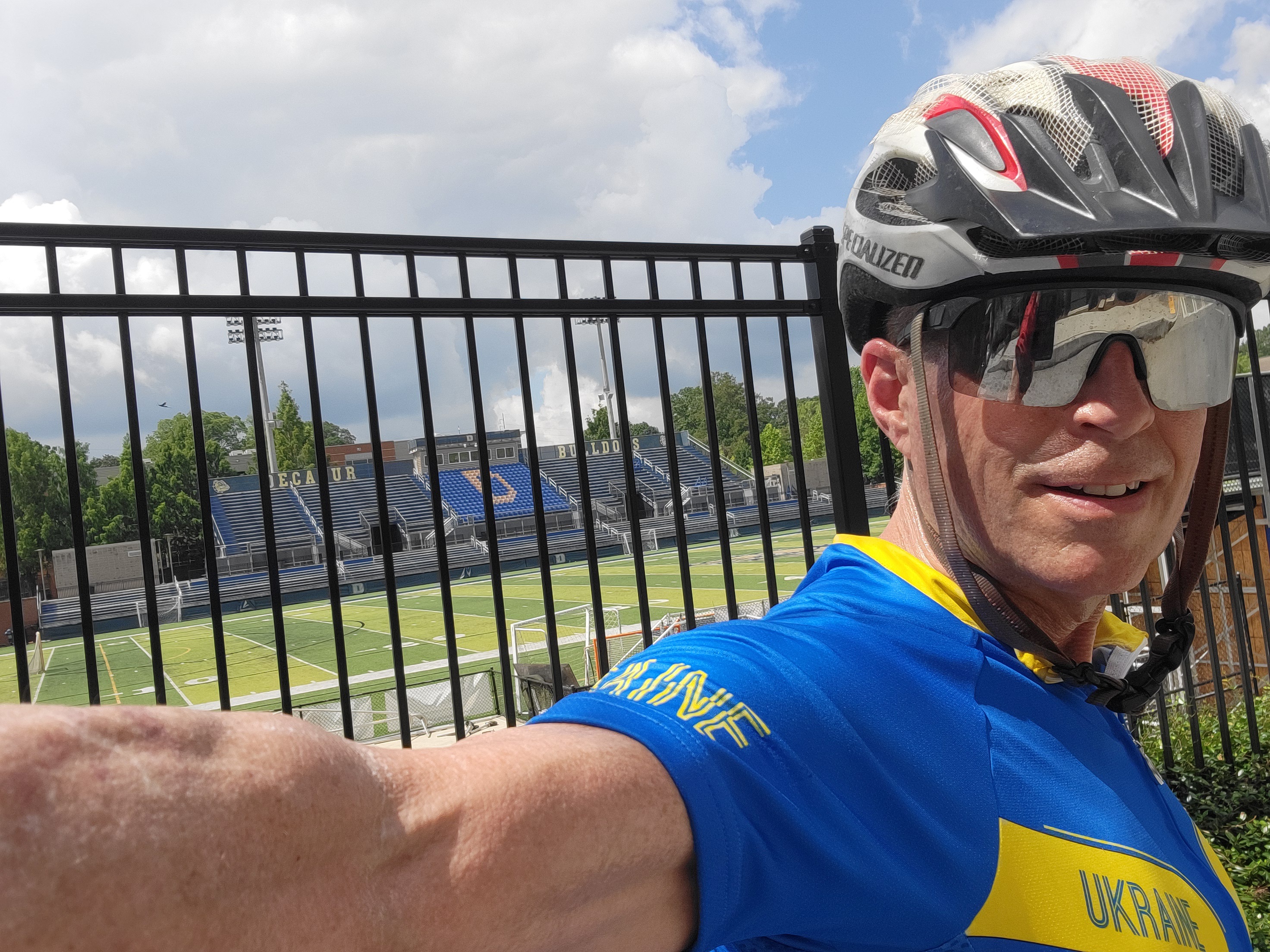
Riding my bike through Decatur on my way back from Stone Mountain Park, I paused for a selfie at the football field of Decatur High. 51 years ago this month, I scrubbed every inch of the home side bleachers. (I would've marked the 50th anniversary last summer, but a hernia precluded such an arduous ride.)

Less than a year before, Dad had purchased West Chemical Engineering Company on Huff Road, not far from Tech. Where townhomes and expensive restaurants now stand, Dad and a couple employees (me included) manufactured soaps, disinfectants, and water treatments in a shed behind an old house. Photo: Dad with Mom at the corner of Huff Road and Ellsworth Industrial Boulevard. A shed with 100-gallon mixers was attached to the back. [For more on work at Dad's company throughout my teen years, see my blog post Prep Kid in a Factory (09/2022)]

But Dad gave me a special mission that summer, when I was between my eighth and ninth grade years. Atlanta City Schools were his customers, and the concrete stadium seats at Decatur high were gray and mottled black with thirty-plus years of soot. Dad bought a piece of new technology called a "pressure washer." With a college kid named Jerry who drove us there and oversaw my work, I scoured the whole stadium, one one-inch strip at a time, from the upper left hand corner of this picture to the lower right-hand corner. Then I repeated the process to "seal" the concrete with a polymer mix that would keep grime from lodging in the surface.

Here's the "before" picture that Dad took on a cloudy day. In the "after" picture (which I haven't located), the concrete gleams white as vanilla ice cream.

The hardest part of my job was to fill the pressure washer's tank with a toxic soap mixture every few hours. I hauled a five gallon bucket filled with hydrochloric acid from the locker room (lower right) back up the stairs to the pressure washer. The acid has a sharp smell that burns your eyes and lungs. I'd hold my breath, advance ten steps, set the bucket down, run from the fumes, gasp, run back to the bucket, and repeat.

Did I mention, there's no shade there?

But looking back, I'm fond of that time. Jerry had little in common with me, so I had eight hours a day to myself -- good thing, for an introvert. He did have a portable radio, so I heard a lot of pop songs -- "Yesterday Once More" by the Carpenters, "Diamond Girl" by Seals & Croft, "Touch Me in the Morning" by Diana Ross -- songs that bring the whole summer back to me with a smile. Sometimes Jerry would give me leave to cross the street to a hot dog joint.

Something else was fascinating. On the right side of Dad's "before" photo, we can see some of the blocks of public housing. We were the only two white guys in a neighborhood where everyone I saw was black, a new experience for me. The homes had no air conditioning, so all the windows were open, and I heard all day the sounds of lives very different from mine.

I once wrote about those summers working for Dad in my response to a study about repetitive work. When workers' "executive" brains are engaged in the repetitive action, the rest of the mind is free for problem-solving and daydreaming. I agreed: That's what made heaven out of summer afternoons of hot, sticky, smelly, repetitive work in my dad's chemical company. Tightening lids on hundreds of soap bottles, pressure washing dozens of 55-gallon drums, bleaching the bleachers at South Decatur High School -- I was rapt in my own imagination, writing scripts, imagining alternative futures for myself, replaying scenes from my life with different outcomes.

I didn't see Decatur High again until 2009,when I started riding my bike through Decatur. Aluminum bleachers had replaced the concrete, and the public housing was replaced by expensive condominiums. Time had erased my work. But I'm proud to mark the anniversary.

Friday, June 21, 2024

Prayer in a Time of Trial


Two versions of the Lord's Prayer appear side by side in the Episcopal Book of Common Prayer, one familiar, the other streamlined with one substantive change. In the more familiar one, we pray, "Lead us not into temptation." The alternative is, "Save us from the time of trial." The Catholics have adopted the second version on the grounds that the Lord doesn't lead anyone into temptation. I agree. But that line has spoken to me more and more as the world has seen a rise of populist autocrats and their reactionary politics.

I recently had the opportunity to put into words all the feelings that have been riding on that one line.  Our seminar Education for Ministry had been discussing The Cross and the Lynching Tree by James H. Cone.  It was my turn to collect the strands of our discussion into a prayer.  Over the next weeks, I wrote:

O God, we affirm your presence, no matter how dark the world is. We know that we must strive for justice and peace among all people and respect the dignity of every human being. We wonder if speaking up in a time of political polarization will lead to retribution, and we doubt that we have the courage to face that possibility. So we hold on to you in faith that you will steady us in any small steps we take and will strengthen our conviction as we go. In Jesus' name we pray. Amen.

While this prayer expresses dread I've felt for some years, its strands come straight from that session. We had looked at the connections between Christ's crucifixion and lynchings in America. We put the Biblical event in dialogue with modern history, culture, and our own experiences and beliefs.

Joyce was especially inspired by Mamie Till who left open the casket of her brutalized son Emmett to shock the country into action. Jessica quoted scripture about "obedience even to death on the Cross." I mentioned our Baptismal vow to strive for justice and respect the dignity of every human being. Marilyn spoke of overcoming crippling fear. Nuno quoted DuBois on going forward "no matter how dark the world is." Pete contrasted Niebuhr's armchair faith to MLK's courageous stand against threats and actual violence. We found our focus: Mission as an external expression of internal conviction. Pete recalled how Tom Hanks's character in Saving Private Ryan is reluctant to accept his mission but grows in conviction as he proceeds.

Tom, hearing my prayer, pointed me to Isaiah 59.14-15:

Justice is turned back, and righteousness stands far away; for truth has stumbled in the public squares, and uprightness cannot enter. Truth is lacking, and he who departs from evil makes himself a prey. The Lord saw it, and it displeased him that there was no justice.

"Is there no one?" asks the Lord. And he sends an intercessor dressed in the armor of righteousness and faith. The Prophet Isaiah. Jesus. WEB DuBois. Mamie Till. MLK. Us. 

[Link to our two-part discussions of The Cross and the Lynching Tree, first half, second half.]

Monday, June 17, 2024

Surprised by Still Life at the High

My friend Susan and I took an afternoon to see Dutch Art in a Global Age at Atlanta's High Museum. She's a painter; I'm a lifelong amateur cartoonist. She likes color; I like character. So I'm surprised to report that I responded most strongly to examples of a genre that has always puzzled me before, the still life.

[Photo: Susan with a vase of flowers; Selfie with fruit and flies.]

I learned from this exhibit that the genre of still life was born in the Netherlands during the 17th century when Dutch ships were returning home from all over the world laden with riches. The objects display the art patron's imports -- typically citrus from Spain, strong drink from Italy, tobacco from North America, plus silver and coffee from South America. So these paintings do in fact tell us a bit about the characters of the people who paid for them.

The artist, meanwhile, is displaying both his ingenuity, arranging objects to look as if they had not been arranged, and his skill in creating life-like images.

Eyeing example after example was a bit like playing that kind of puzzle where you look for hidden objects. Expect a wine glass so clear you might not see it at first glance. Expect china with its own intricate pattern. I soon learned to expect at least one little creature crawling or flying.

I usually linger over portraits and depictions of cities. Compared to the sharpness and humor of the little still lives, the energy was diffused in group portraits and street scenes.

Two Rembrandt sketches did excite me. They're pencil or charcoal, the size of postcards. One was a self-portrait, with Rembrandt looking cocky. The other is a landscape, wetland in the foreground, country lane and windmill beyond, all summoned to the imagination by just a couple of elaborated horizontal lines.

Friday, June 14, 2024

Wildcat: Finding Flannery in her Stories

Before I saw Maya Hawke in Wildcat, a film directed by her father Ethan, I knew that she plays Flannery O'Connor when the author was in her early 20s. I knew that Maya also plays several characters from Flannery's stories.

I also knew Flannery's work, how funny it is when she gets deep into the mindset of people who are quirky, sometimes repulsive. Whether her protagonists are Bible-brandishing bigots or condescending liberal atheists, illiterate or college-educated, they often come to a reckoning when their most precious truth is attacked. That can be at the same time both funny and horrific.

I thought I also knew Flannery. In her essays and published letters, she comes across as highly ironic, magisterial, fierce in her defense of Roman Catholic faith, even against other Catholics who water it down. For instance, “What people don’t realize is how much religion costs. They think faith is a big electric blanket, when of course it is the cross.” About her work, she writes, "I am always highly irritated by people who imply that writing fiction is an escape from reality. It is a plunge into reality...." (Both quotations are used in the movie.) I knew that she was confined to her mother's farm by lupus, the disease that killed her father, but I imagined her there a bastion of confidence in God and herself.

What I didn't realize until I saw the movie is how vulnerable Flannery O'Connor was. In the scenes from her life, we see Hawke tremble with fever, cry in anger, flush with embarrassment as Flannery endures chronic humiliations and acute disappointments. Flannery's patronizing editor withdraws plans to publish her novel because she refuses to follow a conventional outline. Near tears, she tells him she won't outline because "I write to discover what I'm doing!" Her mentor makes promises he doesn't keep. Her mother shows disappointment in her daughter with every sigh and helpful suggestion. Then there's Flannery's diagnosis and worsening condition, as climbing stairs and even walking to the mailbox become ordeals.

We see parallels to Flannery's inner life when Hawke also plays characters abandoned, bereft of what's most precious to them, betrayed by people they thought they knew, or staring down the barrel of a convict's gun. We're meant to see resonances between Flannery's experience and her work.

Actor Laura Linney also plays multiple roles as Flannery's mother and characters in the stories. As Flannery's mother, Linney projects smug self-righteousness. She wants her daughter to smile more, and she responds to a story by Flannery with a dismissive chuckle, "Well, it really isn't Harper's Bazaar, is it?"

At the same time, Linney shows genuine concern for her daughter. She forces Flannery to the doctor, then shields her from the diagnosis. Worried by her daughter's depression, she calls in a priest and listens intently from the next room as that priest validates Flannery with an imperative, "Write!"

In Flannery's story "The Life You Save May Be Your Own," she's the mother who sells her mute daughter for the price of a wedding license. Linney's smile shows how the mother is relieved to pass on the burden of caring for the girl, while her lingering gaze at the receding car also shows hope that her daughter will rise to the challenge and grow. In another story, Linney plays a prim bigot whose adult child scorns her, then mourns her -- an intense ambivalence that Flannery may have shared.

Flannery's mother complains when her daughter imports some pea fowl to the farm. They sit on her flowers, she says, and the male doesn't even spread his tail feathers. Flannery smiles and assures her that he will, when he's ready. Thus Ethan Hawke (who co-wrote the script with Shelby Gaines) sets up an inspired conclusion.

Where I've looked on the web, the title of the movie is said to describe Flannery herself, a "wildcat" writer who refuses to be tamed by the doubters who want conventional fiction. That does describe Flannery in the movie, but Flannery's story "Wildcat" isn't about the animal, but the blind man who "smells" it in the vicinity of his little cabin. He can't sleep, he won't go out. There's resonance with Flannery, for whom disability and death lurked every day of her adult life.

Unlike the character in her story, Flannery made a blessing of the wildcat, writing furiously in the fourteen years before it finally got her.

[I toured Flannery's farm in 2016 and finished the day by viewing the movie John Huston made from her novel Wise Blood. See Flannery Would Have Loved it (06/2016).]

Thursday, June 06, 2024

Matala, Crete: Where Carey Met Joni

←← | ||
Cyclist Scott Smoot enters virtually into a cave above Matala, Crete


He was a young American in Crete working at a café. She was a singer-songwriter getting away from the pressures of stardom. When she cleared a messy table and presented him with a tray of empty glasses, he took this passive-aggressive indictment out of her hands and smashed it at her feet. Thus began a beautiful love affair.

It could be a full length romcom, but Joni Mitchell packs all you need to know in the song "Carey" from her superlative 1970 album Blue. Her song is an upbeat celebration of their affair on the eve of her departure. She's leaving because she misses her California lifestyle with "clean white linen / and that fancy French cologne." (Read my appreciation of Blue (07/2020).)

This happened in Matala, a tourist town nestled between a scenic beach and high white cliffs pocked with caves, a hippie haven and celebrity magnet at the time.

Because of that song, I've included Matala in my virtual bike tour of places I've lived or loved. Throughout the worst part of the pandemic, when restaurants served only take-out meals, my friend Susan and I, eating outside on her patio six feet apart, would stop talking when her Blue CD reached "Carey" : you couldn't be anxious or discouraged hearing it.

I've never known Greece or romance, but through Joni I've experienced both -- vicariously.

Miles YTD 761 || 2nd World Tour Total 16,618 miles since June 2020 || Next Stop: Jerusalem

←← | || Use the arrows to follow the entire tour from the start.

Tuesday, June 04, 2024

Sondheim's Here We Are: Only One Thing to Say

"So, uh, did you like the show?"

This was Stephen Sondheim, then 63, to aspiring composer-lyricist Jason Robert Brown, then in his early 20s. In 1993, Sondheim was treating Brown and a friend to dinner following the premiere of a new Sondheim show.

Twenty minutes into the dinner, the fact that Sondheim had to ask was itself an answer. Brown's babbling about everything but the show couldn't hide that he was disappointed by it. Sondheim, his hero, was hurt.

When Brown was nearly 40, he reflected on the experience in The Sondheim Review (summer 2010). For creative artists, "The generations coming next are the ones whose approval we need if our lives are to mean anything."

When Brown apologized by phone the next day, Sondheim admitted that he would have done "that kind of stupid thing" at the same age. Then he told Brown, just be supportive. "Say only this: I loved it."

In that spirit, I'm responding to what I've heard since the release of the original cast album of Here We Are, Sondheim's collaboration with playwright David Ives and director Joe Mantello.

[PHOTO: When the CD arrived, I paused for a selfie with it still in its shrink-wrap: this would be my last time to hear a Sondheim score for the first time. As my friend Susan observed, I was sorry-grateful. ]

So, Mr. Sondheim, right away I LOVE the music we hear in the Overture. It's catchy, chipper, playful -- even though we come to associate the first theme with words about "the end of the world." The texture is transparent, the interplay of independent lines delightful, the harmony crunchy. I know how you like Stravinsky and Ravel: In instrumentals and underscoring throughout the show, you have equaled their most fun chamber pieces. Kudos to orchestrator Jonathan Tunick for punching up that connection.

The character Marianne sings "Are we not blessed?" and draws her companions into a little psalm about joys in life such as birdsong, friendship, and Shakespeare. Same here. She sings, "I'm completely undone / by the endless abundance of life." (Love the emphasis of that internal rhyme abundance). She urges her husband to "buy this perfect day / Let it stay just this way / forever." I love how that foreshadows (causes?) the story of friends who do magically get stuck in one day. I love that you and David Ives make Marianne so shallow and yet so joyful. I love how you go deeper into her shallowness in the second act when she sings,

I like things to shine...
I like things to glow.
Why can't I be free
to like what I see
and not what I know?

Can she be superficial and self-aware at the same time? What a pleasure to know her.

I love that you balance all the positive things you write for Marianne with pronouncements of judgment on the world from her grown child Fritz (formerly "Frances"), "Only just the End of the World" for

power brokers, and chiropractors,
and underpaid teachers,
and overpaid actors.

So many things on (his/her/their) list are on mine, too, but mine don't rhyme so neatly and go by so quickly. It's the kind of patter we Sondheim fans have always loved.

I love how Fritz falls in love with a soldier at first sight, and spends the rest of the show in a state of wonder about her sudden uncertainty. Does Fritz -- "gay since I was three" -- really love this man? Now that she has experienced love, does Fritz really want to abet a terrorist plot to bring on the Apocalypse? I love the soldier's voice and his dogged devotion to Fritz.

I love the kind Bishop with a thing for slippers. I love that the music you write for him is an easy two-step that used to be referred to as "old soft shoe."

Tell your collaborator David Ives that the dialogue between the Bishop and Marianne is funny and real, gentle and thought-provoking. Also, tell Ives I love the greeting of the waiter at the first of three unbearably pretentious restaurants: "Good morning, adventurers. I'll be enabling your table."

Mr. Sondheim, I love what you said to me when we met just once 47 years ago. That was the year after your Kabuki musical had flopped, and you were planning a show about a barber who chops his customers into meat pies. I asked, why not try to appeal more to the public? You wanted to write shows unlike anything else you've seen.

I love the fact that you knew full well the limitations of this material and adapted it anyway. Your collaborators write in the liner notes how surrealism "resists" the logic of a story and undercuts the "deep feeling" so important to musical theatre.

Given that they are so right about surrealism, I love that you took for your final work the greatest challenge of your career.

Tuesday, April 30, 2024

Who Mourns for Apollo: Virtual Bike Tour Reaches Greece

←← | ||
[Photo: I drop in on the set of my favorite episode of Star Trek. Michael Forest is "Apollo." He seems to covet the natty jersey given me by my nephew Raymond Craig Smoot.]

The virtual biking tour of places in the world that "I've lived or loved" brings me to Athens, repository of stories I've known since Mom sat me on her lap to read me D'Aulaire's Book of Greek Myths. As I grew, I checked that book out from libraries many times to re-read the stories and lose myself in the illustrations. See my appreciation of the book at The Olympic Universe (08/2021).

So at age eight I was primed to be moved by Star Trek's episode about the Greek gods, "Who Mourns for Adonis?" It hooks us with a unique image: a giant hand, disembodied and translucent, emerges from the stars and grips the Enterprise. It is Apollo, alone on a distant planet, who has waited millennia for earthlings to find him and resume worshipping him. Despite that lame gold lamé tunic, the Drama Club set and a table that some prop guy lifted from a highway rest stop, actor Michael Forest is charismatic. But Kirk and crew don't bow down. They find that Apollo's power has a technological source concealed in the temple and they destroy it. Apollo weeps and fades away.

I mourned the death of the gods and their magical world. The D'Aulaires book, too, ends with an illustration of a ruined temple and the matter-of-fact observation that all things come to an end. That wasn't a message I wanted to accept at age 7. (Losing Santa Claus had been hard enough.) At 65, I'm getting used to the idea, and my faith helps me -- sometimes with the aid of poetry -- to see spirit in the material world around me, the way the Greeks saw gods and demigods everywhere.

Since the last stop on my bike tour, I've gone 680 miles, 80 of them by swimming laps. [To see my virtual visit to Istanbul and other places, including Paris, London, and San Francisco, use the arrows above and below this posting.]

Miles YTD 517, average speed 14mph || 2nd World Tour Total 17,135 miles since June 2020 || Next Stop: Matala, Crete -- where Carey met Joni.

←← | || Use the arrows to follow the entire tour from the start.

Wednesday, February 07, 2024

Theology for Breakfast: Forward Day by Day Nov 2023-Jan 2024

Every morning I read scripture assigned for the day in the Episcopal Book of Common prayer, then relax into a short reflection on those readings offered by the quarterly Forward Day by Day. Every quarter I've culled highlights, going back to 2013.

November
Scott Robinson of Philadelphia put me off with his twee spelling of "Renaissance Faires" in his r&eacut;sum&eacut;, (not to mention what one thinks of Renaissance fairs per se). But he drew me into his meditations, first by laying down his defenses, then by making thoughtful use of scripture and experience.

Robinson owns a set of character flaws that I can identify with. Responding to the parable of the weeds, he writes, "I wish I weren't so defensive. I'm confident God didn't plant that." Nor did God plant his envy, his quick temper, and his need for approval. We may assume that the burning of weeds is an image for God's punishment of infidels, but it's more meaningful to imagine that God rips and burns the weeds in us so that we may grow into our true nature.

Much to his own surprise, Robinson wept in church at the parable of the mustard seed. Why? He had been lashing out at his family in his impatience with rehabilitation following surgery; the parable convicted him of expecting instant results from a tiny seed. When Robinson reviews some hard times in his life, such as when he had to sleep in a barn or bathe in the sink of a public restroom, I could buy in, especially when he admitted, "But I could always call my family and return home." We can all count on God, he says, but we should remember that Jesus at Gethsemane did not call his Father for a bailout.

In one meditation, Robinson imagines how others see him. He is separated from his wife, he once exploded at a pharmacist's mistake, he didn't honor a trans person's pronouns: so much for his faith, they must be thinking. He sorrowfully concludes with a quote attributed to St. Francis, "Remember that you may be all the Gospel your neighbor will ever read."

Robinson doesn't like verses that impute violence to Jesus, such as the swords that shoot from the divine mouth in Revelation 19. Like Robinson, a young woman he knew in seminary downplayed such verses, her reaction to her upbringing in a macho fundamentalist church. But she recognized that the "flower power" Jesus is good only for people of her socio-economic status, shielded from hunger and violence. Justice needs a Jesus who wields a sword. For November 11, Robinson selects a line from Psalm 16, He broke the flashing arrows, the shield, the sword, and the weapons of battle and introduces the saint honored on that date, Martin of Tours, a Roman soldier turned Bishop. Robinson tells us that Martin gave up weapons to use his moral clout to save prisoners from torture and execution, even the heretics.

Robinson applies Micah's words to us: Hear this, you who build Jerusalem with wrong (Micah 3.9-10). Robinson writes,

They all seem like isolated decisions. A church locks the doors, keeping out desperate hurricane refugees. A community makes it harder for people of color to vote or bans books by and about them in our libraries. We allow the income gap between rich and poor to grow ever wider. ...We proclaim ourselves a Christian nation so often that it doesn't seem possible that God could be looking upon us with anger.

Robinson puts a happy twist on parables of the kingdom. In one parable, the kingdom of heaven is like the treasure that a man finds; another begins The kingdom of heaven is like a merchant in search of fine pearls. The merchant gives up everything he has to buy the pearl of great price. Robinson writes, "In the previous parable, the man is enriched by finding the kingdom. In the second, the kingdom is enriched by finding us. We are the pearl of great value. It is for us that God gives everything." In the bottom line, we're asked, "Have you thought of yourself as the pearl God seeks? How does imagining yourself as the treasure in the field shape your relationship with God?" Let's think on that.

December
Aptly named Christine Woodside often draws on her experiences outdoors in New England. She is a writer, editor, wife, and mother in Connecticut. Something I'd like to emulate in her theological reflections is her knack for finding a deeper lesson inside an obvious one.

Her very first story responds to Jesus, Whoever wishes to be great among you must be your servant (Mt 20.26). She remembers working at a restaurant where the boss joined the guys who unloaded deliveries at the back. That's a good example of the scripture. But there's more: she knows what the boss did only because a co-worker told her about the boss's joining the crew. The co-worker was not religious, but he's the one who taught her what Jesus meant.

Keep alert (Mk 13.33) reminds Woodside of a night in her childhood when her mother was sewing in the basement and ran upstairs to get some cloth. She found a door open to the outside and bolted it before going to bed. In the light of morning, the family realized that burglars had entered the house and must've heard her footsteps on the stairs and fled. So, like the teaching of Jesus, we should keep alert. But also, sometimes, you have to "run up the stairs without fear."

Hiking and running up steep hills a lot, Woodside naturally thinks of those activities when she reads 2 Peter 1.3, 5-7 instructs us support your faith with self-control and endurance. She feels the exercise prepares her for service. Bring me to Your holy hill gives Woodside an opportunity to turn the usual lesson on its head: such an experience does stay with us forever, in the decisions you learn from on the way, and in the gratitude for returning to home, running water, and a loving family.

Woodside loves weather, Through horrific scenes of Revelation, she sees the presence of God (21.3-4): The house of God is among mortals... God himself will be with them. He will wipe away every tear from their eyes. Our consciousness of God should be like Woodside's consciousness of weather: it's more to her than the (in)convenient background to human activity. She remains acutely aware and appreciative.

January 2024
The author of January's meditations has attended my church with her husband, our bishop. She's Beth-Sarah Wright, an author and speaker. Her response to Psalm 22 (My God, my God, why have you forsaken me?) was to quote Romans 8:26-67, about "the Spirit intercedes for us with wordless sighs." The assurance that you don't have to be able to speak what you pray comforted my sister. Wright offers Psalm 139 as an antidote to feelings that we're not good enough. When Jesus asks Philip how they'll feed 5000, it is to "test" the apostle; Wright tells how she once failed such a test by declining an offer to speak. Her father told her, "Always say yes and figure out how to do it later. God has already put inside you what is needed to accomplish the task."

Saturday, January 06, 2024

Bradley Cooper's Maestro: A Star is Torn

As Leonard Bernstein went out to the maestro's podium unrehearsed and came back a world-famous conductor, so I went into Maestro a fan of Leonard Bernstein and came back a fan of Bradley Cooper. He co-wrote the screenplay with John Singer, directed the movie, acted the title role, and conducted a real-live orchestra.

By choosing to start where so many biopics end, when the artist becomes a star, Cooper turns a Hollywood cliché on its head. He's telling us that the artist's stardom is not the story.

The focus instead is established in a prologue, when Bernstein (Cooper convincing as Lenny ca. 1990) tells an interviewer, "I still see her sometimes." She is the actress Felicia Montealegre, his wife, who died of lung cancer in 1978.

When Felicia (played by Carey Mulligan) meets him at a party, he has already composed symphonic works and he's at work on a Broadway musical. She enters her relationship with him open-eyed. She knows that he is promiscuous in loves -- of music, theatre, young men, intoxicants, and cigarettes. She knows, and wants to encourage his artistic growth, as he encourages hers. Can such a marriage work? That's the question behind the rest of the film.

One of Cooper's choices was to film this very public couple's story in black and white until the point in their marriage when color TV became a thing.

A TV interview in the Bernstein home reveals how the marriage is going in 1957: not well. Felicia tells newsman Edward R. Murrow that "it's hard" to raise three children while your husband's in concert halls around the world, on Broadway writing West Side Story, in a TV studio producing an educational series. She says she scarcely has time to be an actress. The subtext is, "It's not working," audible in Carrie Mulligan's tense voice through her forced smile. To a question about conducting v. composing, Lenny says one career is public and "extroverted," while composing opens up a "grand inner life." The subtext is, you're there alone -- no wife, no children. Cooper, as Lenny, makes clear that Lenny hadn't quite realized how torn their relationship and his life are until that very moment. After a pause, he laughs that such a life can make you "schizophrenic."

Another of Cooper's choices was to make Bernstein's own music the soundtrack to his life. Seems obvious, but so effective. Lenny's exuberant, jazzy music from both the ballet Fancy Free and its spinoff musical comedy On the Town is used for a scene of Lenny and Felicia watching a rehearsal that morphs into a fantasy as they join the dancers. Lenny and his longtime lover, splitting up for the sake of appearances, kiss in Central Park for the last time to the accompaniment of "To What You Said," Bernstein's setting of Walt Whitman's poem about the end of a relationship with a "comrade" outside "the customary loves and friendships." In another scene, Felicia cries to see her husband at his best, teaching a chorus of young singers his anthem from Candide, "Make Our Garden Grow." At the gala premier of his Mass, while his music wreaths Kennedy Center with overlapping iterations of his melody for the phrase Laude, laudate -- praising God -- Bernstein grasps hands with his latest boy toy, ignoring Felicia at his other side.

A climactic confrontation takes place in their New York apartment during the Thanksgiving Parade. The family's guests can be heard outside the door, the parade can be heard and seen outside the window, while Felicia and Lenny talk over each other in waves of recrimination. I may be wrong, but I remember that Cooper filmed (and performed) it in a single continuous shot, like a prize fight with several rounds.

Cooper's most daring choice was to take six minutes of the movie to show him as Lenny conducting Mahler's Resurrection symphony in Ely Cathedral, England. No dialogue, no cuts to other locations, only the building ecstasy in Mahler's finale, the intense concentration of the orchestra players, the beatific expressions of the singers, and Lenny's full-body immersion in the music -- leaping, breathing the words, sweating, crying. We cry, too, it's so beautiful. Felicia is there, too, also crying. They embrace: it's an artistic consummation, partly resolving the long line of their story.

There is the sad coda of her cancer. For two of the most moving scenes in the film, Cooper chose to have no dialogue. Lenny, holding Felicia in her sickbed, simply breathes with her. Another scene, Lenny leaves the family in one room, closes the door and grabs a pillow to muffle his own wailing and weeping.

[Read my reflection on the composer whose face, name and music I knew before I was five, and about our phone conversation when I was around 30. See Lentennial: Bernstein at 100 (11/2018) That article includes links to my reviews of Atlanta Symphony Orchestra concerts that featured LB's music. I've also blogged in appreciation of two people in Bernstein's life who appear in the movie at the party where Felicia meets Lenny. They are playwright-lyricists Betty Comden and Adolph Green, doing "Carried Away," a song they wrote with Lenny for themselves to sing in the musical comedy On the Town. Comden and Green are lovingly remembered in my blogpost Make Someone Happy (11/2006)]

Tuesday, November 28, 2023

Mom's Feminist Marriage

Frances Smoot ca. 1970
When Dad retired, he complained that just going to the bank, the store, and the post office had taken him all morning. Mom quipped, "Try it with three small children in the car." Thus Mom described her life as a wife and mother in the 1960s.

So Betty Friedan's book The Feminine Mystique (1963) spoke to her. Friedan begins her book with a survey of the best selling women's magazines. In 1960, a year of startling changes in politics, culture, and technology, McCall's and Woman's Day contained no mention of the world beyond the bedroom, bathroom, and kitchen. Women, now largely college-educated, were dependent on their men and spending their days on trivial chores.

But household chores are sacred, women were told, not trivial. The "feminine mystique" was the party line that women, with their mysterious child-bearing powers, were "closer to nature" than men, to be cherished and protected from the harsh realities of the working-day world. (The hit TV sitcom Bewitched embodied the myth of the mystique, as a super-powered wife stays home doing chores while her husband goes to work, so that he can have what he calls a "normal family." Made explicit, the feminine mystique was ridiculous.)

Years later, Mom remembered how she drove with Friedan's book to a signing in downtown Pittsburgh. "But when I got to the front of the line, I saw how ugly she was and thought, no wonder her husband left her!" Mom dropped out of line.

Still, within a couple of years, Mom was changing her life. When my big sister was in elementary school, Mom became President of the PTA. She was also elected chairwoman of the local chapter of the Republican party [I remember being fascinated by the gavel that she brought home.]

So she was a community leader when Dad told her he'd taken a new job in Chicago and we'd be moving. "And you didn't even ask me?" she said. Decades later, Dad was still abashed about that. "She went along with it that time," he said, "but I never made that mistake again."

In that same conversation with my parents, they were astounded that I didn't remember Mom's Day Off. Saturdays, Dad fed us breakfast, supervised cartoon-watching, and took us on excursions to the garden center and hardware store, while she dressed up and drove away to no-one-knows where. Mom told me that her Saturdays probably saved their marriage.

In the 1970s, Mom went back to work as a teacher at Holy Innocents Episcopal School. (She'd taught sixth grade one semester before her first child started to show.) Dad encouraged her to get her Master's in Education. Laughing, they told me that he even wrote some of her papers. She became the team leader for 3rd grade and created the school's summer program, which she directed for two decades. Mom also became an entrepreneur. With friends, she purchased properties to rent or resell. She managed a pool of writing tutors that she called “The Write Connection.” When she was called forward at an all-school faculty meeting to be honored at her retirement for her 33 years of service, she astonished the crowd by doing a handspring.

Super-powered indeed.

[See my page Family Corner for much more about Mom, Dad, and their families. See my Dementia Diary about the downs and occasional ups in Mom's life since she moved alone to a retirement home near me. See also Bewitched Craft for more ways that the sitcom reflected its time.]

Tuesday, November 14, 2023

Dementia Diary: Mom at 89

In the photos below, Mom receives a necklace given by her mother to Mom's cousin Pat. When my sister and I visited Pat this month, she gave us the necklace for Mom to have. It made a great birthday present when Mom turned 89 a few days later.

These days, Mom appears to be engaged in anything I say with her Visiting Angel Laura. Sometimes she comments. Although her speech consists largely of half-words and non-sequiturs, her tone and expression clue us in on whether she's expressing a concern, recounting an amusing anecdote, or making a tart comment.

She didn't say much of anything during my visit Friday. I stood beside her wheelchair holding her hand while Laura chatted with me. With her free hand, Mom felt my arm and sometimes leaned in to kiss it.

Monday, November 13, 2023

Theology for Breakfast: Forward DxD Aug-Oct 2023 - Faith is a Body Thing

Every morning I read scripture assigned for that day in the Episcopal Book of Common prayer, then relax into a short reflection on those readings offered by the quarterly Forward Day by Day. Every quarter I've culled highlights, going back to 2013.

August
Fr. Allen W. Farabee of Florida found so many life lessons and life questions in the scriptures for August that I'll just list highlights.
  • The "hillside picnic" in Mark 6, when the crowd is anxious about having enough food, reminds Farabee of grocery-store raids at the start of COVID. For most of us, food insecurity was a frightening new experience. "In the end, the crowd is asked to sit down, and they are served -- and all eat are filled."
  • "The first words spoken by a person to God in the Bible express fear" (Adam: I heard you...and I was afraid.) Stepping into the boat from the surface of the lake, Jesus says, "Take heart, it is I; do not be afraid." Farabee comments: "In the end, it is all we want to hear."
  • In the Greek marketplace, Paul speaks the language of the Athenians. Farabee asks, "Where are you called to proclaim the Good News? In what ways will you need to 'speak the language?'" (I reflected that this blog is my way of doing that -- as I find God in the books and movies and musicals of secular artists.)
  • God emptied himself and took the form of a slave, in Phil.2.5-7; those who want to save their life will lose it, in Mark 8.35. Farabee comments, "I don't think such a premise can be debated. It is unprovable. But this reversal is the way of life. So says Jesus. And I believe him." That's pretty close to being the only creed we need.
  • Most of our sins are not as gross as David's murderous determination to rape Uriah's wife Bathsheba, but sin still "distorts our lives." To illustrate, Farabee tells how he broke a date in 6th grade when a more attractive girl asked him to the dance. Life went on, he said, "but my soul has never forgotten. Nor should it." Yet God still used even David, and God is still at work in us.
  • Psalm 88 ends without hope. Farabee recalls a time when he served a congregation that rejected him, when he "could have prayed Psalm 88 over and over." He reassures us, "Don't skip over the darkness. God is still there."
  • "Are you able to drink the cup that I drink...?" Jesus asks James and John. Seeing that everyone is able to be killed, Farabee asks just what "able" means in this context? Are we "able?"
  • I never noticed what Farabee points out, that the Prayer Book schedules readings that celebrate the goodness of creation for Saturdays. "Our faith begins in the goodness of creation -- or it will lead us nowhere."
  • The broken pieces of rejected pottery outside an artisan's studio seemed wasteful to Farabee, until he saw the finished products inside. This gives a different spin on Mark 12.10 (a quote from Psalm 118). The stone that the builders rejected could have been a first draft, a model, for something much better. "Trust God to turn waste into glory."
  • Psalm 140.10 prays for hot coals to fall upon the enemy. Farabee says, we've wished that too. "Come on. Admit it. We get hurt or offended or maligned... and the bitter impulses of our souls bubble to the surface, searing out better selves." But remember another verse for the same day, 143.10, "Teach me to do what pleases you, for you are my God."
At the end of August, Farabee responds to Mark 14.17, Jesus coming to dinner with the twelve on what will be a night of betrayal. "If you remember," Farabee writes, "we began this month scattered on the hillside, hungry... worried there would not be enough." How fitting that we end with Jesus, friends, Passover bread and wine, signifying the promise of God's kingdom. Farabee's last words to us are: "Try to remember Jesus each time you break bread, feed the hungry, and share what you have."

September
Jodi Belcher holds a doctor of divinity degree from Duke and continues to live and teach in Durham. What stood out to me in her morning meditations was her emphasis on the body in our scriptures. Belcher tells us how, as a teenager, she got the impression that faith was purely spiritual and the body was bad. I can identify.

She finds physicality in prayer, as when Jacob "wrestles" all night with his inner demon, and Jesus is praying apart from his friends and "falling apart" with tears at Gethsemane. In the sweeping grandeur of the Exodus story, Belcher notices "grace notes of earth and flesh" when Moses and the Lord "find each other": the flock, the bare feet, the sacred ground, and a couple of basic questions, "Who am I? Who are you?" For Belcher, the familiar phrase "faith without works is dead" is telling us "faith is a body thing," not a spiritual feeling or intellectual belief, and mostly involves "welcoming and caring for bodies, our own and our neighbor's." transition to social ills - "wages cry out" in James 5.4 -- which I read after hearing a piece on "true price of immigration"

Other familiar scriptures are more comforting or more urgent when taken as physical realities, not metaphors. "I am with you," the Lord repeats three times to Jacob (Gen 28.15). Picturing Psalm 23, Belcher wonders how "goodness shall follow me all the days of my life," since she imagines the Shepherd leading us from the front. Is goodness perhaps something we leave behind wherever we go? When Paul assures the Philippians that God "will transform the body of our humiliation [to] be conformed to the body of His glory," Belcher isn't sure what Paul is imagining (and I bet Paul wasn't, either), but at least the apostle is telling us that our bodies are worth resurrecting. Again, God derides Jonah for mourning the withering of a shrub while thinking that God wouldn't care about the destruction of Nineveh, where there are 20,000 human bodies "besides many animals." (Belcher comments that the story doesn't say that love is more important than justice, but that justice can go beyond punishment and oppression.)

When Matthew takes Jesus to his home for dinner, Belcher notes how often Jesus's ministry involves just "sitting with" people who are usually avoided. I saw a demonstration of that when I played piano for a communion service that my church offered at a retirement home. After the last hymn, a woman asked me if I could play "You'll Never Walk Alone" because her sister used to sing it, and "she's being pulled off life support in Florida right now, as we speak." She wept. Mother Pat noticed, and simply sat with her and listened to her. (Meanwhile, I did find the song's chord chart on my phone and played it on the piano, softly).

Anger makes us "liable to judgment" in Matthew 5.22, but anger may also be a physical alarm in response to an injustice or a crack in a relationship. Take care of those when you feel anger, Belcher advises us.

On the same day that Belcher reflects on James 5.4, "wages cry out," I heard a story on NPR about "the true price of immigration." When we figure how underpayment of immigrant men, women, and children for their labor keeps down prices for goods and services, while we save taxpayers' money by cutting immigrants off from such services as English lessons and medical benefits, the thought that wages cry out makes a strong physical image for injustice.

October
The writer for October, Kathryn Nishibayashi, fourth-generation member of St. Mary's in LA and graduate of the Church Divinity School of the Pacific, spent 12 years teaching elementary school. I'm grateful to her for reinterpreting the parable of the sower (Matthew 13) as her analogy for teaching. In a few students, now grown and still connected with her, she sees how "the seeds" she had sown took root and helped them to "grow into the people God has made them to be." But, like me, she will never know for most of her students what took, and what didn't. "The gift God gives us is not a certainty in the outcome but the honor of laboring together in the field."

Sunday, October 29, 2023

Cycling Istanbul

 ←← | ||
Me & Amir biking in Istanbul, virtually.
Before Amir blew past me on a bike trail in Powder Springs GA, I had nothing personal to write about Istanbul. With this selfie and a fist bump, he literally handed me the personal connection I needed.

As I exerted myself to keep up with Amir, my average speed rose higher than it'd been all summer (hernia, surgery). When he relaxed his cadence, I came up alongside him to request that he not slow down.

Unlike me, Amir's a big guy, outgoing, and I soon learned that he is new to Atlanta, works cyber security for Delta and has been to Istanbul on business this year. When I reached my quota of miles for the day, we snapped a selfie, and then he took off after a pair of riders who'd passed us a minute earlier.

Without Amir, my only connection to Istanbul would be the classic crime novel that begins there, Murder on the Orient Express, and screen adaptations that I've loved. For the BBC's version, actor-director David Suchet added a prologue to the Istanbul chapter that punches up questions of law, punishment, and justice raised by the novel. He adds faith to the mix. Here's a link to What Mr. Suchet Saw: Christ in Christie

When I met Amir on October 2, I'd covered 300 of the 557 miles to Istanbul from my previous virtual stop in Kiev.  I gave up some riding time in October to COVID and a trip with my sister to Illinois for a visit with our oldest living relative, Cousin Pat.  I finished the last 16 miles today.  [To see my stops in other places, including San Francisco, Quebec, and Dublin, use the arrows at the top of this post and below.]

Miles YTD 2901 || 2nd World Tour Total 16,436 miles since June 2020 || Next Stop:

←← | || Use the arrows to follow the entire tour from the start.

Monday, October 16, 2023

From Agatha Christie's Hallowe'en Party to A Haunting in Venice

(left) The edition I purchased in Ireland, 1977; the cast of the movie, 2023.


This is not a doctoral thesis, just a game I played to keep up my interest in Agatha Christie's 1969 novel Hallowe'en Party, nominal inspiration for A Haunting in Venice, directed by its star actor Kenneth Branagh. I kept a mental inventory of bits from the novel that went into the movie -- which otherwise has nothing to do with the book.

The premise for the book is pretty good, with some promise of atmosphere. During a community Halloween party at the home of Rowena Drake, a small town's most prominent church lady, an awkward girl has been found dead, head submerged in the tub where kids had bobbed for apples minutes before. The teaser is that the girl had boasted loudly about having once seen a murder "years" before, only she hadn't recognized that it was murder at the time. Hercule Poirot, called into the case by his friend Ariadne Oliver, suspects that someone who overheard the girl has killed her to protect their own secret.

But, as Agatha Christie's novels go, Hallowe'en Party seems pretty tired. The murder has already happened when the novel begins, so forget about rich Halloween atmosphere. The dialogue is freighted with red herrings as people speculate about every disturbance of the past few years that the girl might have witnessed -- most of these dismissed out of hand after we've gone through the tedium of reading about them. An inordinate amount of dialogue contains phrases to the effect, nowadays, (young people, parents, legal officials) are too (coddled and immoral, too indulgent, too merciful) and the murderer is probably (one of the insane people -- addicts, probably -- that indulgent policies have allowed to roam among us). The only thing to stand out here is that the town's foreigner -- Olga Seminoff, nursemaid -- gets some respect, not always the case in Dame Agatha's books.

The movie, on the other hand, goes the other direction, more atmosphere than story. Does Venice even celebrate Halloween? A voiceover narrator says that Venice adopted the holiday from American soldiers recently stationed there at the end of World War II. Poirot is staying in Venice, retired from detective work, when his friend Ariadne Oliver invites him to help her "crack" a local seer's seance routine. The movie makers have fun with dark water, visions of the dead, crashing objects, cobwebs and skulls in tunnels, a legend of orphans left to die in the dungeon during the Plague.

I think the movie's creators also had fun picking little bits of Christie's novel to justify their claim to have "adapted" it. Here's what I picked up:

  • Big picture: a Halloween party for kids at the home of a socialite named Rowena Drake.  In the novel, she is a widow whose wealthy mother-in-law died suddenly over a year before.  In the movie, she is an opera singer who hasn't sung since her grown daughter drowned in the canal the previous year.
  • Ariadne Oliver, mystery novelist, is present. Her supposed love of apples is referenced several times in both stories. She invites Poirot to get involved.
  • An intelligent 11-year-old boy named Leopold knows secrets about the adults in the room.
  • A nursemaid named Olga Seminoff is under suspicion.
  • A pair of teenagers (both of them boys in the novel, a brother and sister in the movie) rig up some ghostly special effects. The ghostly effects include sightings of spirits in mirrors.
  • Someone's head is forced underwater in the tub of bobbing apples. 

For me, the best parts of both the movie and the book are those where Poirot goes on a tear, separating false claims and false theories from what must be true.   Branagh's Poirot goes moping through much of the movie, feeling a bit ill, he says, seeing things that he can't possibly be seeing -- so the moments of clarity were welcome.  

The role of the medium was built up to be a larger-than-life character, one that Michelle Yeoh inhabits with no room to spare.  Young Leopold is another scene-stealer. 

Branagh's other two Christies, based on much stronger novels, made sharper, stronger films; but I do enjoy seeing the grand structure he and his writer Michael Green have fabricated from a few clues left by Dame Agatha.

[See my Crime Fiction page for a curated list of my reflections on other Christie books and movies, including a biography of her and a memoir by the actor who portrayed Poirot for decades, David Suchet.]

Sunday, October 15, 2023

The Shining onstage with the Atlanta Opera

The story of Stephen King's novel The Shining is familiar even to those who know only a couple of frames from the movie: a small family takes up residence in a big empty resort hotel for the winter, and the father gets cabin fever times 1000. When Atlanta Opera teamed up with the Alliance Theatre to produce the opera based on that story, fans of King and musical theatre alike wondered, what can the composer and librettist give us that we haven't had already?

The composer Paul Moravec told local NPR radio personality Lois Reitzes that music intensifies feelings: scary is more scary, tenderness is more tender. I found that to be true. There's the expected ominous foreboding, but also warmth, a lullabye, and painful husband-wife dialogue. When the story startles us, the music enhances the effect.

With the librettist Mark Campbell, Moravec also compresses huge swaths of Stephen King's novel into memorable moments onstage, using the magic of music to unfold two or more scenes at one time. While hotel employee Dick Hallorann tours the hotel with the mother Wendy and her 11-year-old son Danny, Danny's father Jack Torrance is on the other side of the stage, being confronted by his employer: incidents have come to light that Jack hadn't reported, especially alcohol abuse and his dismissal from a teaching position for hitting a student. While Jack protests that he's okay and everything will be all right, Wendy tries to reassure Danny and herself that everything will be all right.

During this same pair of scenes, we learn two other pieces of consequential information. A flash of light and a musical flourish alert the audience of a special connection between Mr. Hallorann and little Danny, a telepathic communication that Hallorann calls "the shining." If the time comes that Danny needs help, Hallorann promises that he'll hear the call and come as fast as he can. Meanwhile, Jack learns that a previous caretaker went berserk, killed his family and himself. Jack is determined to prove that he is a good provider, a strong protector, a man who doesn't need help. This armor of masculine independence will be a barrier between Jack and Wendy when she sees signs of trouble.

The ghostly inhabitants of the hotel lurk as a chorus that we hear even when we cannot see them, a powerful tool for Moravec and Campbell to show Jack's absorption into their culture of desperate hedonism. The live-action singers are reinforced by eerie animated projections of blurred, glowing versions of themselves. Three men in the group emerge to act like fraternity brothers to initiate Jack into their practices -- chief of which seems to be making "corrections" when a wife or child challenges the head of the family.

Moravec and Campbell integrate dozens of pages of backstory by simply bringing Jack's abusive father in to expand that trio to a quartet of ghosts for an infernal big band number. Does he belong there, who had no connection to the hotel in life? He belongs, if we see the ghosts as manifestations of Jack's own inner demons. The ghosts are real enough to Danny. At one riveting moment, he screams to his mother, "They've got him!" Who? "The people in the hotel!" It's easy to see the hotel as one outpost of a hell that contains more than the whackos who lived there. And we don't need supernatural scaffolding to understand how abuse Jack suffered as a boy left a reservoir of anger that will swamp little Danny when the dam breaks.

Supernatural influence, or the eruption of purely personal evil? The Shining, like a classic that shares many of its features, The Turn of the Screw, is creepy both ways. [That made a good opera, too. See my review of 04/2013]

Because music can imprint a memory through melody, Jack's sincere promise to Danny to love and protect him always rises to prominence from a swirl of music, upping the impact of a fatal decision.

Having now seen the movie, read the book, and heard the opera, I can attest that the single most emotional moment of the story, whatever the form, is as strong here as ever, so strong that I wept during intermission. That's a good thing for an opera.

Sunday, September 24, 2023

Between Alice Parker and Eudora Welty: My Experience in the Opera The Ponder Heart

A recent photo of Alice Parker. Inset: Eudora Welty, when I was her neighbor, ca. 1980


I'm pleased to learn from a web search that composer Alice Parker received an award for "Sacred in Opera" from the National Opera Association just last year. We go way back. I thought of her last week when I saw her name on music that our choir director pulled out of our library, the pages yellowed with age.

In 1982, with the Choral Society of Jackson, Mississippi, I sang in a workshop production of Alice Parker's fourth opera The Ponder Heart, her text drawn entirely from the novel by Pulitzer-winning writer Eudora Welty, lifelong resident of Jackson. We were to sing the score for potential investors who might be persuaded to fund a full-scale production.

Alice Parker was well-known to all American choral singers for her arrangements of Negro Spirituals and other sacred folk material. The music was published as "the Robert Shaw" series, after the famed choral conductor. Her name was always in smaller print than his, but the arrangements were all hers.

At our first rehearsal, she was courtly, commanding, unflappable and always ready to laugh. In my mind, I see high heels, flowing skirt, tightly cinched waist, straight back, a scarf, and firm hair -- but my memories of her blend with images of elegant movie stars of her vintage -- Lauren Bacall, for instance.

The small town setting of Miss Welty's novel gave Parker opportunities to write in different styles of what we today might call Americana: shape-note singing, blues, and gospel. But I was a music nerd less excited by simple folk tunes than by techniques she used to layer authentic material into the texture of her dramatic story.

My favorite instance of a technical twist was in Parker's arrangement of a sentimental gospel song that began with the words, "Somewhere the sun is shining." In the story, the central character "Uncle Daniel" Ponder falls in love with a certain soprano in the church choir. Given the perception that sopranos are enamored of their upper registers, Alice Parker arranged the soloist's music in a different meter from the choir's, allowing her a couple extra beats to massage her high notes while the choir waltzed on in strict time. (I think we sang in 6/8 while the soprano had some measures in odd meters).

At one rehearsal, the director handed me freshly-composed music for the big trial scene in act II. I was to play it on the piano for the chorus while Miss Parker, in another room, rehearsed the leads. We were all sight-reading, and I recall that it was difficult material with dissonances and varying meter -- my favorite things! After a couple of hours, when Alice Parker heard her music for the first time, I was playing it. The next day, she brought in new music for the same scene, throwing out everything we'd worked on.

I was enraptured, not disappointed. That year I'd been singing with a cassette tape of Marry Me a Little, a musical revue made up entirely of songs cut from Stephen Sondheim's musicals. Having put so much effort into a number that was cut from the opera, I felt that I had paid my dues to join the exalted company of musical theatre professionals.

When we performed the score at New Stage Theatre, located in the neighborhood where both Eudora Welty and I lived, it was a social occasion. Drinks and finger food were laid out on long tables; the musicians took seats on one side of the room, while the wealthy guests sat on the other. Just before we started, Ms. Welty approached and asked me, "Young man, may I have this seat?" She sat at my side throughout the performance.

The guests backed a full-scale production by New Stage. Immersed in my second year of teaching, I did not participate in that one, though I did go to see it, of course. I remember thinking that it was a sweet story, but not one to excite you. The critic from The New York Times said pretty much the same thing. Edward Rothstein concluded, "But what made the music work was some of what Miss Welty called the Ponder heart – a love of simplicity, good humor and plain speaking."

The opera was cited for recognition of Sacred in Opera along with her operas on more overt religious themes. In their citation, the National Opera Association wrote that all of Parker's operas demonstrate “what it means to live a productive life as a member of a community, whether that community is a town, an extended family, or a musical or faith tradition.”

I'll admit that I thought Alice Parker was ancient in 1982. Actually, she was then seven years younger than I am now, and she's still active. If you're Googling yourself, Ms. Parker, and you see these lines, come on to St. James Episcopal in Marietta, GA for our All Saints service, and hear us do your music.

[Update: Alice Parker died on Christmas Day, 2023.]

Saturday, September 16, 2023

Dread and Hope for Sondheim's Last Show

On the Vulture page of New York Magazine online, Frank Rich's interview with playwright David Ives and theatre director Joe Mantello has me intrigued about something I've been dreading: Stephen Sondheim's last show Here We Are.

I've seen the films on which the two acts of the show are based (Luis Bunuel's films Discreet Charm of the Bourgeoisie and Exterminating Angel). Act one is based on the former, in which well-heeled friends can't get food or even a drink from any vendor they visit, for a variety of unlikely reasons. Act two is based on the latter, in which well-heeled guests have eaten a banquet, but, for no apparent reason, cannot exit the dining room. The Met presented a tedious opera that Thomas Ades made of the latter story. These are, for me, arch social allegories. You hear the premise, you get the point; you don't need it drawn out to three hours.

Still, David Ives is dynamite. A student production of his short play All in the Timing gave me ten of the most delightful minutes of theatre I've ever experienced. Montello's production of Assassins set a new standard for that show (see my recent reflection Assassins On-Target 01/2023). And Sondheim made marvelous shows from dry material, such as the history of the industrialization of Japan in Pacific Overtures, and from off-putting characters, such as a cannibal barber in Sweeney Todd.

But when I heard that Sondheim had not completed any songs for act two when he died on the night of Thanksgiving, 2021, I felt relief that we'd be spared a miserable coda to Sondheim's brilliant career.

[Update: The show is "Three hours of sophistication that I've not seen [on Broadway] in 25 years" (W42st.com) says Paul Ford. The teacher who got me into Sondheim in 1974, Paul went on to play piano for the original productions of many Sondheim shows and wrote a book about it, Lord Knows at Least I Was There (blogpost of 04/2022). ]

The corrected story, according to Ives and Mantello, is that Sondheim et. al. agreed that the second act shouldn't have music. "Why would these people sing?" Sondheim said. In the depths of the pandemic lockdown, Ives and Mantello realized that, logically, they wouldn't.

Of course, as my friend Susan observed, "logically," no one should be singing at all in any musical, except that it's billed as a musical. And for half a musical, she said, Mantello and Ives should charge only half price.

All that aside, I treasure the article because Rich presents us with the parts of his conversation that focused on the creative process behind the show. Rich is a longtime theatre critic for the NY Times who interviewed Sondheim on many stages around the country.

Is there any other artist whose every draft of every piece of his work has been so open to public view? I've been lapping up writing about Sondheim's collaborations and personal writing process since 1974, when, at 15, I read Craig Zadan's Sondheim and Company in one sitting. There are dozens of recordings of Sondheim's songs that never made it into shows that never made it on Broadway. He and his collaborators tell all about intentions, first drafts, and fulfillment in interviews, biography, and memoirs (link to my digests of every single book at my Sondheim page).

The story of his exhilaration in the initial stages and the long periods of enervating self-doubt are still models for creatives and, considering that he was still working at 91, touching. His eyes failing, he ordered oversized music paper so that he could see where he was putting his notes. He didn't want to be "a pointillist composer." When Ives fiddled with a lyric, Sondheim mock-objected, "Come on, I'm an icon of the American Musical Theatre!"

The search for a title is part of the story. For years, it's been referred to variously as Bunuel and as Square One. Because Sondheim procrastinated with so many excuses, including an ingrown toenail, someone suggested The Dog ate My Homework. Montello thinks Here We Are fits because it suggests "a destination, a state of being, and also an offering."

For Ives and Montello, Here We Are is a "distilled, smaller-scale version of a life's work" and "a sort of requiem" for Sondheim.

Here's hoping.

I recommend a blogpost by Showriz, clearly knowledgeable and appreciative of Sondheim.

Sunday, September 10, 2023

"Our Father" and other new poems

Images posted with four new poems & birthday selfie from July.  

Since April, I've posted five pieces to my poetry blog First Verse.

  • Our Father has resonated with its readers, though the details are all specific to my experience.
  • A cat overtakes the real subject in Sleep was inside me.
  • As friends laughed about the residences of their 20s, a Biblical theme emerged in First homes.
  • I attended a funeral in Boston and bicycled through Atlanta, thanks to live-streaming. The powerful mix of experiences inspired Eulogy

Finally, there's my parody of Rodgers and Hammerstein's standard "My Favorite Things" to sing at a farewell party at St. James for Father Daron Vroon.

The images are by my friend Susan Rouse, except for my sister's cat, portrayed by  Android. 

Tuesday, September 05, 2023

Don't Let the Boys See You Cry: Good Night, Irene

Coffee and donuts for servicemen - AP, from NPRs website

I taught US History but never heard of the "donut dollies" who followed troops in England, France, and Germany. They dispensed coffee and wise cracks, played jazz bands, and listened to private confessions.

Novelist Luis Alberto Urrea created fiction on the framework of experiences his mother wrote about in her journals. Until she died, he knew little about her story, except that she suffered from nightmares every night of her life.

Urrea builds his story with laughs, friendship, and a rom-com perfect romance with a (fictional) cocksure pilot named Hans "Handyman." Beyond that, the arc of the story follows the trajectory of Allied advances and setbacks.

Irene's commander tells her, "Above all, don't let them see you cry." The part that moves me to tears, again and again, is the gratitude that men express, as in this letter:

I was trying to hide my terror from the other guys, but all I could think of was home. Then I saw you.... I know I was just a face among hundreds of faces, but you looked at me in the eye and gave me coffee and made me laugh

Another side to that story is how many young pilots don't come back. The women's real job was to be "the final blessing from home."

One very tough encounter for Irene, and for me, is a few minutes at the bedside of a horribly burnt soldier so that he won't have to die alone.

I couldn't tell you what happened when, or name more than a handful of characters, but I also couldn't wait each night to get back into the world of Irene and her tall driver Dorothy.

Monday, September 04, 2023

"Unconditional Love" and "the Mystery of Faith": Now I Get It

Sunday I heard two phrases new to me that clicked into place a lot of what I believe.

First, our music director Bryan Black quoted Richard Rohr about "mystery" in our faith. It's not any secret of God's that cannot be understood; rather, a mystery in our faith is something infinitely understandable. Whatever we say to pin it down -- whether it's the doctrine of the Trinity, or the incarnation -- will be insufficient. There remains room for exploration and more implications.

Bryan naturally applied this to great music and the poetry we were singing Sunday, "Blessed be the Pure of Heart." The concluding line that God makes a pure heart "his cradle and his throne" is a good example.

Then, our curate Mother Megan Swett used a phrase new to me in her first sermon for St. James, Marietta. I've long heard of God's "unconditional love" for us, but she said it another way that gives us some agency: in light of God's unconditional love, we must accept our "unconditional worth."

The world, she says, doesn't accept that. Instead, we think we have to create a Self of Worth, and the evil of the world comes from defending that Self, putting that Self ahead of others, or becoming angry and hateful towards those who do not accept the Worth that we have constructed.

In the context of a gospel lesson about taking up our cross and dying to self, she said that's not some performative suffering we do, or some suffering we take on as punishment. It's our Self of Worth that we must give up.

If we were to live as if we believed in our unconditional worth, and in the unconditional worth of others -- well, that would be the kingdom Jesus preached about.