Tuesday, September 17, 2019

Holy Cross: Beyond the Jesus Brand

The cross is a brand on billboards and bumper stickers; a talisman in vampire movies.  Writing a meditation for Holy Cross Day in the September 2019 issue of Forward Day by Day, the rector of St. Luke's Episcopal Church of Camillus, New York defined the significance of that icon in a way that makes sense to me. I quote Jon M. White, verbatim:
Galatians 6.14a.May I never boast of anything except the cross of our Lord Jesus Christ, by which the world has been crucified to me, and I to the world.
Jesus' ministry is invitational, not coercive. He responds to the faith of those who seek him with healing and wholeness - he does not demand their obeisance or obedience. Jesus reserves his sharpest words for those who impose barriers on loving responses to the world's pain.
The cross reminds us that the oppressive powers of evil must always be resisted, not co - opted. The death and resurrection of Jesus reminds us that the kingdom of God is made manifest when we name and confront evil, when we work to destroy its power and undo its effects. But the generative power of God is too great even for death, and the cross of Christ reminds us of God's victory over evil on our behalf.

The day's reading from John 12.31-36 also refers to Jesus's being lifted up on the cross to draw others to him.

I'm responding here to the alternative to those other understandings of the crucifixion's efficacy, as ransom paid to Satan, or satisfaction paid to a retributive God, or sacrifice of an innocent. Those spoke to earlier generations more than to mine. But White says it simply: God in Jesus showed us how to confront evil with love, and the resurrection gives us courage to face the consequences.


Photos: From St. James, Marietta, the cross carved into the doors to the nave, where I peaked in one night to see the illuminated altar; the cross made for Lent by longtime parishioner Bill Johnson, with naturally cracked wood at its heart.


Saturday, September 14, 2019

Dementia Diary: "Everything's Funny!"

She said today that everything's funny. It's true: she fell after her shower, and Laura her sitter couldn't get her up without help: that was funny.  The med tech had more than twelve pills, inhalers, and creams for her: that was funny. "After this, I won't need breakfast," she always says.

 I've got a few punchlines that make her laugh so hard that she stops and bends over, always in places inopportune -- automatic doors stuck open until she moves, or in front of the restaurant kitchen where two waiters waited.

Here are some guaranteed laugh lines:

  • "There's nothing wrong with my knees," she says, before she tries to stand.  But when we walk, she looks down and says, "Why are my feet making that noise?"  Because you're shuffling, Mom. I observe that she walks like Godzilla, swaying side to side.  She invariably slaps my shoulder, and I yell "Child abuse!" 
  •  We avoid curbs, ever since she face - planted at the curb at Target.  Picturing that cracks her up.
  • Dressing, she always notices in the mirror the "hole" at the back of her head, a balding spot. I promise that I'll cover it with my hand, or say that I have a baseball cap for her to wear. Big laughs.
  • As we go out to lunch, we pass a community room where all the wheelchair - bound patients sit with vacant stares. "We're going out to lunch," I say, "but they're already out to lunch." She loves that.
  • When we get in the car, I help her to fasten the seat belt. I say, "I've got to tuck you in."  
  •  She says she hasn't got any purse or money or anything; I tell her she's like the Queen -- "You live in this palatial building, chauffeurs drive you everywhere, and you have people to handle your finances."  She laughs until she can't breathe when I tell her that the manager here calls her "Princess."
Today, she cracked me up with the observation, "My underwear is getting bigger." She can't believe that she now weighs more than I do, because her walking and exercise are so limited.

And did I mention the one about Sassy?  "Your little dog died a couple years ago, Mom," I replied to her sadly.  "Good!" Mom said.  "I haven't fed her anything!"

There was the shopping list posted to her mirror: "Wine. Cigarettes."  You haven't smoked in 50 years, I said.  "Well, you don't want me to  live forever, do you?"

Maybe not.  But so long as she's alive, I hope she can keep this sense of humor.
See more at my page, Dementia Diary.

Theology for Breakfast: Forward Day by Day, August 2019

The quarterly periodical Forward Day by Day gives an Episcopalian the day's readings as set forth in the Book of Common Prayer along with personal reflections by a different writer for each month.  I've used this resource with the short service for morning (BCP p. 140) for years, now, marking any meditation that strikes me for collection on this blog every three months.  I made so many check marks in August that I can't wait until the next quarter. The author is  Cathy Tyndall Boyd, rector of St. Martin's Episcopal Church in Williamsburg, Virginia.


Boyd likes to focus on parts of Biblical stories that seem inexplicable or even abhorrent to us.
  • For no apparent reason, David refuses the honor of caring for the ark of the Lord (2 Samuel 6.10); Boyd reflects on how she, too, once wanted to refuse an obligation to serve a stranger, and how the kindness of that stranger turned out to be a memorable blessing. She asks, "When have you said, 'no thanks,' and wished you had chosen differently?"
  • "David's command to have Uriah murdered and his coercive intercourse with Bathsheba are not momentary lapses in judgment -- this is David's long game." She goes on, "God knows what utter savagery David is capable of committing -- the same kinds you and I are capable of -- and loves us anyway. This boggles the mind. Thanks be to God."
  • Boyd writes similarly of Paul, a "problematic character." Granted that, she asks, "what do we do with Saul of Tarsus... a terrible, awful, mean person." Again, "It is a great mystery and a deep mercy that God's purpose can be worked out by angry, spiteful, mean people."
  • About Paul, she writes, "I suspect he was a pretty serious dude," but she draws our attention to a joke that Paul makes as a prisoner when the governor Agrippa accuses him of trying to convert him: I pray to God that not only you but also all who are listening to me today might become such as I am -- except for the chains (Acts 26.29). Boyd concludes that "Jesus's friends and disciples are real people who tell jokes, enjoy shared meals, and value humanity more than legality."
  • About Act2 28.9, how Paul healed many people of illness and blindness, she ponders how we usually think of Paul: "Agitator, preacher, orator, persecutor, letter - writer, sure -- but a healer?" She cautions us, "Sometimes we are blind to the full picture because we con't want to see the soft, lovely, kind parts of people we usually find hard, irritating, or abrupt."
Boyd writes, anent Mark 9.32 They did not understand what he was saying, that Jesus "isn't an orderly guy - at every turn, he upends the political and theological status quo," and "Christianity is not a very orderly religion." I love the next line: "God is more of an artist than a mathematician -- things rarely add up." So "our lives of faith are not so much about possessing the truth, exacting certainty, or bending God's will to our will," but a life in Christ -- the "community" of His body, the church. She advises us to "be flexible and open to a bit of miraculous Holy Spirit chaos."

Do not be afraid, little flock, for it is your Father's good pleasure to give you the kingdom, says Jesus (Luke 12.32). Because "life is a creative process," Boyd writes, we can see a shape or design in retrospect, but during the events, "trying to picture an invisible and unknown future, it's easy to be afraid."

Boyd imagines that great cloud of witnesses in the first part of Hebrews 12.1 as the crowd cheering us in our own individual races imagined in the second part, urging us to persevere; and we are in that cloud of witnesses, too. Nice way to tie all together. She writes that the entire chapter 12 is a love letter to "forerunners" in the Jewish faith.

Boyd makes me reconsider the lengthy Psalm 119, one that I've found tedious to read or sing. She quotes verse 145 (!), I call with my whole heart; answer me, O Lord, that I may keep your statutes. She writes
When I need help expressing the depths of despair or the heights of joy, I can find the perfect words here [in the Psalms]. During times when I am angry or feel persecuted, I am comforted that the psalmist has been there before me. When I have hostile thoughts that I am reluctant to call "prayer," I go to the psalms and find the words. Given that this poetry is thousands of years old, it appears God can handle all my feelings. For this I am grateful. ...The God who made us knows us and loves us fully.

About Psalm 131.2, I do not occupy myself with great matters, or with things that are too hard for me, Boyd observes that all the readings assigned for August 22 "burst with intrigue": Absalom's rebellion, the plot to silence Paul, and the effort to entrap Jesus in heresy. Boyd reminds us how often Jesus tells us that this kind of intrigue continues throughout our lives. She concludes
It is a necessary spiritual discipline to resist occupying ourselves with things -- or people -- we can't control. The God who made heaven and earth can handle being God; our job is to bask in that truth and let the rest of it go. [emphasis mine]

Boyd's benedictory final meditation responds to the bleak sentence from Mark 14.50, All of them deserted him and fled. She observes that Liturgical Christians associate this passage with Holy Week, but it pops up again and again. "The life of faith," she writes, "like the liturgical year..."
...is a circular thing. We learn things, we grow; we forget the things we have learned, we fall, we get back up -- and we learn more things. Lather, rinse, repeat.... Jesus is our model of faithfulness to God.
People let us down, she adds, but "we are not meant to do our lifework alone. Thanks be to God."

Monday, September 02, 2019

Record Time, Labor Day Weekend


Yes, today I rode my bike in record time from the Martin Luther King, Jr. Memorial Center to Stone Mountain and back, 2:40 minutes, 14.2 m.p.h., a personal record (beats 14.1 last year).  But really I just want to record the time I've had, a delightful interlude in the busy start of the school year. [Surpassed 9/14, 14.3 m.p.h.]

[Photo: After the ride.]


The weekend began with Middle School Field Day, then a walk with Brandy in the battlefield park, and a walk from my friend Susan's house to the Marietta Square for a sidewalk dinner in front of Shillings. Saturday, I took Brandy to the Vet in Roswell for bloodwork preparatory to tackling her heartworms; we won't know how bad the "burden" she carries until tomorrow. Fingers crossed. I rode 42 miles at 16.5 m.p.h. on the Silver Comet, and enjoyed my home - cooked dinner with cocktail on the patio, and Brandy enjoyed the time with me.

[Photo: Brandy alert in the car.]


Sunday, breakfast with Suzanne, friend and former neighbor, now living in far Buckhead. We went to church just like old times, and the chorus sucked in rehearsal but nailed our anthems during the service. I took Mom to lunch, and then went off to the memorial service for "Miss Bobbie" Lytle, long - time administrative assistant at Walker School. The former Headmaster Don Robertson told how he'd interviewed many for the job, and none needed it more than Bobbie, and she was so kind and friendly, but she wasn't up to speed on typing and shorthand. His wife had pointed out that she'd be the face of Walker for everyone who visited, and wasn't kind and friendly what that job needed? No regrets, Don said, decades later.


This morning, Susan met Brandy and me for a walk through the early - morning preparations for another day of "Art in the Park" at Marietta's Square, and we ate at our favorite breakfast / lunch place, Douceur de France, a dog - friendly café.

A drive downtown and my ride followed, on a gloriously clear sunny day, breezes picking up perhaps from distant Hurricane Dorian. I kept the radio off so that I could just enjoy the time.

[Photos below: Susan with Brandy after a walk through the Confederate Cemetery; Susan's photo of Brandy and me at the café.]


Saturday, August 24, 2019

A Teacher’s Way Inside "The Outsiders"


The Outsiders, first novel by then - 16 - year - old S. E. Hinton, is hard for an upper - middle - aged teacher to identify with. The narrator is 14 - year - old Ponyboy, and the conflict is mainly about guys who grease their hair and fight the Socs with neat haircuts and fancy cars who look down on them. But the character of Darry, the narrator’s 20 - year - old brother, gives me a way into the novel.

[Photo: Promotion for the 1983 movie, with Patrick Swayze as "Darry," Rob Lowe as "Soda," and C. Thomas Howell as "Ponyboy."]


When we first read about Darry, we’re told how strong he is, how he works to support his orphaned brothers. But he’s “hard” (2). Ponyboy writes that Darry’s “always hollering at me” and that he “rarely grins.” A bit later, when Socs have jumped Ponyboy, Darry rescues his little brother and shakes him too hard. Darry keeps asking “Are you all right?” (6) Ponyboy doesn’t like the shaking, and Darry says “I’m sorry,” but Ponyboy doesn’t believe it: “Darry isn’t ever sorry for anything he does.”

Darry is sorry again when he slaps Ponyboy (50). Ponyboy has come home late, and both Darry and the middle brother Soda are waiting up, worried. When Ponyboy says “I didn’t mean to” come home so late, Darry mocks him, “I didn’t mean to!...I didn’t think!...Can’t you think of anything?” Seconds later, he slaps Ponyboy, who runs from the house. Darry “screams” after him, “I didn’t mean to!”

When they meet again, it’s in the hospital where Ponyboy has been treated for injuries from rescuing children from a fire. Ponyboy has a joyful reunion with Soda before he notices Darry leaning in the doorway, fists “jammed in his pockets,” and his eyes “pleading” (97). Ponyboy realizes, “horrified,” that his brother is crying. Suddenly all the words that he’s heard from the rest of the gang come back to him, that “Darry did care about me” and “was trying too hard to make something of me” (99). This time, when Darry says, “I’m sorry,” Ponyboy hugs him tightly.

Any teacher can look back on times when he said something in the moment that was hurtful, usually thinking that he’s saying it for the student’s own good. When the damage has been done, it feels awful, and when the student forgives, it’s a huge relief, so much so that I can name the times this has happened over decades in the field. This very real moment in the book helped me to connect emotionally to the story.

[Composed in thirty minutes to be a model for students, who will write about their own "way into" the novel, showing how a character, theme, plot line, or something else, develops throughout its chapters.]

Saturday, August 17, 2019

My 39th First Day of School

On the first day of classes, I often wear the tie given me 20+ years ago by 8th grader Ryan Sullivan, purchased with British pounds that he borrowed from me during our class trip to London. It reminds me how funny middle school can be, and how grateful teachers and students can be for each other. I always start the day thinking about contingencies and gaps in my opening statements, and I always end feeling relieved, because the kids responded and it went well despite my over planning.

This 39th time, I thought I'd planned it just right. There would be a discussion of the difference between a teacher's grading students' work and a student's earning credit for work, how my job was to en + courage students to do their own best work for full credit. After a few minutes of that, we'd get into a "getting to know you" activity that involved themselves as subjects and some object of importance to them.


But the discussions bogged down, and time ran out. At least other years there'd been a frenetic amount of activity from my over - planned lessons. I was discouraged when my colleague Mary Ann asked how the day had gone.


She empathized. "I didn't want to face the crickets this year," she said.


Her approach was to create work stations for each of her objectives. At one, students removed strips of wood from a tower without the tower's collapsing; each strip of wood prompted a getting - to - know - you type of question that they answered on a single page - where other students would see what they liked in common. Another station required students to read a portion of the syllabus and to generate norms for the class. At another station, students wrote on Post - Its about positive and negative writing experiences they'd had, then stuck those in quadrants for experiences at school, at home, etc.


I didn't get all the details, but I get the approach. In fact, it's the approach I'd already planned for the second day. an activity that I'd tried last year, "Out of the Box," to teach that the essence of creativity is to find connections between things that don't seem to relate, and that it's fun; but you have to search the box to find things to connect! Our boxes this year will be books and life experience.


Another teacher I admire, Katherine, had also been stymied by student reticence. Reflecting, she understood that, while the kids want to make a good first impression, they're also scared of making a bad one, so "they're not going to put themselves out there." She welcomed Mary Ann's model.


I need to put up a Post - It to remind me of this for my 40th first day.


Tuesday, August 13, 2019

Cass Elliot's Voice

I was the only one to gasp in theatres this summer when two hit movies made allusions to Cass Elliot. Rocketman recreates a party at the home of "Mama Cass" following young Elton John's American debut, where her rich, golden singing voice mixes into other ambient sounds during the scene. Then that voice lends its distinct timbre to the harmony in recordings by the Mamas and the Papas featured in the soundtrack to Once Upon a Time in Hollywood, and, in another scene of a Hollywood party, an unnamed character is clearly intended to be Cass: fat, eating pills like candy, in miniskirt and go - go boots, dancing with "Michelle Phillips," who was the other "mama" in the group.


Cass Elliot died of massive heart failure in July 1974, following a sold - out concert at the London Palladium, where she no doubt proclaimed, "I'm coming to the best part of my life," a song written for her that year. She was only thirty - two years old.


I'm nearly twice that old now, and for fifty years her voice has been what I hear when I sing - in the shower, at the piano, or in church. I first heard "Mama Cass" on my radio in a cheerful but pretty stupid song, "Move In a Little Closer, Baby." The highly repetitive refrain was an earworm, but her voice was equally memorable. It matched the quality of the song's brass fanfare - bright and maybe a little cutting in the highest register, warm and smooth at the low end. A year or two later, my dad introduced me to another of her songs, "It's Gettin' Better," because he liked the sentiment:


Once I believed that when love came to me,
It would come with rockets, bells, and poetry.
But with me and you,
It just started quietly, and grew.
And believe it or not,
Now there's something groovy and good 'bout whatever we've got.
'Cause it's gettin' better...

That's how Dad thought of his marriage, to his dying day. It's a pop tune stuck in its g - droppin' groovy time, never covered or played anymore, but it remains an anthem for me.

Both "Move in a Little Closer, Baby" and "It's Gettin' Better" were on the first of several LP's I collected that featured Cass Elliot, both as soloist and as member of the Mamas and the Papas. I sang along, matching my voice and inflections to hers, and began to fancy myself a great singer. I didn't get a lot of feedback on that from my long - suffering family, but that didn't quell my inner Cass.

Only now, through some internet research, I've discovered that this most uncool of all my uncool enthusiasms in middle school was actually closely connected to the coolest icons out there: Jimi Hendrix and Janis Joplin. A documentary told about drugs, rock - and - roll, and, yes, sex. Cass's sunny music is eclipsed in the documentary by tales of Cass's unrequited desire for "Papa" Denny, bitter resentment of Michelle, illnesses caused by substance abuse and starvation diets, and unconsummated marriages of convenience. Cass never identified the father of her daughter.


I prefer to think of a triumphant arc to her story. Cass Elliot, born Ellen Naomi Cohen, came close to the career she wanted when she was called back for the comic role of the secretary in the Broadway musical I Can Get it for You Wholesale, but the show is remembered now for making a star of the singer who beat Cass for that part, Barbra Streisand. On the rebound, Cass joined folk groups in coffee houses, then found huge success with the Mamas and the Papas in folk - rock. The surprise success of her solo recording of an old Bing Crosby song "Dream a Little Dream of Me" gave her the chance to go solo, with modest success. She recorded pop, some country - inflected songs, and an album with rock guitarist Dave Mason. She was a frequent guest on variety shows.  She found her true voice at the very end, when she made a live recording of her night club act, "Don't Call Me Mama Anymore." For me, even though I loved the upbeat numbers most, the song in that set that made the most lasting impression was Cass's voice at its warmest doing a sensitive, heartfelt reading of  "I'll Be Seeing You." At last, a song for grown ups!  CBS TV featured her in a "special," a pilot for a series of her own.


Perhaps because she had tried on so many personae -- pop girl, folky earth mother, glamour queen -- and because she kept going despite the derision, she became a gay icon. An English play A Beautiful Thing and the movie made from it make Cass Elliot's voice the soundtrack to a love story for two young men in public housing who find each other and acceptance among their working - class neighbors. Lyrics to some of Cass's songs seem to be directed at the Stonewall Generation of gays who finally came out of the closet to tell the world that they wouldn't be afraid anymore:


Make your own kind of music
Sing your own special song
Make your own kind of music
Even if nobody else sings along.
 -"Make Your Own Kind of Music" by Barry Mann and Cynthia Weill

This summer's posthumous appearances by Cass remind me of one time that she appeared in a film, one I rushed to see fifty years ago, Pufnstuf, an Oz - like fantasy. Playing a witch, Cass first appeared in a bathtub, up to her neck in bananas, grapes, and other fruit. She sang a song by Norman Gimbel and Charles Fox, even more "Stonewall" --


At first I'd wonder
What hex I was under.
What did I do to be so different?
Then I discovered
Some others like me.
Wonder no longer,
Together we're stronger.
It's not so bad to be different.
Be truly yourself,
That's what you must be.

Cass, you lifted up a lot of second - rate material with that beautiful voice.  The songs may be gone, but the sound and the feeling remain. I'm grateful.

Saturday, August 10, 2019

Re - Branding Hate Groups as Fear Groups

I wonder if "hate groups" and "hate crimes" would lose their cachet for young men if they were re - branded as "fear groups" and "fear crimes?"

Indications from the El Paso shooter's online essay are that he came to the border fearing something like this:

[Photo: Still from the film World War Z. If this is what a young man pictures when he thinks of a wall at our southern border, what is the rational, heroic thing for him to do?]

I'd be scared, too, given the narrative of hordes of "murderers, drug dealers, rapists" from "s---hole countries" who are "invading" our Southern Border in a "caravan" of "tens of thousands."

As the El Paso shooter reportedly wrote, this nightmare scenario long pre-dates the President. It's a narrative called The Passing of the Great Race, bestseller by Madison Grant in 1916, an idea now called "White Genocide." [See "White Nationalist Changes His Mind: Heart Came First" in my blog (12/28/2018] Before that, when Lincoln was a candidate for President, the "Know - Nothing Party" saw immigrants from Roman Catholic countries as the same kind of threat. An even older narrative lies behind all of these, the one we heard in the chant at Charlottesville, "Jews will not replace us." According to that narrative, Karl Marx and other Jews use political liberalism to open borders and dilute the "great race." That was the narrative behind the mass shooter at the Tree of Life Synagogue last year.

The President is right to connect the El Paso crime to video games. Some teach us it's okay to target Zombies or Nazis because they're so dangerous, they don't count as human. Mowing them down gets likes and laughs. For the same reason, I and the audience at a showing of Tarantino's latest movie laughed at horrific violence visited upon Nazis and zombie - like cultists.

When the President asked what he can do about the "invasion" at a rally in March, someone said, "Shoot them." The audience laughed; the President quipped, "Only in the Panhandle" to more laughs and cheers. That's not the reaction of insane people or haters; it's the reaction of decent, sane people coming together in a pep rally to face something that frightens them.

The El Paso shooter, fearful of the imminent white genocide thinks of himself as a hero standing up for decent real humans against the Zombie Apocalypse. The foolish young man in the basement of the church in Charleston a few years ago said as much about himself, that someone had to stand up for the white race. The insanity isn't in the shooters; it's in the narrative. But let's not call that narrative anything cool like "pure evil" or "hate"; it's fear.

Wednesday, August 07, 2019

Iron Lake: Debut of Detective Series, 20 Years Later

←← | ||

Moved by William Kent Krueger's stand - alone novel Ordinary Grace to investigate the mystery series touted on the back cover, I'm ready to dive deeper into the series.

Though I didn't give the novel my full attention this summer, and thus missed the fine points of who did what, and why, the novel enveloped me in its place and its community. We're in the town of Aurora, MN, wintertime, where old and modern, Christian and Ojibwe, mix.


Our focus mostly remains on Corky O'Connor, former sheriff, fighting to regain self - confidence lost in the incident that lost him his position. He's also fighting to get his family back together, though he's also having an affair. His relationship to his eldest daughter is especially rich in its push - and - pull. His estranged wife Jo is also a strong character, and portions written through her point of view have their own flavor; she grows to be a full - fledged co - protagonist by the end.


Corky, part - Roman Catholic and part Ojibwe, learned as a boy about the Ojibwe legend of the Windigo, an avenging spirit. Is it only an old legend, a real supernatural presence, or a manifestation of the Ojibwe characters' own fears? Krueger manages to play it all ways, heightening the atmosphere of his story.


I'm ready for more.

[See my responses to other Krueger books]

←← | || Use arrows to follow the series in sequence.

Friday, August 02, 2019

Hal Prince Lives

Theatre Director Harold Prince rarely appears in my blog, though his most frequent musical collaborator Stephen Sondheim gets a whole page, my curated list of reflections on Sondheim's shows, music, and lyrics. But Prince's presence is pervasive in how I think of theatre, whether I mention him specifically or not.

Harold Prince brought texture to theatre, a rich layering of metaphor with story, character, song, and design. He pushed his collaborators to give live stage shows the fluid transitions of film. See still photos of any Prince show, not just Sondheim, but Evita and Phantom, and you'll see how striking visuals reflect the content of the story. While he died this week at age 91, he lives on in the work of theatre professionals who now take those qualities for granted.


[Photos: In Follies, we see the show's theme of reflection in a song about mirrors, the singer in the foreground doubled by a "ghost" of her younger self in the background; a favorite scene transition from Phantom; Prince with collaborators Andrew Lloyd Webber above, Stephen Sondheim below.]

Sondheim writes in his memoir that he was the "romantic" of the two, while Prince was an "ironist." The clash made their collaboration strong, inventive, but also, he acknowledges, "cold." The audience often felt they were observing from a "distant" vantage point. (Finishing the Hat, 165-166). He adds that there seems to have been a "thaw," as perhaps time has opened audiences up to what Prince was doing.

Read more in this blog for demonstrations of Prince's ideas in his work:


  • Every Minor Detail is a Major Decision (07/19/2016) is my blogpost about Everything was Possible and an early edition of Sondheim & Company, books that go behind - the - scenes for an in - depth look, respectively, at the creation of Follies, and at all the Prince - Sondheim collaborations of the 1970s. Prince made sure that every member of a show's creative team made every choice in support of a unified vision for the show.
  • Learning from Harold Prince: A Director's Journey (07/19/2014) is what I gleaned from Carol Ilson's study of the director's career. Prince's use of a controlling metaphor on each show is explained here, along with others' appreciation for his enthusiasm and even his ability to "wing it" when he worked.
  • Joy of Pacific Overtures (05/11/2017) studies how Prince's ideas brought out beauty and joy in a Broadway musical improbably focused on the industrialization of Japan.
  • Prince with other collaborators.
    • Cabaret had book by Joe Masteroff, score by John Kander and Fred Ebb, but the look, feel, and shape of the show is all Hal Prince, to this day. I responded to a local production in "Cabaret Still Fresh" (06/22/09).
    • Parade was Prince's collaboration with book writer Alfred Uhry and composer / lyricist Jason Roberts Brown, concerning the notorious lynching of Leo Frank. I responded to a disgruntled audience member with my blogpost, "So You Want Theatre to be Uplifting?" (08/04/2008)
  • Failure (12/26/2017) concerns the crash of high expectations for the Prince - Sondheim - Furth collaboration Merrily We Roll Along. Cast member Lonny Price directed a moving documentary, The Best Worst Thing That Ever Happened, which I wrote about at Christmastime in "A Merrily Little Christmas." The show, about the crumbling friendship of two musical collaborators, led to the crumbling friendship of its musical collaborators. The documentary does reach a happy ending for us, for Sondheim, and a visibly moved and gratified Prince.

Reflection Near the End of Summer Vacation


Yesterday was the last Thursday of summer break, and I'm in a reflective mood.  Since school let out in late May, I've visited all the people on my check list, read some of what I'd intended, developed some of the blog posts that I drafted.  I rode my 60 miles for my 60th birthday, 2000 miles for the year - to - date, and, at this rate, I'm less than a year away from 25,000 miles on my bike, one lap around the earth..

[Photo: End of a 32 mile ride yesterday, at my lowest weight of the summer (146) and fastest average speed of the summer (17.0 mph)]

Every third thought of the summer concerned my beloved Mia. Before May was out, I learned that she would have only weeks left.  Each morning I looked for signs that her energy and interest were flagging.  She remained her loving, happy self until mid - July, and she bounced back a few times, even then.  [Photo from May]


After Mia was gone, I prepared the house for another little spirit.  From a local rescue operation called "Our Pal's Place," I've adopted Brandy, three years old.  She's learning to love rides in the car, walks, sleeping upstairs, tummy rubs on the carpet, late nights reading on the patio, and some hours alone every day while I'm at work or on my bike.  After a couple of weeks, OPP will take her back for heart - worm treatments. Then I hope to adopt a playmate for her.

Thursday, August 01, 2019

Once Upon a Time in Hollywood: Ominous Comedy

Quentin Tarantino's Once Upon a Time in Hollywood starts as a comedy along the lines of Wodehouse's episodic stories about posh Bertie Wooster and his man Jeeves. "Rick Dalton" (Leonardo DiCaprio) is the pretty boy movie star who suffers one embarrassment after another, trying to resuscitate his career with guest appearances on TV in 1969. "Cliff Booth" (Brad Pitt) is his rugged, competent stunt double, but also his valet, chauffeur, repairman, and life coach. DiCaprio and Pitt appear to be having so much fun with each other that we root for both characters in their episodes.

We laugh all the way through the movie, at "Rick Dalton's" self - absorption, at spoofs of 1960s TV and movies, at reminders of pop music and ad jingles. Some moments I want to remember: Kurt Russell as a producer excoriates "Cliff" for fighting with "Bruce Lee" (Mike Moh); Cliff's Pit Bull dog "Brandy" so happy to see him, so fascinated by the plop of foul - looking "mean dog" dog food into a plate. There are moments to enjoy with sheer admiration for recreations of LA at the time, the cars, the highways, the airport, the neon signs of the drive - in restaurants -- all in that slightly orange - tinted color of that era's films.


The most touching scene is also one of the funniest, a conversation between has - been middle - aged actor Dalton and precocious 8 - year - old actress "Trudi" (Julia Buttress). DiCaprio tears up when she advises him, and again, when she affirms him.


[Photo: The fun of Once Upon a Time in Hollywood begins with spoofs of 1960s-era design -- poster, clothes, make - up, that Kodacolor quality]

Tarantino introduces an ominous undertone for his comedy when we learn that the perky young blonde woman next door to Rick Dalton is Sharon Tate (Margot Robbie). We remember her less from her small roles on TV and movies of the day, than from her notoriety as the most prominent victim of Charles Manson's cult of killers in August, 1969. Tarantino and the actress Robbie build our sympathy as Tate enters a theatre to watch herself in a film. It's touching how she hopes to be recognized, and how she relishes the audience's reactions to her antics onscreen.

Tarantino plays up that tension when a teenager calling herself "Kitty Kat" (Margaret Qualley) hitches a ride with Cliff to Spahn Ranch, where Charles Manson ran his cult. One emotional anchor of the movie may be a strange and tense encounter between Cliff and his old, somewhat demented friend Spahn (Bruce Dern) with Squeaky Frohm et. al. waiting outside like zombies.

Tension builds as the neighbors' stories move us nearer the time of Tate's horrific fate. The comedy seems to be over when the radio plays the Mamas and the Papas eerie record "Young Girls are Coming to the Canyon" in the car of Manson cultists driving up to the home of Roman Polanski and Sharon Tate.


The suspense built, not just because I knew that the Manson murders were approaching, but because the length of the film had pushed me past what my 60 - year - old bladder can endure. The movie is delightful, episode - by - episode, but not compelling; what pulls us forward is the question of what these comic characters will be doing when the violent night comes. Figuring that Tarantino had a surprise in store helped me to make it to the credits before I had to spring for the men's room.

Tuesday, July 30, 2019

Roberta Flack's "First Time Ever..." was 50 Years Ago


The first time ever I saw your face,
I thought the sun rose in your eyes....
- Ewan MacColl, 1957

Singing those lines at the piano, Roberta Flack set such a slow tempo that the producer of her debut album 50 years ago asked, "Ok, so you don't care if it's a hit?" She replied, "No sir." (Credited in Wikipedia to Flack's interview with Elinor J. Precher, Louisville Courier - Journal, 11/11/1983.)


But if Flack didn't care to make a hit, and the producer didn't care enough to stop her, then what did they care about? Art.


Flack's artistry begins with her unique voice, and how she modulates it. Whether she belts high notes or coos from her low range, she has the same warm, smokey timbre; she sustains long lines, and keeps them straight, using vibrato or the ornamental bending of notes only sparingly. At her tempo, in the space between "first" and "time," we hear the singer's tongue on the teeth for each "t," sounding both tender and sensuous. Roberta Flack's slow crescendo from the opening whisper to a wide - open melisma on "rise" mirrors the lyric's dawning sun. By the time she gets to "the first time ever I lay with you," we're ready for the earth to move.


"The First Time..." wasn't a hit until director Clint Eastwood used it in his film Play Misty for Me. The song went to #1 in 1972, and the album First Take climbed the Billboard charts.


I didn't like the song. Too slow. Too intimate. (I would have said "Weird.") I'm a late Boomer, 10 years old when Flack recorded the song, 12 when it played on the radio, absorbed in my comic books, TV, and upbeat pop music.

But even I was aware of a counter - culture of albums, clothes, "experimental" movies and plays, weird poetry, "underground" comics -- things that older boomers bought to express contempt for the commercialism of the 1950s. And I was aware of the Beatles, on their pedestal of art and experimentation above merely mortal rock groups.

This was continuation of a development in pop culture from the 1950s. With the advent of the long - playing record (LP), singers and producers experimented with making albums more than a collection of dance tunes and ballads. They could be intentional about the sequence of songs they chose to perform; they could break the 4 - minute limit to 45 - rpm "singles"; they could make a statement about themselves and the world. Already, in the late - 50s, Sinatra with arranger Nelson Riddle had made albums with themes (travel, loneliness, young love); in the mid - 60s, Beach Boys and Beatles won both commercial success and critical esteem for technical innovations and thematic connections on their albums Pet Sounds and Sgt. Pepper; in 1971, Marvin Gaye would release What's Going On?, a sound collage of interlocking musical motifs and social commentary.


So Roberta Flack in First Take, enabled by producer Joel Dorn, could still sell albums without making concessions to pop tastes. The album opens with Gene McDaniel's "Compared to What?", each verse targeting a different aspect of life in America, ca. 1969, such as the President with his war, "Folks just don't know what it's for," and this bitter couplet: "Unreal values, crass distortion / Unwed mothers need abortion." Flack pounds the chords and sneers the refrain - "Keepin' it real - but, compared to what?" Waiting for the next song to start, we barely hear an isolated plucked note on string bass, a long silence, then another. When Flack sings, the lyrics are Spanish, a poem "Angelitos Negros" by Andres Eloy Blanco that challenges a black painter who adorned a church with conventional images of white cherubs. Flack sings, (here in translation), "Even if the Virgin is white / Paint little black angels for me / Since they also go to heaven." For more than five minutes the song builds with Spanish guitar and violin, until Flack slips into wordless vocalese around the sixth minute of the track, and full strings play an orchestral apotheosis for the title's "Angelitos Negros," little black angels.


In 1973, when Roberta Flack made number one on the Billboard Charts with "Killing Me Softly," I bought the album, partly for the cover picture of Flack at a grand piano. (It's actually a grand piano superimposed on a photo of Flack standing at a microphone on stage.) By then I was into Carole King, Carly Simon, and Melissa Manchester - singer / songwriters who played piano. I'd memorized Flack's title song (music by Charles Fox, lyrics by Norman Gimbel), singing it with the radio in Dad's car on the way to school every morning (Lord, bless Dad for tolerating that). I learned the upbeat numbers on Flack's album -- a honky - tonk crowd pleaser called "When You Smile"; a funky break - up song "No Tears (In the End)" ; and "River," a hand - clapping Gospel number for the Age of Aquarius: "There's a river somewhere, / Flows through the lives of everyone." But on the more numerous slow songs, I could not keep up with Flack's long lines. For the song "Conversation Love," while she sustained each line, I gulped for air two or three times:

Throw sad reflections to the wind where they belong
Surprising things will rise to the top
And hand-painted dreams flow...
(Hear "Conversation Love" on Youtube here.)

I learned from that album how to appreciate a slow cumulative effect. Flack's 10 - minute long arrangement of Leonard Cohen's "Suzanne" includes ruminative piano, incantatory singing, a driving rhythm, and, near the end, a windstorm of strings playing scales: mysterious, sensuous, and, in the end, epic. I still don't know what it's talking about, but I've always had the sense that this was deep. I love it.

So now, nearly 50 years later, I've listened to First Take. It sounds fresh and authentic, not like a relic. To appreciate it takes concentration, patience, and an open mind: it's not background music.  Though Flack demands less of us in her easygoing recordings of standards in the 1990s and Beatles songs  a few years ago,  her voice retains its power and smokey beauty.

    My Blogposts on related topics:
  • "Carole, Joni, and Carly in Context" (07/04/2012)
  • Melissa Manchester (04/06/2015
  • "Discovering Joni Mitchell 40 Years Later" (07/06/2012)
  • "Beatles, for Boomers" (07/05/2019).

First Teen President and Other Teen Power Fantasies

What if a middle school boy had the power of his wildest fantasies? Current events, the film Shazam!, and some 50 - year anniversaries have recently reminded me how my imagination between ages 11 and 13 was taken up with dreams of power -- mostly supernatural, sometimes political.


First Teen President
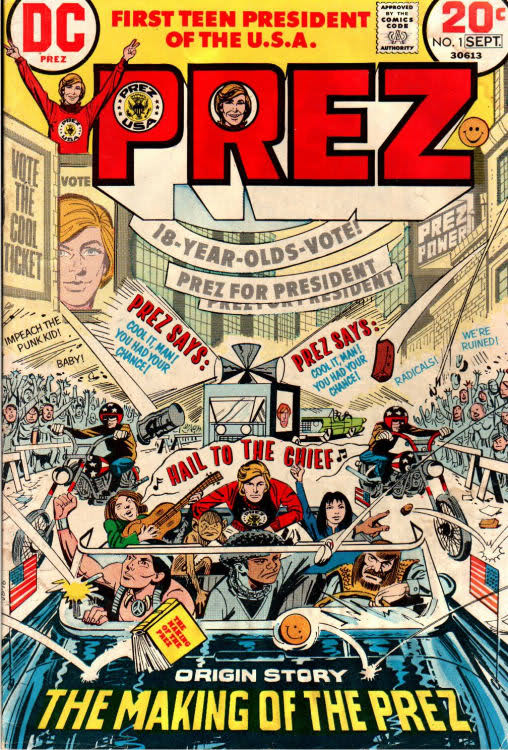
Comic book creator Jack "King" Kirby, a hero of my early teens, imagined "the first teen president." Perhaps he was playing to the comic book nerds who could only imagine wielding power, or maybe it was his own fantasy of a fresh start for America. Prez premiered in a time of the Vietnam War, nuclear proliferation, riots, and minority group "liberation" movements, while President Nixon each day seemed more deeply enmeshed in the net of investigations spreading from the Watergate break in.

[Photo: The cover of Jack Kirby's short - lived comic series Prez from the Kirby museum. Read my blogpost on Kirby's art and life (06/05/2015).]

I don't remember anything about Prez, not even if there ever was a second issue in the series. But I do remember how I imagined tackling America's problems if I got the opportunity:


  • America, only. "S---hole countries" was not a phrase that would have occurred to me in 8th grade, but it covers the basics of my foreign policy. I argued with my carpool that the starvation of millions on the other side of the globe had no effect on us, their failure to modernize was their own fault, and we should keep our own money for our selves.
  • Forget diplomacy, just trust me. I felt like the whole Vietnam War thing could be solved if I could just talk sense to the leaders of both sides, make them see that war just hurts everybody, and offer rewards if they'd agree to end the fighting. That's just what the President's son - in - law did at a convention this spring for factions in the Arab - Israeli conflict, talking sense and offering investments; the President trusts his "very good, very close" relationships with dictators to change their behavior.
  • Take back the country ...from bad guys and weirdos. For this member of Richard Nixon's "Silent Majority," the middle - class white families we watched on TV sitcoms defined "normal." Not normal, but scary or ridiculous, were hippies, Black Panthers, gays, socialistic college students, feminists, "Chicanos" and "Amerindians" demonstrating for respect. Nixon's 1968 campaign broadcast a montage of activists with this tag line: "Vote like your life depended on it." I felt that way at 10; I would have readily responded to the slogans "Take America Back" and "Make America Great Again."
  • Strength. The tallest strongest boys in our 7th grade class, Cody and Mike, each had a loyal fan base. I was with Mike, the goofier and less intimidating of the two. In fact, I don't remember anyone else from the class except Robert, from team Cody, who remarked on my "broad shoulders." From Vice President Pence's endorsement of his running mate for his "strong, broad shoulders," to Trump's effusive praise of Putin, Kim, and others as "very strong," to his grip contest with France's president, I sense that he and his circle admire strength in itself, as I did.
  • Hit harder. I'd hoped to learn magic spells in The Satanic Bible by Anton LeVey, Priest of the Church of Satan, back in 1971. All I took away from furtively skimming pages at the store, though, was LeVey's response to something Jesus said that I'd never heard, "if someone slaps you, turn the other cheek." LeVey's commandment made more sense to me in 7th grade, "Hit him back, harder." I would've cheered along with the crowd hearing Melania Trump's version, "My husband will hit back ten times as hard."
  • Positive Magic. While my parents kept The Power of Positive Thinking on a bookshelf, Trump's parents had the author Norman Vincent Peale as a family friend. Back in 1971, I understood Peale's idea to be that anything you say with enough conviction will become true, as if by magic. Our President practices this religiously, but he also has staff and media commentators to help to make his positive statements true. For example, when he said that "millions" of illegal voters obscured his popular mandate in 2016, a commission formed to prove him right, disbanding only after the President's "alternative facts" couldn't be verified.
  • Congress, Courts, Constitution: Why? In middle school, I didn't know what the Constitution was or how Congress related to the House of Representatives and the Senate. What I knew of the court system was just what I saw on Perry Mason. I would've identified with our President when he complained about old fashioned rules in Congress that slowed down his agenda.
  • Secret Plan Honestly, in 7th grade I wanted to be a super - villain more than President, and my secret plans came from TV's Batman: you launch some attention - getting device (Joker's laughing gas, Penguin's magnetized umbrellas) and "in the confusion" get away with whatever you want. Our President demonstrated how it works a couple Mondays ago, when the President's attacks on Black members of Congress captured media attention while the administration issued a new asylum policy that came as a surprise to the agencies enforcing it.
  • Be Very, Very Afraid! In my super - villain fantasies, the most fun part was issuing threats and imagining how everyone would cave. Our President is not afraid to go all out with threats of "fire and fury" to North Korea, "retaliation such as the world has never seen" to Iran, or a casual remark that he could "wipe" Afghanistan off the map if he doesn't get the response he wants.
I thought I had little in common with this President. Now I see: This is the President I always dreamed of when I was 13.


[Photo: Zachary Levi and Jack Dylan Grazer in Shazam! (2019) ]

Super Powers
What if a young teenage boy had super powers and a secret identity? That's the premise of DC's film Shazam!. Lonely orphan Billy Batson (Asher Angel) simply says the eponymous magic name -- anagram of Greek gods including Hercules and Zeus -- and he becomes tall, buff, fast, invulnerable, able to fly and shoot lightning from his fingers. 

I knew this hero in his trademark gold - braided white cape and bright red onesie. In the early 1970s, DC published reprints of him from the 1930s, and revived the character. For understandable reasons, DC now suppresses the fact that Billy Batson's alter - ego was named "Captain Marvel."

For all his power, Billy is still a fourteen - year - old. In this movie version, Billy resists the fostering of his foster family, instead continuing his search for the birth mother who lost her toddler Billy in a crowd. Played by adult actor Zachary Levi, the super - hero is easily distracted, too sure of what he thinks he knows, desperate to be liked and admired. Our super - hero uses his super - powers to perform stunts for social media, to charge cell phones, and to show off for crowds. When the real bad guy shows up with powers to match his own, Billy just wants to quit; his climb out of despair to help his newfound family gives emotional resonance to a movie that's otherwise, light, fun, and funny.


Thursday, July 25, 2019

"Ordinary Grace" More than a Mystery

||


In William Kent Krueger's novel Ordinary Grace, deaths by "accident, nature, suicide, and murder" befall a small Minnesota town during the summer of 1961 when the narrator was just 13 years old. Yet for me, more gripping than any dramatic reveal of a corpse was Frank's realization about his younger brother: "You're my best friend, Jake. You're my best friend in the whole world. You always have been and you always will be" (196).

Though Krueger is author of the series featuring detective Cork O'Connor, and this novel won the mystery writers' "Edgar" award, the  mystery of who did it is secondary to another kind of mystery of grace in adversity.

[Image: William Kent Krueger. Ordinary Grace. New York: Atria, 2013.]

Our affection for some characters deepens throughout the novel. For example, Frank and his brother Jake "adore"(40) their older sister Ariel. She is "the hope and consummation of [their] mother's own unfilfilled longings," heading to Juilliard in the fall, dating the rich kid Karl Brandt, typing the memoir of Karl's uncle Emil, but always attentive to her little brothers. Frank sees that she has been sneaking out of the house at night, but he promises not to tell. When Frank comes home a mess from mischief that got out of hand, he finds her sobbing at the piano, unaware that he is watching:

"Frankie," she cried leaping from the bench. "Oh, Frankie, are you all right?"
She forgot in an instant whatever was the source of her own suffering and she turned all her attention on me. And I, in my selfish innocence, allowed it. (95)
The mystery of Ariel's sadness is the throughline for the story while Frank is involved in episodes with other town characters. Conflict simmers between daughter and mother about Ariel's decision not to attend Juilliard after all. There's a natural building up of tension in the preparation for the premiere of her original patriotic chorale for the town's Fourth of July, and the mystery of what has happened when she doesn't come home after the concert.

Another character, Gus, has as much growing up to do as Frank does, though Gus is a generation older. He's drunk the first time we see him, getting bailed out of jail by Frank's father, the pastor Nathan Drum. Gus calls the pastor "Captain," having served under him in the war, and Gus now serves him as gravedigger and handyman at the church. With a bad boy grin, he shows Frank how to eavesdrop on the pastor's office visits through the ductwork. But when he and his pal the odious Officer Doyle drag Frank into mischief involving alcohol, fireworks, and animal cruelty, Gus owns up to his part. It's a turning point in Gus's life; in every crisis that follows, Frank can rely on Gus.


Then there's Jake, sweet, empathetic to others, highly intuitive.


Jake's stammer makes him a victim of others in ways that Frank only begins to understand during this summer of 1961. Through Jake, Frank becomes more sensitive to other outsiders in town. That includes Warren, an itinerant Sioux Indian with family ties to a neighbor of the Drums, object of suspicion; the gentle but mentally slow boy Bobby; and even the town's rich man, Emil Brandt, blind and scarred by war, living with his sister Lise, deaf and autistic.


Frank's empathy encompasses even characters we hate. Mean Officer Doyle understands what Frank needs at a critical moment, and bends the law to help him (257). Frank overcomes his fear of a malevolent older teen named Morris Engdahl, who ends up an object of Frank's sympathy (304).


While Frank always reveres his father Nathan, he comes to appreciate his father's inner life, his wisdom and vulnerability. Inebriated, Gus says, "Captain, you're still a son of a bitch.... They're all dead because of you, Captain" (15); the boys wonder what Gus means, but don't ask. When the boys discover a corpse, Nathan opens up about the shock of seeing death on the battlefield, admitting "You never get used to it"(37). He is offering the boys a chance to share their feelings, but he "gave no sign that he was disappointed in our silence" (38). Trying to help the family of a veteran who abuses his wife and child, Nathan seems to seek fatherly counsel himself from Emil Brandt, a man blinded in war:

"Sometimes, Nathan, I think that it wasn't so much the war as what we took into the war. Whatever cracks were already there the war forced apart, and what we might otherwise have kept inside came spilling out.... You may have gone to war thinking you were going to be a hotshot lawyer afterward, but I believe that deep inside of you there was always the seed of a minister."
"And in you?"
"A blind man." Brandt smiled. (68)
Nathan handles pastoral duties with competence and compassion. Frank, eavesdropping on a counseling session with a contentious married couple, hears his father ask how they first met, redirecting them toward what drew them to each other in the first place (87). Eavesdropping again, Frank hears his father's calm, accepting response to a young man distraught about being a homosexual "freak" (243). When Frank sees his father, his tower of strength, weeping in a rainstorm (192), we weep, too. When, for once, the pastor is at a loss for words, there's a kind of miracle, the title's "ordinary grace"(270).

Aside from the pastor, statements about faith are largely negative. Frank's mother Ruth is a fan of Ayn Rand (18) and chronically disappointed that her "hotshot lawyer" came back from the war to be a poorly paid country preacher. When crisis hits the family, Ruth is so angry at Nathan for running to God, that she leaves him; Frank feels that he's praying to "empty air" (174); and Jake is so angry at God that he won't even bow his head at grace for meals (183). Ruth tells Frank, "There is no God to care about us. We've got only ourselves and each other" (224), but Frank thinks silently how faith had fortified his father. When things seems to be at their worst, Frank and Jake are uplifted simply by the "good scent of summer... the fresh wet of the laundry [on the] clothesline... the luscious mud smell of the river two blocks away" (237). Frank reflects at the funeral home how "ritual is the railing we hold to...that keeps us upright and connected until the worst is past" (259). And Jake sums up everything he learns about "grace" when he says it means "not being afraid anymore" (282).


At the burial of a vagrant, the pastor speaks from the heart in his inspirational homily for just Frank and the pallbearers:
Even this man who is unknown to us was known to God and God was his constant companion. [God] never promised that we wouldn't suffer, that we wouldn't feel despair and loneliness and confusion and despeartion. What he did promise was that in our suffering we would never be alone. And though we may sometimes make ourselves blind and deaf to his presence he is beside us and around us and within us always. (71)
The sermon for his own daughter deepens that thought, taking off from the cry of Jesus on the cross, "My God, why have you forsaken me?"

Aside from the story and its wisdom, Krueger's technical expertise gives the novel some highpoints of joy, when, in a single line, there's a fitting - into - place of theme, conversation, event. For example, at the conclusion of that chess game between Nathan and Emil, during which each move has been described aloud for the benefit of the blind man, all the threads of their conversation dovetail with the winning move (69). Another time, his mother takes his hand at the funeral, pulling together emotions and conversation and story in a gesture (258). Most satisfying of all is the moment, alluded to in the title, that ties together themes of faith, the story of a family, and the character of Jake.


As I review the book, typing this, I keep running across more details that I want to explore. This is one mystery novel that warrants reading again.

Thanks to my friend Nancy Calhoun for giving me her copy; I've already started to read Krueger's Iron Lake, first in his detective series.

[See my responses to other Krueger books]

|| Use arrows to see the books in sequence.

Tuesday, July 23, 2019

Gratitude for Mia

Mia, curled up on a cushion nearby, naps as she has done most hours of the past five days. There have been flashes of Mia's usual curiosity and delight, as when our friend Susan has walked with us in the cemetery.

Still, listening to Mia (see blog post of 07/17/2019), I hear that it's time: she is not taking pleasure in her own life, uninterested in food or snacks, letting the squirrels run rampant on her deck, giving only a couple of slow tail - wags when I offer to take her for a walk.  I've made an appointment this afternoon for her with the doctor who years ago repaired Mia's tendon, who diagnosed Mia's cancer fifteen months ago.


Mia, here is a favorite photo of you from just a few months ago. In it, you've just come running to the door of the kitchen, having heard the jingle of my car keys; you are politely seated, head tilted, ears cocked, tail wagging, eyes searching mine for a clue: will we be going for a walk?


I am so thankful that I've had seven years with you. I am grateful also for Susan, who has been a companion for you through to the final hour.


PS from the following day: When I went upstairs to change for our appointment with the vet, Mia surprised me by jumping up to join me.  She hasn't been upstairs much these past few months. She hopped on the bed to watch me.  I knelt at the bedside, she laid her head on my left arm, I stroked her head and cheek with my right hand, and she closed her eyes, so ready to sleep that I thought she might have already passed right there.

Saturday, July 20, 2019

Moon Landing: Also Remember What Might Have Been

Admiration, amusement, and somehow, tears come from listening to NPR Stories this week remembering the moon landing of July 20, 1969.

The Pulse from WHYY tells us that the retro - rockets fired two seconds late, putting the lunar landing module two miles off - base, heading straight to a "football - arena - size" crater ringed with automobile - sized boulders, "Pretty rocky area" said pilot Neil Armstrong. The computer -- less powerful than my cell phone -- was flashing an unfamiliar code that turned out to be an "executive overload" alert, warning that too many tasks threatened to overwhelm its capabilities and it would abort the mission if one more task were added to the queue. Radio communication with Mission Control broke up. And Armstrong had to get the landing right the first time; he had only enough fuel to fire for 30 seconds.

Aldrin said, "Soft touch," to describe the touchdown in lunar powder; he remembers that neither astronaut was aware that they had fully settled on the surface. No wonder Mission Control responded that they could breathe again after Armstrong said, "The Eagle has landed."


We learned how the dust, unhindered by air or gravity, shot off in all directions. We learned how the moon smells: dust in the cabin when they took off their helmets smelled like "the air after a fireworks display."


At that point, there was still the plausible horror that the lunar module would be unable to re - connect with Michael Collins' capsule, orbiting the moon, waiting to use the moon's gravity to fire them all back at earth.

[Photo, left to right: Neil Armstrong, Michael Collins, Edwin "Buzz" Aldrin]


What brought tears was the text of a speech prepared for President Nixon by his speech writer William Safire, to be delivered "in the event of a moon disaster":

Fate has ordained that the men who came to the moon to explore in peace shall stay on the moon to rest in peace. These brave men, Neil Armstrong and Edwin Aldrin, know that there is no hope for their recovery. But they also know that there is hope for mankind in their sacrifice.

I have the same reaction when I re - read a terse announcement that General Eisenhower wrote in his own hand before he knew how the D - Day invasion worked out:

Our landings in the Cherbourg-Havre area have failed to gain a satisfactory foothold and I have withdrawn the troops.My decision to attack at this time and place was based on the best information available. The troops, the air, and the navy did all that bravery and devotion to duty could do. If any blame or fault attaches to the attempt it is mine alone.
(A photo of the paper is available at MHN: Military History Now)
The day was a horror for the men who lived it, but their work to establish bases on land made the liberation of Hitler's captive nations possible. Eisenhower had made a gamble, launching the attack in bad weather; his willingness to take responsibility fills me with admiration.

Then, there are the words that President Reagan spoke when disaster did occur, just what we needed to hear. From From Nasa's web site here, here are highlights, the parts I remember from 1987:


...The Challenger Seven... were aware of the dangers, but overcame them and did their jobs brilliantly. We mourn seven heroes: Michael Smith, Dick Scobee, Judith Resnik, Ronald McNair, Ellison Onizuka, Gregory Jarvis, and Christa McAuliffe. We mourn their loss as a nation together. 
For the families of the seven, we cannot bear, as you do, the full impact of this tragedy. But we feel the loss, and we're thinking about you so very much. Your loved ones were daring and brave, and they had that special grace, that special spirit that says, "Give me a challenge and I'll meet it with joy." They had a hunger to explore the universe and discover its truths. They wished to serve, and they did. They served all of us. 
...And I want to say something to the schoolchildren of America who were watching the live coverage of the shuttle's takeoff. I know it is hard to understand, but sometimes painful things like this happen. It's all part of the process of exploration and discovery. It's all part of taking a chance and expanding man's horizons. The future doesn't belong to the fainthearted; it belongs to the brave. The Challenger crew was pulling us into the future, and we'll continue to follow them. 
...We'll continue our quest in space. There will be more shuttle flights and more shuttle crews and, yes, more volunteers, more civilians, more teachers in space. Nothing ends here; our hopes and our journeys continue. 
...I want to add that I wish I could talk to every man and woman who works for NASA or who worked on this mission and tell them: "Your dedication and professionalism have moved and impressed us for decades. And we know of your anguish. We share it." 
...The crew of the space shuttle Challenger honored us by the manner in which they lived their lives. We will never forget them, nor the last time we saw them, this morning, as they prepared for their journey and waved goodbye and "slipped the surly bonds of earth" to "touch the face of God."


P.S. for the record: Newly turned 10 years old, I was unaware of the dangers for Apollo 11, just that my dreams of space travel and friendly aliens with super powers were on the edge of reality. My family watched during a visit to the Ohio home George and Marcella, who'd been my parents helpful neighbors at the University of Illinois at the time of my birth.